Piezoelectric Pressure Transmitter Market Insights
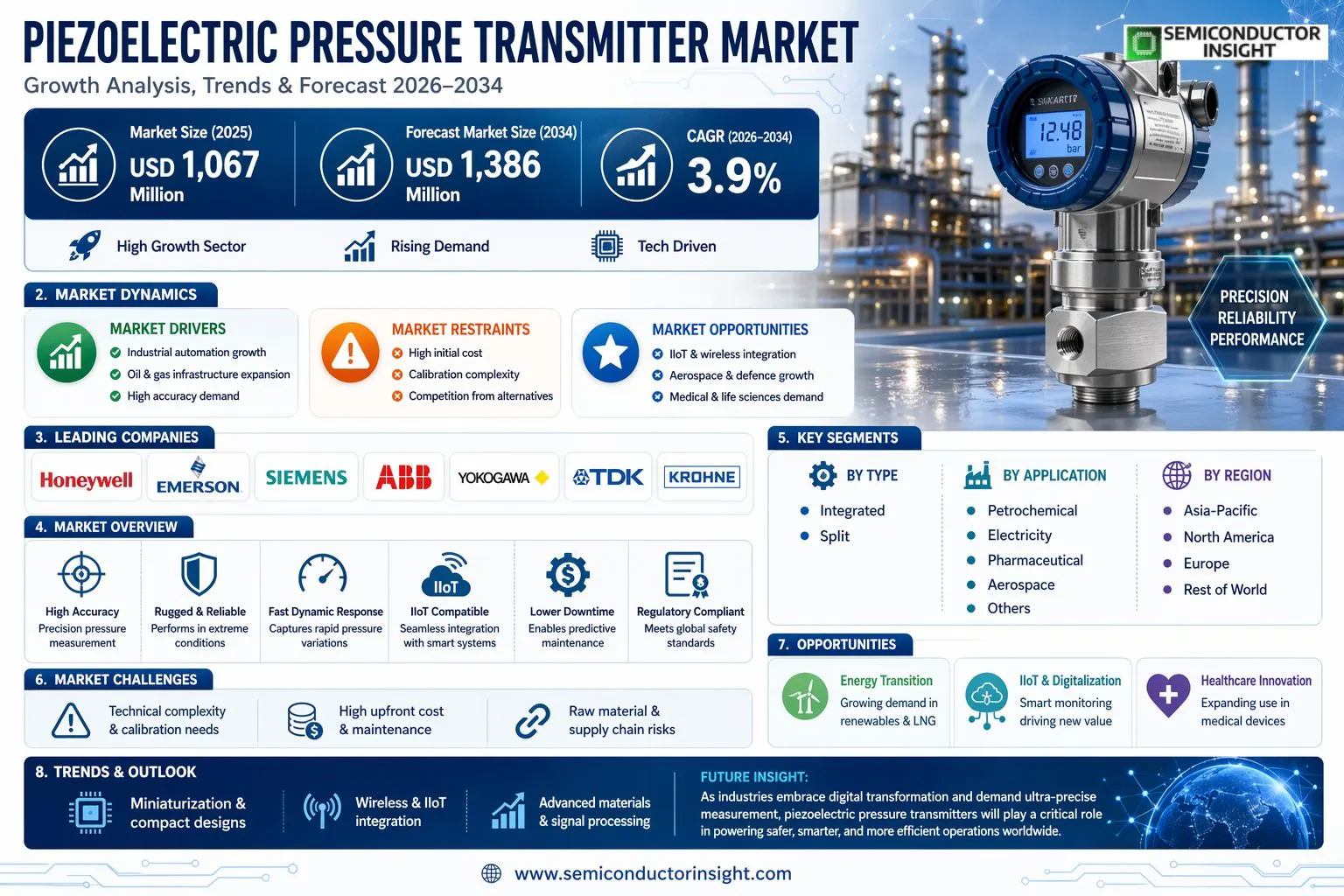
Global Piezoelectric Pressure Transmitter market size was valued at USD 1,067 million in 2025. The market is projected to grow from USD 1,109 million in 2026 to USD 1,386 million by 2034, exhibiting a CAGR of 3.9% during the forecast period.
A piezoelectric pressure transmitter is a precision sensing device that leverages the piezoelectric effect of crystalline materials to convert applied mechanical pressure into a measurable electrical signal. The piezoelectric effect occurs when certain crystals , such as quartz or lead zirconate titanate (PZT) , experience mechanical stress, causing internal polarization and generating distinct positive and negative charges on opposing surfaces. The magnitude of these charges maintains a direct proportional relationship with the applied external pressure, enabling highly accurate pressure measurement. Once the external force is removed, the material returns to its uncharged state. The operating principle is grounded in the positive piezoelectric effect: deformation of the piezoelectric element produces a voltage or charge output that directly corresponds to the pressure exerted, allowing for precise inference of process conditions across demanding industrial environments.
The market is experiencing steady growth driven by expanding demand across key end-use sectors, including petrochemical processing, aerospace, pharmaceutical manufacturing, and power generation. The growing emphasis on industrial automation, process safety, and real-time pressure monitoring in critical infrastructure is further accelerating adoption. Leading global manufacturers such as Honeywell, Emerson, Siemens, Yokogawa, ABB, and TE Connectivity continue to strengthen their market positions through product innovation and strategic partnerships, reinforcing competitive dynamics across both integrated and split-type product segments.
MARKET DRIVERS
Rising Demand from Industrial Automation and Process Control
Piezoelectric Pressure Transmitter Market is experiencing sustained growth driven by the accelerating adoption of industrial automation across manufacturing, oil and gas, chemical processing, and power generation sectors. Piezoelectric pressure transmitters offer high-frequency response, wide dynamic range, and superior accuracy, making them indispensable in environments where real-time pressure monitoring is critical. As industries transition toward Industry 4.0 frameworks, the integration of intelligent sensing devices including piezoelectric-based transmitters into automated production lines has become a strategic priority for operational efficiency.
Expansion of Oil and Gas Exploration Activities
Increasing investment in upstream oil and gas exploration, particularly in deepwater and unconventional resource extraction, is a significant driver for piezoelectric pressure transmitter adoption. These transmitters are engineered to withstand extreme pressure fluctuations, high temperatures, and corrosive environments commonly encountered in drilling and downhole applications. The growing need for reliable wellhead pressure monitoring and pipeline integrity management continues to generate demand for high-performance piezoelectric sensing solutions globally.
➤ Piezoelectric pressure transmitters are increasingly specified in safety instrumented systems (SIS) due to their fast dynamic response and high reliability under transient pressure conditions, reinforcing their role in critical process safety applications.
The growing emphasis on predictive maintenance strategies across heavy industries further supports market expansion. By enabling continuous, real-time pressure data collection, piezoelectric pressure transmitters allow facility operators to detect anomalies early, reduce unplanned downtime, and extend equipment lifecycle. This operational value proposition is compelling adoption among asset-intensive industries seeking to optimize total cost of ownership.
MARKET CHALLENGES
Technical Limitations in Static Pressure Measurement
One of the inherent technical challenges facing Piezoelectric Pressure Transmitter Market is the inability of piezoelectric sensors to accurately measure static or quasi-static pressure over prolonged periods. Unlike piezoresistive counterparts, piezoelectric transmitters are optimally suited for dynamic pressure measurement, which limits their applicability in certain process monitoring scenarios requiring steady-state readings. This constraint necessitates careful application engineering and, in some cases, the deployment of hybrid sensing architectures, adding complexity and cost to system integration.
Other Challenges
Signal Conditioning Complexity
Piezoelectric pressure transmitters generate charge-mode or voltage-mode outputs that require specialized signal conditioning electronics, including charge amplifiers and low-noise cabling. This technical complexity can increase overall system cost and demands a higher level of installation expertise compared to conventional pressure sensing technologies. For smaller industrial operators with limited in-house instrumentation expertise, these requirements can present a meaningful adoption barrier.
Sensitivity to Environmental Factors
Piezoelectric sensing elements can be susceptible to thermal transients, electromagnetic interference, and mechanical vibration when not properly isolated or compensated. In industrial field environments, ensuring consistent measurement accuracy requires robust housing design and careful installation practices. Managing these environmental sensitivities adds to the engineering overhead associated with deploying piezoelectric pressure transmitters in demanding field conditions.
MARKET RESTRAINTS
Intense Competition from Alternative Pressure Sensing Technologies
Piezoelectric Pressure Transmitter Market faces considerable competitive pressure from alternative technologies, particularly piezoresistive, capacitive, and MEMS-based pressure transmitters. These alternatives often offer advantages in static pressure measurement capability, lower per-unit cost, and simpler signal conditioning requirements, making them preferred choices for a broad range of general-purpose industrial applications. The availability of cost-effective substitutes constrains the addressable market for piezoelectric pressure transmitters, particularly in price-sensitive segments and emerging economies.
High Initial Investment and Total Cost of Ownership
The relatively higher acquisition cost of high-performance piezoelectric pressure transmitters, combined with the ancillary investment required for compatible signal conditioning hardware, specialized cabling, and trained installation personnel, can present a restraint to adoption, particularly among small and medium-sized enterprises operating under constrained capital expenditure budgets. While the long-term reliability and measurement performance of piezoelectric devices often justify the premium, upfront cost sensitivity remains a market restraint in several end-use verticals and geographic markets.
MARKET OPPORTUNITIES
Growing Adoption in Aerospace, Defense, and Automotive Testing
Significant market opportunities exist for Piezoelectric Pressure Transmitter Market within aerospace, defense, and automotive test and measurement applications, where dynamic pressure measurement with high bandwidth and precision is essential. Applications such as combustion analysis, ballistic pressure testing, turbine engine monitoring, and crash impact testing demand the unique performance characteristics that piezoelectric transmitters deliver. As global defense budgets expand and automotive OEMs intensify investment in advanced powertrain and safety system development, demand for specialized piezoelectric pressure measurement solutions is expected to grow correspondingly.
Integration with Industrial IoT and Smart Manufacturing Platforms
The convergence of Industrial Internet of Things (IIoT) technology with advanced pressure sensing presents a compelling growth avenue for Piezoelectric Pressure Transmitter Market. Manufacturers are increasingly developing smart transmitter variants with integrated digital communication interfaces such as HART, IO-Link, and wireless protocols, enabling seamless integration into cloud-based process monitoring and analytics platforms. This digital transformation trend positions piezoelectric pressure transmitters as critical data acquisition nodes within smart factory ecosystems, unlocking new value streams in condition monitoring, process optimization, and remote asset management.
Emerging Opportunities in Renewable Energy and Clean Technology Infrastructure
Global transition toward renewable energy infrastructure, including wind energy systems, hydrogen production facilities, and advanced nuclear power plants, is creating new application opportunities for Piezoelectric Pressure Transmitter Market. These environments demand pressure sensing technologies capable of operating reliably under cyclic loading, extreme temperatures, and chemically aggressive conditions , characteristics well-suited to piezoelectric designs. As investments in clean energy infrastructure scale globally, manufacturers of piezoelectric pressure transmitters that can address the specific technical requirements of these applications stand to capture meaningful incremental market share in the coming years.
Trends
Rising Demand Across Industrial Applications Fuels Piezoelectric Pressure Transmitter Market Growth
Piezoelectric Pressure Transmitter Market is witnessing consistent expansion driven by increasing adoption across critical industrial sectors. Industries such as petrochemical, aerospace, pharmaceutical, and electricity generation rely heavily on precise pressure measurement technologies, and piezoelectric pressure transmitters have emerged as a preferred solution due to their accuracy, durability, and ability to operate under extreme conditions. The underlying piezoelectric effect , where crystals generate measurable electrical charges proportional to applied pressure , makes these devices particularly well-suited for dynamic pressure sensing in demanding environments. As industrial automation continues to advance globally, the need for reliable, real-time pressure monitoring has intensified, positioning piezoelectric pressure transmitters as essential components in modern process control infrastructure.
Other Trends
Integration of Smart and Digital Technologies
One of the most significant trends reshaping Piezoelectric Pressure Transmitter Market is the shift toward integrated and digitally connected devices. Manufacturers are increasingly developing transmitters that combine sensing, signal conditioning, and communication capabilities within a single compact unit. This integration reduces installation complexity and enhances system reliability. The integrated product segment is gaining notable traction as end-users prioritize streamlined instrumentation and compatibility with Industrial Internet of Things (IIoT) platforms. Leading players such as Honeywell, Emerson, Siemens, ABB, and Yokogawa are actively investing in smart transmitter development, enabling remote diagnostics, predictive maintenance, and real-time data analytics across connected industrial ecosystems.
Expanding Footprint in Asia-Pacific Manufacturing Hubs
Asia , particularly China, Japan, South Korea, India, and Southeast Asia , represents one of the most dynamic growth regions in Piezoelectric Pressure Transmitter Market. Rapid industrialization, expanding petrochemical refining capacity, and growing pharmaceutical manufacturing activity across the region are generating substantial demand for precision pressure measurement instruments. China, in particular, is a significant contributor to both production and consumption within this market. Regional manufacturers are scaling capacity, while global players are strengthening their local distribution and service networks to capture a larger share of Asia’s growing industrial instrumentation demand.
Competitive Landscape and Product Innovation Drive Market Evolution
Piezoelectric Pressure Transmitter Market is characterized by a moderately consolidated competitive landscape, with the top five global manufacturers collectively holding a significant share of total market revenue as of 2025. Companies including TE Connectivity, KELLER, KROHNE, Danfoss, and Schneider Electric are actively pursuing product innovation, strategic partnerships, and geographic expansion to strengthen their market positions. A notable trend involves the development of application-specific transmitters tailored for high-pressure aerospace environments or chemically aggressive petrochemical processes. As end-users across multiple verticals demand greater measurement precision and longer device lifecycles, continuous innovation in piezoelectric materials and electronic integration remains a defining competitive differentiator in this market.
COMPETITIVE LANDSCAPE
Key Industry Players
Global Piezoelectric Pressure Transmitter Market: Competitive Dynamics and Leading Manufacturers (2025–2034)
Global piezoelectric pressure transmitter market, valued at approximately USD 1,067 million in 2025 and projected to reach USD 1,386 million by 2034 at a CAGR of 3.9%, is characterized by intense competition among a blend of multinational industrial conglomerates and specialized instrumentation firms. Honeywell, Emerson, Siemens, ABB, and Yokogawa collectively command a significant portion of global revenue, leveraging their expansive distribution networks, robust R&D capabilities, and diversified industrial portfolios. These established leaders maintain their competitive edge by offering highly integrated solutions tailored to demanding end-use sectors such as petrochemicals, aerospace, pharmaceuticals, and power generation. Their ability to provide end-to-end automation and measurement ecosystems , combining pressure transmitters with broader process control infrastructure , creates strong barriers to entry and reinforces customer loyalty across long-term industrial contracts.
Beyond the top-tier incumbents, a number of specialized and regionally significant players contribute meaningfully to the competitive fabric of the market. Companies such as KELLER, KROHNE, TE Connectivity, TDK, Danfoss, and Schneider Electric have carved out strong niches by focusing on precision engineering, application-specific sensor design, and sector-targeted innovation. KELLER, for instance, is widely recognized for its high-accuracy piezoresistive and piezoelectric sensing solutions, while KROHNE’s strength lies in flow and pressure measurement for process industries. Meanwhile, firms like Tektronix, MEAS, Asmik, SEIKUSHI, and Hach address more specialized or regional demand segments, contributing to a fragmented mid-tier landscape. The combined competitive pressure from both global giants and niche specialists continues to drive product innovation, pricing competitiveness, and accelerated adoption of integrated smart transmitter technologies across key geographies including North America, Europe, China, and Southeast Asia.
List of Key Piezoelectric Pressure Transmitter Companies Profiled
- Honeywell
- Emerson
- Siemens
- TDK
- Yokogawa
- ABB
- Fluke
- TE Connectivity
- KELLER
- KROHNE
- Schneider Electric
- Asmik
- Tektronix
- SEIKUSHI
- Hach
- MEAS
- Danfoss
Segment Analysis:
| Segment Category | Sub-Segments | Key Insights |
| By Type |
|
Integrated Piezoelectric Pressure Transmitters represent the dominant product type in Global market, driven by their compact, all-in-one design that combines the sensing element and signal conditioning circuitry into a single housing unit.
Split-type transmitters continue to serve niche applications where the sensing head must be installed in extreme environments that are inaccessible or unsuitable for electronic components, allowing the signal processing unit to be remotely housed in a safer location. |
| By Application |
|
Petrochemical stands as the leading application segment for piezoelectric pressure transmitters, owing to the sector’s extensive and continuous requirement for accurate pressure monitoring across upstream, midstream, and downstream operations.
|
| By End User |
|
Oil & Gas Companies constitute the dominant end-user group in Piezoelectric Pressure Transmitter Market, reflecting the sector’s large installed base, continuous plant operations, and demanding measurement requirements across diverse process conditions.
|
| By Piezoelectric Material |
|
Lead Zirconate Titanate (PZT)-Based transmitters currently lead this segmentation due to their superior piezoelectric coefficients, broad operating temperature range, and well-established manufacturing scalability, making them the material of choice for high-volume industrial deployments.
|
| By Output Signal |
|
Digital Output Transmitters are rapidly emerging as the leading segment within this category, reflecting the broader industrial transition toward smart manufacturing, Industry 4.0 architectures, and digitally integrated process control systems.
|
Regional Analysis: Piezoelectric Pressure Transmitter Market
North America’s aggressive shift toward smart manufacturing ecosystems has created fertile ground for Piezoelectric Pressure Transmitter Market. Factories across the United States and Canada are integrating real-time pressure monitoring solutions into automated production lines, where accuracy and rapid response are non-negotiable. This trend is reinforcing long-term procurement strategies centered on high-grade piezoelectric sensing devices capable of seamless integration with digital control platforms.
The North American oil and gas sector remains a principal consumer of piezoelectric pressure transmitters, relying on these instruments for accurate downhole and pipeline pressure measurements. As exploration activities extend into more challenging environments, demand for transmitters offering superior durability and signal fidelity continues to grow. The expanding liquefied natural gas infrastructure across the Gulf Coast region is further amplifying procurement requirements for precision pressure sensing solutions.
The United States’ substantial aerospace and defense industrial base represents a critical vertical for Piezoelectric Pressure Transmitter Market. Applications spanning aircraft engine testing, missile system monitoring, and structural health assessment demand transmitters with exceptional sensitivity and reliability under extreme conditions. Major defense contractors and aerospace OEMs maintain stringent qualification standards, encouraging continuous product advancement among piezoelectric sensor manufacturers operating in this region.
Stringent industrial safety and measurement accuracy regulations enforced by bodies such as OSHA and API compel North American end-users to adopt certified, high-precision pressure transmitters. This regulatory environment, combined with ongoing government and private sector investment in advanced sensor technologies, sustains a competitive and innovation-driven landscape where piezoelectric pressure transmitter manufacturers are incentivized to continuously enhance product performance and reliability.
Europe
Europe occupies a significant position in Global piezoelectric pressure transmitter market, underpinned by the region’s strong engineering heritage, precision manufacturing culture, and rigorous industrial safety standards. Germany, as Europe’s largest industrial economy, is a focal point of demand, with its automotive, chemical processing, and mechanical engineering sectors making extensive use of high-accuracy pressure sensing instruments. Countries such as France, the United Kingdom, Italy, and the Netherlands also contribute meaningfully through their advanced process industries and growing investments in energy transition infrastructure. The European Union’s emphasis on industrial digitalization through initiatives like the European Green Deal and Horizon programs is encouraging broader adoption of intelligent sensor solutions within process automation frameworks. Furthermore, Europe’s well-developed research ecosystem, encompassing partnerships between universities, Fraunhofer institutes, and private enterprises, fosters continuous advancement in piezoelectric material science and transmitter design. Strict ATEX and IECEx certifications governing explosive atmosphere environments compel manufacturers to deliver products of consistently high quality, reinforcing Europe’s role as both a demanding consumer and influential innovator in Piezoelectric Pressure Transmitter Market.
Asia-Pacific
Asia-Pacific represents the fastest-growing regional segment within Global piezoelectric pressure transmitter market, propelled by rapid industrialization, expanding infrastructure investment, and the emergence of sophisticated manufacturing ecosystems across multiple economies. China stands as the region’s dominant force, with its vast petrochemical, semiconductor fabrication, and heavy engineering industries driving substantial demand for precision pressure measurement instruments. Japan and South Korea contribute through their technologically advanced electronics and automotive manufacturing sectors, where piezoelectric pressure transmitters are integral to quality control and process optimization. India’s industrial expansion, particularly in pharmaceuticals, food processing, and power generation, is creating new and growing demand centers. Southeast Asian nations, including Vietnam, Indonesia, and Thailand, are increasingly attracting manufacturing investment that further amplifies regional requirements. Government-led initiatives promoting smart factory adoption and local sensor manufacturing capabilities are expected to significantly strengthen Asia-Pacific’s position in Piezoelectric Pressure Transmitter Market through the 2026–2034 forecast horizon.
South America
South America presents a moderately developing market for piezoelectric pressure transmitters, with demand primarily anchored in the region’s natural resource extraction and energy production industries. Brazil, as the continent’s largest economy, is the principal market, where its substantial oil and gas sector , including deepwater pre-salt offshore operations , generates consistent requirements for highly reliable and robust pressure sensing solutions. Argentina’s shale energy developments in the Vaca Muerta formation similarly drive demand for precision measurement instruments capable of performing under demanding subsurface conditions. The region’s mining industry, particularly in Chile and Peru, also constitutes a meaningful application vertical for piezoelectric pressure transmitters used in slurry pumping and mineral processing operations. While economic volatility and infrastructure investment gaps present certain market constraints, the long-term outlook for Piezoelectric Pressure Transmitter Market in South America remains constructive, supported by the gradual expansion of industrial automation and process safety requirements across key sectors.
Middle East & Africa
The Middle East and Africa region holds a strategically important, though still developing, position in Global piezoelectric pressure transmitter market. The Gulf Cooperation Council nations , Saudi Arabia, the UAE, Qatar, and Kuwait , are the primary demand drivers, where expansive oil and gas production, refining, and petrochemical processing activities necessitate the deployment of high-performance pressure measurement instruments across extensive pipeline and plant infrastructure. Saudi Arabia’s Vision 2030 economic diversification agenda is fostering investment in new industrial sectors, including advanced manufacturing and water desalination, which are anticipated to broaden the application base for piezoelectric pressure transmitters within the kingdom. The UAE’s emergence as a regional hub for technology adoption and smart infrastructure further supports market development. In Africa, South Africa and select North African nations represent nascent but progressively expanding markets, particularly as mining, water management, and energy generation investments increase. Overall, Piezoelectric Pressure Transmitter Market across the Middle East and Africa is set for gradual but steady growth through 2034.
Report Scope
This market research report provides a comprehensive analysis of Piezoelectric Pressure Transmitter Market, covering the forecast period 2026–2034. It offers detailed insights into market dynamics, technological advancements, competitive landscape, and key trends shaping the industry.
Key focus areas of the report include:
- Market Overview: The report begins with an overview outlining its current market scenario, key growth indicators, and industry transformation drivers. It discusses macroeconomic factors, demand–supply balance, regulatory landscape, and the strategic role of piezoelectric technology in powering advancements across industries such as petrochemical, aerospace, pharmaceutical, electricity, and industrial automation.
- Market Size & Forecast: Historical data and future projections for revenue, unit shipments, and market value across major regions and segments.
- Segmentation Analysis: Detailed breakdown by product type (Integrated, Split), application (Petrochemical, Electricity, Pharmaceutical, Aerospace, Other), and end-user industry to identify high-growth segments and investment opportunities.
- Regional Insights: Insights into market performance across North America, Europe, Asia-Pacific, Latin America, and the Middle East & Africa, including country-level analysis where relevant.
- Competitive Landscape: Profiles of leading market participants, including their product offerings, R&D focus, manufacturing capacity, pricing strategies, and recent developments such as mergers, acquisitions, and partnerships.
- Technology Trends & Innovation: Assessment of emerging technologies, integration of AI/IoT, piezoelectric material advancements, fabrication techniques, and evolving industry standards.
- Market Drivers & Restraints: Evaluation of factors driving market growth along with challenges, supply chain constraints, regulatory issues, and market-entry barriers.
- Stakeholder Insights: Insights for component suppliers, OEMs, system integrators, investors, and policymakers regarding the evolving ecosystem and strategic opportunities.
Primary and secondary research methods are employed, including interviews with industry experts, data from verified sources, and real-time market intelligence to ensure the accuracy and reliability of the insights presented.
FREQUENTLY ASKED QUESTIONS:
What is the current market size of Piezoelectric Pressure Transmitter Market?
-> Global Piezoelectric Pressure Transmitter Market was valued at USD 1,067 million in 2025 and is projected to reach USD 1,386 million by 2034, growing at a CAGR of 3.9% during the forecast period.
Which key companies operate in Piezoelectric Pressure Transmitter Market?
-> Key players include Honeywell, Emerson, Siemens, TDK, Yokogawa, ABB, Fluke, TE Connectivity, KELLER, KROHNE, Schneider Electric, Asmik, Tektronix, SEIKUSHI, Samsung, Hach, MEAS, and Danfoss, among others.
What are the key growth drivers?
-> Key growth drivers include rising demand in petrochemical and aerospace industries, increasing adoption of piezoelectric sensing technology in industrial automation, growing pharmaceutical manufacturing requirements, and expanding electricity generation infrastructure globally.
Which region dominates the market?
-> Asia is among the fastest-growing regions driven by rapid industrialization in China, Japan, South Korea, and Southeast Asia, while North America remains a significant market with strong demand from the U.S. across petrochemical and aerospace applications.
What are the emerging trends?
-> Emerging trends include integration of IoT-enabled pressure transmitters, miniaturization of piezoelectric sensors, adoption of advanced piezoelectric materials, and increasing use of integrated-type transmitters across critical industrial and aerospace applications.

Get Sample Report PDF for Exclusive Insights
Report Sample Includes
- Table of Contents
- List of Tables & Figures
- Charts, Research Methodology, and more...
 Download Sample Report PDF