MARKET INSIGHTS
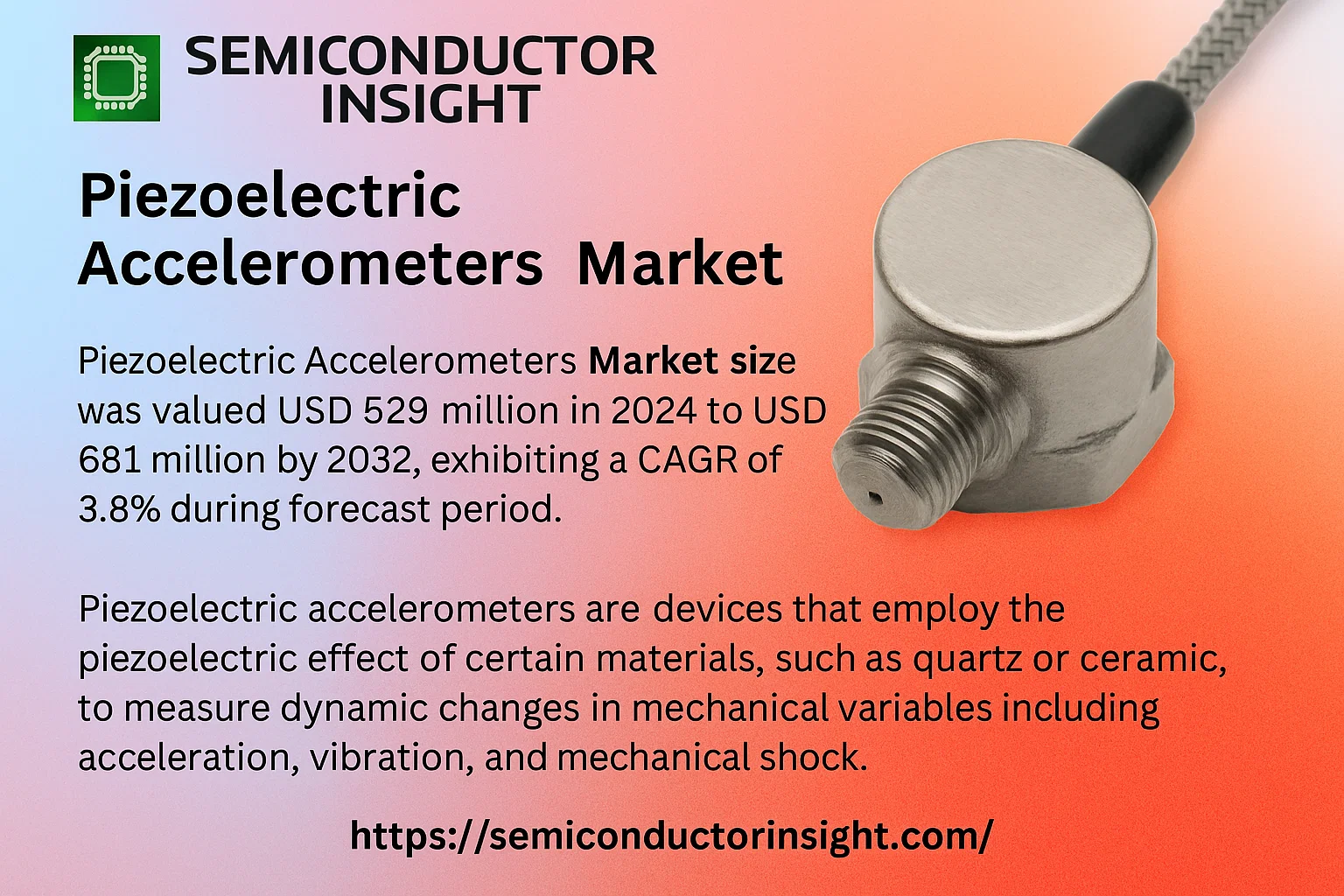
Global Piezoelectric Accelerometers Market size was valued at USD 529 million in 2024 to USD 681 million by 2032, exhibiting a CAGR of 3.8% during the forecast period.
Piezoelectric accelerometers are devices that employ the piezoelectric effect of certain materials, such as quartz or ceramic, to measure dynamic changes in mechanical variables including acceleration, vibration, and mechanical shock. They are renowned for their wide frequency range, high sensitivity, and robustness, making them indispensable in various industrial and scientific applications.
The market growth is primarily driven by increasing demand from the aerospace & defense and automotive sectors for structural health monitoring, vibration testing, and predictive maintenance. However, the market faces challenges such as competition from alternative sensing technologies like MEMS accelerometers. Furthermore, key industry players are actively engaged in product innovation and strategic initiatives to strengthen their market position. For instance, leading manufacturers like PCB Piezotronics (MTS) and Bruel and Kjaer (Spectris) continuously introduce advanced sensors with enhanced durability and connectivity features for Industrial Internet of Things (IIoT) applications. PCB Piezotronics (MTS), Bruel and Kjaer (Spectris), Honeywell, KISTLER, and Meggitt Sensing Systems are some of the prominent players operating globally with extensive product portfolios.
MARKET DRIVERS
Expanding Industrial Automation and Condition Monitoring
Global push towards Industry 4.0 and predictive maintenance strategies is a primary driver for the piezoelectric accelerometer market. These sensors are essential for monitoring machinery health in sectors like manufacturing, energy, and aerospace. Their ability to measure high-frequency vibrations with high sensitivity makes them indispensable for detecting early signs of equipment failure, thereby reducing downtime and maintenance costs. The demand is particularly strong in industries seeking to optimize operational efficiency.
Stringent Safety and Regulatory Standards
Increasingly strict government regulations regarding safety and emissions across automotive, aerospace, and industrial sectors are propelling market growth. Piezoelectric accelerometers are critical for vibration testing and structural health monitoring to ensure compliance with safety standards. For instance, in the automotive industry, they are used extensively in crash testing and vehicle NVH (Noise, Vibration, and Harshness) analysis, driven by global safety norms.
➤ The market for piezoelectric accelerometers is projected to grow steadily, supported by their irreplaceable role in high-temperature and high-frequency applications where other sensor types are less effective.
Furthermore, advancements in material science, leading to more robust and temperature-resistant piezoelectric materials, are enhancing the performance and expanding the application range of these sensors, fueling further adoption.
MARKET CHALLENGES
Competition from Alternative Sensing Technologies
A significant challenge for the piezoelectric accelerometer market is the growing competition from MEMS (Micro-Electro-Mechanical Systems) accelerometers. MEMS sensors offer advantages in terms of cost, size, and power consumption for lower-frequency applications, particularly in consumer electronics and some automotive applications. This price pressure can constrain market growth for piezoelectric types in cost-sensitive segments.
Other Challenges
Signal Conditioning Complexity
Piezoelectric accelerometers require external signal conditioning electronics (like charge amplifiers) to convert the high-impedance output into a usable voltage signal. This adds complexity and cost to the overall measurement system compared to integrated IEPE (Integrated Electronics Piezo-Electric) or MEMS sensors, which can be a barrier for simpler applications.
Sensitivity to Environmental Conditions
While excellent for high temperatures, extreme environments involving intense humidity, strong electromagnetic interference, or base strain can affect the accuracy and longevity of piezoelectric accelerometers, requiring careful installation and sometimes protective housing.
MARKET RESTRAINTS
High Initial Cost of High-Performance Systems
The relatively high initial cost of precision piezoelectric accelerometers and their associated signal conditioning equipment can be a restraint, especially for small and medium-sized enterprises or for applications with tight budget constraints. While cost-effective for critical high-end applications, this limits their penetration into broader, more price-sensitive markets.
Limited Low-Frequency Response
Piezoelectric accelerometers inherently have a low-frequency cutoff and cannot measure true static acceleration (like gravity). This limitation restricts their use in applications requiring DC response or very low-frequency measurements, creating a niche that is often filled by other technologies like capacitive or piezoresistive accelerometers.
MARKET OPPORTUNITIES
Growth in Renewable Energy Infrastructure
The rapid expansion of the wind energy sector presents a substantial opportunity. Piezoelectric accelerometers are critical for condition monitoring of wind turbine blades, gearboxes, and generators to predict maintenance needs and prevent catastrophic failures. Global focus on renewable energy ensures sustained investment and demand in this area.
Advancements in Wireless and IoT-Enabled Sensors
The integration of piezoelectric accelerometers with wireless technology and IoT platforms is a key growth frontier. This enables remote, continuous monitoring of assets in hard-to-reach locations, such as bridges, pipelines, and offshore structures. The development of low-power wireless sensor nodes creates new opportunities for structural health monitoring on a massive scale.
Expansion in Aerospace and Defense Testing
Continuous innovation in aerospace, including the development of new aircraft, spacecraft, and defense systems, requires rigorous vibration testing. Piezoelectric accelerometers, with their wide frequency range and high-temperature capabilities, are essential for these demanding applications, offering significant opportunities as these industries evolve.
Piezoelectric Accelerometers Market Trends
Sustained Growth Driven by Industrial and Automotive Sectors
Global Piezoelectric Accelerometers Market is on a steady growth trajectory, projected to expand from a valuation of USD 529 million in 2024 to USD 681 million by 2032, representing a compound annual growth rate (CAGR) of 3.8%. This consistent growth is primarily fueled by increasing demand from key industrial sectors. The aerospace and defense industry remains the largest application segment, heavily reliant on these sensors for structural health monitoring, vibration analysis in aircraft, and testing of defense equipment. The automotive sector follows closely, utilizing piezoelectric accelerometers for vehicle testing, safety system validation including airbags and Electronic Stability Control (ESC), and predictive maintenance of manufacturing equipment. The fundamental ability of these devices to accurately measure dynamic changes in mechanical variables like acceleration, vibration, and shock underpins their critical role across these demanding applications.
Other Trends
Market Consolidation and Regional Dominance
The market landscape is characterized by a concentration of key players, with the top five manufacturers collectively holding approximately 42% of the global market share. Industry leaders such as PCB Piezotronics (MTS), Bruel and Kjaer (Spectris), and KISTLER drive innovation and set industry standards. Geographically, North America is the dominant market, accounting for over 45% of global share, supported by advanced aerospace, defense, and automotive industries. Combined, Japan and Europe represent another significant bloc with a share exceeding 47%, indicating a well-established and technologically mature market in these regions.
Product Segmentation and Emerging Applications
In terms of product types, the PE (Piezoelectric) type accelerometer is the market leader, commanding over 50% share due to its robustness and high-frequency response capabilities. The IEPE (Integrated Electronics Piezo Electric) type is also significant, valued for its built-in microelectronics that simplify signal conditioning. Beyond the core sectors, emerging applications in environmental and engineering monitoring for infrastructure health and in the medical field for diagnostic equipment present new growth avenues. These segments represent potential blue ocean markets as industries increasingly adopt condition-based monitoring and precision measurement solutions. The evolving regulatory landscape for safety and emissions is also expected to continue driving demand for high-precision sensing technology.
COMPETITIVE LANDSCAPE
Key Industry Players
A Concentrated Market Led by Established Technology Giants
Global Piezoelectric Accelerometers Market exhibits a moderately concentrated structure, with the top five manufacturers collectively accounting for approximately 42% of the market share. Market leadership is firmly held by a select group of established players renowned for their technological expertise and comprehensive product portfolios. PCB Piezotronics, a division of MTS Systems Corporation, along with Brüel & Kjær, part of Spectris plc, and KISTLER, are the dominant forces. These companies benefit from strong brand recognition, extensive global distribution networks, and long-standing relationships with key end-use industries, particularly in the high-value aerospace & defense and automotive sectors. Competition is largely based on product performance, reliability, customization capabilities, and the ability to meet stringent industry standards. The market is characterized by continuous innovation aimed at improving sensitivity, frequency response, and the durability of sensors for harsh environments.
Beyond the market leaders, several other significant players compete effectively by focusing on specific niches or application areas. Companies like Honeywell, TE Connectivity, and Meggitt Sensing Systems leverage their broad industrial presence to supply accelerometers for integrated systems. Meanwhile, a range of specialized manufacturers, including Dytran Instruments, RION, and Kyowa Electronic Instruments, cater to precise measurement needs in research, development, and specialized industrial monitoring. The market also includes strong regional players, such as Sinocera Piezotronics in China, which serve their domestic markets with competitive offerings. This tier of companies often competes on price, application-specific solutions, and responsive customer service, creating a dynamic and segmented competitive environment alongside the global leaders.
List of Key Piezoelectric Accelerometers Companies Profiled
- PCB Piezotronics (MTS)
- Bruel and Kjaer (Spectris)
- KISTLER
- Honeywell
- Meggitt Sensing Systems
- TE Connectivity
- Dytran Instruments
- RION
- Kyowa Electronic Instruments
- Metrix Instrument (Roper)
- DJB Instruments
- CEC Vibration Products
- ASC sensors
- Sinocera Piezotronics Inc
- IMV Corporation
Segment Analysis:
| Segment Category | Sub-Segments | Key Insights |
| By Type |
|
PE Type accelerometers demonstrate superior market dominance due to their self-generating characteristic, which eliminates the need for an external power source, making them exceptionally reliable for high-temperature and remote monitoring applications. This fundamental advantage provides a robust and simple solution for long-term vibration measurement projects. The IEPE Type segment is favored in laboratory and industrial settings where the integrated electronics simplify signal conditioning, offering a convenient plug-and-play solution that reduces the complexity and cost of the overall measurement chain, thereby driving its adoption in a wide range of diagnostic and predictive maintenance applications. |
| By Application |
|
Aerospace and Defense represents the leading application segment, driven by the critical necessity for high-precision vibration monitoring in aircraft structures, jet engines, and military equipment to ensure operational safety, structural integrity, and performance validation under extreme conditions. The rigorous testing protocols and stringent reliability standards inherent to this sector create sustained, high-value demand. The Automotive application is also a significant driver, fueled by the proliferation of testing for vehicle safety, noise, vibration, and harshness (NVH) analysis, and the development of advanced driver-assistance systems, highlighting the technology’s vital role in innovation and quality assurance across transportation industries. |
| By End User |
|
Original Equipment Manufacturers (OEMs) are the primary end users, integrating piezoelectric accelerometers directly into their products during the manufacturing phase for applications ranging from aerospace vehicles to industrial machinery, ensuring built-in performance monitoring and quality control. The need for embedded sensing solutions to enhance product functionality and reliability secures this segment’s leadership. Research and Development Organizations constitute another vital user group, leveraging these sensors for prototyping, material testing, and fundamental research, where the precise measurement of dynamic forces is indispensable for innovation and validation across scientific and engineering disciplines. |
| By Sensitivity Range |
|
General Purpose accelerometers represent the dominant segment within sensitivity ranges, as they offer a versatile balance of performance and cost-effectiveness suitable for the vast majority of industrial vibration monitoring, machinery health assessment, and basic testing applications. Their broad applicability across diverse fields ensures consistent demand. In contrast, High Sensitivity variants are critical for specialized applications requiring the detection of extremely subtle vibrations, such as in seismic monitoring or acoustic research, while Low Frequency / High Shock sensors are engineered for demanding environments like automotive crash testing or structural analysis where capturing high-impact events accurately is paramount. |
| By Mounting Method |
|
Stud Mount is the leading mounting method, preferred for permanent installations where maximum rigidity and high-frequency response are critical, such as on heavy machinery, engines, and fixed test structures, providing a secure and reliable connection that ensures accurate data capture. Magnetic Mount accelerometers are highly popular for temporary diagnostic applications due to their exceptional ease of use and quick deployment on ferromagnetic surfaces, making them ideal for routine maintenance checks and troubleshooting. The Adhesive Mount method finds its niche in applications where drilling is not feasible or on delicate surfaces, offering a less invasive solution despite potential limitations at very high frequencies. |
Regional Analysis: Piezoelectric Accelerometers Market
The region’s vast manufacturing sector, particularly in automotive, consumer electronics, and industrial machinery, generates consistent, high-volume demand for piezoelectric accelerometers. These sensors are integral to condition monitoring systems that minimize downtime and ensure product quality in highly automated production environments, making them essential components of the regional industrial ecosystem.
Significant investments in new infrastructure, including bridges, buildings, and transportation systems, across developing economies in the region drive the need for structural health monitoring. Piezoelectric accelerometers are critical for assessing vibrations and ensuring the long-term safety and integrity of these large-scale construction projects.
Countries like Japan and South Korea are at the forefront of adopting advanced sensor technologies. Local manufacturers are renowned for developing highly sensitive, miniaturized, and reliable piezoelectric accelerometers that meet the demanding requirements of aerospace, defense, and high-precision industrial applications, fostering a culture of continuous innovation.
The concentration of electronic component manufacturing in the region creates a resilient and efficient supply chain for piezoelectric materials and sensor assembly. This localization allows for significant cost advantages, making accelerometers more accessible and driving their adoption across a wider range of applications and smaller enterprises.
North America
North America represents a mature yet highly sophisticated market for piezoelectric accelerometers, characterized by stringent regulatory standards and a strong focus on research and development. The region’s well-established aerospace and defense sectors are major consumers, requiring high-performance sensors for testing and monitoring aircraft, spacecraft, and military equipment. The energy sector, particularly oil and gas exploration and wind power, utilizes these accelerometers for machinery health monitoring in challenging environments. Furthermore, the presence of leading academic and research institutions fuels demand for precision measurement tools in scientific applications. The market is driven by a need for reliability, accuracy, and compliance with strict industry certifications, leading to a preference for high-value, advanced sensor solutions over low-cost alternatives.
Europe
Europe maintains a strong position in the Piezoelectric Accelerometers Market, supported by its advanced automotive industry and commitment to industrial quality and safety. German automotive manufacturers and their extensive supply chain are significant drivers, employing accelerometers for vehicle testing, NVH (Noise, Vibration, and Harshness) analysis, and production line monitoring. The region’s focus on renewable energy, especially wind turbine installations across Northern Europe, creates steady demand for condition monitoring systems to ensure operational efficiency and longevity. Strict European Union regulations concerning machinery safety and environmental standards further propel the adoption of reliable vibration sensing technologies. The market is characterized by a high level of technical expertise and a preference for precision-engineered, durable products from established European sensor manufacturers.
South America
The South American market for piezoelectric accelerometers is developing, with growth primarily linked to the region’s mining and energy sectors. Countries like Chile, Peru, and Brazil, with their extensive mining operations for copper, iron ore, and other minerals, use these sensors to monitor heavy machinery and critical infrastructure, aiming to improve safety and operational efficiency. The energy sector, including hydropower and oil extraction, also presents opportunities for vibration monitoring applications. While the market is smaller compared to other regions, it shows potential for growth as industrialization progresses and investments in infrastructure and natural resource extraction continue, though adoption can be influenced by economic fluctuations and varying levels of industrial maturity across different countries.
Middle East & Africa
The Middle East & Africa region presents a diverse but growing market for piezoelectric accelerometers, largely driven by the oil and gas industry in the Gulf Cooperation Council (GCC) countries. The extensive network of refineries, pipelines, and petrochemical plants requires robust condition monitoring systems, creating a steady demand for durable sensors capable of withstanding harsh desert environments. In Africa, infrastructural development projects and a nascent mining sector offer emerging opportunities. The market dynamics are varied, with the Middle East showing more mature demand linked to its energy economy, while Africa’s market is in earlier stages of development, with growth potential tied to economic diversification and industrialization efforts across the continent.
Report Scope
This market research report provides a comprehensive analysis of the Piezoelectric Accelerometers Market , covering the forecast period 2025–2032. It offers detailed insights into market dynamics, technological advancements, competitive landscape, and key trends shaping the industry.
Key focus areas of the report include:
- Market Overview: The report begins with an overview outlining its current market scenario, key growth indicators, and industry transformation drivers. It discusses macroeconomic factors, demand–supply balance, regulatory landscape, and the strategic role of semiconductors in powering advancements across industries such as automotive, telecommunications, consumer electronics, and industrial automation.
- Market Size & Forecast: Historical data and future projections for revenue, unit shipments, and market value across major regions and segments.
- Segmentation Analysis: Detailed breakdown by product type, technology, application, and end-user industry to identify high-growth segments and investment opportunities.
- Regional Insights: Insights into market performance across North America, Europe, Asia-Pacific, Latin America, and the Middle East & Africa, including country-level analysis where relevant.
- Competitive Landscape: Profiles of leading market participants, including their product offerings, R&D focus, manufacturing capacity, pricing strategies, and recent developments such as mergers, acquisitions, and partnerships.
- Technology Trends & Innovation: Assessment of emerging technologies, integration of AI/IoT, semiconductor design trends, fabrication techniques, and evolving industry standards.
- Market Drivers & Restraints: Evaluation of factors driving market growth along with challenges, supply chain constraints, regulatory issues, and market-entry barriers.
- Stakeholder Insights: Insights for component suppliers, OEMs, system integrators, investors, and policymakers regarding the evolving ecosystem and strategic opportunities.
Primary and secondary research methods are employed, including interviews with industry experts, data from verified sources, and real-time market intelligence to ensure the accuracy and reliability of the insights presented.
FREQUENTLY ASKED QUESTIONS:
What is the current market size of Piezoelectric Accelerometers Market?
-> Global Piezoelectric Accelerometers Market was valued at USD 529 million in 2024 and is projected to reach USD 681 million by 2032, growing at a CAGR of 3.8% during the forecast period.
Which key companies operate in Piezoelectric Accelerometers Market?
-> Key players include PCB Piezotronics (MTS), Bruel and Kjaer (Spectris), KISTLER, Meggitt Sensing Systems, and Honeywell, among others. Global top 5 manufacturers hold a share of about 42%.
What are the key growth drivers?
-> Key growth drivers include increasing demand from aerospace & defense and automotive sectors, technological advancements in vibration monitoring, and stringent industrial safety regulations.
Which region dominates the market?
-> North America is the largest market, with a share over 45%, followed by Europe and Asia (with Japan being a major contributor).
What are the emerging trends?
-> Emerging trends include the dominance of the PE type segment (over 50% share), increased adoption in environmental and engineering monitoring, and integration of IEPE technology for easier signal conditioning.

Get Sample Report PDF for Exclusive Insights
Report Sample Includes
- Table of Contents
- List of Tables & Figures
- Charts, Research Methodology, and more...
 Download Sample Report PDF