MARKET INSIGHTS
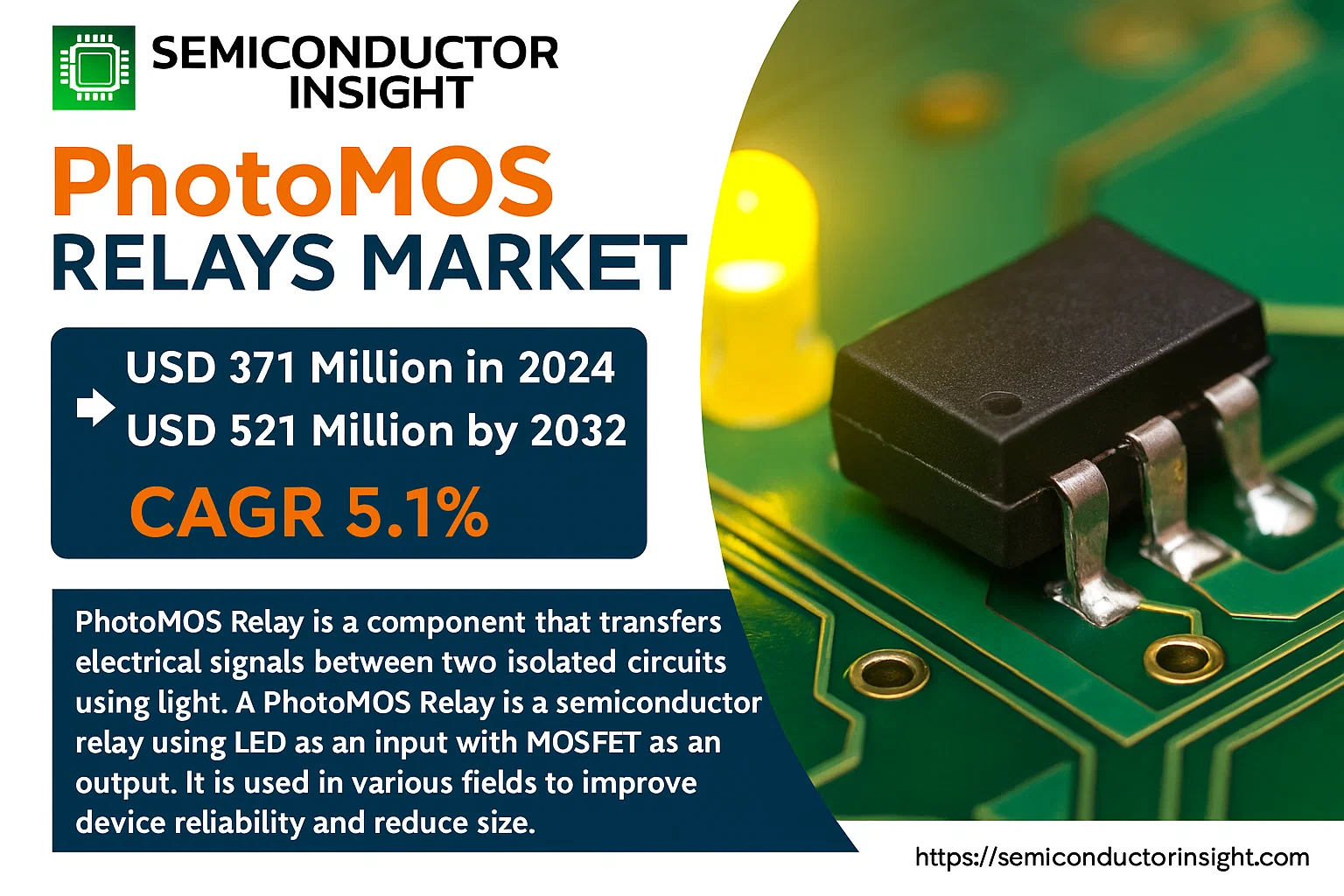
Global PhotoMos Relays Market size was valued at USD 371 million in 2024 to USD 521 million by 2032, exhibiting a CAGR of 5.1% during the forecast period.
PhotoMOS Relay is a component that transfers electrical signals between two isolated circuits by using light. A PhotoMOS Relay is a semiconductor relay with an LED as an input and MOSFET as an output. It is used in various fields to improve device reliability and reduce size.
The Market growth is driven by increasing demand for high-reliability switching components across multiple industries. While the telecommunications sector remains a key driver, the EV & Power Storage System segment is experiencing particularly strong growth due to global electrification trends. Furthermore, industrial automation and medical device applications continue to adopt PhotoMOS relays for their noise immunity and long operational life. However, the Market faces challenges from alternative solid-state switching technologies and price competition. Key players like Panasonic and OMRON dominate the Market with over 50% combined share, focusing on product innovation and expanding their voltage range portfolios to maintain competitive advantage.
MARKET DRIVERS
Rising Demand for Industrial Automation
Global push towards Industry 4.0 and smart manufacturing is a primary driver for the PhotoMos relay Market. These solid-state relays are essential components in Programmable Logic Controllers (PLCs), industrial robots, and automated test equipment due to their high reliability, long operational life, and noise immunity. The need for precise control and isolation in harsh industrial environments is fueling adoption.
Expansion of Electric Vehicles and Renewable Energy Systems
The transition to electric vehicles (EVs) and the growth of solar and wind power installations create significant demand for high-voltage switching components. PhotoMos relays are used in battery management systems (BMS), charging stations, and power conditioning units because they offer silent operation, high dielectric strength, and resistance to shock and vibration. The Market is expected to grow in correlation with the clean energy sector, which is projected to expand by over 8% annually.
➤ The superior performance of PhotoMos relays in high-frequency switching applications, such as semiconductor test handlers and medical imaging equipment, provides a distinct advantage over electromechanical relays, driving replacement sales.
Furthermore, the miniaturization of electronic devices across consumer electronics, telecommunications, and medical equipment necessitates smaller, more reliable components. PhotoMos relays meet this need with their compact packaging and solid-state construction, which eliminates mechanical wear and tear.
MARKET CHALLENGES
Cost Sensitivity and Competition
Despite their advantages, PhotoMos relays are generally more expensive than traditional electromechanical relays. In highly price-sensitive Market segments, such as consumer appliances and basic industrial controls, this cost differential can be a significant barrier to adoption. Manufacturers must continuously work on cost-reduction strategies through improved manufacturing processes.
Other Challenges
Heat Dissipation at High Loads
While excellent for low to medium power applications, managing heat generation remains a challenge for PhotoMos relays in high-current switching scenarios. This can limit their use in some high-power industrial applications without adequate thermal management solutions.
Technical Complexity and Design-In
Integrating PhotoMos relays requires careful consideration of driving circuits, load characteristics, and isolation requirements. This can increase design complexity and time-to-Market for OEMs compared to using simpler electromechanical alternatives.
MARKET RESTRAINTS
Global Semiconductor Supply Chain Constraints
Like many electronic components, the PhotoMos relay Market is susceptible to disruptions in the global semiconductor supply chain. Shortages of raw materials, such as silicon wafers, and fabrication capacity bottlenecks can lead to extended lead times and increased prices, potentially delaying projects and limiting Market growth in the short term.
Economic Volatility and Reduced Capital Expenditure
Periods of global economic uncertainty often lead to reduced capital investment by businesses in sectors like industrial automation and telecommunications. Since PhotoMos relays are capital goods components, a downturn in industrial investment can directly restrain Market growth as orders for new equipment decline.
MARKET OPPORTUNITIES
Growth in Medical and Analytical Instrumentation
The medical device and analytical instrument Market presents a strong growth opportunity. PhotoMos relays are ideal for sensitive equipment like patient monitors, DNA sequencers, and blood analyzers due to their low electromagnetic interference (EMI), high reliability, and ability to switch small signals accurately. Global medical device Market is expected to grow steadily, driving demand for high-performance components.
Advancements in Next-Generation Telecommunications
The ongoing rollout of 5G infrastructure and the development of 6G technologies require highly reliable switching components for base stations and network equipment. PhotoMos relays offer the fast switching speeds and durability needed for these applications. The need to upgrade and expand global telecommunications networks creates a sustained, long-term opportunity for Market players.
Expansion into New Application Areas
There is significant potential for Market expansion into new applications such as advanced driver-assistance systems (ADAS) in automobiles, industrial IoT sensors, and energy storage systems. The unique combination of isolation, reliability, and compact size makes PhotoMos relays suitable for these evolving, high-growth fields.
PhotoMos Relays Market Trends
Sustained Growth Fueled by Electrification and Miniaturization
Global PhotoMos Relays Market is on a robust growth trajectory, valued at USD 371 million in 2024 and projected to reach USD 521 million by 2032, representing a compound annual growth rate (CAGR) of 5.1%. This sustained expansion is fundamentally driven by the global trends of electrification and the demand for smaller, more reliable components. PhotoMOS relays, which use an LED input and MOSFET output to transfer electrical signals with high galvanic isolation, are increasingly favored over traditional electromechanical relays for their longevity, noise reduction, and compact size. The Asia-Pacific region is the largest Market, accounting for approximately 35% of the global share, with significant contributions also coming from Europe and North America, which together hold over 55% of the Market.
Other Trends
Application-Specific Demand Dynamics
The application landscape reveals clear trends in end-user demand. The largest application segment is Test Measurement & Telecommunication, underscoring the critical need for signal integrity and reliability in communication infrastructure and precision instruments. Following closely is the EV & Power Storage System segment, which is a key growth driver. The transition to electric vehicles and the expansion of renewable energy storage systems require sophisticated power management and control, areas where PhotoMOS relays excel due to their high isolation and durability. Other significant applications include Medical & Military equipment and Industrial & Security Devices, where operational safety and failure prevention are paramount.
Product Segmentation and Regional Market Development
In terms of product types, the Above 20 V and Below 80 V segment is the largest, holding about a 30% Market share. This voltage range meets the requirements for a broad array of industrial and consumer applications. The competitive landscape is concentrated, with the top two manufacturers, Panasonic and OMRON, collectively holding over 50% of the global Market. This concentration suggests a Market driven by technological expertise and established supply chains. Regional development is particularly strong in Asia-Pacific, fueled by manufacturing hubs and rapid technological adoption, while mature Markets in North America and Europe focus on high-value applications in medical, industrial, and automotive sectors.
Competitive Consolidation and Future Outlook
The Market is characterized by the dominance of a few key players, which influences pricing, innovation, and distribution channels. The competitive intensity is expected to remain high as companies invest in research and development to enhance product performance for emerging applications. The ongoing miniaturization of electronics and the global push towards automation and smart technologies present significant opportunities. The future growth of the PhotoMOS relay Market is intrinsically linked to the expansion of its key application sectors, particularly electric vehicles, power storage, and advanced telecommunications infrastructure, ensuring a positive long-term outlook.
COMPETITIVE LANDSCAPE
Key Industry Players
A Market Dominated by Established Electronics Giants
Global PhotoMOS Relays Market is characterized by a high level of concentration, with the top two manufacturers, Panasonic and OMRON, collectively holding a Market share exceeding 50%. These companies have established themselves as global leaders through extensive product portfolios, significant R&D investments, and robust global distribution networks. Their dominance is supported by strong brand recognition and long-standing relationships with key customers across major end-use industries such as test measurement, telecommunications, and industrial automation. The Market structure is moderately consolidated, with a clear distinction between the leading players and a tier of smaller, specialized manufacturers.
Beyond the Market leaders, a group of other significant players operates by focusing on specific product niches, regional Markets, or specialized applications. Companies like Toshiba and NEC leverage their broad semiconductor expertise to offer competitive PhotoMOS relays. Specialists such as IXYS (now part of Littelfuse) and Cosmo Electronics focus on high-performance and high-voltage segments, while manufacturers like Bright Toward Industrial cater to cost-sensitive Markets. These companies compete by offering differentiated products, often targeting specific voltage ranges or application requirements in sectors like medical devices, military systems, and power storage solutions.
List of Key PhotoMOS Relays Companies Profiled
- Panasonic Corporation
- OMRON Corporation
- Toshiba Electronic Devices & Storage Corporation
- NEC Corporation
- IXYS (A part of Littelfuse, Inc.)
- Cosmo Electronics Corporation
- Okita Works
- Bright Toward Industrial Co., Ltd.
- Crydom (A part of Sensata Technologies)
- Sharp Corporation
- Fujitsu Component Limited
- CIT Relay & Switch
- Standex-Meder Electronics
- Hasco Relays
Segment Analysis:
| Segment Category | Sub-Segments | Key Insights |
| By Type |
|
Above 20 V and Below 80 V relays represent the dominant segment, primarily due to their broad compatibility with a vast range of standard electronic circuits and control systems. This voltage range is particularly suited for general-purpose industrial automation and telecommunications equipment, where reliable signal switching without high power handling is paramount. The widespread adoption is driven by the balance these relays offer between performance, safety, and cost-effectiveness, making them a foundational component in many modern electronic designs across various industries. |
| By Application |
|
Test Measurement & Telecommunication is the leading application segment, leveraging the PhotoMOS relay’s core advantages of high-speed switching, excellent isolation, and long-term reliability. In test and measurement equipment, the relays ensure signal integrity and accuracy, while in telecommunications infrastructure, they provide the robust and fail-safe switching required for network reliability. The growth of high-speed data networks and the continuous need for precise testing equipment in research and development solidify this segment’s leadership position, with demand being consistently strong. |
| By End User |
|
Industrial Automation stands as the primary end-user segment, driven by the extensive integration of PhotoMOS relays into manufacturing control systems, robotic assembly lines, and process instrumentation. The superior reliability, fast response times, and compact size of these relays are critical for optimizing operational efficiency and minimizing downtime in automated environments. Furthermore, the trend towards Industry 4.0 and smart factories, which require robust and interconnected control components, continues to fuel significant demand from this sector, ensuring its leading role in the Market. |
| By Isolation Level |
|
High Isolation relays are the leading segment, as they provide a crucial safety barrier in applications involving high voltages or sensitive electronics, protecting both equipment and users. This level of isolation is essential in medical devices, industrial control systems, and power storage applications where fault conditions could be hazardous. The demand is driven by increasingly stringent international safety standards and the growing complexity of electronic systems that require reliable separation between control circuits and power circuits to ensure operational integrity and compliance. |
| By Package Type |
|
Surface Mount (SMD) packages dominate the Market, aligning with the electronics industry’s widespread shift towards automated PCB assembly and the miniaturization of end products. The SMD format allows for higher component density on circuit boards, which is critical for compact devices like smartphones, networking hardware, and portable medical instruments. This segment’s leadership is reinforced by the efficiency gains in manufacturing processes and the continuous demand for smaller, more powerful electronic devices across all application areas, making SMD the preferred packaging solution. |
Regional Analysis: PhotoMOS Relays Market
The region’s immense electronics manufacturing base provides an unparalleled captive Market. Proximity to key component suppliers and assembly plants creates a highly efficient and cost-effective supply chain for PhotoMOS relays, reinforcing the region’s leadership. Local manufacturers benefit from shorter lead times and tighter integration with end-product designers.
Aggressive investment in Industry 4.0 and smart factory initiatives across the region is a major demand driver. PhotoMOS relays are critical for precision control, measurement, and safety systems in automated machinery and robotics, with widespread adoption in automotive, semiconductor, and general manufacturing sectors pushing continuous Market growth.
Home to leading global electronics firms and R&D centers, the Asia-Pacific region is at the forefront of developing next-generation PhotoMOS relays. This includes advancements in higher density packaging, improved isolation capabilities, and relays designed for emerging applications in electric vehicles and 5G infrastructure, ensuring the region stays ahead in product evolution.
A vast and technologically savvy consumer base drives demand for electronics that incorporate PhotoMOS relays. From smartphones and gaming consoles to smart home devices and electric vehicle charging systems, high domestic consumption ensures a steady and growing Market, encouraging local production and fostering a cycle of innovation and affordability.
North America
The North American Market for PhotoMOS relays is characterized by strong demand from high-technology and research-intensive sectors. The United States, in particular, is a major hub for aerospace, defense, and medical equipment manufacturing, where the high reliability, long life, and excellent noise immunity of PhotoMOS relays make them the preferred choice for critical applications. The region’s stringent safety and quality standards in these industries further drive the adoption of these solid-state components over traditional electromechanical relays. Additionally, significant investments in upgrading industrial infrastructure and the rapid growth of data centers and telecommunications networks contribute to steady Market demand. The presence of leading semiconductor companies and a culture of innovation supports the development and early adoption of advanced PhotoMOS relay solutions tailored for next-generation technologies.
Europe
Europe represents a mature and technologically advanced Market for PhotoMOS relays, with demand largely driven by the automotive, industrial automation, and renewable energy sectors. The region’s strong focus on automotive excellence, including the shift towards electric and hybrid vehicles, creates significant opportunities for PhotoMOS relays used in battery management systems, onboard chargers, and various control units. In industrial automation, German and Italian manufacturing sectors are key consumers, valuing the relays’ reliability in harsh environments. The push for green energy has also increased their use in solar inverters and power conditioning systems. Strict regulatory standards for energy efficiency and electromagnetic compatibility in Europe ensure that high-performance components like PhotoMOS relays remain in strong demand, supported by a robust network of engineering expertise and component distributors.
South America
The PhotoMOS relays Market in South America is developing, with growth potential tied to the gradual modernization of industrial and telecommunications infrastructure. Brazil and Argentina are the primary Markets, where investments in industrial automation within the manufacturing and agricultural sectors are beginning to create demand for reliable switching components. The telecommunications industry, especially with the ongoing rollout of improved network infrastructure, also presents opportunities. However, Market growth can be inconsistent, influenced by regional economic volatility and currency fluctuations which impact investment in capital equipment. The Market is largely served by international suppliers, with local manufacturing for these components being limited. Adoption is often focused on specific applications where the long-term reliability of PhotoMOS relays offers a clear advantage over cheaper alternatives.
Middle East & Africa
The Middle East and Africa region shows niche but growing demand for PhotoMOS relays, primarily driven by infrastructure development projects and the oil & gas industry. In the Gulf Cooperation Council (GCC) countries, investments in smart city initiatives, telecommunications, and industrial diversification programs are creating new applications. The relays’ ability to operate reliably in high-temperature environments makes them suitable for oil & gas equipment and power generation facilities prevalent in the region. In Africa, growth is more nascent, with potential linked to telecommunications expansion and modest industrial development. The Market is characterized by a focus on durability and reliability due to challenging operating conditions, but overall volume remains low compared to other regions, with distribution channels still developing.
Report Scope
This Market research report provides a comprehensive analysis of the PhotoMos Relays Market, covering the forecast period 2025–2032. It offers detailed insights into Market dynamics, technological advancements, competitive landscape, and key trends shaping the industry.
Key focus areas of the report include:
- Market Overview: The report begins with an overview outlining its current Market scenario, key growth indicators, and industry transformation drivers. It discusses macroeconomic factors, demand–supply balance, regulatory landscape, and the strategic role of semiconductors in powering advancements across industries such as automotive, telecommunications, consumer electronics, and industrial automation.
- Market Size & Forecast: Historical data and future projections for revenue, unit shipments, and Market value across major regions and segments.
- Segmentation Analysis: Detailed breakdown by product type, technology, application, and end-user industry to identify high-growth segments and investment opportunities.
- Regional Insights: Insights into Market performance across North America, Europe, Asia-Pacific, Latin America, and the Middle East & Africa, including country-level analysis where relevant.
- Competitive Landscape: Profiles of leading Market participants, including their product offerings, R&D focus, manufacturing capacity, pricing strategies, and recent developments such as mergers, acquisitions, and partnerships.
- Technology Trends & Innovation: Assessment of emerging technologies, integration of AI/IoT, semiconductor design trends, fabrication techniques, and evolving industry standards.
- Market Drivers & Restraints: Evaluation of factors driving Market growth along with challenges, supply chain constraints, regulatory issues, and Market-entry barriers.
- Stakeholder Insights: Insights for component suppliers, OEMs, system integrators, investors, and policymakers regarding the evolving ecosystem and strategic opportunities.
Primary and secondary research methods are employed, including interviews with industry experts, data from verified sources, and real-time Market intelligence to ensure the accuracy and reliability of the insights presented.
FREQUENTLY ASKED QUESTIONS:
What is the current Market size of PhotoMos Relays Market?
-> PhotoMos Relays Market size was valued at USD 371 million in 2024 to USD 521 million by 2032, exhibiting a CAGR of 5.1% during the forecast period.
Which key companies operate in PhotoMos Relays Market?
-> Key players include Panasonic, OMRON, Toshiba, NEC, IXYS, Cosmo Electronics Corporation, Okita Works, and BRIGHT TOWARD INDUSTRIAL. Global top two manufacturers, Panasonic and OMRON, hold a share over 50%.
What are the key growth drivers?
-> Key growth is driven by increasing demand to improve device reliability and reduce size across various fields, including telecommunication, industrial control, medical devices, and power storage systems.
Which region dominates the Market?
-> Asia-Pacific is the largest Market, with a share of about 35%, followed by Europe and North America, which together hold a share over 55%.
What are the emerging trends?
-> Key trends include the adoption of PhotoMOS Relays in EV & Power Storage Systems, Test Measurement & Telecommunication, and Medical & Military applications, leveraging their galvanic separation and signal isolation capabilities.

Get Sample Report PDF for Exclusive Insights
Report Sample Includes
- Table of Contents
- List of Tables & Figures
- Charts, Research Methodology, and more...
 Download Sample Report PDF