MARKET INSIGHTS
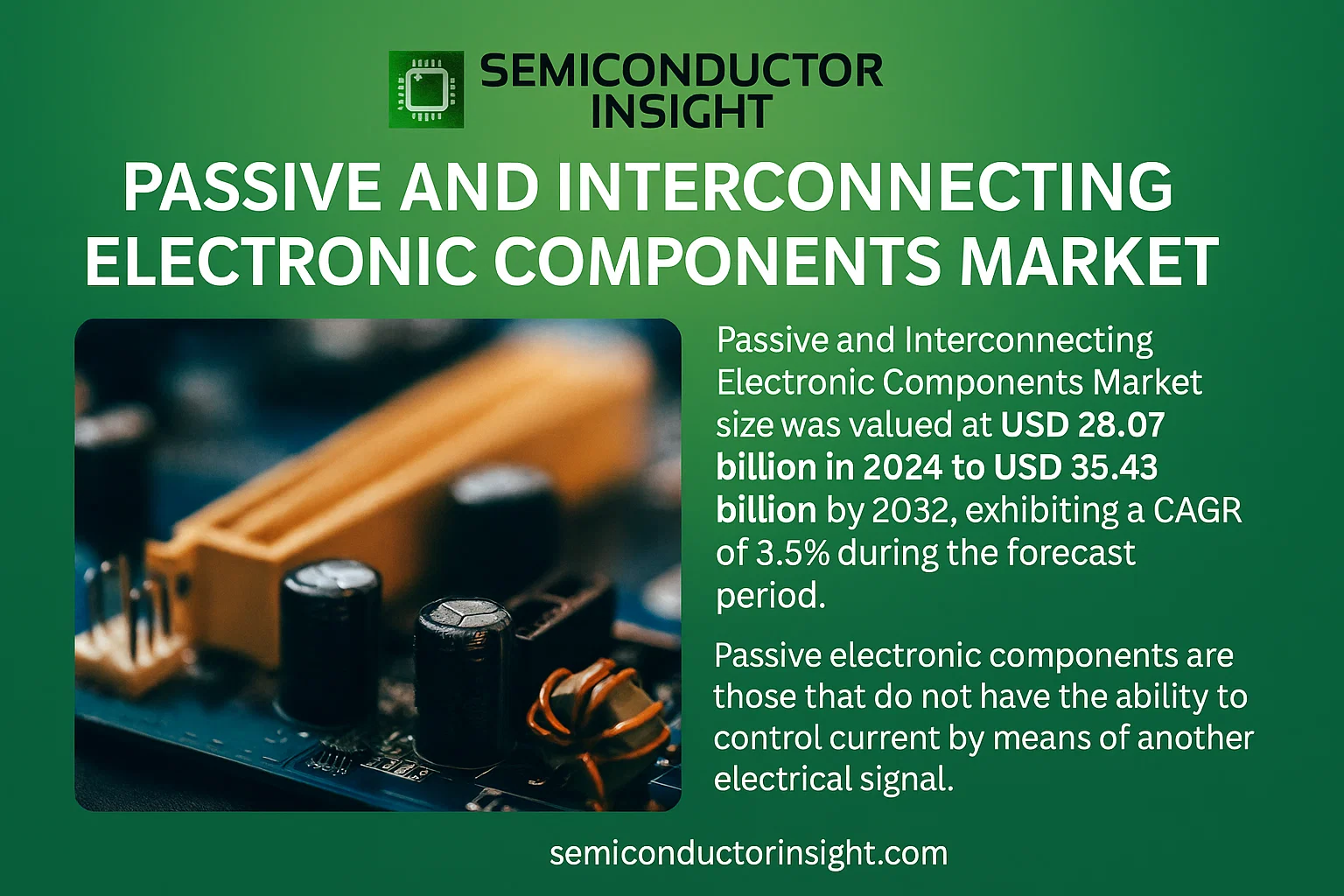
Global Passive and Interconnecting Electronic Components Market size was valued at USD 28.07 billion in 2024 to USD 35.43 billion by 2032, exhibiting a CAGR of 3.5% during the forecast period.
Passive electronic components are those that do not have the ability to control current by means of another electrical signal. These fundamental parts are essential for managing the flow of electricity within circuits without amplification. Examples include capacitors, resistors, inductors, transformers, and diodes. Interconnecting components, such as connectors, are devices that link two active devices to transmit current or signals.
The market is experiencing steady growth driven by several factors, including the expanding automotive electronics sector and rising demand from consumer electronics and industrial applications. Furthermore, the proliferation of IoT devices and advancements in telecommunications infrastructure are contributing to market expansion. China is the leading regional market, accounting for approximately 30% of global demand due to its massive manufacturing base, followed by the United States with about a 25% share. Key players operating in this fragmented market include ABB, STMicroelectronics, Fujitsu Component, and AVX Corporation.
MARKET DRIVERS
Proliferation of Smart Electronics and IoT
The exponential growth of the Internet of Things (IoT) and smart devices is a primary driver for the passive and interconnecting components market. Billions of new connected devices, from industrial sensors to consumer wearables, require a vast number of resistors, capacitors, inductors, connectors, and PCBs to function. This creates sustained, high-volume demand across all component categories, fueling market expansion and technological innovation to meet the need for miniaturization and reliability.
Advancements in Automotive Electronics
The automotive industry’s rapid transformation towards electrification, advanced driver-assistance systems (ADAS), and in-vehicle infotainment represents a major growth vector. Modern vehicles contain thousands of passive components and complex interconnection systems. The shift to electric vehicles (EVs) particularly increases demand for high-performance capacitors and specialized connectors capable of handling high voltages and currents, directly boosting market revenue.
Furthermore, the ongoing rollout of 5G infrastructure worldwide necessitates advanced passive components that can operate at higher frequencies with lower signal loss. This drives investment in research and development for new materials and designs, particularly for filters, antennas, and high-frequency connectors, ensuring continued market growth.
MARKET CHALLENGES
Supply Chain Volatility and Raw Material Shortages
The market faces significant challenges from persistent supply chain disruptions and price fluctuations for critical raw materials. Components often rely on materials like陶瓷, tantalum, and copper, whose availability and cost can be highly volatile. Geopolitical tensions, trade restrictions, and logistical bottlenecks further exacerbate these issues, leading to extended lead times and increased production costs for manufacturers.
Other Challenges
Technical Complexity of Miniaturization
As devices become smaller and more powerful, the demand for miniature components like multilayer ceramic capacitors (MLCCs) and micro-connectors intensifies. This pushes the limits of manufacturing precision, requiring substantial capital investment in advanced production equipment and stringent quality control, which can be a barrier for smaller players.
Intense Price Pressure
The market is characterized by fierce competition and high sensitivity to price, especially for standard, high-volume components. This pressure erodes profit margins and compels continuous operational efficiency improvements and cost-reduction strategies to remain competitive.
MARKET RESTRAINTS
Economic Uncertainty and Fluctuating End-User Demand
Macroeconomic instability, including inflation and potential recessions in key markets, can significantly restrain growth. Consumer electronics, a major end-market, is particularly susceptible to dips in discretionary spending. This leads to inventory corrections and reduced orders from OEMs, creating a cyclical downtrend that impacts the entire supply chain for passive and interconnecting components.
Standardization and Commoditization Pressures
For many mature passive components, high levels of standardization have led to commoditization. This makes it difficult for manufacturers to differentiate their products beyond price, limiting profitability. While innovation persists in high-end segments, the bulk of the market is constrained by this competitive dynamic, which slows value growth.
MARKET OPPORTUNITIES
Expansion in Renewable Energy and Industrial Automation
Global push for renewable energy and smarter industrial automation presents substantial opportunities. Solar inverters, wind turbines, and industrial robotics all require robust, reliable passive components and interconnection solutions designed for harsh environments and high efficiency. This segment demands specialized products with higher margins, offering a path for value growth beyond consumer electronics.
Innovation in Advanced Packaging and High-Frequency Applications
Emerging technologies like System-in-Package (SiP) and the continued evolution of 5G/6G networks create demand for novel interconnecting technologies and specialized passive components. Opportunities exist in developing integrated passive devices (IPDs), high-density interconnect (HDI) boards, and components that minimize electromagnetic interference (EMI), positioning companies at the forefront of next-generation electronics.
Passive and Interconnecting Electronic Components Market Trends
Sustained Growth Driven by Expansion in Key Applications
Global market for Passive and Interconnecting Electronic Components is demonstrating steady growth, with a projected increase from a valuation of USD 28,070 million in 2024 to USD 35,430 million by 2032, representing a compound annual growth rate (CAGR) of 3.5%. This upward trend is fundamentally driven by the continuous demand across major end-use industries. The automotive sector, in particular, is a significant growth engine, with modern vehicles incorporating an ever-increasing number of electronic control units (ECUs), sensors, and infotainment systems, all of which rely heavily on passive components like capacitors and resistors, as well as connectors for signal and power transmission.
Other Trends
Geographical Market Concentration
The market is geographically concentrated, with China and the United States representing the dominant shares. China currently leads Global market, accounting for approximately 30% of total demand, a position supported by its massive electronics manufacturing base. The United States follows closely, holding about 25% of the market share, driven by its strong aerospace, defense, and IT industries.
Technological Miniaturization and Integration
A key trend shaping the industry is the push for miniaturization and higher integration. As electronic devices become smaller and more powerful, there is a corresponding demand for passive components with smaller form factors, higher performance, and greater reliability. This is especially critical in applications like medical electronics and information technology, where space is at a premium. Additionally, the development of integrated passive devices (IPDs) is gaining traction, combining multiple passive functions into a single package to save board space and improve performance.
Competitive Landscape and Industry Consolidation
The competitive landscape is fragmented, with the top three manufacturers, including ABB, ST Microelectronics, and Fujitsu Component, collectively accounting for only about 5% of Global market. This indicates a highly competitive environment with numerous players. The market sees activity from other significant companies such as AVX Corporation, Eaton Corp., and 3M Electronics. This dynamic fosters continuous innovation but also presents challenges related to pricing pressure. Market participants are focusing on strategic developments, including mergers and acquisitions, to enhance their product portfolios and expand their geographical reach to capitalize on the growth potential in emerging regions.
COMPETITIVE LANDSCAPE
Key Industry Players
A Highly Fragmented Market Driven by Global Electronics Demand
Global Passive and Interconnecting Electronic Components Market is characterized by a high degree of fragmentation, with the top three manufacturers accounting for only about 5% of the total market. The competitive environment is intense, with numerous players vying for market share across key regions such as China, which leads with approximately 30% of the market, followed by the United States with about 25%. Leading global manufacturers like ABB, ST Microelectronics, and AVX Corporation are established players with diverse portfolios spanning capacitors, resistors, and connectors. Their competitive strategies are heavily focused on technological innovation, expanding production capacity to meet the demands of key sectors like automotive, information technology, and industrial automation, and pursuing strategic mergers and acquisitions to consolidate market position and expand their geographical footprint.
Beyond the top tier, the market includes a significant number of specialized and niche players that compete effectively by focusing on specific component types or application segments. Companies such as Hamlin (specializing in sensors and relays) and API Technologies (providing components for aerospace and defense) have carved out strong positions. Other significant participants like Eaton Corp. in power management components and 3M Electronics in interconnect solutions contribute to a dynamic and competitive ecosystem. Regional manufacturers, particularly in Asia, also play a crucial role, often competing on cost-efficiency and serving local supply chains. This diverse landscape ensures continuous innovation and price competition, driven by the sustained global demand for electronic devices across all major end-use industries.
List of Key Passive and Interconnecting Electronic Components Companies Profiled
- ABB
- ST Microelectronics
- Fujitsu Component
- AVX Corporation
- Eaton Corp.
- Hamlin
- 3M Electronics
- API Technologies
- Datronix Holding Ltd.
- American Electronic Components
- Murata Manufacturing Co., Ltd.
- TDK Corporation
- Yageo Corporation
- Vishay Intertechnology, Inc.
- TE Connectivity
Segment Analysis:
| Segment Category | Sub-Segments | Key Insights |
| By Type |
|
Capacitors represent a dominant product category, driven by their fundamental role in energy storage, filtering, and power conditioning across virtually all electronic circuits. Their indispensable nature in consumer electronics, telecommunications infrastructure, and industrial automation systems sustains high demand. Innovations in materials, such as the development of multi-layer ceramic capacitors with higher capacitance values and better temperature stability, continue to expand their application range. The segment also benefits from the ongoing miniaturization trend in electronics, which requires smaller, more efficient capacitor solutions. |
| By Application |
|
Automotive is a major growth engine for the market, propelled by the increasing electronic content in modern vehicles. The transition towards electric vehicles, advanced driver-assistance systems, and sophisticated in-vehicle infotainment requires a substantial number of reliable passive components. This sector demands components that can withstand harsh operating conditions, including extreme temperatures and vibrations, leading to a focus on high-reliability and durable products. The trend towards vehicle electrification and connectivity ensures sustained, robust demand from this application segment for the foreseeable future. |
| By End User |
|
Original Equipment Manufacturers (OEMs) constitute the most significant end-user segment, as they integrate passive and interconnecting components directly into their final products. These manufacturers, spanning industries from automotive to consumer electronics, drive specifications and set quality standards. Their large-volume procurement strategies and long-term supply chain partnerships heavily influence market dynamics. The demand from OEMs is characterized by a need for consistent quality, reliable supply, and components that meet specific technical and performance criteria for their diverse product portfolios. |
| By Product Innovation Trend |
|
Miniaturization is the paramount trend shaping product development, driven by the relentless demand for smaller, lighter, and more portable electronic devices. This trend pushes manufacturers to develop components with reduced footprints and profiles while maintaining or improving electrical characteristics. The evolution towards chip-scale packages and surface-mount technology advancements exemplifies this focus. This innovation direction is critical for applications in mobile communications, wearable technology, and advanced medical devices, where space is at a premium and performance cannot be compromised. |
| By Supply Chain Dynamism |
|
Established Global Players maintain a stronghold on the market through their extensive product portfolios, significant research and development capabilities, and robust global distribution networks. Companies like ABB, ST Microelectronics, and AVX Corporation leverage their scale to achieve cost efficiencies and invest in next-generation technologies. Their ability to provide a wide range of certified, high-reliability components makes them preferred partners for major OEMs across diverse industries. However, this segment faces constant pressure from agile niche suppliers who focus on innovative solutions for specific applications. |
Regional Analysis: Passive and Interconnecting Electronic Components Market
Asia-Pacific’s manufacturing capacity is unparalleled, with deeply integrated supply chains for raw materials and component production. This concentration allows for efficient, large-volume manufacturing of everything from basic resistors to complex RF connectors, creating a significant cost and availability advantage that global markets rely upon.
Beyond mass production, countries like Japan and South Korea are centers for high-end R&D, pushing the boundaries in miniaturization, performance, and thermal management for components. This focus on advanced technology ensures the region remains at the forefront, catering to the most demanding applications in automotive electronics and telecommunications.
The market is fueled by strong domestic demand from rapidly growing industries. The consumer electronics sector, automotive production (especially electric vehicles), and significant government investments in industrial automation and smart infrastructure create a robust and multi-faceted consumption base for components within the region itself.
Supportive government policies, including subsidies for semiconductor and electronics industries, along with initiatives like “Made in China 2025,” actively promote the development and self-sufficiency of the electronic components sector. This strategic backing provides a stable and favorable environment for long-term growth and investment.
North America
North America remains a critical and technologically advanced market, characterized by high demand for specialized, high-reliability components. The region’s strength lies in its innovation-driven sectors, including aerospace, defense, telecommunications, and advanced computing. Demand is particularly strong for connectors and passive components that meet stringent performance and quality standards for applications in mission-critical systems, data centers, and next-generation communication networks like 5G. The presence of major OEMs and a strong focus on R&D fosters a market for cutting-edge components, though it relies significantly on imports from Asia for standard, high-volume parts. The push for re-shoring some electronics manufacturing could influence future supply chain dynamics within the region.
Europe
The European market is distinguished by its strong automotive and industrial sectors, which demand high-quality, durable, and precise electronic components. The transition to electric vehicles is a major growth driver, increasing the need for advanced capacitors, sensors, and interconnect solutions capable of handling high power and harsh environments. The region also has a robust industrial automation industry that requires reliable passive and interconnecting components. While Europe possesses established component manufacturers, it faces intense competition from Asian producers. The market is shaped by stringent regulatory standards, including environmental directives like RoHS and REACH, which influence component design, materials, and sourcing strategies for all players operating within the region.
South America
The South American market for passive and interconnecting components is smaller but developing, with growth primarily driven by the consumer electronics and automotive industries in countries like Brazil. The market is largely import-dependent, with components sourced mainly from Asia and North America. Local manufacturing is limited, focusing primarily on assembly rather than full-scale production of core components. Economic fluctuations and political instability in some countries can create volatility in demand and investment. However, gradual industrialization and infrastructure development projects present opportunities for future market expansion, particularly for basic components used in consumer goods and industrial equipment.
Middle East & Africa
This region represents an emerging market with growth potential tied to infrastructure development, telecommunications expansion, and economic diversification efforts, particularly in Gulf Cooperation Council countries. The demand for electronic components is driven by investments in smart city projects, construction, and the growing consumer electronics market. The region is almost entirely reliant on imports, with distribution networks centered around major trade hubs. While the current market size is modest compared to other regions, long-term investments in technology and industrialization are expected to gradually increase the demand for a wide range of passive and interconnecting components over the coming years.
Report Scope
This market research report provides a comprehensive analysis of the Passive and Interconnecting Electronic Components Market , covering the forecast period 2025–2032. It offers detailed insights into market dynamics, technological advancements, competitive landscape, and key trends shaping the industry.
Key focus areas of the report include:
- Market Overview: The report begins with an overview outlining its current market scenario, key growth indicators, and industry transformation drivers. It discusses macroeconomic factors, demand–supply balance, regulatory landscape, and the strategic role of electronic components in powering advancements across industries such as automotive, aerospace & defense, information technology, medical electronics, and industrial automation.
- Market Size & Forecast: Historical data and future projections for revenue, unit shipments, and market value across major regions and segments.
- Segmentation Analysis: Detailed breakdown by product type, technology, application, and end-user industry to identify high-growth segments and investment opportunities.
- Regional Insights: Insights into market performance across North America, Europe, Asia-Pacific, Latin America, and the Middle East & Africa, including country-level analysis where relevant.
- Competitive Landscape: Profiles of leading market participants, including their product offerings, R&D focus, manufacturing capacity, pricing strategies, and recent developments such as mergers, acquisitions, and partnerships.
- Technology Trends & Innovation: Assessment of emerging technologies, integration of AI/IoT, component design trends, fabrication techniques, and evolving industry standards.
- Market Drivers & Restraints: Evaluation of factors driving market growth along with challenges, supply chain constraints, regulatory issues, and market-entry barriers.
- Stakeholder Insights: Insights for component suppliers, OEMs, system integrators, investors, and policymakers regarding the evolving ecosystem and strategic opportunities.
Primary and secondary research methods are employed, including interviews with industry experts, data from verified sources, and real-time market intelligence to ensure the accuracy and reliability of the insights presented.
FREQUENTLY ASKED QUESTIONS:
What is the current market size of Passive and Interconnecting Electronic Components Market?
-> Global Passive and Interconnecting Electronic Components Market was valued at USD 28,070 million in 2024 and is projected to reach USD 35,430 million by 2032, growing at a CAGR of 3.5% during the forecast period.
Which key companies operate in Passive and Interconnecting Electronic Components Market?
-> Key players include ABB, ST Microelectronics, Fujitsu Component, AVX Corporation, Eaton Corp., Hamlin, 3M Electronics, API Technologies, Datronix Holding Ltd., and American Electronic Components, among others.
What are the key growth drivers?
-> Key growth drivers include rising demand from the automotive, information technology, and aerospace & defense sectors, along with technological advancements and increased electronics integration across industries.
Which region dominates the market?
-> China is the leading market with about 30% of Global share, followed by the US with about 25%.
What are the emerging trends?
-> Emerging trends include miniaturization of components, adoption of advanced materials, increasing use in medical electronics, and the integration of IoT and AI technologies.

Get Sample Report PDF for Exclusive Insights
Report Sample Includes
- Table of Contents
- List of Tables & Figures
- Charts, Research Methodology, and more...
 Download Sample Report PDF