Ozone Sensor Module Market Insights
Global Ozone Sensor Module market size was valued at USD 345 million in 2025. The market is projected to reach USD 486 million by 2032, exhibiting a CAGR of 5.2% during the forecast period.
The ozone sensor module is a device component used to detect the ozone concentration in the environment. Based on the electrochemical principle, the ozone concentration is converted into an electrical signal or other measurable signal by the reaction of electrodes with ozone, thus achieving real-time monitoring of the ozone concentration. The ozone sensor module offers fast response speed, high sensitivity, and good stability, and is widely used in environmental monitoring, air purification, medical disinfection, food processing, and other fields. Key types include Resolution 0.1ppm, Resolution 0.01ppm, Resolution 0.005ppm, and others.
The market is experiencing steady growth due to several factors, including stringent environmental regulations, rising demand for air quality monitoring, and expanding applications in disinfection and purification sectors. Additionally, advancements in sensor miniaturization and IoT integration contribute significantly to market expansion. Initiatives by key players are fueling further development. EC Sense, Infinite Electronics, Interlink Electronics, Innodisk Corporation, Crowcon, Zhengzhou Winsen Electronics Technology, Shenzhen Singoan Electronic Technology, Sangbay, Guangzhou Luftmy Intelligent Technology, and Skesen are some of the key players operating in the market with diverse portfolios.
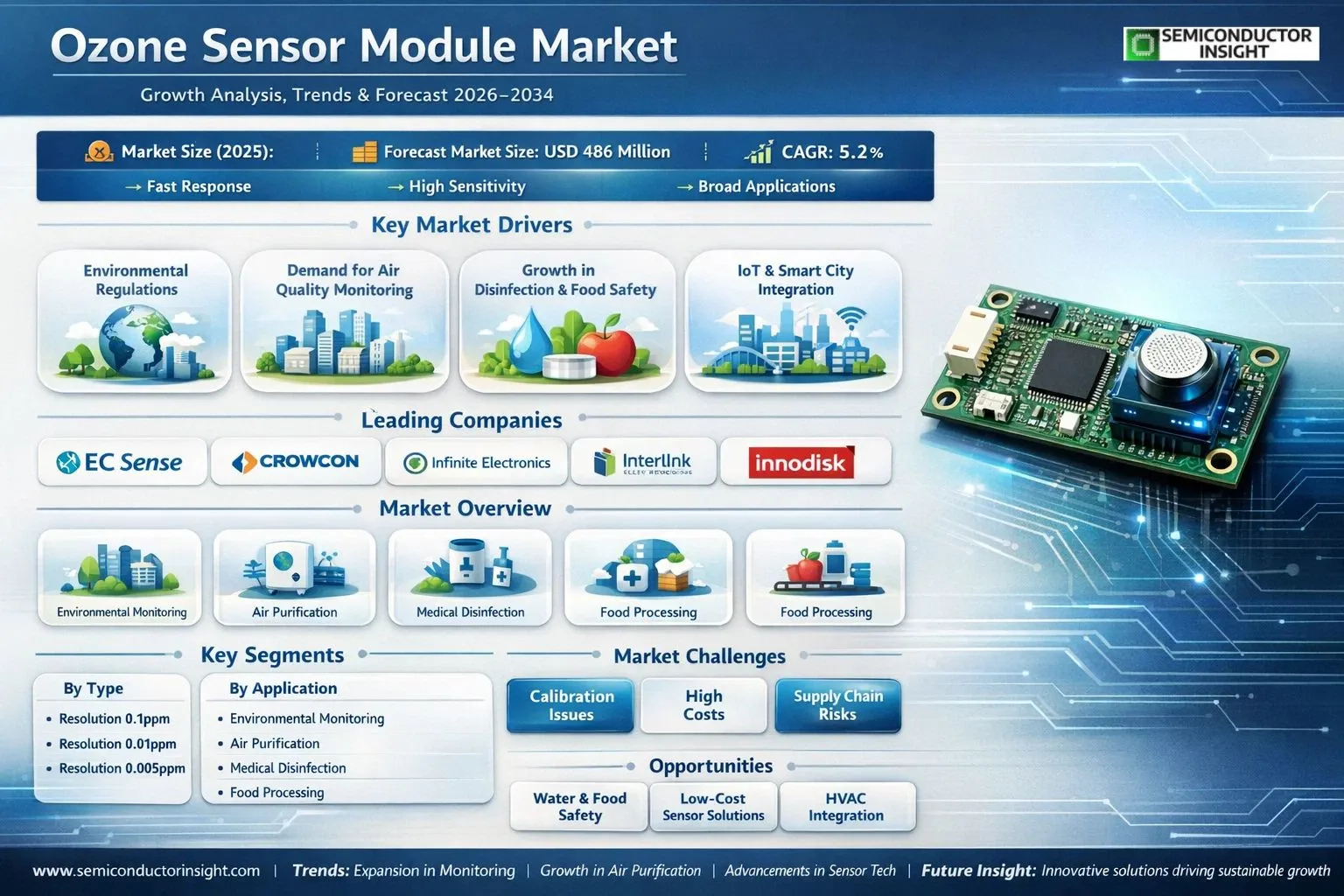
MARKET DRIVERS
Rising Environmental Regulations and Air Quality Concerns
Ozone Sensor Module Market is propelled by stringent global regulations on ambient air quality, particularly in regions like Europe and North America where ozone levels are closely monitored. Governments are enforcing limits on tropospheric ozone to protect public health, driving demand for reliable detection modules in urban monitoring stations. This trend has accelerated with over 70% of major cities reporting elevated ozone concentrations during summer peaks.
Integration with IoT and Smart City Initiatives
Advancements in Internet of Things (IoT) technology enable ozone sensor modules to provide real-time data for smart city frameworks, enhancing predictive analytics for pollution hotspots. The market benefits from a projected IoT adoption rate exceeding 25% in environmental sensors by 2028, fostering scalable deployments in industrial and residential sectors.
➤ Health Awareness Post-Pandemic Boosts Portable Ozone Detection Devices
Consumer demand for personal air quality monitors has surged, with ozone sensor modules integral to portable units used in indoor environments. This driver supports market expansion, as health-conscious populations seek proactive measures against respiratory issues linked to ozone exposure.
MARKET CHALLENGES
Sensitivity to Interfering Gases and Calibration Needs
In Ozone Sensor Module Market, electrochemical and UV-based sensors face cross-sensitivity to humidity, VOCs, and nitrogen oxides, leading to accuracy issues in complex environments. Regular calibration is required every 6-12 months, increasing operational costs for end-users in water treatment and HVAC systems.
Other Challenges
High Development and Manufacturing Costs
Scaling production of precision components like optical filters and electrodes remains expensive, with raw material fluctuations impacting margins. Smaller players struggle against established firms dominating 60% of the market share.Supply chain disruptions for semiconductors further complicate module assembly, delaying deployments in emerging applications.
MARKET RESTRAINTS
Technical Limitations in Harsh Environments
Ozone Sensor Module Market encounters restraints from sensor drift and limited lifespan in extreme conditions, such as high temperatures above 50°C or corrosive industrial settings. This restricts adoption in sectors like wastewater treatment where reliability below 95% accuracy is unacceptable.Power consumption challenges in battery-operated modules hinder portable applications, with average lifespans under 2 years necessitating frequent replacements.Standardization gaps across global markets slow interoperability, as varying protocols for data output complicate integration into diverse monitoring networks.
MARKET OPPORTUNITIES
Expansion in Water and Food Safety Monitoring
Growing use of ozone disinfection in water purification and food processing opens avenues for Ozone Sensor Module Market, with installations expected to rise 15% annually in Asia-Pacific. Modules enabling closed-loop control optimize ozone dosing, reducing chemical overuse.Development of low-cost, AI-enhanced modules promises penetration into developing economies, where air quality networks are expanding rapidly.Partnerships with HVAC manufacturers for integrated solutions in commercial buildings represent untapped potential, aligning with green building certifications worldwide.
Ozone Sensor Module Market Trends
Growing Adoption in Environmental Monitoring
Ozone sensor modules, leveraging electrochemical principles, deliver fast response times, high sensitivity, and reliable stability for real-time ozone concentration detection. In Ozone Sensor Module Market, environmental monitoring stands out as a primary trend, driven by heightened global focus on air quality management. These modules enable precise tracking of ozone levels in ambient air, supporting regulatory compliance and pollution control efforts across urban and industrial areas.
Other Trends
Expansion into Air Purification and Medical Applications
Another key development involves integration into air purification systems and medical disinfection processes. Ozone sensor modules provide essential feedback for optimizing ozone generation in purifiers, ensuring safe operation and efficiency. In healthcare settings, they facilitate controlled ozone use for sterilization, minimizing risks while enhancing disinfection protocols. This trend reflects broader demand for compact, accurate sensing solutions in consumer and professional applications.
Advancements in Resolution Variants and Regional Growth
Within Ozone Sensor Module Market, segments by resolution—such as 0.1ppm, 0.01ppm, and 0.005ppm—cater to diverse precision needs, with higher resolutions gaining traction in food processing and specialized monitoring. Leading manufacturers like EC Sense, Crowcon, and Zhengzhou Winsen Electronics Technology are innovating to meet these demands, fostering competitive dynamics. Regionally, Asia, particularly China, emerges as a growth hub due to rapid industrialization and stringent environmental policies, alongside established markets in North America and Europe where applications in various sectors drive sustained uptake. These shifts underscore the market’s evolution toward multifunctional, high-performance modules amid ongoing industry challenges and opportunities.
COMPETITIVE LANDSCAPE
Key Industry Players
Ozone Sensor Module Market Leaders and Emerging Challengers
Ozone Sensor Module Market exhibits a moderately concentrated structure, where the top five global players command a substantial revenue share as of 2025. EC Sense stands out as a leading innovator, leveraging advanced electrochemical sensing technology for precise ozone detection, benefiting from strong demand in environmental monitoring and air purification sectors. Crowcon, a prominent name under Halma plc, dominates with robust, reliable modules integrated into industrial safety systems, holding significant market influence through extensive distribution networks and compliance with stringent safety standards. This oligopolistic dynamic fosters innovation in resolution capabilities, such as 0.1ppm and finer variants, while competition intensifies around response speed and stability for applications in medical disinfection and food processing.
Beyond the frontrunners, a cadre of niche players contributes to market diversity, particularly from Asia-Pacific regions like China, where localized manufacturing advantages prevail. Companies such as Zhengzhou Winsen Electronics Technology and Shenzhen Singoan Electronic Technology excel in cost-effective, high-volume production tailored for emerging markets, focusing on scalability for regional environmental regulations. Guangzhou Luftmy Intelligent Technology and Skesen emphasize smart integrations with IoT platforms, carving niches in air quality analytics. International firms like Infinite Electronics and Interlink Electronics provide specialized flexible sensor solutions, while Innodisk Corporation targets embedded industrial applications. Emerging challengers are driving price competition and technological advancements, yet face hurdles in global standardization and supply chain resilience amid rising raw material costs.
List of Key Ozone Sensor Module Companies Profiled
- EC Sense
- Crowcon
- Zhengzhou Winsen Electronics Technology
- Shenzhen Singoan Electronic Technology
- Sangbay
- Guangzhou Luftmy Intelligent Technology
- Skesen
- Infinite Electronics
- Interlink Electronics
- Innodisk Corporation
- Alphasense
- Figaro Engineering
- SPEC Sensors
- Honeywell
- Teledyne API
Segment Analysis:
| Segment Category | Sub-Segments | Key Insights |
| By Type |
|
Resolution 0.1ppm
|
| By Application |
|
Environmental Monitoring
|
| By End User |
|
Environmental Agencies
|
| By Technology |
|
Electrochemical
|
| By Deployment Type |
|
Fixed/Stationary
|
Regional Analysis: Ozone Sensor Module Market
Asia-Pacific
Urbanization and pollution control policies propel Ozone Sensor Module Market. Stringent regulations in manufacturing hubs demand continuous monitoring, while smart city projects integrate sensors for proactive ozone management.
Ozone sensor modules thrive in water treatment and air quality systems. Industrial safety protocols and agricultural disinfection applications expand usage, leveraging durable designs suited to tropical climates.
Local firms dominate with affordable innovations, partnering with global leaders. Cost optimization and rapid scalability define competition in the Asia-Pacific Ozone Sensor Module Market.
IoT and AI synergies unlock predictive maintenance features. Expansion into renewable energy monitoring and public health networks offers untapped potential.
North America
The North America Ozone Sensor Module Market benefits from robust regulatory frameworks like EPA standards, emphasizing precise ozone detection in ambient air and industrial settings. Advanced research institutions drive innovation in electrochemical and UV-based sensors, enhancing accuracy for compliance reporting. Integration with building automation systems supports energy-efficient ventilation, while healthcare facilities adopt modules for sterilization process validation. Key players focus on ruggedized designs for harsh environments, such as oil and gas operations. Growing awareness of indoor air quality post-pandemic accelerates residential and commercial deployments. Strategic partnerships with tech giants bolster wireless connectivity features, aligning with smart infrastructure initiatives. Despite high initial costs, long-term reliability fuels steady adoption across diverse sectors.
Europe
Europe’s Ozone Sensor Module Market is shaped by EU air quality directives, mandating widespread deployment in urban monitoring stations and vehicular emissions control. Emphasis on circular economy principles promotes recyclable sensor components, with Nordic countries leading in sustainable manufacturing practices. Water purification plants increasingly rely on these modules for ozone dosing optimization, ensuring eco-friendly disinfection. Collaborative R&D under Horizon programs advances miniaturization and multi-gas sensing capabilities. Stringent worker safety laws in chemical industries heighten demand for portable units. The shift toward net-zero emissions integrates sensors into renewable energy projects, fostering market maturity through policy-driven innovation and cross-border standardization efforts.
South America
In the South America Ozone Sensor Module Market, agricultural expansion and deforestation concerns elevate the role of sensors in ozone layer protection and crop protection applications. Brazil and Argentina invest in monitoring networks to track tropospheric ozone impacts on yields, integrating modules with precision farming tech. Urban centers like São Paulo prioritize air quality solutions amid rapid growth, deploying sensors in public transport and wastewater facilities. Local adaptations address tropical conditions, enhancing humidity resistance. Emerging public-private partnerships accelerate technology transfer from global suppliers, while biodiversity conservation initiatives in the Amazon region incorporate advanced detection for environmental safeguarding. Gradual regulatory harmonization promises sustained momentum.
Middle East & Africa
The Middle East & Africa Ozone Sensor Module Market gains traction through oil and gas sector needs for leak detection and safety compliance in arid climates. Desalination plants utilize sensors for ozone-based purification, optimizing water security in water-scarce regions. Gulf nations’ smart city visions embed modules in IoT frameworks for pollution tracking. Africa sees potential in mining operations and urban air initiatives, with solar-powered variants suiting off-grid areas. Infrastructure investments bridge technology gaps, while regional forums promote knowledge sharing. Climate resilience projects further drive adoption, positioning the market for phased growth amid diverse economic landscapes.
Report Scope
This market research report provides a comprehensive analysis of Ozone Sensor Module Market, covering the forecast period 2026–2034. It offers detailed insights into market dynamics, technological advancements, competitive landscape, and key trends shaping the industry.
Key focus areas of the report include:
- Market Overview: The report begins with an overview outlining its current market scenario, key growth indicators, and industry transformation drivers. It discusses macroeconomic factors, demand–supply balance, regulatory landscape, and the strategic role of ozone sensor modules in powering advancements across industries such as environmental monitoring, air purification, medical disinfection, and food processing.
- Market Size & Forecast: Historical data and future projections for revenue, unit shipments, and market value across major regions and segments.
- Segmentation Analysis: Detailed breakdown by product type, technology, application, and end-user industry to identify high-growth segments and investment opportunities.
- Regional Insights: Insights into market performance across North America, Europe, Asia-Pacific, Latin America, and the Middle East & Africa, including country-level analysis where relevant.
- Competitive Landscape: Profiles of leading market participants, including their product offerings, R&D focus, manufacturing capacity, pricing strategies, and recent developments such as mergers, acquisitions, and partnerships.
- Technology Trends & Innovation: Assessment of emerging technologies, integration of AI/IoT, semiconductor design trends, fabrication techniques, and evolving industry standards.
- Market Drivers & Restraints: Evaluation of factors driving market growth along with challenges, supply chain constraints, regulatory issues, and market-entry barriers.
- Stakeholder Insights: Insights for component suppliers, OEMs, system integrators, investors, and policymakers regarding the evolving ecosystem and strategic opportunities.
Primary and secondary research methods are employed, including interviews with industry experts, data from verified sources, and real-time market intelligence to ensure the accuracy and reliability of the insights presented.
FREQUENTLY ASKED QUESTIONS:
What is the current market size of Ozone Sensor Module Market?
-> Ozone Sensor Module Market was valued at USD 345 million in 2025 and is expected to reach USD 486 million by 2032, at a CAGR of 5.2% during the forecast period.
Which key companies operate in Ozone Sensor Module Market?
-> Key players include EC Sense, Infinite Electronics, Interlink Electronics, Innodisk Corporation, Crowcon, Zhengzhou Winsen Electronics Technology, among others.
What are the key growth drivers?
-> Key growth drivers include demand for environmental monitoring, air purification systems, medical disinfection, and food processing applications.
Which region dominates the market?
-> Asia is the fastest-growing region, while North America remains a dominant market.
What are the emerging trends?
-> Emerging trends include high-resolution sensors such as 0.1ppm and 0.01ppm, electrochemical sensing technology, and real-time IoT integration.

Get Sample Report PDF for Exclusive Insights
Report Sample Includes
- Table of Contents
- List of Tables & Figures
- Charts, Research Methodology, and more...
 Download Sample Report PDF