MARKET INSIGHTS
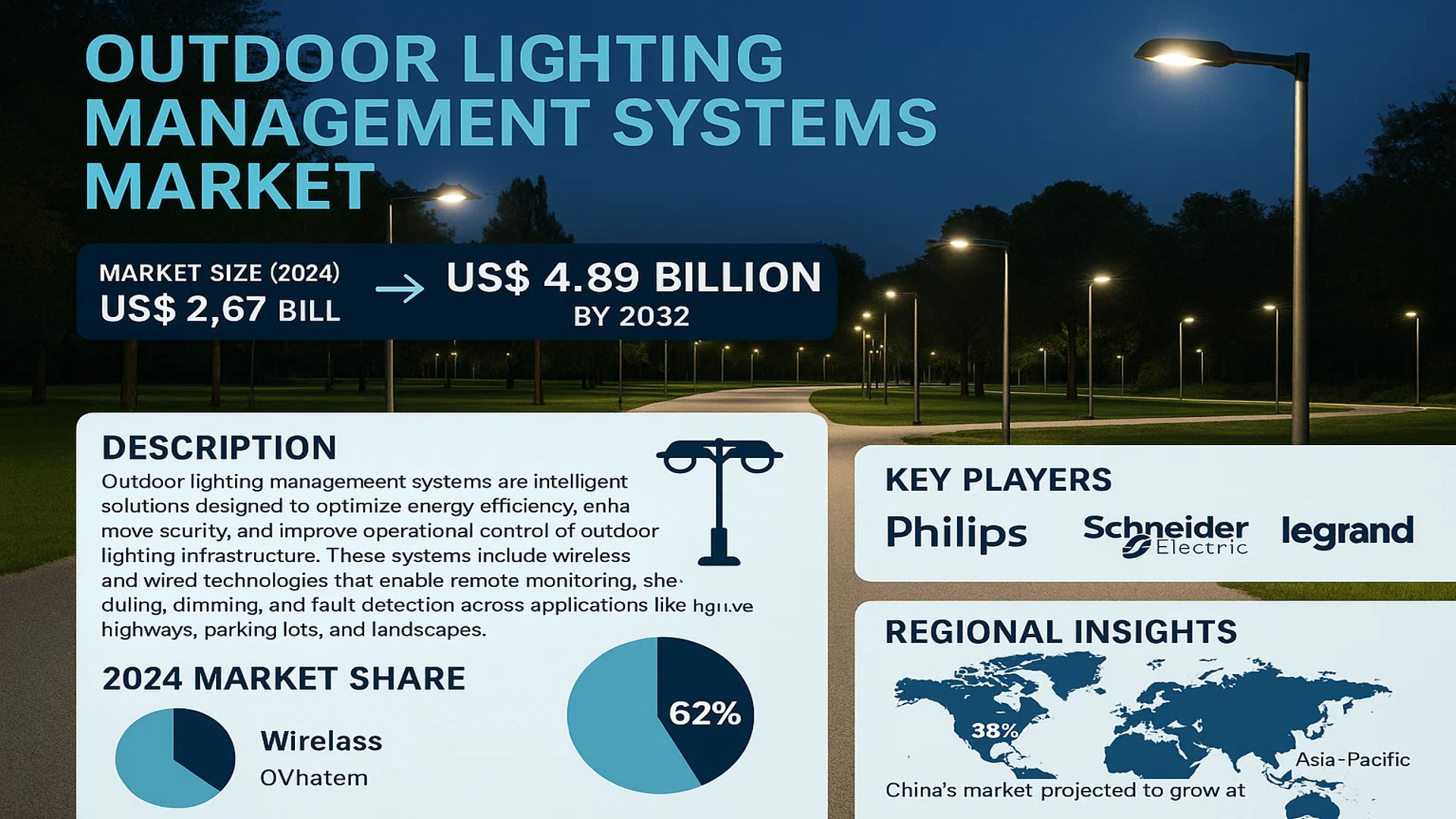
The global Outdoor Lighting Management Systems Market size was valued at US$ 2.67 billion in 2024 and is projected to reach US$ 4.89 billion by 2032, at a CAGR of 7.8% during the forecast period 2025-2032.
Outdoor lighting management systems are intelligent solutions designed to optimize energy efficiency, enhance security, and improve operational control of outdoor lighting infrastructure. These systems include wireless and wired technologies that enable remote monitoring, scheduling, dimming, and fault detection across applications like highways, parking lots, and landscapes. Leading manufacturers such as Philips, Schneider Electric, and Legrand offer integrated platforms combining IoT sensors, cloud connectivity, and data analytics.
While urbanization and smart city initiatives drive adoption, challenges like high initial costs persist. The wireless segment dominates with 62% market share in 2024 due to scalability benefits. North America leads regional demand (38% share), followed by Europe and Asia-Pacific, where China’s market is projected to grow at 12.1% CAGR through 2032.
MARKET DYNAMICS
MARKET DRIVERS
Growing Smart City Investments to Drive Adoption of Outdoor Lighting Management Systems
The global push toward smart city infrastructure is significantly accelerating demand for outdoor lighting management systems. Governments worldwide are increasingly allocating budgets for intelligent lighting solutions that enhance urban efficiency and sustainability. By 2027, smart city initiatives are projected to invest over $250 billion annually, with smart lighting representing approximately 12% of this expenditure. These systems enable remote monitoring, adaptive brightness control, and energy optimization – delivering up to 60% energy savings compared to conventional lighting. The integration of IoT sensors into streetlights is creating multi-functional urban infrastructure nodes, further boosting market growth.
Energy Efficiency Regulations Compel Adoption of Advanced Lighting Controls
Stringent government regulations targeting energy conservation are mandating the transition to intelligent outdoor lighting solutions. The European Union’s Energy Efficiency Directive requires member states to achieve 32.5% energy efficiency improvements by 2030, with public lighting upgrades forming a key component. Similar regulations in North America and Asia are driving municipal authorities and commercial property owners to implement lighting management systems that deliver measurable energy savings. Modern LED fixtures paired with smart controls now achieve up to 80% greater efficiency than traditional lighting, making them economically viable despite higher initial costs.
Wireless Technology Advancements Enable Cost-Effective Deployments
The rapid evolution of wireless communication technologies is removing previously prohibitive installation costs for outdoor lighting networks. LPWAN solutions like LoRaWAN and NB-IoT now provide reliable, low-power connectivity for managing lighting infrastructure across expansive areas. Wireless deployments eliminate the need for expensive trenching and cabling, reducing implementation costs by an estimated 35-45% compared to wired alternatives. Recent advancements in mesh networking protocols have also improved system reliability, with packet delivery rates exceeding 99.5% in field tests.
MARKET RESTRAINTS
High Implementation Costs Remain Barrier for Budget-Constrained Municipalities
While offering compelling long-term savings, the substantial upfront investment required for outdoor lighting management systems continues to challenge widespread adoption. A complete smart lighting retrofit for mid-sized cities often requires capital expenditures ranging from $10-20 million, creating financial obstacles for municipalities with constrained budgets. The cost burden extends beyond hardware to include network infrastructure, software platforms, and ongoing maintenance – requiring payback periods averaging 5-7 years that exceed typical budget cycles for many local governments.
Interoperability Issues Complicate System Integration
The lack of universal standards across lighting control protocols creates integration challenges for operators managing multi-vendor environments. Proprietary solutions from major manufacturers frequently require customized interfaces to communicate with existing infrastructure, adding complexity and cost to deployments. These interoperability issues are particularly problematic for cities transitioning gradually from legacy systems, where mixed technology environments must coexist during lengthy upgrade cycles.
Cybersecurity Vulnerabilities Raise Operational Concerns
The network-connected nature of modern lighting systems introduces potential cybersecurity risks that deter some risk-averse operators. Vulnerabilities in wireless protocols and centralized management platforms could allow unauthorized access to lighting networks, with potential consequences ranging from service disruption to more severe infrastructure attacks. Implementing robust security measures adds approximately 15-20% to system costs, creating tension between security and affordability.
MARKET CHALLENGES
Maintaining Reliability Across Diverse Environmental Conditions
Outdoor lighting systems must maintain uninterrupted operation despite exposure to extreme weather, temperature fluctuations, and physical stresses. Wireless components particularly face reliability challenges in harsh environments where signal interference and component degradation can impair performance. System designers must implement ruggedized hardware and redundant communication paths to achieve the 99.9% uptime expected from critical municipal infrastructure.
Data Management Complexity with Expanding IoT Integration
As lighting networks evolve into comprehensive IoT platforms handling multiple sensor data streams, operators grapple with managing exponentially increasing data volumes. A single smart streetlight node can generate over 1GB of operational data monthly, creating storage and processing challenges for city-scale deployments. Without proper data architecture planning, organizations risk overwhelming their analytical capabilities while extracting minimal actionable insights.
Regulatory Uncertainty Around Spectrum Allocation
The rapid proliferation of wireless IoT devices is straining available radio spectrum, particularly in urban areas with dense device concentrations. Emerging regulatory restrictions on certain frequency bands could force costly retrofits for existing lighting control systems. Operators must navigate this evolving landscape while ensuring continued compliance and performance across jurisdictions with differing regulations.
MARKET OPPORTUNITIES
Integration with Smart City Platforms Creates New Value Propositions
Outdoor lighting infrastructure is evolving into a foundational element of broader smart city ecosystems, creating opportunities for value-added services. Lighting poles equipped with environmental sensors, traffic monitors, and communication relays can generate $750-1,200 annually in ancillary revenues per unit. This multi-function approach transforms lighting networks from cost centers into revenue-generating platforms, improving project economics and accelerating deployment cycles.
AI-Driven Predictive Maintenance Reduces Operational Costs
Advanced analytics powered by machine learning algorithms enable predictive maintenance that can reduce service costs by up to 30%. By analyzing performance data across thousands of fixtures, these systems identify components likely to fail and schedule proactive replacements during routine maintenance windows. This approach minimizes emergency service calls and extends equipment lifespan while optimizing maintenance budgets.
Expansion in Emerging Markets Offers Ground-Floor Opportunities
Developing nations undergoing rapid urbanization present significant growth potential as they leapfrog directly to smart lighting solutions. Many Asian and African cities are implementing comprehensive lighting management systems alongside basic infrastructure development, avoiding the costly transition phase experienced in mature markets. This greenfield approach allows for optimized system designs without legacy compatibility constraints.
OUTDOOR LIGHTING MANAGEMENT SYSTEMS MARKET TRENDS
Smart City Initiatives Drive Demand for Advanced Lighting Management Systems
The global outdoor lighting management systems market is experiencing significant growth due to rising smart city initiatives across urban areas. Governments worldwide are investing heavily in intelligent lighting solutions to enhance energy efficiency and public safety. Wireless lighting management systems, in particular, have gained traction due to their scalability and ease of integration with IoT-based urban infrastructure. In 2024, wireless systems accounted for nearly 58% of the total market share, driven by their application in highways, parking lots, and public spaces. Furthermore, the adoption of AI-powered lighting controls has enabled dynamic brightness adjustment and predictive maintenance, reducing operational costs by up to 30% in several metropolitan regions.
Other Trends
Energy Efficiency Regulations
Stricter government regulations on energy consumption are pushing municipalities and commercial entities to transition to smart outdoor lighting solutions. Countries in North America and Europe have introduced mandates requiring LED-based lighting with intelligent controls to minimize carbon footprints. The U.S. Department of Energy estimates that smart street lighting alone can reduce energy usage by 50-70% compared to conventional systems. As a result, manufacturers are increasingly focusing on solutions that integrate motion sensors, daylight harvesting, and remote monitoring to comply with these policies while optimizing cost savings.
Integration with Renewable Energy Sources
The growing emphasis on sustainability has spurred innovation in hybrid outdoor lighting systems that combine solar power with smart grid connectivity. In regions with high solar potential, such as the Middle East and Southeast Asia, solar-integrated lighting management systems are gaining popularity for their off-grid reliability and reduced dependency on traditional power sources. Recent advancements in battery storage technology have improved the feasibility of these systems, enabling continuous operation even during low sunlight periods. Industry data indicates that solar-powered outdoor lighting installations are projected to grow at a CAGR of 8.4% between 2024 and 2032, reflecting a shift toward greener infrastructure.
Technological Advancements in Li-Fi and 5G Integration
Emerging technologies such as Li-Fi (Light Fidelity) and 5G are opening new possibilities for outdoor lighting management systems. Li-Fi-enabled streetlights, which transmit data through light waves, are being piloted in smart cities for high-speed wireless communication without radio frequency interference. Meanwhile, 5G-compatible lighting infrastructure is facilitating real-time data collection for traffic monitoring and environmental sensing. These innovations are expected to transform urban lighting from a passive utility into an active component of the IoT ecosystem. Early adopters in Japan and South Korea have reported 15-20% improvements in operational efficiency through these integrations.
COMPETITIVE LANDSCAPE
Key Industry Players
Market Leaders Focus on Smart Lighting Innovations to Gain Competitive Edge
The global outdoor lighting management systems market features a moderately fragmented competitive landscape, with established players and emerging contenders vying for market share. Philips Lighting (now Signify) dominates as a market leader, commanding significant revenue share through its technologically advanced solutions like Interact Landmark and CityTouch smart lighting systems. The company’s extensive portfolio and strong municipal partnerships position it favorably across multiple geographies.
Schneider Electric and Legrand maintain substantial market presence, particularly in Europe and North America, leveraging their comprehensive IoT-enabled lighting control solutions. These players benefit from integrated building automation offerings that combine outdoor lighting with broader energy management systems.
Mid-sized companies including Cooper Lighting Solutions (Eaton) and Leviton are gaining traction through specialized product lines and targeted acquisitions. Recent industry shifts toward wireless controls and smart city applications have prompted these firms to accelerate R&D investments and strategic partnerships with sensor technology providers.
The competitive environment continues intensifying as lighting manufacturers expand into software-as-a-service (SaaS) models for remote monitoring. Major players are increasingly competing not just on hardware specifications but also through predictive maintenance capabilities and AI-driven energy optimization features.
List of Key Outdoor Lighting Management System Providers:
- Signify (Philips Lighting) (Netherlands)
- Schneider Electric (France)
- Legrand (France)
- Eaton (Cooper Lighting Solutions) (U.S.)
- Leviton (U.S.)
- CP Electronics (UK)
- Intermatic (U.S.)
- Light Symphony (U.S.)
- Lighting Controls Ltd (UK)
- Rako (UK)
Segment Analysis:
By Type
Wireless Management System Segment Leads Market Growth Due to IoT Integration and Smart City Initiatives
The market is segmented based on type into:
- Wireless Management System
- Subtypes: Bluetooth, Zigbee, Wi-Fi, LoRaWAN, and others
- Wired Management System
- Hybrid Systems
By Application
Highway Lighting Projects Dominate Market Share Due to Infrastructure Modernization
The market is segmented based on application into:
- Highway
- Parking Lot
- Landscape
- Public Spaces
- Others
By Technology
Smart Lighting Controls Adoption Accelerates with Energy Efficiency Regulations
The market is segmented based on technology into:
- Smart Sensors
- Daylight Harvesting Systems
- Remote Monitoring
- Connected Lighting Networks
By End User
Municipalities and Government Sector Lead in Outdoor Lighting Deployment
The market is segmented based on end user into:
- Government & Municipalities
- Commercial Establishments
- Industrial Facilities
- Residential Complexes
Regional Analysis: Outdoor Lighting Management Systems Market
North America
The North American market leads in adoption due to strong regulatory pushes for smart city initiatives and energy-efficient infrastructure. The U.S. holds the largest share, driven by federal programs like the Department of Energy’s Lighting R&D Plan and widespread municipal upgrades to LED systems with IoT-enabled controls. Wireless management systems dominate, particularly for highways and public spaces, as they reduce installation costs by up to 30% compared to wired alternatives. Challenges include high initial deployment costs, though long-term energy savings (projected at 50-70% with smart controls) justify investments. Key players like Cooper Lighting Solutions and Leviton are accelerating innovation in adaptive lighting for urban resilience.
Europe
Stringent EU energy efficiency directives, including the Ecodesign Regulation, mandate smart lighting solutions, positioning Europe as the second-largest market. Germany and France spearhead deployments, integrating lighting management with broader smart grid projects. The shift toward circular economy principles favors vendors offering modular, upgradable systems like Philips and Schneider Electric. However, fragmentation in regional standards and slower retrofit rates in Eastern Europe temper growth. Notably, wireless systems account for over 60% of new installations, driven by their compatibility with renewable energy microgrids.
Asia-Pacific
APAC is the fastest-growing region, with China and India contributing 75% of demand. Rapid urbanization and government-led smart city projects (e.g., China’s “14th Five-Year Plan”) prioritize intelligent outdoor lighting. While cost sensitivity favors wired systems in developing nations, wireless adoption is rising in metros like Tokyo and Singapore. A unique challenge lies in balancing scalability with legacy grid limitations. Local players such as Light Symphony compete globally by offering hybrid (wired-wireless) solutions tailored to high-density urban areas. The market’s potential remains constrained only by inconsistent regulatory enforcement in emerging economies.
South America
Growth here is nascent but promising, with Brazil leading in smart streetlight pilots across São Paulo and Rio de Janeiro. Economic volatility restricts large-scale rollouts, but multilateral funding (e.g., IDB loans) supports critical infrastructure upgrades. Wired systems prevail due to lower maintenance needs, though wireless gains traction in private developments like shopping malls. The lack of standardized protocols across countries impedes regional interoperability, creating opportunities for agile providers like Rako to offer customizable platforms.
Middle East & Africa
The UAE and Saudi Arabia drive demand through megaprojects like NEOM and Expo-linked developments, leveraging lighting systems for sustainability branding. Wireless technologies dominate new installations, aided by high 5G penetration. In Africa, Kenya and South Africa show potential with PPP models for solar-powered streetlights, but political instability and underdeveloped grids limit scalability. Vendors focus on rugged, off-grid solutions—Lighting Controls Ltd.’s solar-integrated controllers, for instance, saw a 40% uptake in 2023 for African markets.
Technology Spotlight: Wireless systems now comprise 58% of global sales (2024), surpassing wired solutions in revenue. This shift reflects demand for cloud-based analytics and predictive maintenance features, particularly in regions prioritizing IoT convergence.
Report Scope
This market research report provides a comprehensive analysis of the Global Outdoor Lighting Management Systems Market, covering the forecast period 2024–2032. It offers detailed insights into market dynamics, technological advancements, competitive landscape, and key trends shaping the industry.
Key focus areas of the report include:
- Market Size & Forecast: Historical data and future projections for revenue, unit shipments, and market value across major regions and segments.
- Segmentation Analysis: Detailed breakdown by product type (Wireless Management System, Wired Management System), application (Highway, Parking Lot, Landscape, Others), and end-user industry.
- Regional Outlook: Insights into market performance across North America, Europe, Asia-Pacific, Latin America, and the Middle East & Africa, including country-level analysis.
- Competitive Landscape: Profiles of leading market participants, including their product offerings, R&D focus, manufacturing capacity, pricing strategies, and recent developments such as mergers, acquisitions, and partnerships.
- Technology Trends & Innovation: Assessment of emerging technologies, integration of IoT and smart lighting solutions, and evolving industry standards.
- Market Drivers & Restraints: Evaluation of factors driving market growth along with challenges, supply chain constraints, regulatory issues, and market-entry barriers.
- Stakeholder Analysis: Insights for component suppliers, OEMs, system integrators, investors, and policymakers regarding the evolving ecosystem and strategic opportunities.
Primary and secondary research methods are employed, including interviews with industry experts, data from verified sources, and real-time market intelligence to ensure the accuracy and reliability of the insights presented.
FREQUENTLY ASKED QUESTIONS:
What is the current market size of Global Outdoor Lighting Management Systems Market?
-> Outdoor Lighting Management Systems Market size was valued at US$ 2.67 billion in 2024 and is projected to reach US$ 4.89 billion by 2032, at a CAGR of 7.8% during the forecast period 2025-2032.
Which key companies operate in Global Outdoor Lighting Management Systems Market?
-> Key players include Cooper Lighting Solutions, Philips, Schneider Electric, Legrand, and Leviton, among others.
What are the key growth drivers?
-> Key growth drivers include urbanization, smart city initiatives, energy efficiency regulations, and demand for sustainable lighting solutions.
Which region dominates the market?
-> North America holds the largest market share, while Asia-Pacific is the fastest-growing region.
What are the emerging trends?
-> Emerging trends include integration of IoT, AI-powered lighting controls, and solar-powered outdoor lighting systems.

Get Sample Report PDF for Exclusive Insights
Report Sample Includes
- Table of Contents
- List of Tables & Figures
- Charts, Research Methodology, and more...
 Download Sample Report PDF