Key Statistics
Key Takeaways
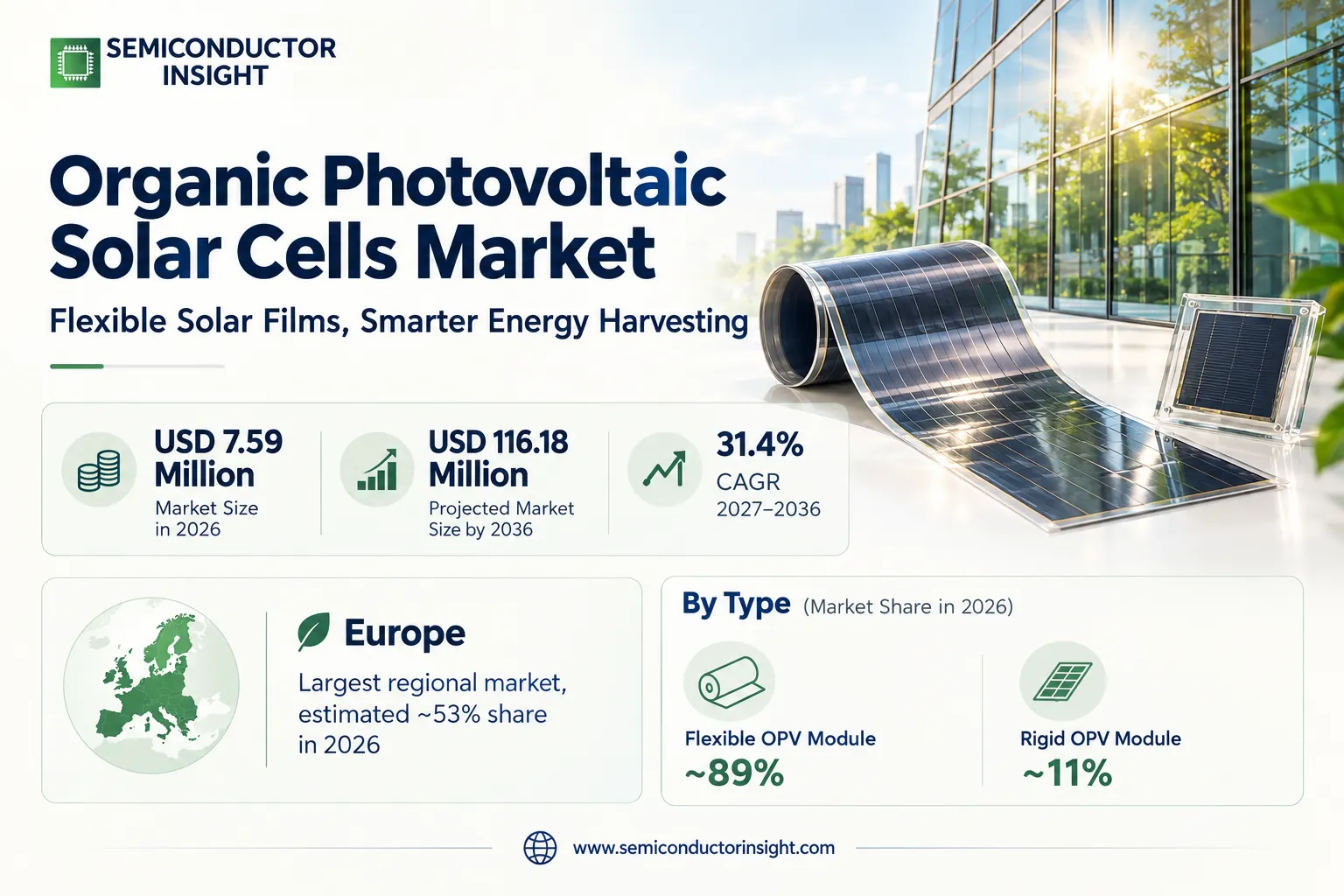
- Small but expanding base: Organic photovoltaic cell and module sales reach USD 7.59 million in 2026 and USD 116.18 million in 2036, with a 31.4% annual growth trajectory. Early commercial façades, indoor-light harvesters and pilot transparent glazing all contribute to this narrowly defined component market.
- Flexible-module lead: Flexible OPV Module represents an estimated ~89% of 2026 revenue because low-weight films can be bonded to façades, curved surfaces and electronics housings without the structural load of conventional glass solar panels.
- Rigid pilot segment: Rigid OPV Module contributes an estimated ~11%, reflecting coated glass, laminated transparent windows and demonstration assemblies that must still demonstrate production consistency, durability and certification at architectural dimensions.
- Application structure: BIPV contributes an estimated ~53% of demand, IoT ~22%, Transportation & Mobility ~14% and Consumer & Portable Power ~11%; low-light electronics offer different unit economics from exposed building envelopes.
- Regional concentration: Europe holds an estimated ~53% share in 2026, ahead of South America at ~27% and Asia-Pacific at ~14%; installed European façade references and South American specialty deployments influence this starting allocation.
- Demonstrated installations: Heliatek reported a 330 m², 22 kWp installation at the BMW Dingolfing plant in February 2026, while NEXT installed six transparent 40-by-60-inch OPV windows at its California headquarters in July 2025.
- Indoor power commercialization: Epishine printed cells have entered remote-control supply chains, and Dracula Technologies introduced a LAYER V2.0 design with a stated 30% performance gain in January 2026; neither fact should be equated with sales of finished consumer electronics.
- Qualification priorities: Water-vapor barriers, long-term output, mounting compatibility, low-light spectral response and manufacturing yield determine whether laboratory or pilot OPV advances become recurring 2027–2036 module purchase orders.
Organic Photovoltaic Solar Cells Market Overview
Organic photovoltaic solar cells market is valued at USD 7.59 million in 2026 and is projected to reach USD 116.18 million by 2036, equivalent to a 31.4% CAGR over the 2027–2036 outlook. Europe accounts for an estimated ~53% of 2026 revenue, reflecting a concentration of lightweight façade deployments and printed indoor-light harvesting specialists.
Organic photovoltaic cells use carbon-based light-absorbing semiconductors deposited as thin films between electrodes, converting illumination into electrical power without relying on crystalline silicon absorbers. Printing and coating methods allow low-temperature processing on flexible substrates, enabling modules that can follow building contours or fit behind an indoor electronic enclosure. The commercial challenge is not simply demonstrating a cell under favorable light: a buyer needs dependable electrical output, mechanical attachment, encapsulation, and an installation route that survives the intended service life.
The revenue perimeter includes OPV cells, flexible solar films, coated glass OPV modules, and pilot or early commercial module shipments for building-integrated photovoltaics, portable products and indoor energy harvesting. Prototype and development-stage sales belong inside the product category where they are for OPV components. The perimeter excludes crystalline-silicon panels, perovskite photovoltaics, complete buildings, architectural construction contracts, batteries, sensor electronics and entire consumer products. A 22 kWp façade installation demonstrates module use but the full building project value is not OPV module revenue.
Field references increasingly separate OPV from purely academic performance claims. In February 2026, Heliatek described 414 HeliaSol films covering 330 square metres of three towers at the BMW Dingolfing facility, providing about 22 kWp of capacity. The project is relevant because lightweight films could be bonded directly to concrete surfaces that would be challenging for heavy conventional panels. Such projects also create operating data on adhesion, electrical output and maintenance, helping procurement teams evaluate repeated installations rather than isolated samples.
Indoor photovoltaic cells address a different power budget. Epishine manufactures roll-to-roll printed organic cells intended to harvest ambient indoor light for devices such as remote controls, labels and sensors. Linköping University reported in April 2026 that its spin-out’s technology would be used in Google TV remote controls, illustrating a path from university research into OEM component procurement. Dracula Technologies separately introduced a new printed LAYER V2.0 product generation for low-light devices. These developments support component demand, not the entire downstream value of a television or building-management network.
The market remains exposed to qualification risk despite the attractive range of surfaces it can address. Transparent glazing requires acceptable visible-light appearance and edge sealing; outdoor flexible films need moisture resistance, fire-safety documentation and repeatable mounting; indoor cells must work under the actual spectrum and duty cycle of LED lighting. Customers consequently evaluate energy yield per usable area, installation labor and lifetime service cost together. The distinction between pilot capacity and contracted serial output will remain central to commercial scaling through 2036.
Segment Analysis: By Type
Flexible OPV Module leads with an estimated ~89% of 2026 value, reflecting lightweight films that suit façades and miniature indoor harvesting. Rigid OPV Module accounts for ~11%, including transparent coated glazing and other pilot assemblies. These classifications describe the delivered OPV cell or module construction, not whether the customer installs the component on a building, vehicle or electronic device.
| Type | Function | Market position |
|---|---|---|
| Flexible OPV Module | Flexible OPV Module uses printed films on thin polymer substrates and supports HeliaSol façades, ASCA flexible strips and Epishine indoor cells. For the 89% modeled 2026 share, the engineering advantage comes from matching an organic absorber and electrode stack to the host surface while limiting handling damage. Flexible OPV Module product suppliers must prove stable electrical connections, realistic energy yield and protective barriers before recurring purchases become attractive. | Estimated ~89% of 2026 revenue. Flexible OPV Module buyers consider roll-to-roll deposition, lamination and bend tolerance, and compare module price against assembly labor and expected lifetime. A Flexible OPV Module cell with excellent laboratory conversion efficiency may still be unsuitable if the substrate fails during installation or if sealing changes its optical appearance. The Flexible OPV Module segment is therefore defined by deliverable OPV components rather than a downstream installed-system invoice. |
| Rigid OPV Module | Rigid OPV Module uses organic coatings on dimensionally stable glazing or panels and supports NEXT transparent 40-by-60-inch window demonstrations. For the 11% modeled 2026 share, the engineering advantage comes from matching an organic absorber and electrode stack to the host surface while limiting handling damage. Rigid OPV Module product suppliers must prove stable electrical connections, realistic energy yield and protective barriers before recurring purchases become attractive. | Estimated ~11% of 2026 revenue. Rigid OPV Module buyers consider glass lamination, optical uniformity and edge-seal durability, and compare module price against assembly labor and expected lifetime. A Rigid OPV Module cell with excellent laboratory conversion efficiency may still be unsuitable if the substrate fails during installation or if sealing changes its optical appearance. The Rigid OPV Module segment is therefore defined by deliverable OPV components rather than a downstream installed-system invoice. |
Flexible OPV Module: outdoor film and indoor harvesting
Thin organic films can be attached to lightweight architectural surfaces without steel mounting racks, while indoor cells can be cut into compact forms for wireless controls. Heliatek and ASCA address outdoor integration; Epishine and Dracula Technologies target small devices with different irradiance and duty-cycle requirements. The shared technology class does not imply identical efficiency or durability tests. Procurement teams distinguish outdoor IEC-related safety and weathering requirements from indoor light-spectrum characterization and standby-power budgets.
The modeled ~89% flexible share includes early deployment and development shipments, rather than an assumption that every installed photovoltaic panel is organic. In outdoor BIPV, the key benefit is a surface previously unsuitable for conventional modules; indoors, avoiding periodic battery changes may justify a premium for a small cell. Converting these use cases into 2036 revenue depends on installation quality, energy-harvesting electronics and credible component availability.
Rigid OPV Module: transparent glazing and specialist laminates
Rigid organic photovoltaic modules are often associated with coated glass, transparent building envelopes and pilot window formats. NEXT Energy Technologies described 40-by-60-inch laminated transparent OPV windows in February 2025 and a six-window installation in July of that year. The commercial question is whether the organic coating, glazing stack and frame can satisfy architectural requirements while preserving useful visible-light transmission. Such demonstrations establish feasibility without proving mass production.
At an estimated ~11% of 2026 revenue, rigid OPV remains a smaller route than flexible films because full-size glazing adds handling, inspection and certification burdens. Its addressable value is the OPV-coated module or component, not the labor or architectural value of an entire façade. As coating throughput and installation references accumulate, glass manufacturers may become important commercialization partners; pilot shipments must still be distinguished from repeatable high-volume purchase orders.
Segment Analysis: By Application
BIPV is the largest modeled application with ~53% of 2026 OPV component revenue. IoT follows at ~22%, Transportation & Mobility at ~14%, and Consumer & Portable Power at ~11%. The application distinction matters because a building surface receives outdoor irradiance and faces decades of exposure, whereas an indoor remote control can generate useful energy from room lighting despite having a tiny module area.
| Application | Demand characteristics |
|---|---|
| BIPV | Estimated ~53% of 2026 demand. OPV modules for BIPV address facade surfaces, roofs, transparent windows and retrofits. Their engineering requirements include load limits, fire and weathering qualification, building integration; procurement often begins with a limited pilot before a qualified design becomes a repeatable order. For BIPV, module energy yield must be compared with the power actually required by the host equipment, and the component value is separated from the finished system. |
| Transportation & Mobility | Estimated ~14% of 2026 demand. OPV modules for Transportation & Mobility address curved body panels, low-power mobility accessories and auxiliary surfaces. Their engineering requirements include vibration, exposure, adhesive fatigue and low available area; procurement often begins with a limited pilot before a qualified design becomes a repeatable order. For Transportation & Mobility, module energy yield must be compared with the power actually required by the host equipment, and the component value is separated from the finished system. |
| IoT | Estimated ~22% of 2026 demand. OPV modules for IoT address asset trackers, shelf labels, indoor sensors and remote controls. Their engineering requirements include LED spectrum, standby load, low-light start-up and component footprint; procurement often begins with a limited pilot before a qualified design becomes a repeatable order. For IoT, module energy yield must be compared with the power actually required by the host equipment, and the component value is separated from the finished system. |
| Consumer & Portable Power | Estimated ~11% of 2026 demand. OPV modules for Consumer & Portable Power address portable chargers, design objects and specialist consumer accessories. Their engineering requirements include handling durability, user charging patterns and enclosure design; procurement often begins with a limited pilot before a qualified design becomes a repeatable order. For Consumer & Portable Power, module energy yield must be compared with the power actually required by the host equipment, and the component value is separated from the finished system. |
Building-integrated OPV demand is influenced by surfaces that cannot carry the weight or appearance of conventional modules. Heliatek installations on concrete towers and industrial façades show how lightweight film can extend the range of usable building surfaces. NEXT Energy Technologies explores transparent glazing with an organic coating, a different architecture requiring optical and architectural validation. Both routes depend on installers and building owners accepting a documented performance and service proposition rather than choosing solely by nominal wattage.
Indoor IoT energy harvesting competes on maintenance avoidance rather than peak solar output. A low-power sensor, remote control or electronic label can require only intermittent energy, allowing a small organic cell to replenish storage from indoor light. Epishine’s Google TV remote-control application and Dracula Technologies’ LAYER development illustrate distinct supply pathways. The buyer must still validate lighting variability, sleep-mode consumption and any auxiliary storage components before replacing a disposable battery architecture.
Transportation and portable products introduce physical stresses that are less pronounced in a fixed indoor installation. A curved module may flex during assembly, see repeated thermal cycles or become shaded by ordinary use. OPV suppliers can address such niches where light weight and geometry outweigh absolute efficiency, but broad substitution for vehicle traction batteries or rooftop crystalline-silicon panels is not part of this market. The most credible opportunities are accessory-scale energy functions with a measurable component specification.
Regional Analysis
Europe is modeled at ~53% of 2026 OPV cell and module sales, followed by South America ~27%, Asia-Pacific ~14%, North America ~5% and Middle East & Africa ~1%. These allocations describe the narrow organic photovoltaic component category. They are not shares of global solar electricity generation, and they reflect the mixture of installed film projects, small device cells and pilot glazing rather than national crystalline-silicon deployment volumes.
Where do organic photovoltaic modules find different commercial pathways across the five regions?
Europe benefits from direct outdoor module manufacturing and indoor printed-cell commercialization, whereas South America has more project-specific lightweight installations. Asia-Pacific contributes electronics supply-chain capabilities and selective organic-film reference sites. North America is developing transparent coated glazing, and Middle East & Africa remains a small trial market where harsh outdoor conditions raise the qualification threshold. These distinct procurement patterns explain why a modeled share cannot be inferred from the total capacity of conventional photovoltaic farms.
Regional growth scenarios are Europe ~29.0%, South America ~30.0%, Asia-Pacific ~35.0%, North America ~37.0% and Middle East & Africa ~34.0% over 2026–2036. The faster percentage scenarios begin from smaller component-revenue bases and should not be read as claims that those regions will overtake Europe in absolute sales. Building approvals, printed-cell production capacity, local integrator competence and application-specific warranty requirements will determine the pace of realized orders.
| Region | Position | Growth outlook | Demand profile | What decides supplier selection |
|---|---|---|---|---|
| Europe | Estimated ~53% share in 2026. Europe occupies a position shaped by manufacturing, façade pilots and indoor-cell engineering. The Europe allocation is specific to organic photovoltaic cells and modules and excludes complete buildings or conventional silicon systems. Purchasing in Europe may change as 2027 demonstration projects become repeat supply agreements. For Europe, the technical decision concerning estimated ~53% share in 2026 also requires country-level product integration before a 2026 specification can support repeatable deliveries through 2036. A Europe contract linked to estimated ~53% share in 2026 must distinguish the qualified organic module from the price of a downstream installation or electronic system. | Modeled ~29.0% CAGR through 2036. The regional trajectory reflects long-term performance records and public-building approvals and the transition from pilot orders to application-specific contracts. A high percentage growth rate can arise from a small 2026 starting share of ~53% without implying a leading absolute revenue position in 2036. For Europe, the technical decision concerning modeled ~29.0% cagr through 2036 also requires engineering-led commercialization before a 2026 specification can support repeatable deliveries through 2036. A Europe contract linked to modeled ~29.0% cagr through 2036 must distinguish the qualified organic module from the price of a downstream installation or electronic system. | Europe demand is associated with manufacturing, façade pilots and indoor-cell engineering. In 2026 the Europe product mix spans thin flexible films and smaller organic cell assemblies, not entire installed energy systems. End users in Europe assess operating conditions, light exposure and integration costs before issuing 2027–2036 purchase commitments. For Europe, the technical decision concerning europe demand is associated with also requires module specifications before a 2026 specification can support repeatable deliveries through 2036. A Europe contract linked to europe demand is associated with must distinguish the qualified organic module from the price of a downstream installation or electronic system. | Supplier selection in Europe depends on long-term performance records and public-building approvals. Procurement teams active in Europe examine electrical output, attachment methods, storage conditions and warranty evidence for the particular deployment. The modeled ~53% regional share remains a component-market allocation rather than a count of solar projects or installed megawatts. For Europe, the technical decision concerning supplier selection in europe depends also requires documented qualification before a 2026 specification can support repeatable deliveries through 2036. A Europe contract linked to supplier selection in europe depends must distinguish the qualified organic module from the price of a downstream installation or electronic system. |
| South America | Estimated ~27% share in 2026. South America occupies a position shaped by specialty lightweight installation and imported module projects. The South America allocation is specific to organic photovoltaic cells and modules and excludes complete buildings or conventional silicon systems. Purchasing in South America may change as 2027 demonstration projects become repeat supply agreements. For South America, the technical decision concerning estimated ~27% share in 2026 also requires country-level product integration before a 2026 specification can support repeatable deliveries through 2036. A South America contract linked to estimated ~27% share in 2026 must distinguish the qualified organic module from the price of a downstream installation or electronic system. | Modeled ~30.0% CAGR through 2036. The regional trajectory reflects weathering validation and importer technical support and the transition from pilot orders to application-specific contracts. A high percentage growth rate can arise from a small 2026 starting share of ~27% without implying a leading absolute revenue position in 2036. For South America, the technical decision concerning modeled ~30.0% cagr through 2036 also requires engineering-led commercialization before a 2026 specification can support repeatable deliveries through 2036. A South America contract linked to modeled ~30.0% cagr through 2036 must distinguish the qualified organic module from the price of a downstream installation or electronic system. | South America demand is associated with specialty lightweight installation and imported module projects. In 2026 the South America product mix spans thin flexible films and smaller organic cell assemblies, not entire installed energy systems. End users in South America assess operating conditions, light exposure and integration costs before issuing 2027–2036 purchase commitments. For South America, the technical decision concerning south america demand is associated also requires module specifications before a 2026 specification can support repeatable deliveries through 2036. A South America contract linked to south america demand is associated must distinguish the qualified organic module from the price of a downstream installation or electronic system. | Supplier selection in South America depends on weathering validation and importer technical support. Procurement teams active in South America examine electrical output, attachment methods, storage conditions and warranty evidence for the particular deployment. The modeled ~27% regional share remains a component-market allocation rather than a count of solar projects or installed megawatts. For South America, the technical decision concerning supplier selection in south america also requires documented qualification before a 2026 specification can support repeatable deliveries through 2036. A South America contract linked to supplier selection in south america must distinguish the qualified organic module from the price of a downstream installation or electronic system. |
| Asia-Pacific | Estimated ~14% share in 2026. Asia-Pacific occupies a position shaped by electronics integration and emerging building-material channels. The Asia-Pacific allocation is specific to organic photovoltaic cells and modules and excludes complete buildings or conventional silicon systems. Purchasing in Asia-Pacific may change as 2027 demonstration projects become repeat supply agreements. For Asia-Pacific, the technical decision concerning estimated ~14% share in 2026 also requires country-level product integration before a 2026 specification can support repeatable deliveries through 2036. A Asia-Pacific contract linked to estimated ~14% share in 2026 must distinguish the qualified organic module from the price of a downstream installation or electronic system. | Modeled ~35.0% CAGR through 2036. The regional trajectory reflects qualification by electronics OEMs and regional installers and the transition from pilot orders to application-specific contracts. A high percentage growth rate can arise from a small 2026 starting share of ~14% without implying a leading absolute revenue position in 2036. For Asia-Pacific, the technical decision concerning modeled ~35.0% cagr through 2036 also requires engineering-led commercialization before a 2026 specification can support repeatable deliveries through 2036. A Asia-Pacific contract linked to modeled ~35.0% cagr through 2036 must distinguish the qualified organic module from the price of a downstream installation or electronic system. | Asia-Pacific demand is associated with electronics integration and emerging building-material channels. In 2026 the Asia-Pacific product mix spans thin flexible films and smaller organic cell assemblies, not entire installed energy systems. End users in Asia-Pacific assess operating conditions, light exposure and integration costs before issuing 2027–2036 purchase commitments. For Asia-Pacific, the technical decision concerning asia-pacific demand is associated with also requires module specifications before a 2026 specification can support repeatable deliveries through 2036. A Asia-Pacific contract linked to asia-pacific demand is associated with must distinguish the qualified organic module from the price of a downstream installation or electronic system. | Supplier selection in Asia-Pacific depends on qualification by electronics OEMs and regional installers. Procurement teams active in Asia-Pacific examine electrical output, attachment methods, storage conditions and warranty evidence for the particular deployment. The modeled ~14% regional share remains a component-market allocation rather than a count of solar projects or installed megawatts. For Asia-Pacific, the technical decision concerning supplier selection in asia-pacific depends also requires documented qualification before a 2026 specification can support repeatable deliveries through 2036. A Asia-Pacific contract linked to supplier selection in asia-pacific depends must distinguish the qualified organic module from the price of a downstream installation or electronic system. |
| North America | Estimated ~5% share in 2026. North America occupies a position shaped by transparent architectural glazing pilots and component design-in. The North America allocation is specific to organic photovoltaic cells and modules and excludes complete buildings or conventional silicon systems. Purchasing in North America may change as 2027 demonstration projects become repeat supply agreements. For North America, the technical decision concerning estimated ~5% share in 2026 also requires country-level product integration before a 2026 specification can support repeatable deliveries through 2036. A North America contract linked to estimated ~5% share in 2026 must distinguish the qualified organic module from the price of a downstream installation or electronic system. | Modeled ~37.0% CAGR through 2036. The regional trajectory reflects glazing certification and OEM component lifetime evidence and the transition from pilot orders to application-specific contracts. A high percentage growth rate can arise from a small 2026 starting share of ~5% without implying a leading absolute revenue position in 2036. For North America, the technical decision concerning modeled ~37.0% cagr through 2036 also requires engineering-led commercialization before a 2026 specification can support repeatable deliveries through 2036. A North America contract linked to modeled ~37.0% cagr through 2036 must distinguish the qualified organic module from the price of a downstream installation or electronic system. | North America demand is associated with transparent architectural glazing pilots and component design-in. In 2026 the North America product mix spans thin flexible films and smaller organic cell assemblies, not entire installed energy systems. End users in North America assess operating conditions, light exposure and integration costs before issuing 2027–2036 purchase commitments. For North America, the technical decision concerning north america demand is associated also requires module specifications before a 2026 specification can support repeatable deliveries through 2036. A North America contract linked to north america demand is associated must distinguish the qualified organic module from the price of a downstream installation or electronic system. | Supplier selection in North America depends on glazing certification and OEM component lifetime evidence. Procurement teams active in North America examine electrical output, attachment methods, storage conditions and warranty evidence for the particular deployment. The modeled ~5% regional share remains a component-market allocation rather than a count of solar projects or installed megawatts. For North America, the technical decision concerning supplier selection in north america also requires documented qualification before a 2026 specification can support repeatable deliveries through 2036. A North America contract linked to supplier selection in north america must distinguish the qualified organic module from the price of a downstream installation or electronic system. |
| Middle East & Africa | Estimated ~1% share in 2026. Middle East & Africa occupies a position shaped by early trials in exposed façades and autonomous sensors. The Middle East & Africa allocation is specific to organic photovoltaic cells and modules and excludes complete buildings or conventional silicon systems. Purchasing in Middle East & Africa may change as 2027 demonstration projects become repeat supply agreements. | Modeled ~34.0% CAGR through 2036. The regional trajectory reflects heat, ultraviolet exposure and installer qualification and the transition from pilot orders to application-specific contracts. A high percentage growth rate can arise from a small 2026 starting share of ~1% without implying a leading absolute revenue position in 2036. For Middle East & Africa, the technical decision concerning modeled ~34.0% cagr through 2036 also requires engineering-led commercialization before a 2026 specification can support repeatable deliveries through 2036. A Middle East & Africa contract linked to modeled ~34.0% cagr through 2036 must distinguish the qualified organic module from the price of a downstream installation or electronic system. | Middle East & Africa demand is associated with early trials in exposed façades and autonomous sensors. In 2026 the Middle East & Africa product mix spans thin flexible films and smaller organic cell assemblies, not entire installed energy systems. End users in Middle East & Africa assess operating conditions, light exposure and integration costs before issuing 2027–2036 purchase commitments. | Supplier selection in Middle East & Africa depends on heat, ultraviolet exposure and installer qualification. Procurement teams active in Middle East & Africa examine electrical output, attachment methods, storage conditions and warranty evidence for the particular deployment. The modeled ~1% regional share remains a component-market allocation rather than a count of solar projects or installed megawatts. |
Competitive Landscape: Organic Solar Films and Indoor Harvesters
Competition in organic photovoltaics involves multiple product routes rather than a single interchangeable module. Heliatek and ASCA emphasize flexible architectural films, Epishine and Dracula Technologies serve indoor energy-harvesting electronics, and NEXT Energy Technologies develops transparent coated glazing. These suppliers face different customer qualification cycles, power-output specifications and manufacturing constraints. Company participation in general solar research is not by itself proof of current OPV module sales.
Heliatek supplies lightweight HeliaSol films with publicly documented projects in Germany, Brazil, Japan and South Korea. A 330 m² BMW Dingolfing installation in February 2026 and a 70 m² chimney installation at Cologne Bonn Airport in September 2025 illustrate differentiated building surfaces. ASCA likewise markets organic film architectures for integration into façades, products and mobility surfaces. The supplier advantage lies in manufacturable form factors, installer relationships and validated lifetime behavior rather than a simple laboratory efficiency headline.
Epishine and Dracula Technologies focus on low-light power for embedded electronics. Epishine uses roll-to-roll printing and has disclosed a remote-control design-in connected to Google TV. Dracula Technologies described a 30% overall performance gain for LAYER V2.0 in January 2026, targeting smaller cell areas and battery-free sensing. Indoor modules are judged against the energy demand of a specific circuit, so supplier pricing and qualification differ from the square-metre economics of building films.
NEXT Energy Technologies is developing transparent organic photovoltaic coatings on laminated architectural glass. Its February 2025 pilot-line announcement described 40-by-60-inch formats, and a July 2025 installation placed six windows in a commercial façade. These milestones support the existence of a distinct rigid module development route but do not prove the same sales maturity as a standardized electronics cell. Architectural certification, glazing partners and uniform coating performance remain material commercialization requirements.
The broader roster also includes Sunew, OET, MORESCO, ChasingLight and Carbon Valley in published competitive discussions. Some entities may have historical products, research programs or uncertain current commercial capacity. They should not be ranked as current direct serial suppliers without contemporary product and shipment evidence. A useful competitive assessment therefore separates directly documented module manufacturers, emerging development platforms and adjacent materials specialists, rather than assigning unsupported numerical company market shares.
Tier structure
| Tier | Companies | Basis of competition |
|---|---|---|
| Direct architectural films | Heliatek; ASCA | Verified organic photovoltaic film technology, building installations and flexible-module offerings support this direct product grouping. Heliatek has project references including BMW Dingolfing and Cologne Bonn Airport; ASCA describes its flexible OPV architecture and integration applications. Competition is based on module durability, installation compatibility and a credible path from pilot to recurring supply. No unsupported revenue ranking is inferred from the tier label. |
| Direct indoor and glazing platforms | Epishine; Dracula Technologies; NEXT Energy Technologies | Epishine and Dracula Technologies document printed indoor organic photovoltaic components, while NEXT demonstrates coated glass for architectural integration. These firms sell or develop different OPV module formats with distinct qualification criteria and sales cycles. Their presence in the same market does not make indoor microcells and transparent façade windows functionally interchangeable or justify adding complete downstream device revenues. |
| Historical and adjacent ecosystem | Sunew; OET; MORESCO; ChasingLight; Carbon Valley | The wider industry includes firms associated with organic photovoltaic materials, historical modules or research and commercialization activity. Their precise 2026 product status and current shipment scale require company-level evidence before direct supplier tiering. Including these names as contextual participants avoids presenting unverified operations as established mass-production lines, while retaining visibility into alternative coatings and specialty organic semiconductor development. |
Key companies profiled
- Heliatek
- ASCA
- Epishine
- Dracula Technologies
- NEXT Energy Technologies
- Sunew (historical/contextual)
- OET (historical/contextual)
- MORESCO (materials/contextual)
- ChasingLight (research/contextual)
- Carbon Valley (research/contextual)
Manufacturing, Encapsulation and Field-Qualification Economics
Organic photovoltaic production combines light-absorbing organic semiconductor formulation, coating or printing, electrode patterning, barrier-film lamination and final electrical testing. Outdoor façade films, transparent glazing and indoor cells do not share one cost structure. A building film is sold with exposure and installation requirements; a tiny indoor cell is evaluated against component yield and circuit energy consumption. Manufacturing scale matters only after the chosen architecture produces repeatable specifications.
Roll-to-roll manufacturing offers a pathway to low-material-use production for flexible OPV, but coating thickness, registration and moisture barriers influence yield. Epishine describes a printed process suited to compact indoor cells, whereas Heliatek supplies outdoor films intended for large surfaces. A supplier cannot substitute a high laboratory efficiency result for evidence of stable module output after lamination and handling. Customer qualification should include representative operating illumination and mechanical conditions before a 2027–2036 serial commitment.
Transparent rigid modules add a separate architectural manufacturing chain. NEXT Energy Technologies demonstrated 40-by-60-inch laminated OPV glass in February 2025, then integrated six windows into a façade in July. These activities require coating uniformity, edge seals, interconnect routing, insulating-glass fabrication and compliance with building standards. The value of the organic photovoltaic component must be distinguished from the final glazing installation, because framing, labor and ancillary building materials are separate commercial products.
Outdoor lifetime and indoor energy budgets are distinct quality gates. Heliatek reported IEC 61215 and IEC 61730 certifications for its HeliaSol products, while indoor module suppliers emphasize power generation under LED light and battery-maintenance avoidance. Thermal cycling, ultraviolet exposure and moisture ingress affect outdoor films; illumination variability and device sleep current matter for indoor cells. Procurement teams should verify actual product certificates and test conditions rather than transferring one supplier’s qualification to an unrelated organic module architecture.
Market Dynamics: Adoption Drivers, Constraints and Opportunities
Growth reflects new revenue opportunities on surfaces and in devices that conventional photovoltaic modules serve poorly. Lightweight façade retrofits, printed indoor cells, transparent organic glazing, integration partnerships and improved coating throughput support expansion from a small 2026 base. Moisture sensitivity, lifetime uncertainty, efficiency competition and customer certification expenses temper the outlook. The impact model below allocates these forces across the 2027–2036 forecast period.
MARKET DRIVERS
Drivers Impact Analysis*
| Market Drivers | Impact Rank | CAGR Contribution (%) | 2027–2029 | 2030–2032 | 2033–2036 |
|---|---|---|---|---|---|
| Lightweight building-envelope retrofits | High | +12.00% | High | High | Medium |
| Battery-free indoor electronics design-ins | High | +9.50% | High | High | High |
| Transparent coated-glass integration | Medium-High | +6.40% | Medium | High | High |
| Printed-cell production and efficiency gains | Medium | +5.20% | High | Medium | Medium |
| Regional installer and OEM partnerships | Low-Medium | +3.80% | Medium | Medium | High |
| Others (portable and mobility niches) | Low | +1.50% | Low | Medium | Medium |
Building surfaces that cannot carry heavy modules
Industrial towers, façades and retrofit roofs may offer usable area without the structural reserve required for conventional glass modules. Heliatek’s February 2026 BMW Dingolfing installation demonstrates direct attachment of 414 films over 330 m² of concrete surface. For property owners, the commercial proposition is additional electricity generation without a major mounting frame. Suppliers benefit when installers standardize preparation, bonding and electrical routing across repeat projects.
Indoor electronics replacing routine battery service
Battery replacement becomes costly when a building or retail network contains thousands of sensors and labels. Epishine’s Google TV remote-control design-in and Dracula Technologies’ low-light printed cells show routes to ambient-energy harvesting. Organic components can be sized for a device that sleeps most of the time and transmits intermittently. A repeatable energy budget, rather than peak outdoor irradiance, determines whether the buyer approves an OPV component.
Architectural glass becomes an energy-harvesting surface
Transparent OPV coatings can provide an additional function to windows without replacing the underlying glazing architecture. NEXT Energy Technologies demonstrated six 40-by-60-inch organic-coated windows in a July 2025 installation. A commercial supplier must coordinate visible-light appearance, edge sealing, wiring and safety certification with established glass partners. The addressable revenue is the organic photovoltaic glazing component, not the entire office building or façade contract.
Printing improvements raise usable power per area
Dracula Technologies reported a 30% overall performance improvement for its January 2026 LAYER V2.0 platform, following a 15% power-efficiency improvement announced in March 2025. Higher output from the same printed area can help electronics makers reduce module footprint or support a more demanding sensing cycle. Manufacturing yield and consistent low-light response remain necessary before such gains translate into recurring component orders.
Distribution and installation channels broaden reach
Heliatek’s references in Brazil, Japan and South Korea demonstrate that specialty organic films can be deployed beyond a single European domestic market. Each region requires installation expertise, customer support and documentation appropriate to its climate and regulatory environment. Indoor cells instead depend on electronics design channels and contract manufacturers. Suppliers that build these distinct routes can reduce the gap between a technically successful pilot and a purchase order.
MARKET RESTRAINTS
Restraints Impact Analysis*
| Market Restraints | Impact Rank | CAGR Contribution (%) | 2027–2029 | 2030–2032 | 2033–2036 |
|---|---|---|---|---|---|
| Outdoor durability and encapsulation risk | High | -3.00% | High | High | Medium |
| Silicon and perovskite alternatives | Medium-High | -2.40% | High | Medium | Medium |
| Others (certification and small-batch unit costs) | Medium | -1.60% | High | High | Medium |
Barrier performance governs long-term field economics
Organic absorber stacks can degrade when oxygen, moisture, ultraviolet radiation or heat reaches sensitive layers. Outdoor films must maintain adhesion and electrical performance through seasonal cycling, while indoor cells face different but still measurable packaging requirements. A customer comparing an OPV retrofit with a proven silicon alternative will consider lifetime energy yield and warranty exposure. More robust barriers can raise manufacturing cost, reducing the initial price advantage of thin-film processing.
Alternative photovoltaics compete on established efficiency
Crystalline-silicon panels offer a mature installed base, high outdoor conversion efficiency and established procurement standards. Perovskite research offers another thin-film pathway but is a different semiconductor chemistry and is excluded from OPV revenue. Organic cells compete most credibly where weight, shape, transparency or indoor spectral response create a specific advantage. Suppliers must therefore avoid promising direct replacement of every rooftop panel or utility-scale solar installation.
Certification and small production runs constrain margins
A pilot coating line may demonstrate 40-by-60-inch transparent windows, but architectural customers need reproducible glazing and electrical-safety documentation before broad deployment. Flexible films similarly require mounting instructions and product-specific certificates. Early volumes can leave coating, inspection and engineering costs spread across few modules. Until repeatable orders support higher utilization, suppliers may face difficult pricing decisions even when customer interest is strong.
MARKET OPPORTUNITIES
Industrial façade projects with inaccessible surfaces
Large factories often have concrete towers, curved structures or roofs that are unsuitable for heavy photovoltaic panels. Lightweight organic films can use those surfaces if attachment and fire-safety requirements are met. The BMW Dingolfing project provides a documented 2026 example of this design space. Future revenue opportunities depend on turning bespoke installation knowledge into repeatable module specifications and a network of trained installers.
Battery-free retail and building sensing
Electronic shelf labels, remote controls and wireless environmental sensors can benefit from indoor organic cells when battery changes dominate service costs. Epishine and Dracula Technologies provide direct technology examples, but the customer must verify illumination under actual shelf, office or warehouse conditions. Component vendors can create recurring demand through approved OEM platforms, with revenue limited to the cell or module rather than the finished connected device.
Energy-generating transparent glass partnerships
Architects may prefer glazing that maintains a familiar appearance while harvesting some incident light. NEXT Energy Technologies’ 2025 pilot and façade installation indicate progress toward full-size transparent OPV glass. The next commercial step requires glazing partners, product certification and durable electrical interconnections. Even modest component volumes can be material to a small OPV market, but the economic boundary remains the photovoltaic-coated module.
Supply Chain, Integration and Procurement
The organic photovoltaic value chain begins with specialty absorber chemistry and conductive layers, continues through coating and encapsulation, and ends with module integration into a building envelope or electronic product. Suppliers must distinguish film manufacture from downstream installation and distinguish an indoor energy-harvesting cell from the complete sensor it powers. Procurement specifications vary widely because indoor LED illumination and outdoor sunlight create different operating environments.
Materials and inks. Organic semiconductors, transport layers, conductive electrodes and barrier materials are chosen together because a high-performing absorber can still fail commercially if its processing solvent or seal is incompatible with the target substrate. Epishine and Dracula Technologies demonstrate printed indoor approaches, while architectural films face more demanding weathering conditions. Buyers should request spectral response, stability and manufacturing-change documentation for the exact 2026 module rather than extrapolating from unrelated laboratory samples.
Printing and yield. Roll-to-roll film processing can create flexible photovoltaic cells with comparatively low material usage, but web handling, coating defects and electrode registration affect saleable yield. NEXT Energy Technologies has described slot-die coating for transparent glazing, which uses a different production flow from a small printed indoor cell. Commercial pricing depends on repeatability and production utilization, not merely on the nominal speed of a pilot coater.
Sealing and qualification. Encapsulation prevents moisture and oxygen from degrading organic photovoltaic layers, while interconnect design determines whether the module survives bending, lamination or field installation. A lightweight façade film must be evaluated for outdoor temperature and weathering; a remote-control cell must work under the intended indoor lighting spectrum. Each qualified design needs documented power output and replacement availability before an OEM or installer can confidently scale orders.
Installation and OEM procurement. Architectural channels purchase organic modules alongside glazing, wiring and installation services, while electronics OEMs buy printed cells for integration into battery-managed circuits. A supplier may need different distributors and technical teams for these two markets. Product quotations should separate OPV component value from construction labor, sensors, batteries or other finished-system items, preserving a consistent revenue boundary across the 2027–2036 forecast.
Recent Organic Photovoltaic Product and Deployment Developments
- 16 Apr 2026 Indoor OPV OEM integration
Linköping University described Epishine printed organic solar cells being integrated into Google TV remote controls, allowing indoor lighting to replace routine battery charging for many users. The announcement identifies a real consumer-device design-in and a path from academic technology to repeat component procurement. It does not provide a revenue figure for the OPV cells, so the entire retail value of the remote control is not attributed to this market. Source - 25 Feb 2026 Industrial façade installation
Heliatek reported the installation of HeliaSol films on three BMW Dingolfing plant towers in Germany, with about 330 m² of film area, 414 modules and 22 kWp of rated capacity. The films were applied directly to concrete surfaces and represent a practical lightweight BIPV use case. Commercial significance lies in deployment evidence, installation learning and future repeat module opportunities rather than in the automotive plant’s overall construction budget. Source - 05 Jan 2026 Printed indoor-cell upgrade
Dracula Technologies announced LAYER V2.0 for presentation at CES 2026, citing a 30% overall performance increase compared with its previous printed organic photovoltaic platform. The company positioned the technology for battery-free IoT and compact energy-harvesting modules under ambient light. The gain is a company-reported product improvement, not an independent forecast of total market efficiency or a disclosed volume-shipment contract. Source - 02 Sep 2025 Airport chimney solar films
Heliatek described 80 HeliaSol films installed on a 27-metre chimney at Cologne Bonn Airport, demonstrating the suitability of lightweight organic modules for an unconventional vertical surface. The company reference records about 70 m² and 4.4 kWp for the project. The installation adds field evidence on attachment and integration but does not imply that all airport energy systems use organic photovoltaic technology. Source - 23 Jul 2025 Transparent OPV façade pilot
NEXT Energy Technologies installed six transparent organic photovoltaic windows at its Santa Barbara headquarters, each measuring 40 by 60 inches and totaling roughly 100 square feet. The coated glass was incorporated into insulating-glass units and façade framing, demonstrating an architectural integration pathway. The event is a pilot commercialization milestone; broader revenue depends on certification, manufacturing scale and repeat customer procurement. Source - 06 Mar 2025 Indoor module efficiency update
Dracula Technologies announced an enhanced LAYER organic photovoltaic design with a stated 15% increase in power efficiency and new surface-finish options for connected devices. The improvement targeted smaller modules or greater power within the same footprint, potentially reducing the energy-harvesting component burden on an IoT product. Its commercial impact depends on device qualification and manufacturing yield, not on a claim that every sensor has adopted the design. Source - 12 Feb 2025 Large-format coated-glass pilot
NEXT Energy Technologies published details of its pilot-line upgrade to produce 40-by-60-inch transparent laminated organic photovoltaic windows using automated coating. The larger format addresses architectural glass dimensions and helps test optical uniformity and process repeatability. This was a manufacturing and commercialization milestone rather than proof of full-scale factory throughput or a binding multi-building procurement agreement. Source
REPORT SCOPE & SEGMENTATION
| Attribute | Details |
|---|---|
| Study Period | 2021–2036 |
| Base Year | 2026 |
| Estimated Year | 2027 |
| Forecast Period | 2027–2036 |
| 2026 Market Size | USD 7.59 million |
| 2027 Estimated Market Size | USD 9.97 million |
| 2036 Forecast Market Size | USD 116.18 million |
| CAGR (2027–2036) | 31.4% |
| Largest Region | Europe (~53% share in 2026) |
| Largest Type | Flexible OPV Module (~89% share in 2026) |
| Market Boundary | Organic photovoltaic cells and flexible or rigid OPV modules, including early commercial and pilot component shipments; excludes silicon/perovskite PV, full building installations and finished electronics. |
| By Type | Flexible OPV Module · Rigid OPV Module |
| By Application | BIPV · Transportation & Mobility · IoT · Consumer & Portable Power |
| By Region | Five estimated regions cover the 2026 OPV cell and module component market; downstream project value is excluded. EuropeGermany, France, Sweden South AmericaBrazil, Chile, Argentina Asia-PacificJapan, South Korea, China North AmericaUnited States, Canada, Mexico Middle East & AfricaUnited Arab Emirates, Saudi Arabia, South Africa |
| Key Companies Profiled | Heliatek, ASCA, Epishine, Dracula Technologies, NEXT Energy Technologies, Sunew (historical), OET (contextual), MORESCO (materials), ChasingLight (research), Carbon Valley (research) |
| Customization Scope | Country-level 2026–2036 organic photovoltaic cell and module demand, flexible versus rigid formats, indoor-light applications, project-level installation evidence, coating and encapsulation supply chains, and customer qualification requirements. |
Frequently Asked Questions
What is the organic photovoltaic solar cells market size in 2026?
The worldwide organic photovoltaic cell and module market is valued at USD 7.59 million in 2026, with a projected USD 116.18 million by 2036 and a 31.4% CAGR. This small product category includes flexible solar films, indoor printed energy-harvesting cells and rigid organic-coated modules. It excludes conventional silicon panels and the downstream value of buildings, remote controls or sensors containing an OPV component.
Which region leads organic photovoltaic sales?
Europe has the largest estimated 2026 share at ~53%, supported by German façade-film manufacturing and deployments alongside French and Swedish indoor organic-cell developers. South America accounts for ~27%, Asia-Pacific ~14%, North America ~5% and Middle East & Africa ~1%. These figures concern organic photovoltaic components rather than total solar electricity generation or crystalline-silicon module shipments.
Why are flexible organic modules more common than rigid designs?
Flexible OPV Module represents an estimated ~89% of 2026 revenue because thin films can be bonded to constrained surfaces and integrated into small electronic products. Rigid OPV Module holds ~11%, including coated architectural glass. Flexible formats have field references such as Heliatek installations, while rigid glazing must additionally satisfy large-area optical uniformity, lamination and building-code requirements.
Which applications purchase the most organic photovoltaic modules?
BIPV is the largest modeled application with ~53% of 2026 demand, followed by IoT ~22%, Transportation & Mobility ~14% and Consumer & Portable Power ~11%. Building buyers value low-weight surfaces and aesthetics; indoor electronics buyers value avoided battery maintenance. These applications have different light environments and qualification tests, so a single conversion-efficiency number cannot describe their commercial value.
Can organic photovoltaic cells operate under indoor LED light?
Yes, specially designed organic photovoltaic cells can harvest ambient indoor illumination, including LED lighting, to power low-duty electronic functions. Epishine has demonstrated a remote-control supply pathway and Dracula Technologies markets printed LAYER devices for indoor IoT. Actual suitability depends on room-light intensity, spectral distribution, device standby current, transmission schedule and any accompanying energy storage. For Can organic photovoltaic cells operate under indoor LED light?, the technical decision concerning yes, specially designed organic photovoltaic also requires specific component specifications and service evidence before a 2026 specification can support repeatable deliveries through 2036. A Can organic photovoltaic cells operate under indoor LED light? contract linked to yes, specially designed organic photovoltaic must distinguish the qualified organic module from the price of a downstream installation or electronic system.
Are transparent organic windows already in mass production?
Transparent organic photovoltaic glazing has reached meaningful pilot formats and installations, but public examples should not be described as proof of broad mass production. NEXT Energy Technologies announced 40-by-60-inch laminated pilot windows in February 2025 and installed six at its Santa Barbara headquarters in July. Further commercialization requires glass-fabrication partnerships, electrical certification and reproducible coating output.
How do organic cells differ from silicon and perovskite photovoltaics?
Organic photovoltaic devices use carbon-based semiconductor absorbers and often low-temperature printing or coating, enabling lightweight and flexible shapes. Crystalline silicon uses a different semiconductor and dominates conventional rooftop and utility markets. Perovskite photovoltaic devices have another absorber chemistry and are excluded from this market even when their modules are thin or flexible. Product classification follows the actual light-absorbing stack, not appearance alone.
What limits outdoor organic solar-film adoption?
Outdoor organic films must withstand oxygen and moisture ingress, ultraviolet exposure, temperature cycling, attachment stresses and installation handling. Building owners also require credible electrical-safety and fire-related documentation, warranties and measured lifetime energy yield. A film may be attractive on a façade unsuitable for heavy panels, but high installed-area potential does not automatically convert into repeat module orders without successful field qualification.
Which companies supply direct organic photovoltaic technology?
Heliatek and ASCA provide direct flexible-film technology, Epishine and Dracula Technologies document indoor printed organic energy harvesters, and NEXT Energy Technologies develops organic-coated transparent glass. Historical or research-linked names in wider industry rosters should not be assumed to operate large current module factories without contemporary evidence. Buyers should request product specifications and deployment references for the particular application.
What should buyers monitor through the 2036 forecast?
Purchasers should track qualified coating capacity, barrier-film reliability, module energy yield under the actual light spectrum, installer and OEM partnerships, and the transition from pilots to repeat orders. For building films, attachment and lifetime data are critical; for IoT cells, device power budgets and component footprints dominate. Maintaining a consistent module-only revenue boundary avoids overstating this emerging market.
Research Sources & Evidence Base

Get Sample Report PDF for Exclusive Insights
Report Sample Includes
- Table of Contents
- List of Tables & Figures
- Charts, Research Methodology, and more...
 Download Sample Report PDF