
Organic Photosensitive Drum Market Insights
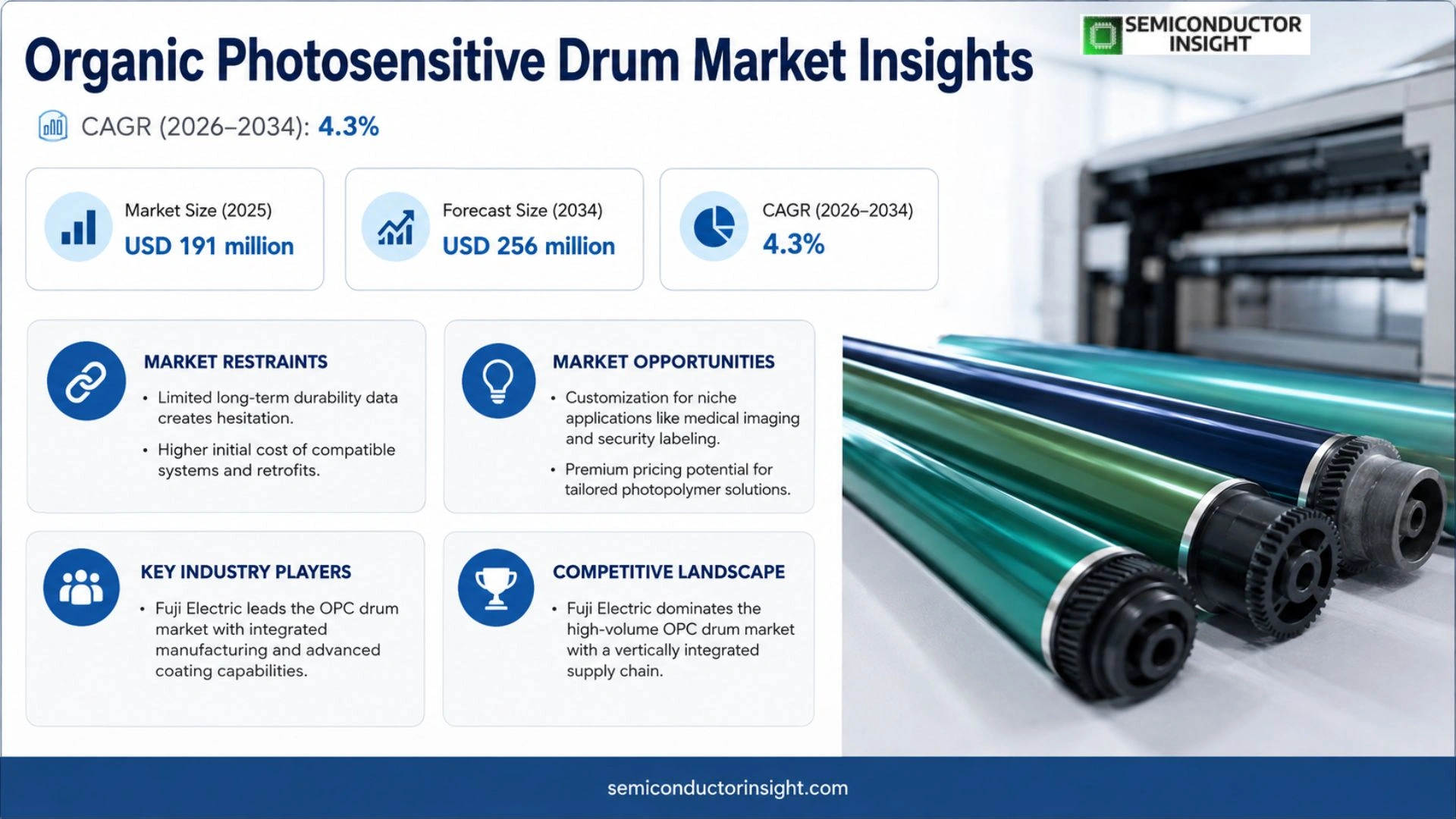
Organic Photosensitive Drum market was valued at USD 191 million in 2025. Forecasts indicate it will reach USD 256 million by 2034, reflecting a compound annual growth rate of approximately 4.3 percent over the forecast horizon.
Organic photoconductor drums, commonly referred to as OPC drums, serve as core components in electrostatic imaging systems such as laser printers and copiers. They employ organic photoconductive layers that generate an electrostatic latent image when exposed to light; this image then attracts toner particles which are transferred onto paper or other media.
The upward trajectory stems from sustained replacement demand for laser‑printer consumables, ongoing enhancements in drum sensitivity and lifespan, and increasing emphasis on environmentally friendly recycling processes. Upstream suppliers provide aluminum tubing, organic photoconductive resins and coating chemicals, while downstream users include printer manufacturers and commercial printing services. Leading manufacturers such as FUJI Electric, Mitsubishi and Kyocera continue expanding product portfolios through multi‑layer coating technologies and long‑life designs.
MARKET DRIVERS
Environmental Regulations Accelerate Adoption
Stringent emissions legislation across Europe and North America is compelling printer manufacturers to replace traditional metal‑based drums with organic alternatives. The shift reduces hazardous waste and aligns product lines with circular‑economy mandates, prompting OEMs to prioritize Organic Photosensitive Drum Market in their development pipelines.
Cost‑Effective Manufacturing Processes
Advances in roll‑to‑roll coating and photopolymer curing have lowered production overheads, allowing smaller batch runs without sacrificing yield. This economic advantage enables mid‑size printers to source organic drums competitively, broadening the market’s customer base beyond large‑scale facilities.
➤ Manufacturers that integrate organic drums now report up to a 12% reduction in total material costs while meeting compliance targets.
Supply‑chain resilience is another catalyst; organic formulations rely less on scarce rare‑earth metals, insulating producers from geopolitical disruptions that historically affected conventional drum availability.
MARKET CHALLENGES
Performance Consistency Under High‑Speed Operations
While organic drums excel in environmental metrics, maintaining uniform photosensitivity at line speeds above 120 m/min remains problematic. Variability in polymer cross‑link density can lead to uneven image transfer, forcing some high‑volume users to retain legacy equipment.
Other Challenges
Integration with Existing Printheads
Legacy printheads calibrated for metal drums often require firmware tweaks to accommodate the different charge‑discharge characteristics of organic surfaces, incurring additional engineering effort.
MARKET RESTRAINTS
Limited Long‑Term Durability Data
End‑users hesitate to fully transition because comprehensive lifespan studies spanning ten‑plus years are scarce. Without longitudinal performance records, procurement teams adopt a cautious stance, preferring incremental rollout over wholesale replacement.
Higher Initial Capital Expenditure
Although operating costs decline, the upfront investment for compatible printing platforms and retrofitting kits can exceed the budget thresholds of small‑scale printers, creating a financial barrier that tempers market momentum.
MARKET OPPORTUNITIES
Customization for Niche Applications
Specialty sectors such as medical imaging and security labeling demand bespoke drum sensitivities. Organic Photosensitive Drum Market is uniquely positioned to develop tailored photopolymers that meet stringent resolution and durability specifications, opening premium‑pricing avenues.
Strategic Partnerships with Component Suppliers
Forming alliances with adhesive and coating providers can accelerate co‑development cycles, delivering integrated drum assemblies that reduce installation time. Such collaborations are likely to attract OEMs seeking turnkey solutions for rapid market entry.
Organic Photosensitive Drum Market Trends
Replacement Cycle as Engine of Growth
The core driver of Organic Photosensitive Drum Market is the relentless need to replace consumable components in laser‑based imaging equipment. Unlike capital‑intensive printer shipments, the drum’s revenue stream derives from the average service life of each unit, typically ranging from 15 000 to 30 000 pages. As office fleets modernize and high‑volume commercial printers expand their output, the cumulative demand for new drums remains robust despite a modest slowdown in overall printer sales. Suppliers therefore prioritize extending the functional lifespan of each drum while preserving image fidelity, which translates into incremental pricing power and margin resilience. The current unit price of US $5.28, combined with an industry profit margin near 12 %, reflects a balance between material cost and the premium attached to reliability and resolution. Because the drum is a single‑use item, manufacturers can forecast demand with high granularity, aligning production capacity of roughly 45 million units against actual sales of about 39.5 million units annually. This surplus capacity provides a cushion for supply‑chain fluctuations while enabling rapid response to regional spikes in printer usage, such as in emerging markets where office automation is accelerating.
Other Trends
Upstream Material Innovation
Suppliers of aluminum tubing, organic photoconductive resins and functional coatings are channeling R&D spend into multi‑layer architectures that boost sensitivity without sacrificing wear resistance. The shift toward proprietary polymer blends reduces reliance on scarce metal powders, thereby lowering raw‑material exposure and supporting cost‑effective scaling. Precision machining advances and tighter tolerances further improve drum flatness, which directly benefits high‑resolution output required by graphic‑intensive applications. These upstream enhancements not only differentiate product portfolios but also feed downstream confidence, as end‑users report fewer repeat‑service calls and longer intervals between replacements.
Environmental and Lifecycle Management
Regulatory scrutiny over electronic waste has prompted manufacturers to embed recyclability into drum design. By adopting solvent‑free coating processes and incorporating recyclable aluminum substrates, producers can divert a larger share of end‑of‑life units from landfills. This environmental focus aligns with the purchasing criteria of large enterprises that increasingly mandate green procurement clauses. Companies that swiftly integrate closed‑loop recycling programs stand to capture ancillary revenue streams through material recovery, while also reinforcing brand reputation amid sustainability‑driven procurement policies. Consequently, the market is witnessing a gradual transition from pure cost competition to a value‑added model where environmental stewardship and lifecycle economics shape competitive advantage.
COMPETITIVE LANDSCAPE
Key Industry Players
Organic Photosensitive Drum Market – Competitive Landscape Overview
Fuji Electric dominates the high‑volume segment of the OPC drum market, leveraging its vertically integrated supply chain that spans aluminum tubing, organic photoconductive layers, and precision coating facilities. Its ability to combine scale with a reputation for reliability enables it to secure long‑term contracts with major OEMs of laser printers and copiers, which in turn sustains a steady flow of replacement sales. Mitsubishi Electric follows closely, differentiating through aggressive investment in multi‑layer coating technologies that extend drum life and lower consumable costs for end users. Both firms have built substantial R&D pipelines aimed at reducing material waste and meeting emerging environmental standards, positioning them as the benchmark for performance and sustainability in the sector.
Beyond the tier‑one manufacturers, a cadre of niche players contributes significant innovation pressure. Kyocera, GPI, and KR OPC focus on specialty drums for color‑high‑resolution devices, exploiting proprietary resin formulations that boost sensitivity. A&G Optoelectronics and HG Technologies target the aftermarket with cost‑effective solutions for mid‑range equipment, while Wellsure and Suzhou Goldengreen Technologies concentrate on regional distribution in Asia‑Pacific, capitalizing on local printer refurbishment cycles. Companies such as Zhuhai Tian Ying Technology, Hitec‑Imaging, and emerging Chinese firms are experimenting with bio‑based photoconductive compounds, a move that may reshape material sourcing if regulatory incentives intensify.
List of Key Organic Photosensitive Drum Companies Profiled
- Fuji Electric
- Mitsubishi Electric
- Kyocera Corp.
- GPI (Global Photoconductor Inc.)
- KR OPC
- A&G Optoelectronics
- HG Technologies
- Wellsure
- Suzhou Goldengreen Technologies
- Zhuhai Tian Ying Technology
- Hitec‑Imaging
- Canon Inc.
Segment Analysis:
| Segment Category | Sub-Segments | Key Insights |
| By Type |
|
Integrated Drum and Toner Type
|
| By Application |
|
Commercial
|
| By End User |
|
Enterprise Copiers
|
| By Performance |
|
Long Lifespan
|
| By Sustainability |
|
Eco‑friendly Materials
|
Regional Analysis: Organic Photosensitive Drum Market
North America
Federal and state agencies have tightened thresholds for volatile organic compounds, compelling manufacturers to certify that their organic photosensitive drums meet new benchmarks. Certification pathways are becoming more collaborative, with industry consortia supplying pre‑validated test data that accelerate market entry while preserving compliance integrity.
Logistics hubs along the Great Lakes and Gulf Coast have been optimized for just‑in‑time delivery of high‑purity resins, reducing buffer stock requirements. This agility helps manufacturers offset occasional raw‑material shortages without inflating end‑user prices.
Digital printing presses equipped with organic drum systems are gaining traction in commercial graphics houses that prioritize low‑waste workflows. Early adopters report improved line‑time stability, which translates into higher throughput and reduced scrap rates.
Brands targeting eco‑conscious audiences increasingly request proof runs on substrates printed with organic drums, viewing the process as a differentiator that aligns product packaging with green messaging.
Europe
European manufacturers are capitalizing on a fragmented regulatory environment that still permits localized experimentation with bio‑based photoactive layers. Countries such as Germany and the Netherlands have fostered cluster initiatives linking universities, chemical firms, and printer integrators, accelerating knowledge transfer. While the overall market size lags behind North America, the pace of collaborative innovation creates a fertile ground for niche players seeking to differentiate through bespoke drum chemistries. Market observers note that cross‑border trade agreements within the EU simplify component sourcing, allowing European firms to compete on cost without compromising environmental claims.
Asia‑Pacific
In Asia‑Pacific, rapid expansion of e‑commerce fulfillment centers drives demand for high‑speed, low‑maintenance printing solutions, positioning organic drums as an attractive alternative to traditional coated variants. Chinese and Indian suppliers are scaling up production of precursor polymers, yet face challenges in meeting the purity levels demanded by premium market segments. Collaborative ventures between regional chemical producers and multinational printer brands aim to bridge this gap, suggesting a gradual convergence toward higher quality standards. Consumer awareness of sustainability is emerging, particularly in Japan and South Korea, where premium packaging often incorporates green printing credentials.
South America
South American markets are influenced heavily by fiscal incentives tied to green manufacturing. Brazil’s tax rebates for low‑emission printing equipment have spurred modest investments in organic drum technology, though infrastructure constraints limit widespread rollout. Local printers prioritize cost‑effectiveness, so organic drums must demonstrate a clear lifecycle cost advantage to achieve broader acceptance. Nonetheless, growing environmental regulations in Argentina and Chile hint at an upcoming shift toward stricter compliance, which could catalyze demand for cleaner drum solutions.
Middle East & Africa
The Middle East & Africa region presents a paradox of high capital availability alongside nascent sustainability frameworks. United Arab Emirates firms are piloting organic drum installations in specialty printing facilities that serve luxury goods sectors, leveraging the region’s reputation for high‑quality output. In Africa, South Africa’s emerging print industry is cautiously evaluating organic drums, weighing upfront material costs against potential reductions in hazardous waste handling expenses. As regional governments begin to articulate environmental targets, Organic Photosensitive Drum Market may experience incremental uptake driven by regulatory alignment and corporate social responsibility initiatives.
Report Scope
This market research report provides a comprehensive analysis of the Organic Photosensitive Drum Market , covering the forecast period 2026–2034. It offers detailed insights into market dynamics, technological advancements, competitive landscape, and key trends shaping the industry.
Key focus areas of the report include:
- Market Overview: The report begins with an overview outlining its current market scenario, key growth indicators, and industry transformation drivers. It discusses macroeconomic factors, demand–supply balance, regulatory landscape, and the strategic role of semiconductors in powering advancements across industries such as automotive, telecommunications, consumer electronics, and industrial automation.
- Market Size & Forecast: Historical data and future projections for revenue, unit shipments, and market value across major regions and segments.
- Segmentation Analysis: Detailed breakdown by product type, technology, application, and end-user industry to identify high-growth segments and investment opportunities.
- Regional Insights: Insights into market performance across North America, Europe, Asia-Pacific, Latin America, and the Middle East & Africa, including country-level analysis where relevant.
- Competitive Landscape: Profiles of leading market participants, including their product offerings, R&D focus, manufacturing capacity, pricing strategies, and recent developments such as mergers, acquisitions, and partnerships.
- Technology Trends & Innovation: Assessment of emerging technologies, integration of AI/IoT, semiconductor design trends, fabrication techniques, and evolving industry standards.
- Market Drivers & Restraints: Evaluation of factors driving market growth along with challenges, supply chain constraints, regulatory issues, and market-entry barriers.
- Stakeholder Insights: Insights for component suppliers, OEMs, system integrators, investors, and policymakers regarding the evolving ecosystem and strategic opportunities.
Primary and secondary research methods are employed, including interviews with industry experts, data from verified sources, and real-time market intelligence to ensure the accuracy and reliability of the insights presented.
FREQUENTLY ASKED QUESTIONS:
What is the current market size of Organic Photosensitive Drum Market?
-> Organic Photosensitive Drum market forecasts indicate it will reach USD 256 million by 2034, reflecting a compound annual growth rate of approximately 4.3
Which key companies operate in Organic Photosensitive Drum Market?
-> Key players include FUJI Electric, Mitsubishi, Kyocera, GPI, KR OPC, A&G Optoelectronics, HG Technologies, Wellsure, Suzhou Goldengreen Technologies, Zhuhal Tian Ying Technology, and Hitec-Imaging, among others.
What are the key growth drivers?
-> Key growth drivers include rising demand for laser printers and copiers, continual replacement cycles for consumables, performance upgrades such as higher sensitivity and longer lifespan, and a strong industry focus on green recycling and environmentally friendly materials.
Which region dominates the market?
-> Asia-Pacific is the dominant region, driven by large-scale adoption of electrostatic imaging equipment and robust manufacturing ecosystems, while Europe and North America also show significant activity.
What are the emerging trends?
-> Emerging trends include development of multi‑layer functional coatings, long‑life drum designs, higher resolution capabilities, stronger wear resistance, and the shift toward greener, recyclable material systems.

Get Sample Report PDF for Exclusive Insights
Report Sample Includes
- Table of Contents
- List of Tables & Figures
- Charts, Research Methodology, and more...
 Download Sample Report PDF
