Polymer Dielectrics Market Insights
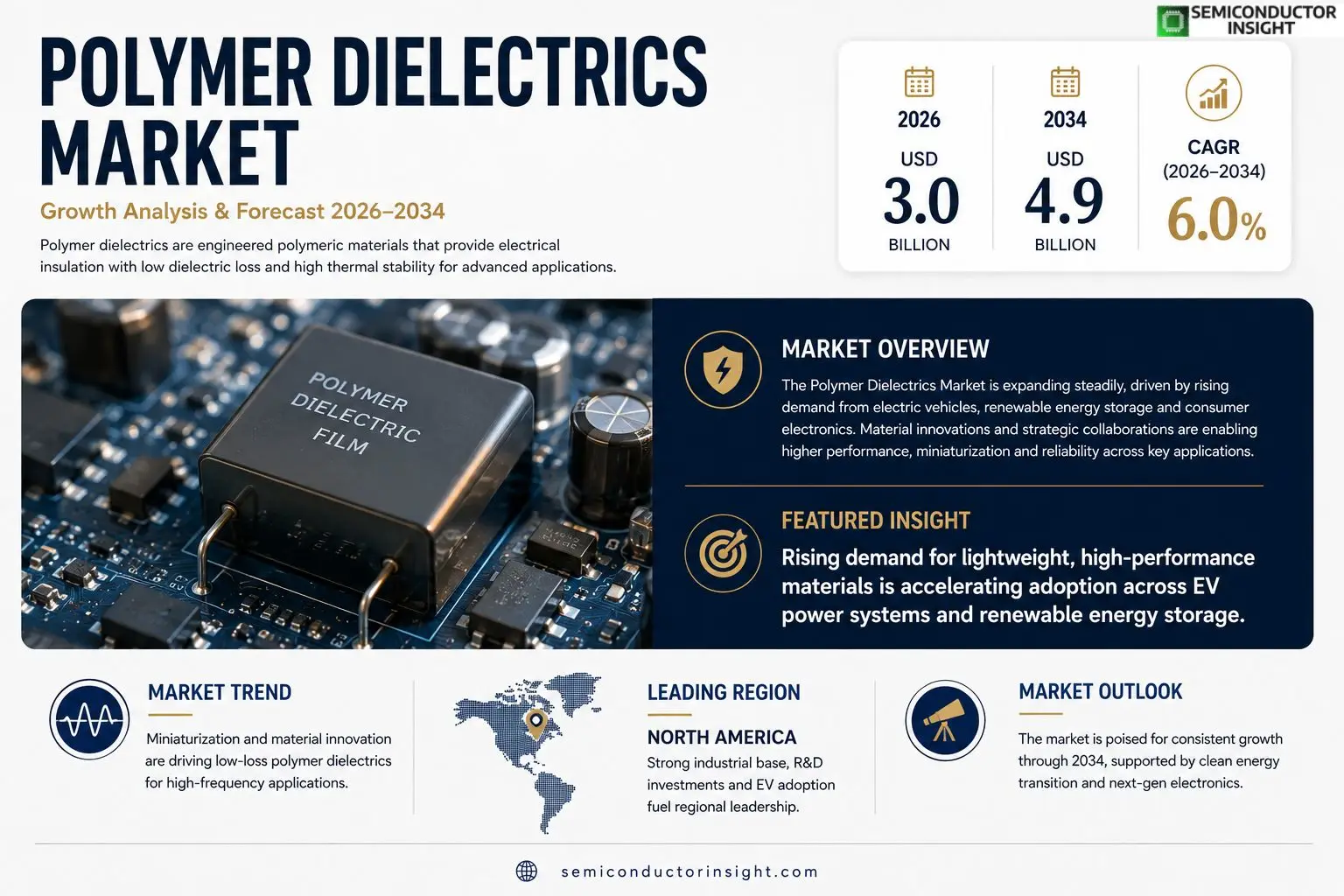
polymer dielectrics market size was valued at USD 2.8 billion in 2025. The market is projected to grow from USD 3.0 billion in 2025 to USD 4.9 billion by 2034, exhibiting a CAGR of 6 % during the forecast period.
Polymer dielectrics are engineered polymeric materials that provide electrical insulation while offering low dielectric loss and high thermal stability; they are essential components in capacitors, power modules, and high‑frequency communication devices.The market is accelerating because electric‑vehicle adoption and renewable‑energy storage require higher‑performance insulation, while miniaturization of consumer electronics drives material innovation; leading companies such as DuPont, Rogers Corporation and Mitsubishi Chemical are expanding their portfolios through advanced formulations and strategic collaborations.
MARKET DRIVERS
Increasing Demand for Lightweight Electronics
Polymer Dielectrics Market is being propelled by the rapid growth of portable and wearable electronic devices, which require dielectric materials that combine low weight with high insulation performance. Manufacturers are prioritising polymers that enable thinner form‑factors while maintaining reliability.
Advancements in Renewable Energy Technologies
Renewable energy applications, such as high‑efficiency solar inverters and offshore wind converters, are driving the need for polymer dielectrics that offer superior heat resistance and low loss characteristics. These technical requirements support steady adoption across the sector.
➤ Flexible polymer dielectric films are now being integrated into next‑generation power modules, extending operational lifetimes by up to 20%.
Overall, the convergence of miniaturisation trends and clean‑energy initiatives creates a robust growth platform for the industry.
MARKET CHALLENGES
Stringent Reliability Standards
Achieving the high reliability demanded by automotive and aerospace sectors remains a major obstacle for Polymer Dielectrics Market. Certification processes are lengthy, and failure to meet endurance criteria can delay product launches.
Other Challenges
Cost Competitiveness
While polymer solutions offer performance benefits, their production costs can exceed those of traditional ceramic dielectrics, making price sensitivity a critical factor for mass‑market adoption.
MARKET RESTRAINTS
Limited Availability of High‑Purity Monomers
The supply chain for ultra‑pure monomers, essential for low‑loss polymer dielectrics, is constrained by limited production capacity. This bottleneck can increase lead times and affect the scalability of Polymer Dielectrics Market.
Regulatory Hurdles in Emerging Regions
In several emerging economies, evolving safety and environmental regulations create uncertainty for manufacturers seeking to expand operations, thereby restraining market penetration.
MARKET OPPORTUNITIES
Growth in 5G Infrastructure
The rollout of 5G networks demands high‑frequency components with low dielectric loss. Polymer dielectrics that can operate efficiently at mm‑wave frequencies present a sizeable opportunity for Polymer Dielectrics Market.
Emergence of Electric Vehicle Power Systems
Electric vehicles rely on compact power converters where polymer dielectric films can reduce weight and improve thermal management. This application segment is projected to become a primary growth engine in the coming years.
Polymer Dielectrics Market Trends
Growth Accelerated by EV Adoption and Renewable Energy Storage
Polymer Dielectrics Market is experiencing a pronounced upswing as electric‑vehicle (EV) deployment expands and renewable‑energy storage systems demand higher‑performance insulation. These applications require polymer dielectrics that combine low dielectric loss with robust thermal stability, enabling reliable operation under elevated voltage and temperature conditions. Simultaneously, the push toward smaller, more power‑dense consumer electronics is driving material scientists to develop formulations that support component miniaturization without compromising electrical integrity. This dual pressurefrom large‑scale energy infrastructure and compact electronic devicescreates a broad-based catalyst for market expansion, reinforcing the strategic importance of polymer dielectrics across multiple technology sectors.
Other Trends
Material Innovation for Miniaturization
Advances in polymer chemistry are delivering dielectrics with enhanced permittivity and reduced loss tangent, which are critical for the next generation of high‑frequency communication modules and advanced capacitors. Researchers are integrating nanofillers and copolymer blends to achieve a balance between mechanical flexibility and dielectric strength, thereby supporting the trend toward thinner, lighter devices. These innovations also improve long‑term reliability in harsh operating environments, a key consideration for automotive power modules and grid‑level energy storage. The focus on material innovation reflects the market’s response to the need for higher energy density while maintaining safety and performance standards.
Competitive Landscape and Portfolio Expansion
Leading players such as DuPont, Rogers Corporation, and Mitsubishi Chemical are actively broadening their product portfolios through advanced formulation development and strategic collaborations. By leveraging proprietary polymer chemistries, these companies are delivering differentiated dielectric solutions that address specific industry challenges, from high‑voltage EV power electronics to ultra‑compact wearable devices. The competitive environment encourages continual R&D investment, fostering a pipeline of next‑generation dielectric materials. As Polymer Dielectrics Market matures, the emphasis on collaborative innovation and targeted product launches is expected to sustain momentum and reinforce the sector’s critical role in emerging energy and electronics technologies.
COMPETITIVE LANDSCAPEKey Industry Players
Polymer Dielectrics Market Competitive Overview
Polymer Dielectrics Market, valued at USD 2.8 billion in 2025 and projected to reach USD 4.9 billion by 2034, is dominated by a few large innovators that shape supply chains and technology roadmaps. DuPont leads the segment with its high‑performance Kapton and CYTOP families, leveraging extensive R&D to target electric‑vehicle power modules and high‑frequency communication devices. Rogers Corporation follows closely, offering ceramic‑filled polymer laminates such as RO3035 that combine low dielectric loss with superior thermal stability. Mitsubishi Chemical complements the tier‑one cohort through its Elium™ and super‑high‑temperature polyimide platforms, which are gaining traction in renewable‑energy storage and aerospace applications. These three firms command the bulk of volume, benefit from strategic collaborations with OEMs, and routinely file patents that set industry standards. Their scale enables aggressive pricing, while their integrated manufacturing footprints support rapid qualification for emerging EV and 5G projects. North America and Asia‑Pacific dominate shipments, but emerging demand in Europe is driving localized production investments.Beyond the tier‑one cluster, a diverse set of specialty manufacturers reinforces market depth and fuels niche innovation. 3M supplies fluoropolymer films that cater to ultra‑low‑loss capacitor stacks, while SKC’s high‑temperature polyimide grades serve aerospace insulation needs. Sumitomo Bakelite and BASF provide chemically resistant resin systems for power‑module substrates. Hitachi Chemical (now part of Showa Denko) offers spin‑coated dielectric coatings for miniaturized consumer electronics. Toray Industries leverages its expertise in nanoporous polymers to improve energy‑density in electric‑vehicle batteries. Solvay’s high‑purity polypropylene dielectric blends address high‑voltage transmission line requirements. Honeywell and Westlake Chemical each contribute unique fluorinated polymers for harsh‑environment applications. Laird Performance Materials focuses on flexible polymer laminates for wearable devices, and Celgard supplies porous polymer membranes that enhance safety in lithium‑ion cells. These niche players also invest heavily in nanocomposite dielectrics and bio‑based polymer research, positioning them for long‑term relevance as sustainability criteria tighten.
List of Key Polymer Dielectrics Companies Profiled
- DuPont
- Rogers Corporation
- Mitsubishi Chemical
- 3M
- SKC
- Sumitomo Bakelite
- BASF
- Hitachi Chemical
- Toray Industries
- Solvay
- Honeywell
- Westlake Chemical
- Laird Performance Materials
- Celgard
Segment Analysis:
| Segment Category | Sub-Segments | Key Insights |
| By Type |
|
Thermoplastic Polymers
|
| By Application |
|
Capacitors
|
| By End User |
|
Automotive (Electric Vehicles)
|
| By Material Property |
|
Low Dielectric Loss
|
| By Performance Requirement |
|
High Voltage Insulation
|
Regional Analysis: North America
United States
The aerospace and defense sectors are major drivers for specialized polymer dielectrics, requiring materials with exceptional thermal stability and electrical insulation properties. Increasing demands for lighter, more efficient aircraft and advanced electronic systems fuel innovation in this application area.
The growing complexity of automotive electronic systems, including electric vehicles (EVs) and advanced driver-assistance systems (ADAS), creates a substantial need for high-performance polymer dielectrics. These materials play a crucial role in ensuring the reliability and efficiency of these systems.
The expansion of 5G networks and data centers necessitates advanced polymer dielectrics for high-frequency applications and efficient signal transmission. The demand for these materials is directly linked to the ongoing evolution of telecommunications infrastructure.
Various industrial applications, including power electronics and sensors, rely on polymer dielectrics for their insulating and dielectric properties. The increasing adoption of automation and IoT technologies is further driving demand in this segment.
Europe
Europe presents a dynamic and diversified market for Polymer Dielectrics, shaped by stringent regulatory standards and a strong emphasis on sustainability. The region’s automotive and aerospace industries are key consumers of these materials. A growing focus on energy efficiency and electric mobility is creating new opportunities for innovative polymer dielectrics. Furthermore, the presence of well-established chemical and materials manufacturers contributes to a robust supply chain. The European Polymer Dielectrics Market is characterized by a blend of mature applications and emerging technologies.
Asia-Pacific
Asia-Pacific is the fastest-growing region for Polymer Dielectrics, fueled by rapid industrialization and increasing electronics manufacturing activity. Countries like China, Japan, and South Korea are significant contributors to this growth. The strong demand from the electronics, automotive, and telecommunications sectors is driving market expansion. Government investments in infrastructure and technology further support this growth trajectory. The Asia-Pacific Polymer Dielectrics Market is poised for continued high growth in the coming years.
South America
South America represents a developing market for Polymer Dielectrics, with growth potential driven by expanding industrial sectors and increasing investment in infrastructure. The automotive and electronics industries are key application areas. While the market is relatively fragmented, there is a growing demand for high-performance polymer dielectrics to support modernization efforts.
Middle East & Africa
The Middle East & Africa region exhibits moderate growth potential for Polymer Dielectrics, driven by investments in infrastructure development and expanding industrial activities, particularly in the oil and gas and construction sectors. The increasing adoption of advanced technologies in these industries is creating new opportunities for polymer dielectric applications.
Report Scope
This market research report provides a comprehensive analysis of the Polymer Dielectrics Market , covering the forecast period 2026–2034. It offers detailed insights into market dynamics, technological advancements, competitive landscape, and key trends shaping the industry.
Key focus areas of the report include:
- Market Overview: The report begins with an overview outlining its current market scenario, key growth indicators, and industry transformation drivers. It discusses macroeconomic factors, demand–supply balance, regulatory landscape, and the strategic role of semiconductors in powering advancements across industries such as automotive, telecommunications, consumer electronics, and industrial automation.
- Market Size & Forecast: Historical data and future projections for revenue, unit shipments, and market value across major regions and segments.
- Segmentation Analysis: Detailed breakdown by product type, technology, application, and end-user industry to identify high-growth segments and investment opportunities.
- Regional Insights: Insights into market performance across North America, Europe, Asia-Pacific, Latin America, and the Middle East & Africa, including country-level analysis where relevant.
- Competitive Landscape: Profiles of leading market participants, including their product offerings, R&D focus, manufacturing capacity, pricing strategies, and recent developments such as mergers, acquisitions, and partnerships.
- Technology Trends & Innovation: Assessment of emerging technologies, integration of AI/IoT, semiconductor design trends, fabrication techniques, and evolving industry standards.
- Market Drivers & Restraints: Evaluation of factors driving market growth along with challenges, supply chain constraints, regulatory issues, and market-entry barriers.
- Stakeholder Insights: Insights for component suppliers, OEMs, system integrators, investors, and policymakers regarding the evolving ecosystem and strategic opportunities.
Primary and secondary research methods are employed, including interviews with industry experts, data from verified sources, and real-time market intelligence to ensure the accuracy and reliability of the insights presented.
FREQUENTLY ASKED QUESTIONS:
What is the current market size of Polymer Dielectrics Market?
-> Polymer Dielectrics Market was valued at USD 2.8 billion in 2025 and is expected to reach USD 4.9 billion by 2034.
Which key companies operate in Polymer Dielectrics Market?
-> Key players include DuPont, Rogers Corporation, Mitsubishi Chemical, among others.
What are the key growth drivers?
-> Key growth drivers include electric‑vehicle adoption, renewable‑energy storage demand, and miniaturization of consumer electronics.
Which region dominates the market?
-> Not specified in the provided data.
What are the emerging trends?
-> Emerging trends include development of higher‑performance insulation materials for EVs and renewable‑energy applications, and material innovations supporting device miniaturization.

Get Sample Report PDF for Exclusive Insights
Report Sample Includes
- Table of Contents
- List of Tables & Figures
- Charts, Research Methodology, and more...
 Download Sample Report PDF