Optically Transparent Antennas Market Insights
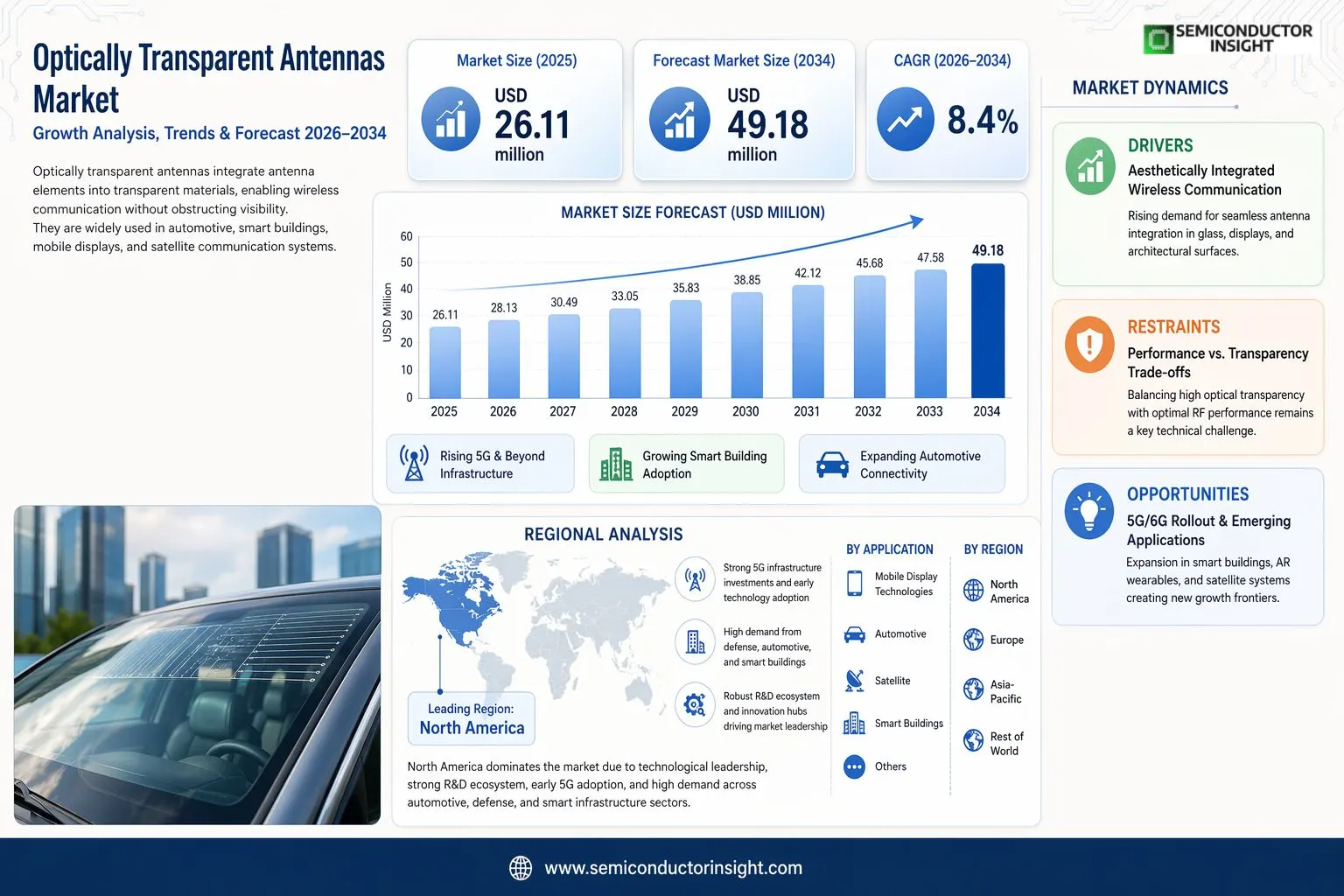
Global Optically Transparent Antennas market size was valued at USD 26.11 million in 2025. The market is projected to grow from USD 28.13 million in 2026 to USD 49.18 million by 2034, exhibiting a CAGR of 8.4% during the forecast period.
Optically Transparent Antennas are devices that incorporate antenna elements into transparent materials, such as glass, plastics, or thin films, allowing them to transmit visible light while simultaneously operating as antennas. These antennas are typically fabricated from materials that are both electrically conductive and sufficiently transparent to visible light, including indium tin oxide (ITO), graphene, and other transparent conductive oxides (TCOs), enabling seamless integration into surfaces without obstructing aesthetics or visibility.
The market is gaining significant momentum driven by the rapid expansion of smart building infrastructure, growing adoption of connected automotive technologies, and increasing demand for aesthetically integrated wireless communication solutions. Furthermore, the proliferation of 5G networks and satellite communication systems is creating new and substantial demand for optically transparent antenna technologies. Key industry participants such as Meta Materials Inc., CHASM Advanced Materials, ALCAN Systems, AGC, and Taoglas are actively advancing product portfolios and forging strategic partnerships to strengthen their market positions globally.
MARKET DRIVERS
Rising Demand for Aesthetically Integrated Wireless Communication Systems
Optically Transparent Antennas Market is experiencing robust growth driven by the increasing need for seamless integration of antenna systems into glass surfaces, displays, and architectural elements without compromising visual clarity. As 5G infrastructure deployment accelerates globally, network operators and device manufacturers are under growing pressure to embed high-frequency antennas into windows, automotive glass, and consumer electronics screens. Optically transparent antennas, fabricated using materials such as indium tin oxide (ITO), silver nanowires, and graphene-based conductors, offer a compelling solution by enabling RF transmission while maintaining optical transmittance levels above 80%. This dual functionality is emerging as a key differentiator in next-generation communication hardware design.
Expansion of Smart Glass and Automotive Connectivity Applications
The automotive sector represents one of the most significant demand drivers for Optically Transparent Antennas Market, as vehicle manufacturers increasingly integrate connected and autonomous driving technologies. Windshields and side windows embedded with transparent antenna structures support vehicle-to-everything (V2X) communication, satellite navigation, and in-vehicle wireless connectivity without the visual obstruction of conventional opaque antennas. Simultaneously, the smart building industry is adopting transparent antenna panels for IoT-enabled building management systems, where aesthetic preservation is a critical architectural requirement. The convergence of smart glass technology and wireless communication infrastructure is creating sustained demand momentum across these verticals.
➤ The integration of transparent antennas into 5G-enabled smart windows and automotive glazing systems is redefining the boundary between structural materials and functional communication hardware, positioning optically transparent antenna technology as a foundational element of next-generation connected infrastructure.
Consumer electronics manufacturers are also contributing to market growth by developing transparent antenna solutions for foldable displays, augmented reality (AR) headsets, and wearable devices where traditional antenna placement presents design and form-factor challenges. The miniaturization trend in electronics, combined with rising consumer expectations for bezel-less and full-screen device designs, is compelling R&D investment in high-performance transparent conductive materials. These trends collectively reinforce the commercial viability and long-term growth trajectory of Optically Transparent Antennas Market.
MARKET CHALLENGES
Performance Trade-offs Between Optical Transparency and RF Efficiency
One of the most persistent technical challenges confronting Optically Transparent Antennas Market is the inherent trade-off between achieving high optical transmittance and maintaining adequate radio frequency (RF) performance. Increasing the transparency of conductive layers typically reduces electrical conductivity, which directly impacts antenna gain, bandwidth, and radiation efficiency. Materials such as ITO, while widely used, exhibit sheet resistance values that are considerably higher than those of conventional metallic conductors, resulting in measurable losses at higher frequency bands including mmWave 5G. Researchers and engineers are actively investigating alternative transparent conductor materials, including metal mesh structures and carbon nanotube films, but achieving consistent performance at scale remains technically demanding and cost-intensive.
Other Challenges
Complex and Cost-Intensive Manufacturing Processes
The fabrication of optically transparent antennas requires precision deposition and patterning techniques such as magnetron sputtering, photolithography, and nanoimprint lithography, which are significantly more expensive than conventional antenna manufacturing. Scaling these processes from laboratory prototypes to high-volume commercial production while maintaining uniform optical and electrical properties across large substrate areas presents a substantial manufacturing challenge. The limited number of qualified suppliers for advanced transparent conductive materials further constrains supply chain flexibility and introduces procurement risks for antenna developers operating in competitive, cost-sensitive markets.
Environmental Durability and Long-Term Reliability Concerns
Transparent antenna structures deployed in outdoor architectural and automotive environments must withstand prolonged exposure to UV radiation, thermal cycling, humidity, and mechanical stress. Thin-film transparent conductors can experience degradation in both optical clarity and electrical conductivity over time under such conditions, raising concerns about long-term reliability and maintenance costs. Ensuring that transparent antenna systems meet the durability standards required for automotive OEM certification and building product warranties remains a significant barrier to broader commercial adoption across these high-value application segments.
MARKET RESTRAINTS
High Material and Production Costs Limiting Broad Market Penetration
Optically Transparent Antennas Market faces notable restraint from the elevated cost of key transparent conductive materials and the specialized fabrication infrastructure required for their production. Indium, a critical component of widely used ITO films, is a relatively scarce element with supply concentrated in a limited number of geographic regions, exposing manufacturers to price volatility and supply chain disruption risk. Alternative materials such as silver nanowires and graphene offer promising performance profiles but currently carry higher processing costs and face challenges in achieving the uniformity and reproducibility required for large-scale antenna production. Until material costs decline through economies of scale and process innovation, the addressable market for transparent antenna solutions will remain largely concentrated in premium-segment applications.
Standardization Gaps and Regulatory Complexity Across Application Verticals
The absence of unified industry standards governing the design, testing, and certification of transparent antenna systems across automotive, architectural, and consumer electronics applications represents a structural restraint on market growth. Each application domain operates under distinct regulatory frameworks — automotive glazing standards, building product certifications, and consumer device electromagnetic compatibility (EMC) requirements — creating fragmented compliance pathways that increase development time and cost for antenna manufacturers. The lack of standardized performance benchmarks also complicates procurement decisions for systems integrators and end-use customers, slowing adoption rates particularly in regulated industries where certification timelines can extend product launch schedules by twelve months or more. Addressing these standardization gaps will be essential for Optically Transparent Antennas Market to realize its full commercial potential.
MARKET OPPORTUNITIES
Accelerating 5G and Beyond-5G Deployment Creating New Design Imperatives
Global rollout of 5G networks and the early-stage development of 6G communication frameworks present substantial growth opportunities for Optically Transparent Antennas Market. As network densification requires antennas to be deployed across a broader range of urban surfaces — including building facades, retail storefronts, and transportation infrastructure — the demand for unobtrusive, visually transparent antenna solutions is expected to intensify considerably. Transparent antennas embedded in smart windows can serve as distributed 5G small cell nodes, enabling dense urban network coverage without compromising the visual character of architectural environments. This application scenario aligns with both regulatory objectives for accelerated 5G deployment and municipal preferences for aesthetically sensitive infrastructure integration.
Emerging Opportunities in Augmented Reality, Wearables, and Flexible Electronics
The rapid advancement of augmented reality (AR) and mixed reality (MR) devices is opening a significant new opportunity frontier for transparent antenna technology. AR headsets and smart glasses require compact, low-profile antenna systems that do not interfere with the optical path of the display or the wearer’s field of vision, making transparent antenna integration a technically preferred solution. Similarly, the growth of flexible and stretchable electronics is generating demand for conformal transparent antennas that can be incorporated into curved surfaces, textile substrates, and next-generation wearable health monitoring devices. Optically Transparent Antennas Market stands to benefit substantially from the expanding ecosystem of form-factor-constrained connected devices, where conventional antenna architectures are fundamentally incompatible with product design requirements. Strategic investment in materials innovation and flexible substrate processing will be key to capturing value in these emerging application segments.
Trends
Rising Demand for Seamless Connectivity Driving Optically Transparent Antennas Market
Optically Transparent Antennas Market is experiencing a notable shift as industries increasingly seek antenna solutions that do not compromise the aesthetic or functional integrity of surfaces. Transparent antennas, fabricated using conductive yet visually clear materials such as indium tin oxide (ITO), graphene, and other transparent conductive oxides (TCOs), are gaining traction across multiple end-use sectors. The convergence of wireless communication needs with design-sensitive applications — from automotive glazing to smart architectural glass — is emerging as one of the most influential trends shaping this market landscape.
Other Trends
Expansion in Smart Building and Automotive Applications
One of the most prominent trends in Optically Transparent Antennas Market is the accelerating integration of these antennas into smart buildings and automotive platforms. In smart buildings, transparent antennas embedded within window glass enable uninterrupted wireless connectivity without obstructing natural light or altering facade design. In the automotive sector, vehicle manufacturers are increasingly adopting optically transparent antenna systems within windshields and side windows to support advanced driver-assistance systems (ADAS), vehicle-to-everything (V2X) communications, and in-cabin connectivity — eliminating the need for conventional protruding antenna structures.
Advancements in Material Technology
Material innovation remains a central trend influencing Optically Transparent Antennas Market. Manufacturers are investing in next-generation transparent conductive materials that offer improved radio-frequency performance alongside high optical clarity. Graphene-based antennas and ultra-thin metallic mesh technologies are being explored as alternatives to ITO, addressing limitations such as brittleness and cost. Key industry participants including Meta Materials Inc, CHASM Advanced Materials, AGC, and Nippon Electric Glass are actively advancing their material platforms to achieve higher transparency thresholds — with the 98% transparent segment gaining particular research and commercial interest.
Growth in Mobile Display and Satellite Communication Segments
The mobile display technologies and satellite communication segments represent fast-evolving application areas within Optically Transparent Antennas Market. As consumer electronics manufacturers pursue ever-thinner and more integrated device architectures, transparent antennas embedded directly into display panels are being explored as a viable path to reducing device footprint. Simultaneously, the expanding low-earth orbit (LEO) satellite ecosystem is generating demand for compact, visually unobtrusive antenna terminals compatible with transparent surfaces.
Competitive Landscape and Regional Momentum
Optically Transparent Antennas Market features a competitive landscape with global players such as ALCAN Systems, Taoglas, DONGWOO FINE-CHEM, Dengyo, VENTI Group, and Kreemo (in association with Sivers Semiconductors) actively developing differentiated product offerings. Asia, particularly driven by activity in China, Japan, and South Korea, alongside North America, is emerging as a key region for both production and adoption of optically transparent antenna technologies. As cross-industry collaborations between material scientists, antenna engineers, and device manufacturers intensify, the market is expected to witness continued product innovation and broader commercial deployment across its primary application segments.
COMPETITIVE LANDSCAPE
Key Industry Players
Optically Transparent Antennas Market – Competitive Intelligence and Strategic Positioning of Leading Manufacturers
Global Optically Transparent Antennas market, valued at USD 26.11 million in 2025 and projected to reach USD 43.31 million by 2032 at a CAGR of 7.7%, is characterized by a moderately consolidated competitive environment with a mix of specialized material science firms, advanced antenna developers, and diversified electronics conglomerates. Meta Materials Inc. stands out as a prominent innovator in this space, leveraging its proprietary metamaterial and transparent conductive film technologies to serve applications spanning automotive, smart buildings, and mobile display technologies. Similarly, CHASM Advanced Materials has carved a strong niche through its carbon nanotube-based transparent conductive materials, which offer competitive alternatives to conventional indium tin oxide (ITO) solutions. AGC, a global glass and material solutions leader, brings significant manufacturing scale and R&D depth, positioning it as one of the top revenue contributors in the market. ALCAN Systems differentiates itself through electronically steerable antenna platforms, targeting satellite connectivity applications where optically transparent integration is increasingly demanded.
Beyond the frontrunners, several other players are making meaningful contributions to the competitive dynamics of Optically Transparent Antennas Market. DONGWOO FINE-CHEM and Nippon Electric Glass leverage their expertise in functional films and specialty glass substrates, respectively, to supply key materials and finished antenna solutions for smart building and automotive segments. Dengyo and VENTI Group cater to infrastructure and telecommunications-driven demand, while Taoglas — a globally recognized antenna solutions provider — addresses high-performance connectivity needs across IoT and mobile platforms. Kreemo, in collaboration with Sivers Semiconductors, represents an emerging convergence of transparent antenna design and semiconductor integration, particularly relevant to next-generation 5G and mmWave deployments. Collectively, the top five players accounted for a significant share of global revenue in 2025, underlining the importance of technological differentiation, material innovation, and strategic partnerships in sustaining competitive advantage within this evolving market.
List of Key Optically Transparent Antennas Companies Profiled
- Meta Materials Inc
- CHASM Advanced Materials
- ALCAN Systems
- AGC
- DONGWOO FINE-CHEM
- Dengyo
- VENTI Group
- Taoglas
- Nippon Electric Glass
- Kreemo (and Sivers Semiconductors)
Segment Analysis:
| Segment Category | Sub-Segments | Key Insights |
| By Type |
|
90% Transparent antennas represent the leading segment within the type classification, owing to their well-established manufacturing processes and broader compatibility with existing transparent conductive materials such as indium tin oxide (ITO) and transparent conductive oxides (TCOs).
|
| By Application |
|
Smart Buildings emerge as the dominant and fastest-evolving application segment, driven by the rapid global push toward intelligent infrastructure, energy-efficient architectural solutions, and seamlessly integrated communication systems.
|
| By End User |
|
Consumer Electronics Manufacturers constitute the leading end-user segment, as the relentless demand for slimmer, more aesthetically refined devices continues to drive the adoption of transparent antenna solutions within smartphones, tablets, laptops, and emerging AR/VR headsets.
|
| By Material Technology |
|
Indium Tin Oxide (ITO)-Based antennas lead the material technology segment, benefiting from decades of industrial refinement, widespread availability, and established integration with glass and flexible substrate manufacturing processes.
|
| By Frequency Band |
|
Sub-6 GHz transparent antennas dominate the frequency band segment, underpinned by the widespread global rollout of 5G networks operating in sub-6 GHz spectrum allocations and the continued prevalence of 4G/LTE infrastructure across both developed and emerging markets.
|
Regional Analysis: Optically Transparent Antennas Market
North America
North America’s dense concentration of technology innovation centers, particularly in Silicon Valley, Boston, and Texas corridors, fuels continuous breakthroughs in conductive nanomaterial formulations used in optically transparent antennas. Startups and established players alike are pioneering indium tin oxide alternatives and silver nanowire-based solutions, broadening the performance envelope of transparent antenna designs suitable for commercial and defense-grade deployments.
The United States defense and aerospace sector represents a significant and growing end-user segment for optically transparent antennas, where stealth integration, low-observable platform requirements, and multi-band communication needs are driving specialized procurement. Programs focused on advanced unmanned systems, conformal antenna arrays, and next-generation cockpit designs are creating consistent demand pipelines that reinforce North America’s leading market position.
Growing deployment of smart building technologies, connected transportation networks, and intelligent retail environments across North American urban centers is amplifying the need for antennas that blend invisibly into glass facades and transparent architectural elements. This trend is directly bolstering Optically Transparent Antennas Market, as architects and system integrators increasingly specify aesthetic-compatible communication solutions in their designs.
North America’s leading automotive OEMs and electric vehicle manufacturers are actively incorporating optically transparent antennas into windshields and sunroofs to support connected car ecosystems, V2X communication, and in-cabin infotainment systems. This application segment is expanding rapidly, as consumer expectations for unobstructed visibility combined with seamless connectivity reshape antenna integration strategies across the North American vehicle production landscape.
Europe
Europe represents the second most significant regional market for optically transparent antennas, shaped by the region’s stringent building energy efficiency regulations, ambitious smart city initiatives, and a well-established automotive manufacturing base. Countries such as Germany, France, the United Kingdom, and the Netherlands are at the forefront of integrating transparent antenna technologies into both consumer electronics and industrial applications. The European Union’s Green Deal and digital transition policies are catalyzing investment in connected infrastructure where aesthetically unobtrusive antenna solutions become a practical necessity. European automotive giants are also embedding transparent antennas into next-generation electric and autonomous vehicle platforms to meet both regulatory connectivity mandates and consumer design preferences. Additionally, Europe’s strong academic research culture, particularly in photonics and advanced materials science, is generating a steady pipeline of patent activity and commercializable innovations. The region’s focus on high-quality manufacturing standards and interoperability testing further supports the maturation of Optically Transparent Antennas Market across diverse end-use sectors.
Asia-Pacific
Asia-Pacific is emerging as the fastest-growing regional market within Global optically transparent antennas landscape, propelled by massive 5G infrastructure rollouts, booming consumer electronics production, and rapidly expanding smart manufacturing ecosystems across China, Japan, South Korea, and India. China’s aggressive national technology self-sufficiency programs are fostering significant domestic development of transparent conductive materials and antenna manufacturing capabilities. Japan and South Korea contribute premium display technology expertise that translates directly into advanced transparent antenna substrate innovation. India’s growing telecommunications infrastructure investments and increasing adoption of smart architectural solutions are gradually expanding the regional demand base. The sheer scale of Asia-Pacific’s electronics supply chain, combined with cost-competitive manufacturing environments and government-led technology modernization drives, positions this region as a critical growth engine for Optically Transparent Antennas Market throughout the 2026–2034 forecast period.
South America
South America occupies a developing but gradually evolving position in Global optically transparent antennas market. Brazil leads regional adoption, driven by expanding telecommunications infrastructure investments and increasing urbanization that is stimulating demand for smart building and connected mobility solutions. While the region’s market size remains comparatively modest against North America, Europe, and Asia-Pacific, growing awareness among system integrators, architects, and telecom operators regarding the functional and aesthetic advantages of transparent antennas is creating a foundation for future growth. Argentina and Chile are also showing early interest, particularly within commercial real estate and retail sectors where design-forward communication infrastructure is gaining traction. However, economic volatility, limited local manufacturing capabilities for specialized nanomaterials, and constrained R&D budgets present ongoing challenges that may moderate the pace of market expansion across South America through the near-term forecast horizon.
Middle East & Africa
The Middle East and Africa region presents a unique and progressively expanding opportunity within Optically Transparent Antennas Market, underpinned by ambitious smart city development programs, luxury real estate construction booms, and accelerating telecommunications infrastructure modernization across Gulf Cooperation Council nations. Countries such as the United Arab Emirates, Saudi Arabia, and Qatar are investing heavily in futuristic urban developments where seamlessly integrated communication technologies, including transparent antennas embedded in architectural glass, align with overarching smart city visions. Africa, while at an earlier stage of market development, is experiencing growing interest in connectivity solutions tied to leapfrog telecommunications strategies. The region’s vast untapped potential, combined with increasing foreign direct investment in technology infrastructure and rising demand for aesthetically refined commercial buildings, positions the Middle East and Africa as a notable long-term growth corridor for Optically Transparent Antennas Market over the 2026–2034 period.
Report Scope
This market research report provides a comprehensive analysis of Optically Transparent Antennas Market, covering the forecast period 2026–2034. It offers detailed insights into market dynamics, technological advancements, competitive landscape, and key trends shaping the industry.
Key focus areas of the report include:
- Market Overview: The report begins with an overview outlining its current market scenario, key growth indicators, and industry transformation drivers. It discusses macroeconomic factors, demand–supply balance, regulatory landscape, and the strategic role of transparent conductive materials in powering advancements across industries such as automotive, telecommunications, smart buildings, and mobile display technologies.
- Market Size & Forecast: Historical data and future projections for revenue, unit shipments, and market value across major regions and segments.
- Segmentation Analysis: Detailed breakdown by product type (90% Transparent, 98% Transparent, Others), application, and end-user industry to identify high-growth segments and investment opportunities.
- Regional Insights: Insights into market performance across North America, Europe, Asia-Pacific, Latin America, and the Middle East & Africa, including country-level analysis where relevant.
- Competitive Landscape: Profiles of leading market participants, including their product offerings, R&D focus, manufacturing capacity, pricing strategies, and recent developments such as mergers, acquisitions, and partnerships.
- Technology Trends & Innovation: Assessment of emerging technologies, integration of AI/IoT, transparent conductive oxide (TCO) design trends, fabrication techniques using materials such as indium tin oxide (ITO) and graphene, and evolving industry standards.
- Market Drivers & Restraints: Evaluation of factors driving market growth along with challenges, supply chain constraints, regulatory issues, and market-entry barriers.
- Stakeholder Insights: Insights for component suppliers, OEMs, system integrators, investors, and policymakers regarding the evolving ecosystem and strategic opportunities.
Primary and secondary research methods are employed, including interviews with industry experts, data from verified sources, and real-time market intelligence to ensure the accuracy and reliability of the insights presented.
FREQUENTLY ASKED QUESTIONS:
What is the current market size of Optically Transparent Antennas Market?
-> Global Optically Transparent Antennas Market was valued at USD 26.11 million in 2025 and is projected to reach USD 43.31 million by 2032, growing at a CAGR of 7.7% during the forecast period.
Which key companies operate in Optically Transparent Antennas Market?
-> Key players include Meta Materials Inc, CHASM Advanced Materials, ALCAN Systems, AGC, DONGWOO FINE-CHEM, Dengyo, VENTI Group, Taoglas, Nippon Electric Glass, and Kreemo (and Sivers Semiconductors), among others.
What are the key growth drivers?
-> Key growth drivers include rising demand for transparent antenna integration in smart buildings and automotive applications, adoption of mobile display technologies, growing satellite communication requirements, and advancements in transparent conductive materials such as indium tin oxide (ITO), graphene, and other transparent conductive oxides (TCOs).
Which region dominates the market?
-> Asia is a significant and fast-growing region in Optically Transparent Antennas Market, with major contributions from China, Japan, South Korea, and Southeast Asia, while North America remains a key market driven by technological innovation and defense-related demand.
What are the emerging trends?
-> Emerging trends include increased adoption of optically transparent antennas in smart buildings, integration with automotive glass, expansion into satellite communication systems, and the development of highly transparent (98% transparency) antenna solutions that combine aesthetic appeal with high-performance wireless connectivity.

Get Sample Report PDF for Exclusive Insights
Report Sample Includes
- Table of Contents
- List of Tables & Figures
- Charts, Research Methodology, and more...
 Download Sample Report PDF