
MARKET INSIGHTS
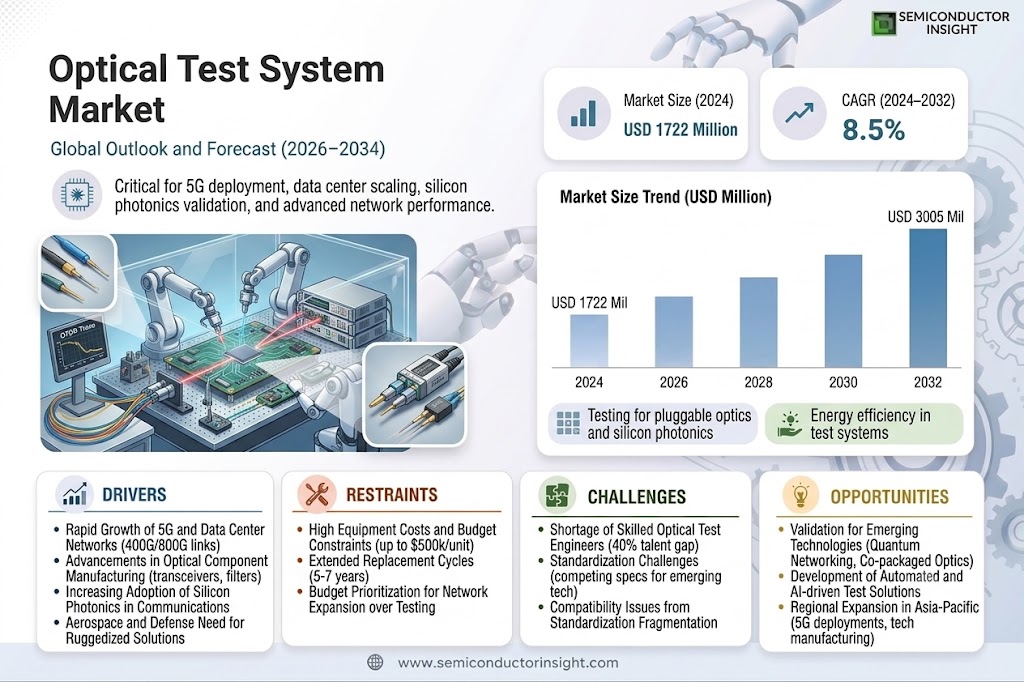
The global Optical Test System Market was valued at 1722 million in 2024 and is projected to reach US$ 3005 million by 2032, at a CAGR of 8.5% during the forecast period. In 2022, the market was valued at USD 1.58 billion, with projections indicating it will reach USD 2.77 billion by 2029 at a CAGR of 7.8%.
Optical Test Systems are specialized equipment designed to evaluate the performance, quality, and reliability of optical components and networks. These systems encompass a wide range of testing instruments including Optical Time Domain Reflectometers (OTDRs), spectrum analyzers, optical loss testers, and modulation analyzers. They play a critical role in validating high-speed optical communication systems, particularly those supporting 100G, 400G, and beyond.
The market growth is driven by increasing demand for data-intensive applications, rapid deployment of 5G networks, and advancements in optical communication technologies. Furthermore, the trend toward automation and integration of multiple testing functions into compact, portable systems is reshaping the industry landscape. Key players such as Keysight Technologies, VIAVI Solutions, and Anritsu Corporation are investing heavily in R&D to develop next-generation test solutions that address emerging challenges in optical networking.
MARKET DYNAMICS
MARKET DRIVERS
Rapid Growth of 5G and Data Center Networks Accelerates Market Demand
The global rollout of 5G networks and exponential growth in data center infrastructure are primary catalysts driving the optical test system market. 5G networks require dense fiber optic deployments with significantly higher bandwidth capacities compared to 4G, creating demand for advanced optical testing solutions. Network operators are investing heavily in testing equipment to validate 400G and emerging 800G optical links that form the backbone of next-generation networks. The data center segment alone accounted for over 35% of optical test system revenues in 2023, a figure projected to grow as hyperscalers continue expanding their global footprint. Testing requirements for pluggable optics, silicon photonics, and co-packaged optics in these environments are becoming increasingly sophisticated.
Advancements in Optical Component Manufacturing Boost Test Equipment Needs
Innovations in optical component design and manufacturing processes are creating parallel demand for more capable test systems. As component manufacturers push the boundaries of performance – developing higher-speed transceivers, lower-loss fibers, and more precise optical filters – testing equipment must evolve to validate these advancements. For instance, the shift from 100G to 400G optical transceivers requires test systems that can accurately measure parameters like extinction ratio and optical modulation amplitude at significantly higher frequencies. Recent product launches in this space include multi-channel optical power meters capable of simultaneous measurements across 32 wavelengths, reflecting the industry’s response to these technical demands.
The increasing adoption of silicon photonics in optical communications presents another growth avenue. Testing photonic integrated circuits (PICs) requires specialized equipment that can handle the unique characteristics of these devices, driving investments in new test platforms.
➤ Leading manufacturers launched over 15 new optical test system models specifically designed for silicon photonics validation in 2023 alone.
Furthermore, the aerospace and defense sector’s growing need for ruggedized optical test solutions is creating specialized market segments with higher ASPs and margins.
MARKET RESTRAINTS
High Equipment Costs and Budget Constraints Limit Market Penetration
While the optical test system market shows strong growth potential, high equipment costs present a significant barrier to wider adoption. Advanced systems capable of testing 400G+ networks can exceed $500,000 per unit, putting them out of reach for many smaller network operators and manufacturers. This pricing structure creates a dichotomy where only tier-1 service providers and large OEMs can afford cutting-edge test capabilities, while smaller players must rely on older equipment or outsourced testing services. The situation is particularly pronounced in developing regions where capital expenditure budgets are more constrained.
The capital-intensive nature of optical test equipment also leads to extended replacement cycles, with many organizations using systems for 5-7 years before upgrading. This slows the replacement market and dampens growth projections, despite rapid technological advancements in the field. Service providers facing margin pressures often prioritize network expansion over test equipment upgrades, further compounding the challenge.
Standardization Challenges Create System Compatibility Issues
The optical communications industry’s ongoing evolution creates standardization challenges that impact test equipment effectiveness. With multiple organizations developing competing standards for emerging technologies like co-packaged optics and quantum networking, test system manufacturers face difficulties in creating universally applicable solutions. This fragmentation leads to compatibility issues where equipment designed for one standard may not work effectively with another. Network operators report that nearly 20% of their test equipment utilization is dedicated to standards validation rather than operational testing, representing significant inefficiency.
These standardization challenges are particularly acute in emerging optical technologies where specifications are still evolving. Test equipment manufacturers must balance the need to support current standards with the flexibility to adapt to future requirements, often resulting in compromised solutions that fail to fully satisfy either need.
MARKET CHALLENGES
Shortage of Skilled Optical Test Engineers Impacts Market Growth
The optical test system industry faces a critical shortage of qualified engineers capable of operating advanced equipment and interpreting complex measurement data. Surveys indicate that over 40% of optical equipment manufacturers report difficulties finding personnel with the necessary skills in optical metrology, test automation, and data analysis. This talent gap is widening as experienced professionals retire and educational institutions struggle to update curricula quickly enough to match industry needs. The problem is particularly acute for positions requiring expertise in both optical engineering and software development.
Other Key Challenges
Keeping Pace with Technological Change
The rapid evolution of optical communication technologies creates constant pressure on test equipment manufacturers to update their product lines. Development cycles for new test systems that once spanned 3-4 years have compressed to 18-24 months, straining R&D resources. Many companies struggle to maintain profitability while keeping their test solutions technically relevant.
Test Automation Integration Complexities
While test automation offers significant efficiency benefits, integrating automated optical test systems into existing production and field environments presents numerous technical challenges. Achieving reliable, high-speed measurements while maintaining accuracy and repeatability requires careful system design and extensive validation, processes that can delay product deliveries and increase development costs.
MARKET OPPORTUNITIES
Emerging Quantum Communication Networks Create New Test Equipment Categories
The development of quantum communication networks represents a transformative opportunity for the optical test system market. Quantum networks require entirely new classes of test equipment capable of measuring quantum states of light, single-photon detection efficiency, and quantum bit error rates. While currently a niche segment, quantum network test equipment represents one of the fastest-growing categories with projected CAGR exceeding 35% through 2030. Early movers in this space are developing specialized test systems that combine conventional optical measurements with quantum-specific capabilities.
The increasing deployment of satellite-based optical communication links presents another high-growth opportunity. Testing space-qualified optical components requires specialized environmental chambers and vibration testing capabilities that few existing systems can provide. Market research indicates satellite optical communication test equipment demand will increase by over 25% annually as more commercial and government space programs incorporate optical data links.
AI-Driven Test Automation Opens New Efficiency Frontiers
The integration of artificial intelligence into optical test systems is creating opportunities to revolutionize testing processes. AI-powered systems can automatically optimize test parameters, identify measurement anomalies, and predict component failures before they occur. Early adopters report test time reductions of 30-40% and defect detection improvements of up to 50% through AI implementation. These efficiency gains are particularly valuable in high-volume manufacturing environments where small improvements in test throughput can significantly impact overall production capacity.
Cloud-based test management platforms represent another growth avenue, allowing distributed teams to collaborate on test development and analyze results from anywhere. This shift toward connected test ecosystems is driving demand for systems with robust data interfaces and cybersecurity features, creating new product differentiation opportunities for manufacturers.
OPTICAL TEST SYSTEM MARKET TRENDS
High-Speed Optical Networking to Emerge as a Dominant Market Driver
The global optical test system market is experiencing accelerated growth due to rising demand for high-bandwidth network infrastructures supporting data-intensive applications. With projections indicating a compound annual growth rate (CAGR) of 7.8% through 2029, the industry is pivoting toward solutions capable of testing 400G and emerging 800G optical networks. This shift correlates directly with hyperscale data center expansions, where annual traffic surpassed 20 zettabytes in 2023, necessitating advanced validation of optical components. Major players like Keysight Technologies and VIAVI Solutions are introducing multiservice test platforms that combine protocol emulation, impairment simulation, and performance validation – reducing testing complexity for next-gen coherent optics deployments.
Other Trends
Integrated Modular Test Platforms
Manufacturers are consolidating traditionally separate testing functions into unified systems, combining optical spectrum analysis, BER testing, and chromatic dispersion measurement in single instruments. This convergence addresses space constraints in production environments while improving workflow efficiency. Recent product launches demonstrate 30-40% reduction in test cycle times when using these integrated solutions compared to legacy setups. The approach particularly benefits telecom equipment manufacturers facing compressed development schedules for 5G transport networks.
Field-Deployable Testing Solutions Expansion
The market is witnessing growing adoption of portable optical test equipment as fiber networks expand into rural and hard-to-access locations. Compact OTDR units now provide laboratory-grade accuracy in packages under 3kg, with battery lives exceeding 10 hours – critical for field technicians maintaining last-mile FTTH installations. Revenue from portable segment grew 18% year-over-year in 2023, outpacing the broader market. This trend aligns with global fiber deployment rates climbing to over 1 million new strands per day across major economies. Simultaneously, cloud-based test management platforms are emerging, enabling remote configuration and data analysis that reduces reliance on specialized onsite personnel.
COMPETITIVE LANDSCAPE
Key Industry Players
Companies Focus on Innovation and Strategic Expansion to Capture Market Share
The global optical test system market exhibits a competitive yet fragmented landscape, with established multinational corporations competing alongside specialized regional providers. Keysight Technologies and VIAVI Solutions Inc. currently dominate the market, collectively accounting for nearly 30% of 2024’s $1.72 billion market value. Their leadership stems from comprehensive product portfolios that address emerging 400G/800G testing requirements and strategic partnerships with telecom operators.
EXFO and Yokogawa Test & Measurement Corporation have solidified their market positions through continuous R&D investment, particularly in 5G network testing solutions. These companies benefit from first-mover advantages in developing compact, automated test systems that reduce operational costs for end-users by approximately 15-20% compared to traditional solutions.
The competitive intensity is further heightened by mid-sized players like Anritsu Corporation and Tektronix, Inc., who are gaining traction through targeted acquisitions and partnerships. For instance, Anritsu’s 2023 acquisition of microwave test specialist Santa Rosa brought critical mmWave testing capabilities ahead of widespread 5G mmWave deployments.
Meanwhile, emerging challengers such as Shanghai Fuzhan Intelligent Technology are reshaping regional competition in Asia-Pacific through cost-effective alternatives, capturing nearly 8% of China’s domestic optical test market in 2024. Their growth reflects increasing localization demands in critical infrastructure sectors.
List of Key Optical Test System Companies Profiled
- Keysight Technologies (U.S.)
- VIAVI Solutions Inc. (U.S.)
- EXFO (Canada)
- Yokogawa Test & Measurement Corporation (Japan)
- CI Systems (Israel)
- Dimension Technology (U.S.)
- Anritsu Corporation (Japan)
- Tektronix, Inc. (U.S.)
- Fluke Corporation (U.S.)
- Kingfisher International (Australia)
- Shanghai Fuzhan Intelligent Technology (China)
Segment Analysis:
By Type
Optical Time Domain Reflectometer Leads Due to Rising Demand in Fiber Optic Network Testing
The market is segmented based on type into:
- Optical Time Domain Reflectometer
- Spectrum Analyzer
- Optical Loss Tester
- Spectral Analyzer
- Optical Modulation Analyzer
- Optical Time Interval Analyzer
- Others
By Application
Information Technology Segment Dominates with Growing 5G and Data Center Deployments
The market is segmented based on application into:
- Aerospace
- Biomedical
- Information Technology
- Military
- Ophthalmic
- Optical
By End User
Telecommunication Providers Lead Market Share with Expanding Fiber Optic Networks
The market is segmented based on end user into:
- Telecommunication Service Providers
- Network Equipment Manufacturers
- Research Laboratories
- Defense Organizations
- Medical Device Companies
By Technology
Automated Testing Solutions Gain Traction for High-Speed Optical Networks
The market is segmented based on technology into:
- Manual Testing Systems
- Semi-Automated Testing Systems
- Fully Automated Testing Systems
- Software-Defined Testing Platforms
Regional Analysis: Optical Test System Market
North America
North America dominates the optical test system market, driven by rapid technological advancements in telecommunications, aerospace, and defense sectors. The U.S. leads with significant investments in 5G infrastructure, quantum computing, and high-speed data transmission technologies, which require precise optical testing solutions. Key players like Keysight Technologies and VIAVI Solutions contribute to the region’s innovation, with compliance to stringent quality and performance standards. Testing demand is further fueled by the growing adoption of fiber optic networks and government-funded R&D programs in photonics. While Canada and Mexico exhibit slower growth due to niche industrial applications, the U.S. market is projected to maintain its leadership through 2030.
Europe
Europe’s market is characterized by strong regulatory frameworks ensuring optical component reliability, especially in the automotive and industrial sectors. Germany and the U.K. are pivotal, with applications in autonomous vehicle LIDAR systems and aerospace testing. The EU’s emphasis on Industry 4.0 and IoT connectivity accelerates demand for spectral analyzers and modulation testers. However, higher production costs limit small-scale adoption compared to Asia-Pacific. Collaborations between research institutes and manufacturers, such as TTP plc and Yenista Optics, help sustain Europe’s focus on precision and automation in optical testing despite economic fluctuations.
Asia-Pacific
APAC is the fastest-growing region, buoyed by China’s expansive 5G rollout and India’s telecommunications expansion. China accounts for over 40% of regional demand, with firms like Shanghai Fuzhan Intelligent Technology scaling portable test solutions for field deployment. Japan and South Korea contribute through advancements in semiconductor testing and consumer electronics. While price sensitivity favors mid-range optical loss testers, emerging economies face challenges in skilled labor availability. The region’s shift toward high-volume manufacturing and increasing FDI in optical component production ensures long-term growth, albeit with competitive pricing pressures.
South America
South America remains a nascent market with Brazil as the primary adopter of optical test systems, primarily for biomedical and aerospace applications. Economic instability and reliance on imports hinder localized production, though Argentina shows potential in ophthalmic testing equipment. The lack of standardized testing protocols and limited R&D investments slow market penetration. Nevertheless, partnerships with global players like EXFO and Anritsu Corporation aim to bridge gaps in network infrastructure testing, particularly for upcoming subsea cable projects.
Middle East & Africa
The MEA region exhibits steady growth, driven by UAE and Saudi Arabia’s smart city initiatives and fiber optic network expansions. Israel’s thriving military and IT sectors create demand for advanced modulation analyzers and secure communication testing. Africa’s market is constrained by underdeveloped infrastructure, though telecom operators’ focus on rural connectivity presents opportunities for cost-effective optical test solutions. Strategic collaborations with firms like HGH and CI Systems are critical to addressing calibration and maintenance challenges in harsh climatic conditions.
Report Scope
This market research report provides a comprehensive analysis of the Global and regional Optical Test System markets, covering the forecast period 2024–2032. It offers detailed insights into market dynamics, technological advancements, competitive landscape, and key trends shaping the industry.
Key focus areas of the report include:
- Market Size & Forecast: Historical data and future projections for revenue, unit shipments, and market value across major regions and segments. The Global Optical Test System market was valued at USD 1,722 million in 2024 and is projected to reach USD 3,005 million by 2032.
- Segmentation Analysis: Detailed breakdown by product type (Optical Time Domain Reflectometer, Spectrum Analyzer, Optical Loss Tester etc.), technology, application (Aerospace, Biomedical, IT, Military etc.), and end-user industry to identify high-growth segments.
- Regional Outlook: Insights into market performance across North America, Europe, Asia-Pacific, Latin America, and Middle East & Africa, including country-level analysis where relevant.
- Competitive Landscape: Profiles of leading market participants including Keysight Technologies, VIAVI Solutions, EXFO, Yokogawa, and Tektronix, covering their product portfolios, R&D focus, and strategic developments.
- Technology Trends & Innovation: Assessment of emerging technologies including high-speed testing for 400G networks, AI integration, miniaturization trends, and multi-protocol testing capabilities.
- Market Drivers & Restraints: Evaluation of factors driving market growth such as 5G deployment and data center expansion, along with challenges like supply chain constraints and high equipment costs.
- Stakeholder Analysis: Insights for component suppliers, OEMs, system integrators, investors, and policymakers regarding the evolving ecosystem and strategic opportunities.
Primary and secondary research methods are employed, including interviews with industry experts, data from verified sources, and real-time market intelligence to ensure the accuracy and reliability of the insights presented.
FREQUENTLY ASKED QUESTIONS:
What is the current market size of Global Optical Test System Market?
-> Optical Test System Market was valued at 1722 million in 2024 and is projected to reach US$ 3005 million by 2032, at a CAGR of 8.5% during the forecast period.
Which key companies operate in Global Optical Test System Market?
-> Key players include Keysight Technologies, VIAVI Solutions Inc., EXFO, Yokogawa Test & Measurement, Tektronix, Anritsu Corporation, and Luna Innovations, among others.
What are the key growth drivers?
-> Key growth drivers include 5G network deployments, data center expansion, increasing demand for high-speed optical networks, and advancements in photonics technology.
Which region dominates the market?
-> Asia-Pacific is the fastest-growing region, driven by China’s telecom infrastructure development, while North America remains a technology leader in optical testing solutions.
What are the emerging trends?
-> Emerging trends include AI-powered optical testing, portable field testing solutions, multi-protocol testing capabilities, and automation in optical network validation.
Get Sample Report PDF for Exclusive Insights
Report Sample Includes
- Table of Contents
- List of Tables & Figures
- Charts, Research Methodology, and more...
 Download Sample Report PDF