Market Insights
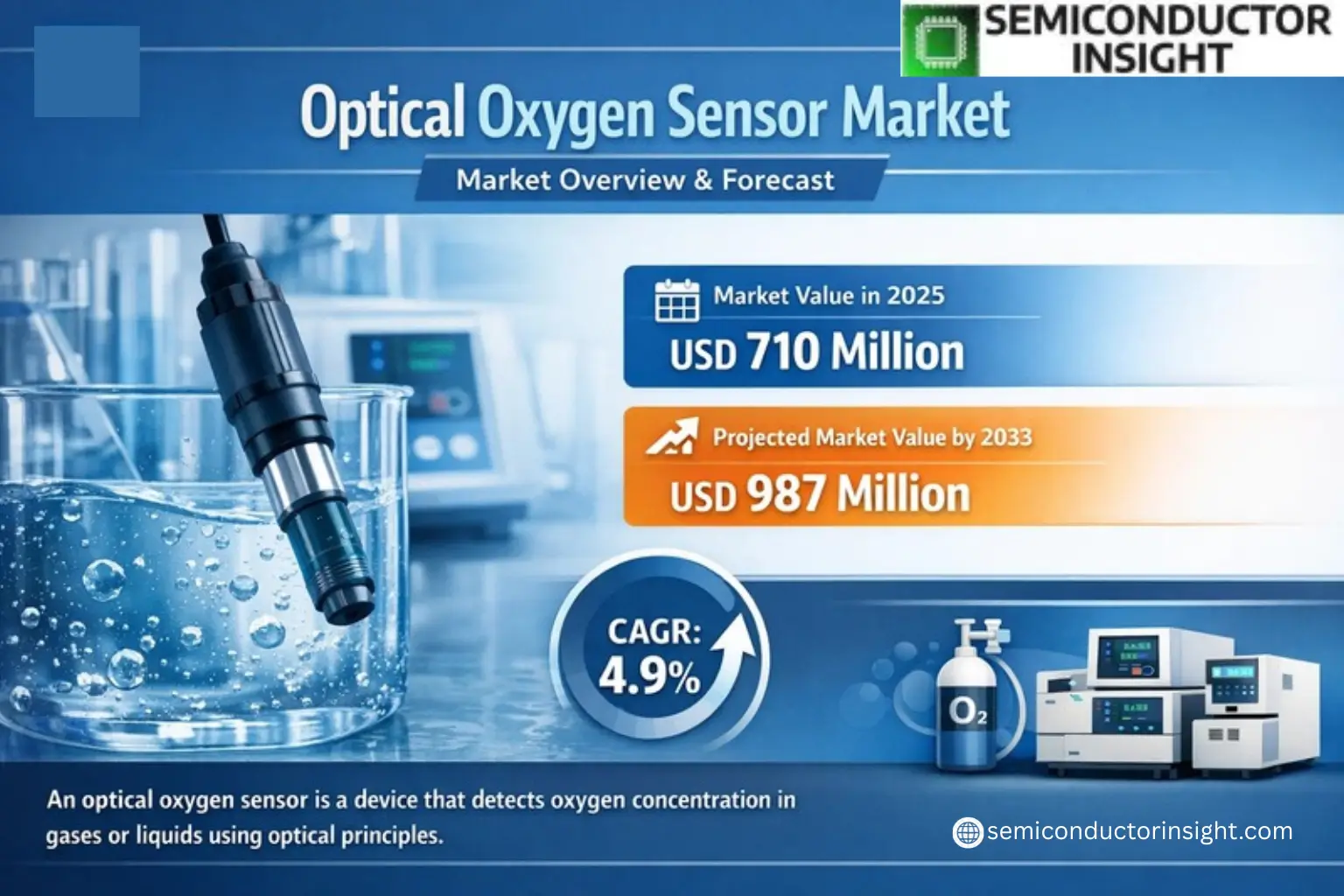
Global Optical Oxygen Sensor Market was valued at USD 710 million in 2025 and is projected to reach USD 987 million by 2033, exhibiting a CAGR of 4.9% during the forecast period.
An optical oxygen sensor is a device that detects oxygen concentration in gases or liquids using optical principles. These sensors operate by measuring the interaction between oxygen and specific light signals, converting this data into quantifiable electrical or optical outputs. Unlike traditional electrochemical sensors, optical oxygen sensors offer advantages such as non-invasiveness, high accuracy, and extended lifespan. They are widely utilized across industries including medical, environmental monitoring, food processing, and scientific research.
The market growth is driven by increasing demand for precise oxygen monitoring in healthcare applications like blood gas analysis and respiratory therapy. Additionally, stringent environmental regulations are accelerating adoption in industrial emissions monitoring. Technological advancements in fluorescence quenching and phosphorescence quenching methods are further enhancing sensor performance. Key players such as Ocean Optics, Hamilton Company, and ABB dominate the market with continuous innovations in miniaturization and IoT integration for real-time data analytics.
MARKET DRIVERS
Growing Demand in Healthcare & Industrial Applications
Optical Oxygen Sensor Market is experiencing significant growth due to rising adoption in medical devices and industrial monitoring systems. These sensors provide non-invasive, real-time oxygen measurement, critical for patient care and industrial safety. The healthcare sector accounts for approximately 38% of global demand, fueled by increasing use in ventilators and anesthesia machines.
Technological Advancements Enhancing Performance
Recent innovations in luminescence quenching technology have improved sensor accuracy to ±0.5% of reading, with response times under 5 seconds. This technological leap is driving replacement cycles in established markets while enabling penetration into new application areas like biopharmaceutical manufacturing and food packaging.
Environmental monitoring applications now represent 22% of market volume, as regulators worldwide implement stricter oxygen level control measures in wastewater treatment and combustion processes.
MARKET CHALLENGES
Technical Limitations in Extreme Conditions
Optical Oxygen Sensors face performance degradation in high-temperature environments (above 60°C) and require frequent recalibration when exposed to volatile organic compounds. This limits their effectiveness in certain industrial settings where conventional electrochemical sensors remain dominant.
Other Challenges
High Replacement Costs
Premium optical sensors cost 2-3 times more than electrochemical alternatives, with membrane replacements needed every 12-18 months in continuous operation scenarios.
Technical Expertise Requirements
Proper installation and maintenance requires trained personnel, creating adoption barriers in price-sensitive emerging markets.
MARKET RESTRAINTS
Supply Chain Constraints for Specialized Materials
Optical Oxygen Sensor Market faces material scarcity issues, particularly with rare-earth phosphorescent compounds used in sensing elements. Lead times for critical components have extended to 12-16 weeks in some regions, potentially limiting near-term market growth despite strong demand.
MARKET OPPORTUNITIES
Expansion in Emerging Smart City Projects
Government initiatives for smart infrastructure in developing economies are creating new avenues for Optical Oxygen Sensor deployment. Municipal applications including air quality monitoring networks and underground utility gas detection systems represent a USD 420 million untapped market potential by 2027.
Miniaturization for Portable Medical Devices
The trend toward point-of-care diagnostics is driving demand for compact optical oxygen sensors under 5mm in size. This niche segment is growing at 11.7% annually, with applications in wearable health monitors and emergency medical equipment.
Optical Oxygen Sensor Market Trends
Growing Demand in Medical and Environmental Applications
Optical Oxygen Sensor Market is projected to grow from USD 710 million in 2025 to USD 987 million by 2033, driven by increasing adoption in medical diagnostics and environmental monitoring. These sensors offer non-invasive, high-accuracy measurement capabilities essential for critical healthcare applications like patient monitoring and laboratory analysis. Environmental agencies also utilize them extensively for water quality assessment and air pollution monitoring.
Other Trends
Fluorescence Quenching Technology Dominates
Fluorescence Quenching sensors currently hold the largest market share due to their superior accuracy and longevity. This segment is expected to maintain its lead with steady growth through 2033, particularly in scientific research applications where precision measurements are paramount.
Regional Market Expansion
North America currently leads the Optical Oxygen Sensor Market, with the U.S. being the largest contributor. However, Asia-Pacific is emerging as the fastest-growing region, with China’s market expanding rapidly to meet industrial and environmental monitoring needs. European markets continue to show steady growth, supported by stringent environmental regulations.
Competitive Landscape Consolidation
The market remains competitive with key players like Ocean Optics, Hamilton Company, and ABB maintaining strong positions. These companies are focusing on product innovation and strategic partnerships to enhance their market share as new applications for optical oxygen sensing continue to emerge across industries.
Industry Challenges and Opportunities
While the Optical Oxygen Sensor Market shows strong growth potential, manufacturers face challenges including price sensitivity in developing markets and the need for continuous technological improvements. However, expanding applications in food packaging and pharmaceutical manufacturing present significant new opportunities for market expansion.
COMPETITIVE LANDSCAPE
Key Industry Players
Global Optical Oxygen Sensor Market Dominated by Technology Innovators
Optical Oxygen Sensor Market is characterized by the presence of established technology leaders specializing in photonics and analytical instrumentation. Ocean Optics and PyroScience hold significant market positions with their advanced fluorescence quenching technologies, collectively commanding over 25% of the global revenue share. The competitive landscape shows distinct segmentation, with Hamilton Company and AMETEK dominating medical applications, while ABB and Yokogawa lead in industrial environmental monitoring solutions.
Emerging players like OPTEX and Sea-Bird Scientific are gaining traction through specialized solutions for scientific research applications. Regional specialists such as Knick in Europe and HORIBA Group in Asia-Pacific are expanding their product portfolios through strategic acquisitions. The market exhibits moderate consolidation with the top 5 players maintaining stable market shares, while technology differentiation remains the key competitive factor.
List of Key Optical Oxygen Sensor Companies Profiled
- Ocean Optics
- Hamilton Company
- Knick
- AMETEK
- OPTEX
- PyroScience
- ABB
- Yokogawa
- Sea-Bird Scientific
- HORIBA Group
- Idronaut
- Thermo Fisher Scientific
- PreSens Precision Sensing
- Optek-Danulat
- Fiber Optic Systems
Segment Analysis:
| Segment Category | Sub-Segments | Key Insights |
| By Type |
|
Fluorescence Quenching dominates due to:
|
| By Application |
|
Medical applications show strongest growth potential:
|
| By End User |
|
Healthcare Providers represent the most significant user base:
|
| By Technology |
|
Fiber Optic technology demonstrates strong adoption:
|
| By Measurement Range |
|
Low Range sensors are most in demand:
|
Regional Analysis: Optical Oxygen Sensor Market
Healthcare accounts for the largest adoption of optical oxygen sensors in North America, particularly in critical care monitoring and anesthesia delivery systems. Hospitals prefer optical sensors for their accuracy and reduced calibration needs compared to electrochemical alternatives.
Stringent OSHA regulations drive optical oxygen sensor demand across chemical plants and oil refineries. These sensors provide reliable monitoring in confined spaces and hazardous environments where traditional sensors may fail or require frequent maintenance.
North American manufacturers lead in developing hybrid sensor technologies combining optical and electrochemical principles. This innovation addresses emerging needs in bioreactor monitoring for biopharmaceutical production and research applications.
Leading universities collaborate with sensor companies to advance luminescence-based sensing techniques. These partnerships accelerate development of next-generation sensors for specialized applications in aerospace and deep-sea exploration.
Europe
Europe maintains significant market share due to standardized medical device regulations and growing adoption in food packaging applications. Germany and the UK lead industrial sensor deployment, while Scandinavian countries show strong demand for environmental monitoring solutions. The region’s emphasis on sustainable manufacturing processes drives innovation in long-life optical sensors. EU-funded research initiatives actively support development of low-power optical sensing systems for IoT applications.
Asia-Pacific
Asia-Pacific exhibits the fastest growth rate for optical oxygen sensors, fueled by expanding healthcare infrastructure and increasing industrialization. Japan and South Korea dominate high-end medical applications, while China focuses on cost-effective industrial sensors. Government initiatives to modernize manufacturing and improve workplace safety standards create new adoption opportunities across emerging economies in the region.
South America
South America shows steady growth in optical oxygen sensor adoption, particularly in Brazil’s oil & gas sector and Argentina’s medical device manufacturing. Infrastructure limitations in rural healthcare facilities create demand for rugged optical sensors with extended maintenance intervals. Regional manufacturers are developing customized solutions for tropical climate conditions affecting sensor performance.
Middle East & Africa
The Middle East drives demand through oil industry applications and smart city initiatives requiring environmental monitoring. Africa’s market remains nascent but shows potential in mining safety applications. Regional manufacturers focus on developing heat-resistant optical sensors suitable for extreme desert conditions prevalent in GCC countries.
Report Scope
This market research report provides a comprehensive analysis of the Optical Oxygen Sensor Market, covering the forecast period 2025–2033. It offers detailed insights into market dynamics, technological advancements, competitive landscape, and key trends shaping the industry.
Key focus areas of the report include:
- Market Overview: The report begins with an overview outlining its current market scenario, key growth indicators, and industry transformation drivers. It discusses macroeconomic factors, demand–supply balance, regulatory landscape, and the strategic role of optical oxygen sensors in powering advancements across industries such as medical, environmental protection, food, and scientific research.
- Market Size & Forecast: Historical data and future projections for revenue, unit shipments, and market value across major regions and segments.
- Segmentation Analysis: Detailed breakdown by type (Fluorescence Quenching, Phosphorescence Quenching), application (Environment, Food, Medical, Scientific Research), and end-user industry to identify high-growth segments.
- Regional Insights: Insights into market performance across North America, Europe, Asia, South America, and Middle East & Africa, including country-level analysis.
- Competitive Landscape: Profiles of leading market participants, including their product offerings, R&D focus, pricing strategies, and recent developments.
- Technology Trends & Innovation: Assessment of emerging technologies and evolving industry standards in optical oxygen sensing.
- Market Drivers & Restraints: Evaluation of factors driving market growth along with challenges and regulatory issues.
- Stakeholder Insights: Strategic insights for component suppliers, OEMs, investors, and policymakers.
Primary and secondary research methods are employed, including interviews with industry experts and data from verified sources to ensure accuracy.
FREQUENTLY ASKED QUESTIONS:
What is the current market size of Optical Oxygen Sensor Market?
-> Optical Oxygen Sensor Market was valued at USD 710 million in 2025 and is projected to reach USD 987 million by 2033, exhibiting a CAGR of 4.9% during the forecast period.
What is the growth rate of Optical Oxygen Sensor Market?
-> The market is expected to grow at a CAGR of 4.9% during 2025-2033.
Which key companies operate in Optical Oxygen Sensor Market?
-> Key players include Ocean Optics, Hamilton Company, Knick, AMETEK, OPTEX, PyroScience, ABB, Yokogawa, Sea-Bird Scientific, and HORIBA Group.
What are the major application areas?
-> Major applications include Environment, Food, Medical, Scientific Research, and others.
Which technology segment leads the market?
-> The Fluorescence Quenching segment holds significant market share.

Get Sample Report PDF for Exclusive Insights
Report Sample Includes
- Table of Contents
- List of Tables & Figures
- Charts, Research Methodology, and more...
 Download Sample Report PDF