Open-Source CPU Architecture Market Insights
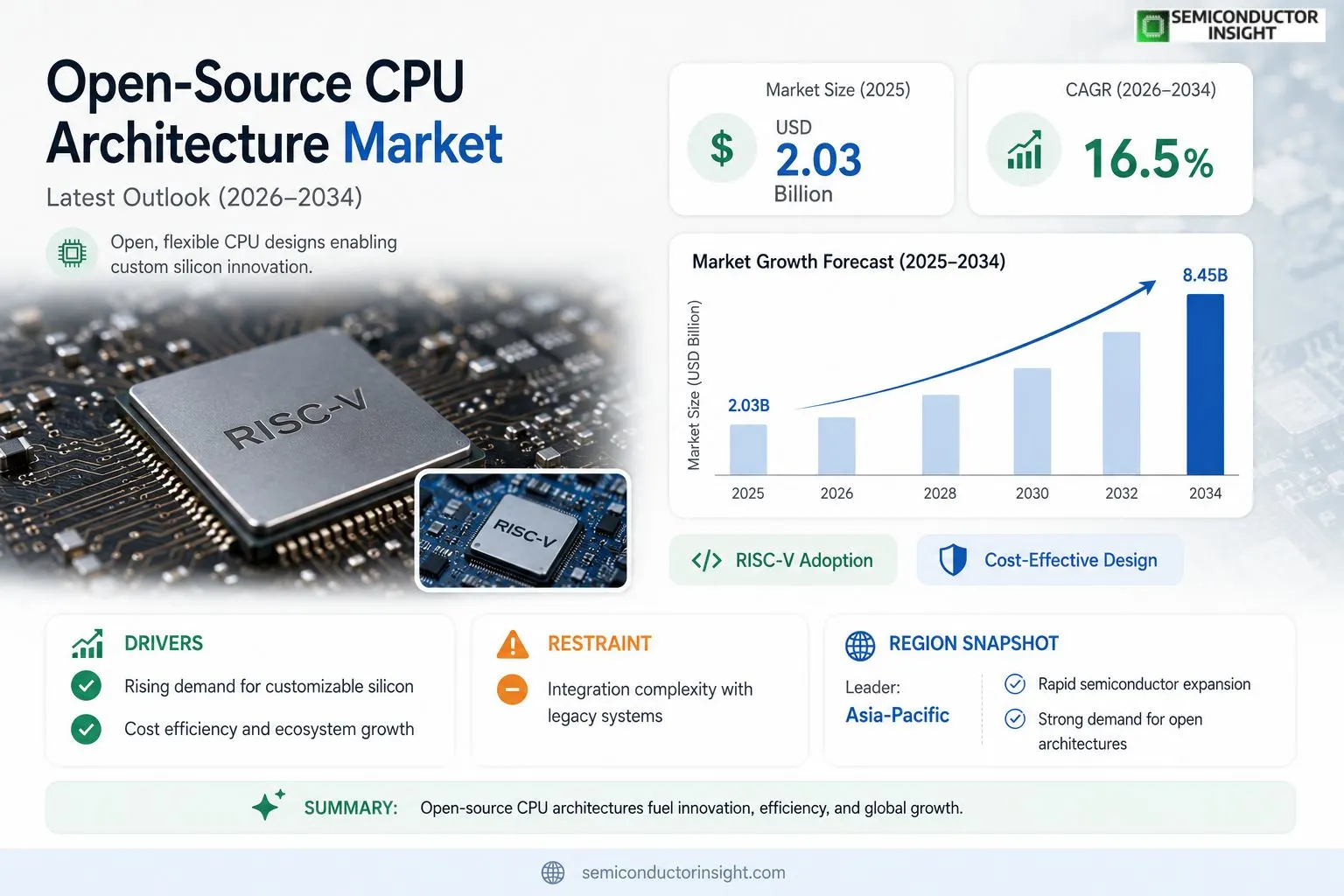
Global Open-Source CPU Architecture Market size was valued at USD 2.03 billion in 2025. The market is projected to grow from USD 2.10 billion in 2026 to USD 8.45 billion by 2034, exhibiting a CAGR of 16.5% during the forecast period.
Open‑Source CPU architectures,most notably RISC‑V,are publicly available instruction set architectures that enable designers to develop custom silicon without licensing fees. These architectures provide modular extensions, support for heterogeneous cores, and transparent specifications that accelerate innovation across embedded, automotive, and data‑center domains.The market is accelerating because semiconductor firms are embracing cost‑effective design cycles, while enterprises seek security‑by‑design solutions for edge AI and IoT devices. Furthermore, substantial venture funding and collaborations among leading chipmakers and open‑source foundations are expanding ecosystem tooling and software stacks, thereby driving broader adoption worldwide.
MARKET DRIVERS
Rising Demand for Customizable Silicon
The surge in edge‑computing and AI workloads has compelled enterprises to seek processors that can be tailored to specific algorithmic needs. Open‑source CPU designs enable rapid iteration, reducing time‑to‑market while preserving performance parity with proprietary alternatives. This flexibility is a core catalyst for the adoption of the Open‑Source CPU Architecture Market.
Cost Efficiency and Ecosystem Growth
By eliminating licensing fees and leveraging community‑driven validation, manufacturers can lower total cost of ownership by up to 30 % compared with traditional silicon solutions. Moreover, a thriving ecosystem of compilers, debuggers, and verification tools is expanding, reinforcing confidence among hardware startups.
➤ “The collaborative model accelerates innovation cycles while democratizing access to high‑performance CPU architectures.”
These drivers collectively position the Open‑Source CPU Architecture Market for robust double‑digit growth through 2028, as more firms adopt modular hardware strategies.
MARKET CHALLENGES
Talent Shortage and Toolchain Maturity
Despite flourishing open‑source communities, there remains a limited pool of engineers proficient in low‑level hardware description languages and verification environments. This talent bottleneck hampers large‑scale deployments and prolongs verification timelines.
Other Challenges
Regulatory Uncertainty
Emerging export‑control regulations for advanced semiconductor technologies introduce compliance complexities, especially for cross‑border collaborations that are typical in open‑source projects.
MARKET RESTRAINTS
Integration Complexity with Legacy Systems
Enterprises that rely on entrenched proprietary instruction sets often face significant integration overhead when transitioning to open‑source CPU cores. Compatibility layers and firmware rewrites increase project risk and cost, tempering rapid market penetration.
Intellectual Property Protection
While openness fosters collaborative improvement, organizations remain cautious about exposing critical design IP. The balance between communal development and proprietary safeguards continues to constrain broader acceptance.
MARKET OPPORTUNITIES
Emergence of Domain‑Specific Accelerators
Specialized accelerators for machine‑learning inference and cryptographic functions are increasingly built atop open‑source CPU cores, offering a modular foundation that can be extended without reinventing the entire stack. This synergy creates a lucrative niche for component vendors.
Geopolitical Diversification of Supply Chains
Countries seeking to reduce dependence on a limited set of semiconductor suppliers view open‑source architectures as a strategic lever. Government‑backed initiatives are funding local development programs, unlocking new revenue streams for the Open‑Source CPU Architecture Market.
Open-Source CPU Architecture Market Trends
Growing Adoption in Edge AI and IoT
Open-Source CPU Architecture Market is experiencing rapid growth as designers leverage publicly available instruction sets to shorten development cycles. By eliminating licensing fees, semiconductor firms can allocate resources to architectural innovation rather than legal overhead. Modular extensions and heterogeneous core support enable customized silicon that meets the power‑efficiency demands of edge AI and Internet‑of‑Things devices. At the same time, transparent specifications foster security‑by‑design practices, allowing enterprises to embed trusted foundations directly into hardware. This combination of cost reduction, flexibility, and enhanced security is driving broader adoption across embedded, automotive, and data‑center segments. Moreover, the openness of the architecture encourages community‑driven benchmarking, allowing designers to compare performance across variants without proprietary constraints. This transparency accelerates decision‑making for OEMs evaluating trade‑offs between power, latency, and silicon area.
Other Trends
Expansion of RISC‑V Ecosystem
The emergence of RISC‑V as the leading open-source instruction set has catalyzed ecosystem growth. Major chipmakers, academic institutions, and open‑source foundations are contributing IP blocks, verification tools, and software stacks that lower entry barriers for new entrants. Collaborative development of standardized extensions, such as vector processing and security enclaves, allows firms to target high‑performance workloads without reinventing core primitives. Automotive manufacturers are integrating RISC‑V‑based controllers to meet stringent functional‑safety standards while preserving flexibility for future updates. In data‑center environments, the ability to tailor core configurations reduces wasteful silicon utilization, supporting sustainability goals. These ecosystem advances are reinforcing Open-Source CPU Architecture Market’s momentum across multiple verticals. In parallel, open-source verification suites are being integrated into continuous integration pipelines, reducing validation time and enhancing reliability for safety‑critical deployments. The growing repository of reference designs also serves as a learning platform for engineers transitioning from legacy proprietary cores.
Investment and Collaborative Innovation
Venture capital inflows and cross‑industry consortia are further accelerating development. Investment rounds have enabled startups to deliver domain‑specific accelerators built on open-source cores, shortening time‑to‑market for specialized applications such as machine‑learning inference at the edge. Joint programs between established semiconductor vendors and open-source foundations are standardizing toolchains, reducing fragmentation, and simplifying compliance testing. As Open-Source CPU Architecture Market matures, analysts anticipate a shift from early‑stage experimentation toward large‑scale production deployments, especially in regions adopting sovereign semiconductor strategies. Continued emphasis on modular design, security integration, and collaborative licensing is expected to sustain the market’s upward trajectory through the next decade. Regulatory bodies in several jurisdictions are beginning to recognize open-source silicon as a viable alternative for meeting compliance standards, further legitimizing its role in critical infrastructure. This emerging policy support, combined with the technical advantages, positions the market for sustained expansion.
COMPETITIVE LANDSCAPEKey Industry Players
Open-Source CPU Architecture Market Is Characterized by a Dynamic Mix of Semiconductor Giants, Fabless Chip Designers, and Open-Source Foundation-Backed Entities Competing Across RISC-V and Adjacent Open ISA Ecosystems
Open-Source CPU Architecture Market is primarily anchored by the RISC-V ecosystem, with SiFive emerging as one of the most prominent commercial leaders offering production-grade RISC-V processor IP cores for embedded, automotive, and data-center applications. The market structure is notably fragmented yet collaborative, shaped heavily by the RISC-V International foundation, which governs the open ISA specification and fosters interoperability among hundreds of member organizations worldwide. Major semiconductor corporations including Qualcomm, Intel, and NVIDIA have made strategic investments and joined RISC-V International, reinforcing their commitment to open-architecture development. Western Digital has been a particularly vocal institutional adopter, having deployed RISC-V cores across its storage product lines at scale. Chinese semiconductor entities such as Alibaba’s T-Head Semiconductor and StarFive Technology have also established themselves as significant contributors and commercial players, developing high-performance RISC-V silicon and releasing open-source core implementations that are widely referenced by the engineering community globally.Beyond the dominant RISC-V segment, several niche but strategically significant players are shaping specialized portions of the open-source CPU architecture landscape. Codasip and Andes Technology provide customizable RISC-V processor IP targeting the embedded and IoT segments, while Ventana Micro Systems is positioning high-performance RISC-V server-class cores for data-center workloads. Microchip Technology and Espressif Systems have integrated RISC-V cores into their microcontroller product families, accelerating adoption at the edge. Additionally, academic and open-hardware initiatives such as the PULP Platform from ETH Zurich and the University of Bologna continue to generate influential open-source core designs including the CVA6 and CORE-V families, which are being commercialized through the OpenHW Group. Reduced.com and Rivos Inc. represent well-funded startup entrants targeting compute-intensive and AI-accelerated RISC-V architectures, further intensifying competition across the value chain as the market approaches its projected valuation of USD 8.45 billion by 2034.
List of Key Open-Source CPU Architecture Companies Profiled
- SiFive
- RISC-V International
- Codasip
- Andes Technology
- Ventana Micro Systems
- T-Head Semiconductor (Alibaba Group)
- StarFive Technology
- Western Digital Corporation
- Espressif Systems
- Microchip Technology
- OpenHW Group
- PULP Platform (ETH Zurich)
- Rivos Inc.
- Qualcomm Technologies
- Reduced.com
Segment Analysis:
| Segment Category | Sub-Segments | Key Insights |
| By Type |
|
RISC‑V Base ISA
|
| By Application |
|
Embedded IoT Devices
|
| By End User |
|
Semiconductor Start‑ups
|
| By Ecosystem Collaboration |
|
Open‑source Foundations
|
| By Development Phase |
|
Prototype Design
|
Regional Analysis: North America
United States
The strong presence of leading universities and research labs in the US drives innovation in open-source CPU architectures. These institutions actively contribute to the development and testing of new CPU designs, fostering a collaborative environment crucial for the market’s progress.
Large corporations in the US are increasingly exploring and adopting open-source CPU architectures to reduce costs, enhance customization, and avoid vendor lock-in. This trend is particularly evident in sectors like cloud computing and high-performance computing.
Government agencies in the US are actively promoting the use of open standards and open-source software, including CPU architectures, to foster innovation and ensure technological sovereignty. Funding for open-source projects and research plays a vital role in the market’s growth.
Major cloud service providers in the US are integrating open-source CPU architectures into their infrastructure, offering customers more flexibility and cost-effectiveness. This trend is expected to accelerate as the demand for scalable and efficient cloud solutions continues to rise.
Europe
Europe represents a significant and growing market for Open-Source CPU Architecture Market. With a strong emphasis on data privacy, security, and technological independence, European countries are actively exploring open-source alternatives to proprietary CPU technologies. The region’s robust industrial base and strong focus on research and development provide fertile ground for innovation in this space. The increasing adoption of open-source CPUs in edge computing and IoT applications is a key growth driver. Furthermore, governmental support for open standards and collaborative research initiatives is fostering a vibrant ecosystem for open-source CPU development across Europe.
Asia-Pacific
The Asia-Pacific region is projected to witness the fastest growth in Open-Source CPU Architecture Market. Driven by rapid industrialization, increasing demand for computing power, and a growing ecosystem of technology startups, countries like China, India, and Japan are becoming key players. The region’s focus on digital transformation and the proliferation of smart devices are fueling the need for cost-effective and customizable CPU solutions. Government initiatives promoting local chip manufacturing and open-source development are further accelerating market growth in Asia-Pacific.
South America
South America presents a nascent but promising market for Open-Source CPU Architecture Market. Increasing investments in technology infrastructure and a growing awareness of the benefits of open-source software are driving adoption. The region’s focus on addressing specific local needs and cost constraints makes open-source CPU architectures an attractive option. While the market is still in its early stages, there is significant potential for growth in the coming years, particularly in sectors like telecommunications and government services.
Middle East & Africa
The Middle East & Africa region is an emerging market for Open-Source CPU Architecture Market. Rapid economic growth, increasing internet penetration, and government initiatives promoting digital transformation are creating opportunities for open-source CPU adoption. The region’s focus on developing local talent and fostering innovation in technology makes it an attractive market for open-source CPU solutions. While the market size is currently smaller compared to other regions, it is expected to witness significant growth in the long term.
Report Scope
This market research report provides a comprehensive analysis of the Open-Source CPU Architecture Market , covering the forecast period 2026–2034. It offers detailed insights into market dynamics, technological advancements, competitive landscape, and key trends shaping the industry.
Key focus areas of the report include:
- Market Overview: The report begins with an overview outlining its current market scenario, key growth indicators, and industry transformation drivers. It discusses macroeconomic factors, demand–supply balance, regulatory landscape, and the strategic role of semiconductors in powering advancements across industries such as automotive, telecommunications, consumer electronics, and industrial automation.
- Market Size & Forecast: Historical data and future projections for revenue, unit shipments, and market value across major regions and segments.
- Segmentation Analysis: Detailed breakdown by product type, technology, application, and end-user industry to identify high-growth segments and investment opportunities.
- Regional Insights: Insights into market performance across North America, Europe, Asia-Pacific, Latin America, and the Middle East & Africa, including country-level analysis where relevant.
- Competitive Landscape: Profiles of leading market participants, including their product offerings, R&D focus, manufacturing capacity, pricing strategies, and recent developments such as mergers, acquisitions, and partnerships.
- Technology Trends & Innovation: Assessment of emerging technologies, integration of AI/IoT, semiconductor design trends, fabrication techniques, and evolving industry standards.
- Market Drivers & Restraints: Evaluation of factors driving market growth along with challenges, supply chain constraints, regulatory issues, and market-entry barriers.
- Stakeholder Insights: Insights for component suppliers, OEMs, system integrators, investors, and policymakers regarding the evolving ecosystem and strategic opportunities.
Primary and secondary research methods are employed, including interviews with industry experts, data from verified sources, and real-time market intelligence to ensure the accuracy and reliability of the insights presented.
FREQUENTLY ASKED QUESTIONS:
What is the current market size of Open-Source CPU Architecture Market?
-> Open-Source CPU Architecture Market was valued at USD 2.03 billion in 2025 and is expected to reach USD 8.45 billion by 2034.
Which key companies operate in Open-Source CPU Architecture Market?
-> Key players include SiFive, Andes Technology, Esperanto, Alibaba Group, and Western Digital, among others.
What are the key growth drivers?
-> Key growth drivers include cost‑effective silicon design, security‑by‑design for edge AI, and increasing adoption of RISC‑V in automotive and data‑center applications.
Which region dominates the market?
-> Asia‑Pacific is the fastest‑growing region, while North America remains a dominant market.
What are the emerging trends?
-> Emerging trends include modular ISA extensions, heterogeneous core integration, and open‑source toolchain ecosystems.
Get Sample Report PDF for Exclusive Insights
Report Sample Includes
- Table of Contents
- List of Tables & Figures
- Charts, Research Methodology, and more...
 Download Sample Report PDF