OLED Encapsulation System Market Insights
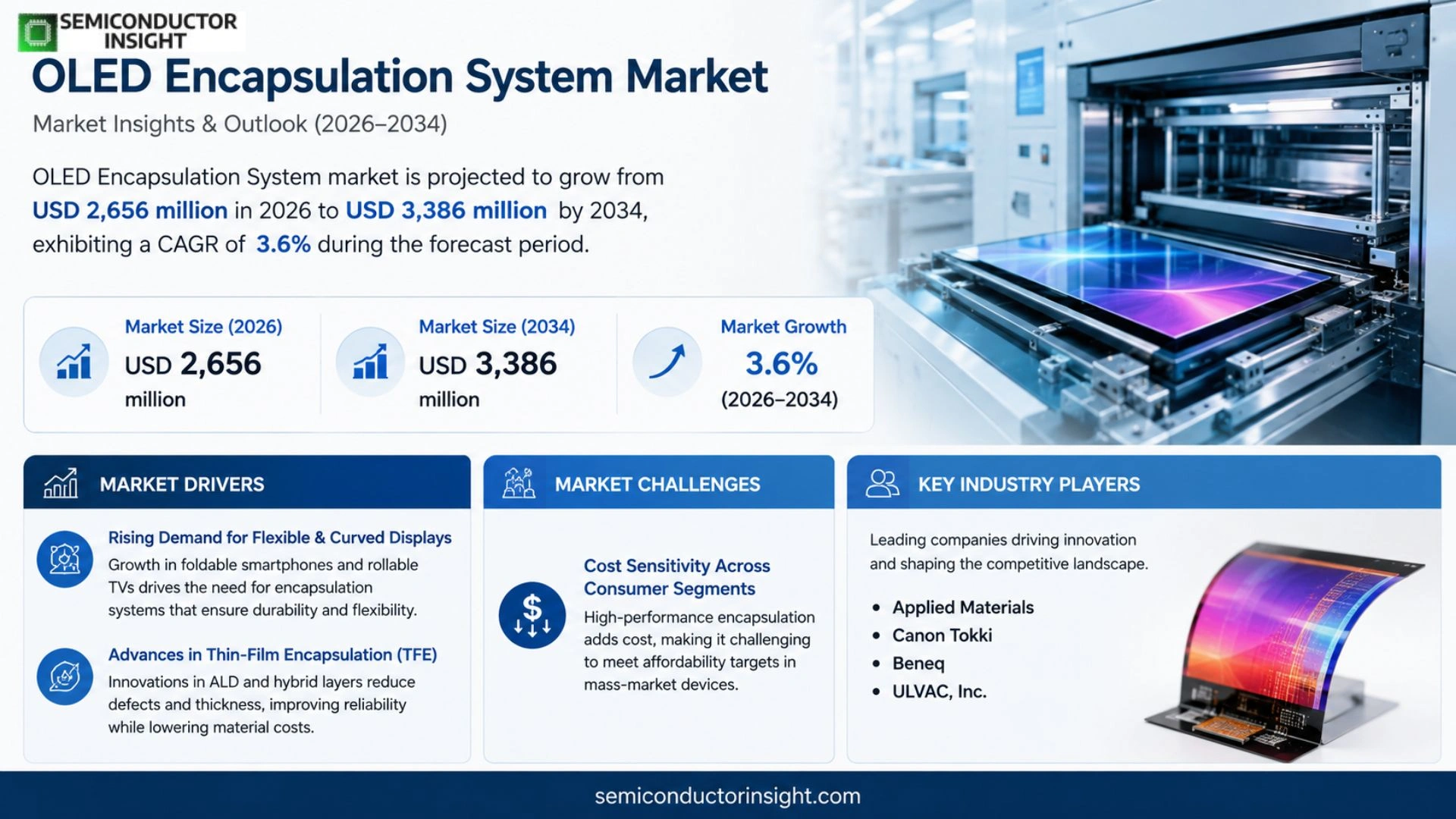
Global OLED Encapsulation System market is projected to grow from USD 2,656 million in 2026 to USD 3,386 million by 2034, exhibiting a CAGR of 3.6% during the forecast period.
OLED encapsulation systems are critical process equipment used in OLED display and microdisplay manufacturing. Their primary role is to build protective barrier structures after deposition so that moisture and oxygen do not penetrate the device and damage the organic emitting layers and electrodes, while also supporting thin, flexible, and foldable product designs without sacrificing lifetime, brightness, or reliability. Based on official product pages from multiple suppliers, this field includes glass‑lid encapsulation, dispensing, bonding, and lamination equipment, as well as thin‑film encapsulation, hybrid encapsulation systems, and integrated platforms that place cleaning, deposition, transfer, and encapsulation within the same vacuum or inert environment.
The market is gaining momentum because flexible OLED adoption pushes demand for thin‑film encapsulation that can block oxygen and moisture while remaining bendable. Simultaneously, advancements in ALD, PEALD, PECVD and inkjet deposition improve barrier performance and lower processing temperatures. Equipment suppliers such as Applied Materials, Canon Tokki and Beneq are expanding their portfolios with integrated solutions that combine cleaning, deposition and encapsulation in a single vacuum line. These developments broaden addressable applications beyond smartphones to tablets, laptops, automotive displays and near‑eye devices, creating new revenue streams for manufacturers.
MARKET DRIVERS
Increasing Demand for Flexible and Curved Displays
The rollout of foldable smartphones and roll‑able televisions has compelled OEMs to seek encapsulation solutions that preserve display integrity while tolerating repeated mechanical stress. OLED Encapsulation System Market players are responding with barrier films that combine high moisture resistance and mechanical pliability, a combination that directly supports manufacturers’ product roadmaps.
Advancements in Thin‑Film Encapsulation (TFE) Technologies
Recent breakthroughs in atomic layer deposition and organic‑inorganic hybrid layers have lowered defect densities to sub‑nanometer levels. These enhancements enable thinner encapsulants without compromising longevity, thereby reducing the total bill of materials for premium devices. Industry analysts note that the ability to shrink encapsulation thickness is a decisive advantage for brands targeting ultra‑slim form factors.
➤ “The convergence of flexible display ambitions and TFE innovations is reshaping the component supply chain, turning encapsulation from a cost centre into a strategic differentiator.”
Manufacturers that integrate next‑generation encapsulation early will likely capture higher margins, as the added reliability translates into stronger brand equity and reduced warranty exposure.
MARKET CHALLENGES
Cost Sensitivity Across Consumer Segments
While premium devices can absorb higher encapsulation expenses, the broader smartphone and wearables markets operate under tight price constraints. Suppliers must balance performance gains with incremental cost, a trade‑off that often narrows the pool of viable candidates for mass‑market adoption.
Other Challenges
Supply Chain Bottlenecks
The reliance on high‑purity precursor chemicals and specialized deposition equipment creates a fragile upstream network. Recent disruptions in specialty gas production have led to longer lead times, pressuring manufacturers to maintain larger safety stocks.
MARKET RESTRAINTS
Material Compatibility and Process Integration
Integrating novel encapsulation layers with existing OLED stack processes can induce adhesion failures or induce thermal stress during annealing steps. Companies that lack in‑house material science expertise often encounter yield losses, which dampens overall market enthusiasm until robust integration protocols are standardized.
MARKET OPPORTUNITIES
Emerging Automotive and Aerospace Applications
Automakers are exploring OLED lighting and instrument panels for their low power draw and design flexibility. These sectors demand encapsulation that can endure temperature extremes and prolonged exposure to humidity. Suppliers that certify their systems for automotive qualification open a revenue stream that eclipses traditional consumer electronics volumes.
OLED Encapsulation System Market Trends
From Protective Step to Process Platform
The equipment category once limited to a single sealing operation has become a decisive production platform. Modern solutions embed cleaning, deposition, transfer and encapsulation within a unified vacuum environment, allowing manufacturers to control moisture and oxygen ingress while simultaneously managing film stress and planarization. Advanced thin‑film barrier stacks, constructed through ALD, PEALD, PECVD and ink‑jet routes, now underpin flexible and foldable display lines, where thickness and bendability are as critical as barrier performance. This architectural shift has altered the business model: suppliers combine equipment sales with long‑term service contracts, software integration and consumable provisioning, turning each line into a recurring‑revenue relationship. Because system reliability now dictates panel yield and lifetime, OEMs treat encapsulation tooling as a core capital investment rather than a peripheral cost item.
Other Trends
Demand Diversification Across Device Segments
Smartphone volumes still dominate, yet the growth trajectory is flattening and attention is turning to mid‑size IT panels, automotive heads‑up displays, and near‑eye micro‑OLED modules. OEMs targeting tablets, laptops and premium TVs are specifying encapsulation platforms that can handle larger substrates without sacrificing barrier quality. Meanwhile, government‑backed initiatives in China and Europe prioritize micro‑OLED for smart‑glasses and augmented‑reality optics, prompting equipment suppliers to adapt toolsets for wafer‑scale production. The broadened application mix raises the average equipment spend per line, because higher‑end devices demand tighter specifications on brightness stability and environmental resilience. Investors are therefore monitoring capital‑expenditure pipelines in both traditional panel fabs and emerging near‑eye display pilots, as each new deployment adds incremental revenue to OLED Encapsulation System Market.
Geographic Concentration and Policy Influence
The supply side remains concentrated in a handful of high‑tech hubs. South Korean firms benefit from close ties to panel manufacturers and can iterate tooling rapidly, while Japanese companies excel in vacuum‑process stability. U.S. players differentiate through large‑substrate integration, and Taiwanese outfits contribute niche R&D capabilities. Recent EU ecodesign regulations, which enforce stricter energy and material efficiency, are pushing suppliers to incorporate optical and power‑saving functions into the encapsulation layer itself. This regulatory pressure, combined with the strategic importance of thin‑film encapsulation for flexible products, is deepening collaboration between equipment makers and material providers. As a result, OLED Encapsulation System Market is being reshaped not only by technology imperatives but also by policy frameworks that reward integrated, sustainable designs.
COMPETITIVE LANDSCAPE
Key Industry Players
OLED Encapsulation System Market: Competitive Overview
Applied Materials dominates the high‑volume segment by leveraging its MAX OLED platform, which integrates deposition, cleaning and encapsulation within a single vacuum envelope. This strategy reduces substrate hand‑offs and improves yield consistency for large‑format panels destined for tablets and TVs. Canon Tokki follows closely, supplying a broad portfolio that spans glass‑lid tools to thin‑film encapsulation lines for flexible displays. Both firms benefit from deep ties to South Korean panel manufacturers, enabling rapid co‑development cycles and alignment with product roadmaps that emphasize bendable form factors. The overall market structure is tiered: a handful of multinational integrators occupy the upper tier, while a second tier of specialist equipment builders focuses on niche processes such as ALD‑based barrier stacks or ink‑jet organic‑layer patterning.
The niche tier is populated by a diverse set of innovators. Beneq’s ALD expertise positions it as a preferred supplier for micro‑OLED and near‑eye applications where barrier density outweighs throughput concerns. ULVAC, Inc. brings longstanding vacuum‑process know‑how to CVD and PECVD encapsulation, often partnering with European display makers. Korean firms such as Kostek Systems and Jusung Eng deliver cost‑effective hybrid encapsulation modules that combine glass‑lid and thin‑film stages, catering to emerging mid‑size OLED lines. Smaller players,including Encapsulix, AIMECHATEC, AP Systems, Kateeva, SELCOS Co., Ltd., Syskey Technology Co., Ltd., Avaco and LAN Technical Service,focus on value‑added capabilities like plasma cleaning, UV curing or bespoke alignment software, allowing them to capture projects that demand high precision without the scale of the market leaders. Collectively, these specialists sustain a vibrant ecosystem where technology risk is distributed and customers can assemble tailored solutions that match their product timelines.
List of Key OLED Encapsulation System Companies Profiled
- Applied Materials
- Canon Tokki
- Beneq
- ULVAC, Inc.
- Kostek Systems
- Encapsulix
- AIMECHATEC
- AP Systems
- Jusung Eng
- Kateeva
- SELCOS Co., Ltd.
- Syskey Technology Co., Ltd.
- Avaco
- LAN Technical Service
Segment Analysis:
| Segment Category | Sub-Segments | Key Insights |
| By Type |
|
Thin‑Film Encapsulation is emerging as the pivotal technology for flexible and foldable OLED products. It delivers:
|
| By Application |
|
IT Displays are gaining traction as a leading application segment because:
|
| By End User |
|
AMOLED Panel Makers dominate end‑user demand, driven by:
|
| By Technology Paradigm |
|
ALD / PEALD is the leading technology paradigm because:
|
| By System Architecture |
|
Cluster Equipment is gaining prominence as the preferred architecture because:
|
Regional Analysis: OLED Encapsulation System Market
Asia‑Pacific
The clustering of OLED fabs in coastal megacities creates a dense demand pipeline for encapsulation modules, prompting equipment vendors to locate service hubs nearby. This geographic concentration enables quick on‑site troubleshooting and shortens lead times for spare parts, a decisive factor when production lines run at high utilization.
National initiatives that classify advanced display packaging as a strategic industry have unlocked preferential financing and streamlined export procedures. Such policy scaffolding lowers entry barriers for start‑ups focusing on barrier films and atomic‑layer deposition technologies.
Recent disruptions highlighted the value of vertically integrated supply chains. Companies that control both raw‑material synthesis and final encapsulation tooling can buffer against component shortages, preserving throughput for flagship smartphone programs.
Flexible wearables and automotive heads‑up displays are gaining traction in the region. Their reliance on ultra‑thin, flexible encapsulation pushes vendors to explore novel organic‑inorganic hybrid barrier stacks, opening a niche that complements traditional smartphone demand.
North America
The United States remains a significant consumer of high‑end OLED panels for premium smartphones and professional displays. While most encapsulation equipment is imported, domestic firms are carving out a niche in customized barrier solutions for defense‑grade optics, where reliability under extreme conditions is non‑negotiable. Partnerships between university research labs and equipment manufacturers are yielding proprietary thin‑film technologies that could later be licensed to Asian fabs. Moreover, growing attention to sustainability has spurred interest in recyclable encapsulation materials, prompting a modest but strategic shift in procurement criteria among North American OEMs.
Europe
European OLED activity centers around niche markets such as automotive infotainment and luxury watch displays. The region benefits from a robust standards framework that drives stringent testing regimes for moisture ingress, making European encapsulation suppliers attractive to global manufacturers seeking certification confidence. Investment from the European Union in “green” display technologies is encouraging the development of low‑energy barrier deposition processes, aligning environmental goals with performance requirements. This regulatory emphasis creates a competitive advantage for firms that can demonstrate both durability and a reduced carbon footprint.
South America
In South America, OLED adoption is still emerging, largely limited to high‑end consumer electronics imported from Asia. Nevertheless, local assemblers are beginning to explore integrating OLED modules into premium automotive dashboards, motivated by an expanding middle‑class market. The region’s import tariffs on finished panels have incentivized a modest build‑to‑order approach, where encapsulation equipment is sourced on a project basis. This creates opportunities for flexible leasing models and after‑market service contracts that can lower upfront capital outlays for regional players.
Middle East & Africa
Growth in the Middle East & Africa is propelled by upscale hospitality venues and flagship retail installations that showcase OLED signage and interactive displays. While the market is still nascent, the demand for robust encapsulation capable of withstanding high ambient temperatures and dust exposure is pronounced. International OEMs are beginning to establish regional service centers to address warranty and maintenance concerns, a move that signals confidence in the market’s long‑term viability. Additionally, government‑driven smart‑city initiatives are earmarking funds for OLED‑based public information systems, hinting at a gradual expansion of the market footprint.
Report Scope
This market research report provides a comprehensive analysis of the OLED Encapsulation System Market , covering the forecast period 2026–2034. It offers detailed insights into market dynamics, technological advancements, competitive landscape, and key trends shaping the industry.
Key focus areas of the report include:
- Market Overview: The report begins with an overview outlining its current market scenario, key growth indicators, and industry transformation drivers. It discusses macroeconomic factors, demand–supply balance, regulatory landscape, and the strategic role of semiconductors in powering advancements across industries such as automotive, telecommunications, consumer electronics, and industrial automation.
- Market Size & Forecast: Historical data and future projections for revenue, unit shipments, and market value across major regions and segments.
- Segmentation Analysis: Detailed breakdown by product type, technology, application, and end-user industry to identify high-growth segments and investment opportunities.
- Regional Insights: Insights into market performance across North America, Europe, Asia-Pacific, Latin America, and the Middle East & Africa, including country-level analysis where relevant.
- Competitive Landscape: Profiles of leading market participants, including their product offerings, R&D focus, manufacturing capacity, pricing strategies, and recent developments such as mergers, acquisitions, and partnerships.
- Technology Trends & Innovation: Assessment of emerging technologies, integration of AI/IoT, semiconductor design trends, fabrication techniques, and evolving industry standards.
- Market Drivers & Restraints: Evaluation of factors driving market growth along with challenges, supply chain constraints, regulatory issues, and market-entry barriers.
- Stakeholder Insights: Insights for component suppliers, OEMs, system integrators, investors, and policymakers regarding the evolving ecosystem and strategic opportunities.
Primary and secondary research methods are employed, including interviews with industry experts, data from verified sources, and real-time market intelligence to ensure the accuracy and reliability of the insights presented.
FREQUENTLY ASKED QUESTIONS:
What is the current market size of OLED Encapsulation System Market?
-> OLED Encapsulation System Market is expected to reach USD 3,386 million by 2034 with a CAGR of 3.6% during the forecast period.
Which key companies operate in OLED Encapsulation System Market?
-> Key players include Canon Tokki, Avaco, LAN Technical Service, Beneq, Applied Materials, Kostek Systems, Encapsulix, AIMECHATEC, AP Systems, Jusung Eng, Kateeva, ULVAC, Inc., SELCOS Co., Ltd., Syskey Technology Co., Ltd.
What are the key growth drivers?
-> Key growth drivers include rapid adoption of flexible and foldable OLED displays, expansion into mid‑size IT OLED, micro OLED and near‑eye applications, and increasing demand for high‑performance thin‑film encapsulation to improve device reliability and yield.
Which region dominates the market?
-> Asia‑Pacific dominates the market, driven by strong equipment ecosystems in South Korea, Japan, Taiwan and growing demand across the region, while Europe and North America remain important secondary markets.
What are the emerging trends?
-> Emerging trends include advancements in ALD/PEALD barrier stacks, integrated vacuum‑environment platforms combining cleaning, deposition and encapsulation, and the shift toward thin‑film and hybrid encapsulation solutions for ultra‑thin, high‑reliability displays.
Get Sample Report PDF for Exclusive Insights
Report Sample Includes
- Table of Contents
- List of Tables & Figures
- Charts, Research Methodology, and more...
 Download Sample Report PDF