OLED Deposition Equipment Market Insights
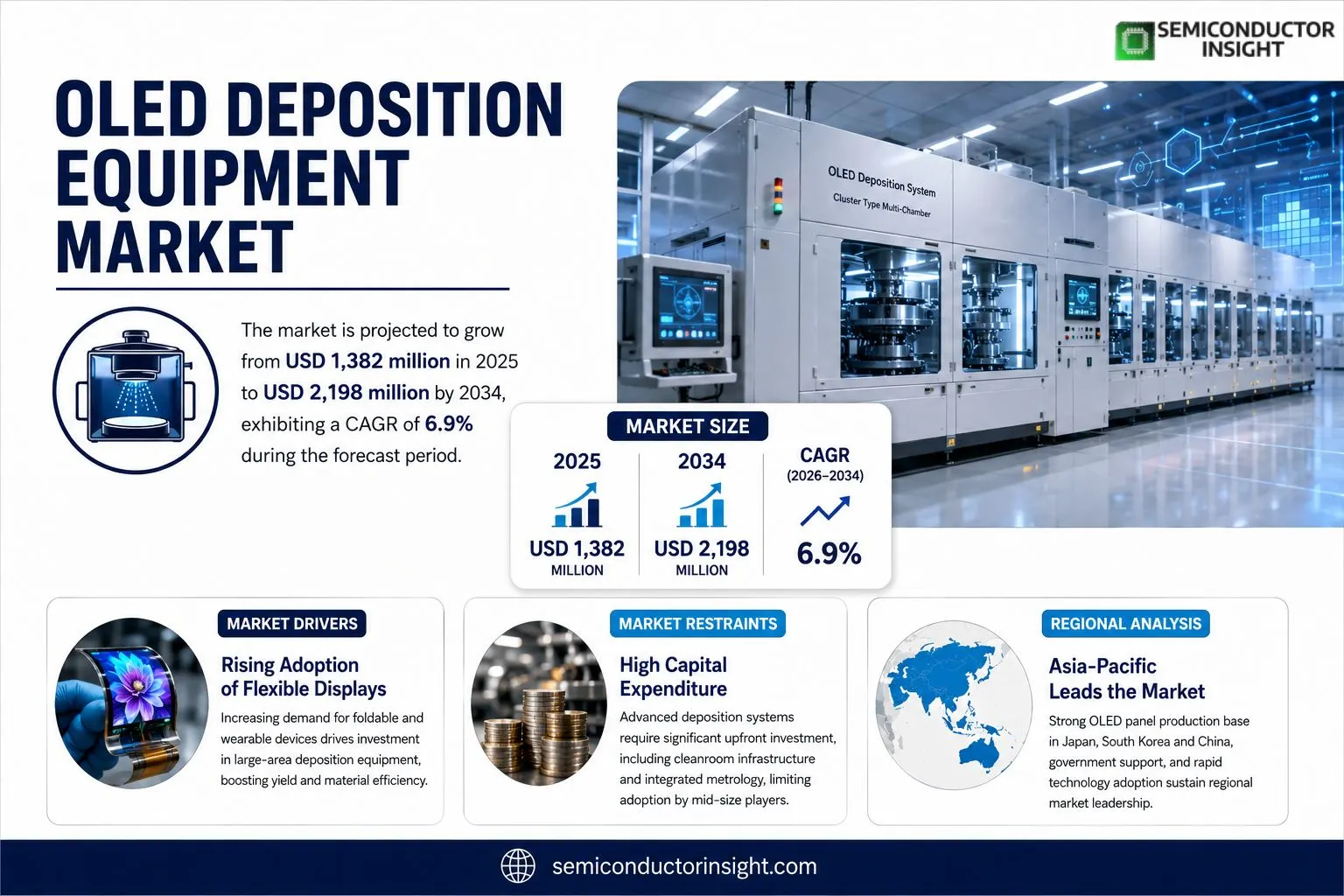
OLED Deposition Equipment market size was valued at USD 1382 million in 2025 and is projected to reach USD 2198 million by 2034, exhibiting a CAGR of 6.9% during the forecast period.
OLED deposition equipment is the core manufacturing system used to precisely deposit organic emissive layers, functional layers, and selected metal layers onto glass or silicon substrates within a high‑vacuum environment. Its primary purpose is to address critical manufacturing challenges such as material utilization efficiency, film‑thickness uniformity, evaporation‑rate stability, mask‑to‑substrate alignment accuracy, particle control, vacuum transfer integrity, and continuous processing without breaking vacuum.The market momentum stems from expanding application scenarios beyond smartphonesIT displays, automotive dashboards, XR microdisplays and lighting solutions are driving demand for larger substrates, higher precision and diversified process routes. Leading suppliers such as Canon Tokki, YAS, Sunic System, SELCOS, SNU Precision and Sineva are shifting from standalone evaporators toward modular multi‑chamber platforms that integrate deposition with encapsulation or alignment functions. Because manufacturers that can optimise material utilization while maintaining stable uptime are best positioned to capture upcoming high‑value orders, investment in next‑generation cluster‑type and inline continuous architectures continues to rise.
MARKET DRIVERS
Rising Adoption of Flexible Displays
OLED Deposition Equipment Market is being propelled by a surge in flexible‑panel production, as consumer brands seek thinner, lighter screens for wearables and foldable smartphones. Manufacturers are allocating a larger share of capex to deposition lines capable of handling large‑area substrates, because the incremental yield from flexible formats outweighs the marginal increase in processing time.
Breakthroughs in Thin‑Film Deposition
Recent improvements in organic‑layer uniformity and low‑temperature processes have lowered defect rates, making high‑resolution panels more reliable. Companies that integrate atomic‑layer‑controlled evaporation see shorter cycle times, which directly supports aggressive volume targets without sacrificing panel quality.
➤ Analysts note that equipment vendors delivering real‑time thickness monitoring are gaining a strategic edge, as operators can now adjust parameters on‑the‑fly to trim waste.
Overall, the convergence of consumer demand for bendable devices and the maturation of deposition technology creates a feedback loop: as more factories invest, suppliers accelerate R&D, delivering even more capable tools that further stimulate adoption.
MARKET CHALLENGES
Cost Sensitivity in High‑Volume Production
Deploying advanced deposition systems entails substantial upfront outlays, and many OEMs operate on thin margins. When a new line is financed, the payback horizon is closely scrutinized; any deviation in yield or downtime inflates the total cost of ownership, prompting cautious rollout schedules.
Other Challenges
Supply Chain Volatility
The reliance on high‑purity organic precursors and specialty gases makes the equipment ecosystem vulnerable to geopolitical shifts and raw‑material shortages, which can delay installation and inflate operating expenses.
MARKET RESTRAINTS
High Capital Expenditure
Even as efficiency gains are evident, the price tag for a full‑scale OLED deposition line remains a barrier for mid‑size manufacturers. The need for clean‑room infrastructure, precision handling robots, and integrated metrology adds layers of cost that deter entry, concentrating market share among a few well‑funded players.
MARKET OPPORTUNITIES
Emerging Automotive Applications
Automakers are experimenting with OLED panels for instrument clusters and ambient lighting, driven by the desire for customizable aesthetics and reduced component count. This nascent demand opens a niche where equipment manufacturers can tailor deposition tools for low‑temperature, high‑reliability modules, positioning themselves at the forefront of a new revenue stream.
OLED Deposition Equipment Market Trends
Shift Toward Modular Multi‑Chamber Platforms
OLED Deposition Equipment Market is witnessing a decisive move from isolated evaporation tools to integrated, modular multi‑chamber systems. Vendors such as Canon Tokki and YAS have unveiled architectures that combine deposition, alignment, and thin‑film encapsulation within a single chassis, allowing customers to switch between glass‑panel and wafer‑level processes without retooling. This engineering approach directly tackles material‑utilization losses and film‑thickness variance, translating into higher yields on larger substrates used for automotive and XR displays. By consolidating vacuum transfer steps, manufacturers reduce cycle time and improve uptime, which in turn boosts the economic case for capital investment. The trend is reinforced by the emergence of point‑source scanning and vertical evaporation modules that can accommodate panel sizes exceeding 10 inches, thereby supporting the next generation of high‑resolution, flexible screens.
Other Trends
Application‑Driven Demand Expansion
Beyond smartphones, the market’s growth engine now includes IT displays, automotive infotainment, and near‑eye XR modules. Companies like Sunic and SNU Precision report increasing orders for equipment capable of handling both glass and silicon wafers, reflecting the diversification of downstream routes. The push for larger, brighter automotive OLED panels has prompted manufacturers to prioritize substrate‑generation compatibility and precise mask‑to‑substrate alignment, attributes that directly affect panel uniformity under automotive thermal cycles. Meanwhile, XR manufacturers are transitioning from glass‑based pilots to wafer‑level OLEDoS lines, a shift that demands tighter process windows and more sophisticated source‑scanning heads. These application pressures create a dual revenue stream for equipment suppliers: refresh cycles for existing smartphone fabs and fresh capital projects for emerging display categories.
Regional Realignment and Supply‑Chain Localization
Japan and South Korea continue to dominate OLED Deposition Equipment Market’s high‑value segment, leveraging deep vacuum‑technology expertise and mass‑production capabilities respectively. Korean firms benefit from government incentives that tie equipment sales to domestic panel expansions, while Japanese players maintain a lead in precision engineering for cluster‑type architectures. At the same time, Chinese and Taiwanese companies such as Sineva and JutVac are closing the gap by localizing key componentsevaporation sources, controllers, and chamber sealsthereby reducing import reliance for domestic OLED fabs. This regional redistribution reshapes the competitive landscape: vendors that can offer modular platforms adaptable to both legacy glass lines and emerging wafer‑level processes stand to capture orders across multiple geographies, while partners that embed localized supply chains will enjoy shorter lead times and lower total cost of ownership for end users.
COMPETITIVE LANDSCAPEKey Industry Players
OLED Deposition Equipment: Competitive Dynamics in a High‑Vacuum Systems Market
Canon Tokki continues to dominate the mass‑production segment, leveraging its long‑standing expertise in cluster‑type thermal evaporation and a broad portfolio that spans glass‑panel and wafer‑level platforms. Applied Materials has entered the arena with its MAX OLED line, offering modular multi‑chamber designs that appeal to customers seeking rapid upgrades and higher throughput. ULVAC holds a pivotal position in the Japanese supply chain, supplying high‑precision evaporation sources and control systems that are favoured by OEMs requiring tight film‑thickness uniformity. Collectively, these firms shape an ecosystem where system integration, aftermarket service depth, and the ability to co‑engineer with material suppliers dictate market share. The competitive structure is therefore less about isolated equipment specifications and more about end‑to‑end turnkey solutions that can be scaled to larger substrates while maintaining process stability.Beyond the headline names, a dense layer of niche players fuels innovation in specialized niches. Sunic System and SNU Precision drive the Korean mass‑production line, delivering cost‑effective inline continuous equipment tailored for automotive and XR display makers. YAS and SELCOS focus on precision alignment modules that improve mask‑to‑substrate accuracy for high‑resolution panels. Sineva, JutVac, and Syskey Technology expand the Chinese and Taiwanese localization effort, offering compact point‑source evaporators and vacuum‑transfer modules. Smaller firms such as Angstrom Engineering, Kurt J. Lesker, MBRAUN, PLASSYS‑BESTEK, Vinci Technologies, Avaco, IMS, and Kitano Seiki provide complementary componentsranging from vacuum‑compatible chambers to bespoke evaporation sourcesthat enable larger equipment manufacturers to assemble customized systems. The breadth of this supplier base creates a competitive pressure that rewards rapid engineering cycles, flexible customization, and robust after‑sales support.
List of Key OLED Deposition Equipment Companies Profiled
- Canon Tokki Corporation
- Applied Materials Inc.
- ULVAC, Inc.
- Sunic System Co., Ltd.
- SNU Precision Co., Ltd.
- YAS Co., Ltd.
- SELCOS Co., Ltd.
- Sineva Technology Co., Ltd.
- JutVac Technology Co., Ltd.
- Syskey Technology Co., Ltd.
- Angstrom Engineering Inc.
- Kurt J. Lesker Company
- MBRAUN GmbH
- PLASSYS‑BESTEK
- Vinci Technologies
- Avaco Ltd.
- IMS Co., Ltd.
- Kitano Seiki Co., Ltd.
Segment Analysis:
| Segment Category | Sub-Segments | Key Insights |
| By Type |
|
OVPD
|
| By Application |
|
AMOLED Displays
|
| By End User |
|
Smartphone panel manufacturers
|
| By System Architecture |
|
Cluster‑Type Equipment
|
| By Substrate Target |
|
Glass‑and‑Wafer Compatible Equipment
|
Regional Analysis: OLED Deposition Equipment Market
Asia‑Pacific
Chinese OLED fabs are expanding their pilot production lines to meet both domestic and export demand. The local policy framework encourages joint ventures between equipment makers and chip foundries, reducing time‑to‑market for new deposition technologies. Suppliers benefit from a rapidly scaling order book, which justifies larger capital allocations toward automation and inline metrology.
South Korean conglomerates maintain a tight integration between design and manufacturing, creating a feedback loop that accelerates equipment refinements. Their emphasis on ultra‑thin organic layers drives demand for deposition systems with tighter thickness control, prompting vendors to differentiate through precision engineering.
Japan’s legacy in materials science supports a robust supply chain for organic precursors, giving local fabs a logistical edge. Equipment manufacturers leverage this proximity to offer customized service packages that combine installation, training and rapid spare‑parts delivery.
Taiwan’s strong semiconductor ecosystem is spilling over into OLED production, with foundries repurposing clean‑room expertise for display lines. This cross‑pollination reduces entry barriers for new deposition platforms, encouraging suppliers to experiment with hybrid process flows.
North America
The United States remains a hub for high‑end OLED research, especially in flexible and transparent displays. While domestic fab capacity is modest, North American firms act as technology incubators, licensing deposition patents to Asian manufacturers. This creates a revenue stream that balances modest local equipment sales with strong intellectual‑property licensing income. Additionally, venture capital funding for next‑generation deposition techniques sustains a pipeline of start‑ups that could reshape equipment architecture in the medium term.
Europe
European players focus on niche OLED applications such as automotive interior lighting and premium automotive dashboards. The region’s stringent environmental regulations drive equipment makers to embed energy‑efficiency features within deposition tools, opening a differentiation avenue beyond pure performance metrics. Collaborative projects funded by the EU often involve multiple equipment vendors, fostering standards that could later be adopted ly, thereby extending European influence despite a smaller manufacturing footprint.
South America
In Brazil and Argentina, OLED adoption is concentrated in consumer electronics imports rather than local panel fabrication. Nevertheless, regional distributors are beginning to stock deposition equipment to support localized prototyping labs for research universities. This nascent activity signals a future where South American engineering talent could attract modest contract manufacturing, offering a low‑cost expansion option for equipment vendors seeking diversified revenue streams.
Middle East & Africa
The Middle East is leveraging sovereign wealth funds to invest in downstream display assembly, aiming to diversify economies beyond oil and gas. Preliminary feasibility studies indicate interest in establishing small‑scale OLED lines, which would require turnkey deposition solutions. In Africa, a handful of technology parks are experimenting with OLED lighting for off‑grid applications; equipment manufacturers see this as an opportunity to tailor deposition tools for low‑volume, high‑reliability production runs.
Report Scope
This market research report provides a comprehensive analysis of the OLED Deposition Equipment Market , covering the forecast period 2026–2034. It offers detailed insights into market dynamics, technological advancements, competitive landscape, and key trends shaping the industry.
Key focus areas of the report include:
- Market Overview: The report begins with an overview outlining its current market scenario, key growth indicators, and industry transformation drivers. It discusses macroeconomic factors, demand–supply balance, regulatory landscape, and the strategic role of semiconductors in powering advancements across industries such as automotive, telecommunications, consumer electronics, and industrial automation.
- Market Size & Forecast: Historical data and future projections for revenue, unit shipments, and market value across major regions and segments.
- Segmentation Analysis: Detailed breakdown by product type, technology, application, and end-user industry to identify high-growth segments and investment opportunities.
- Regional Insights: Insights into market performance across North America, Europe, Asia-Pacific, Latin America, and the Middle East & Africa, including country-level analysis where relevant.
- Competitive Landscape: Profiles of leading market participants, including their product offerings, R&D focus, manufacturing capacity, pricing strategies, and recent developments such as mergers, acquisitions, and partnerships.
- Technology Trends & Innovation: Assessment of emerging technologies, integration of AI/IoT, semiconductor design trends, fabrication techniques, and evolving industry standards.
- Market Drivers & Restraints: Evaluation of factors driving market growth along with challenges, supply chain constraints, regulatory issues, and market-entry barriers.
- Stakeholder Insights: Insights for component suppliers, OEMs, system integrators, investors, and policymakers regarding the evolving ecosystem and strategic opportunities.
Primary and secondary research methods are employed, including interviews with industry experts, data from verified sources, and real-time market intelligence to ensure the accuracy and reliability of the insights presented.
FREQUENTLY ASKED QUESTIONS:
What is the current market size of OLED Deposition Equipment Market?
-> OLED Deposition Equipment Market was valued at USD 1382 million in 2025 and is expected to reach USD 2198 million by 2034 at a CAGR of 6.9% during the forecast period.
Which key companies operate in OLED Deposition Equipment Market?
-> Key players include Canon Tokki, YAS, Sunic, SELCOS, SNU Precision, Sineva, JutVac, Syskey, AMAT, Avaco, ULVAC, among others.
What are the key growth drivers?
-> Key growth drivers include expanding smartphone and flexible display demand, growth of IT and automotive displays, rise of XR microdisplays, and the shift toward larger substrates and higher‑resolution panels.
Which region dominates the market?
-> Asia‑Pacific remains the dominant region, driven by Japan and South Korea’s strong equipment production base and increasing adoption in China.
What are the emerging trends?
-> Emerging trends include modular multi‑chamber systems, integrated deposition‑plus‑encapsulation platforms, wafer‑level OLEDoS equipment, and advanced inline continuous architectures.
Get Sample Report PDF for Exclusive Insights
Report Sample Includes
- Table of Contents
- List of Tables & Figures
- Charts, Research Methodology, and more...
 Download Sample Report PDF