OLED Coating Equipment Market Insights
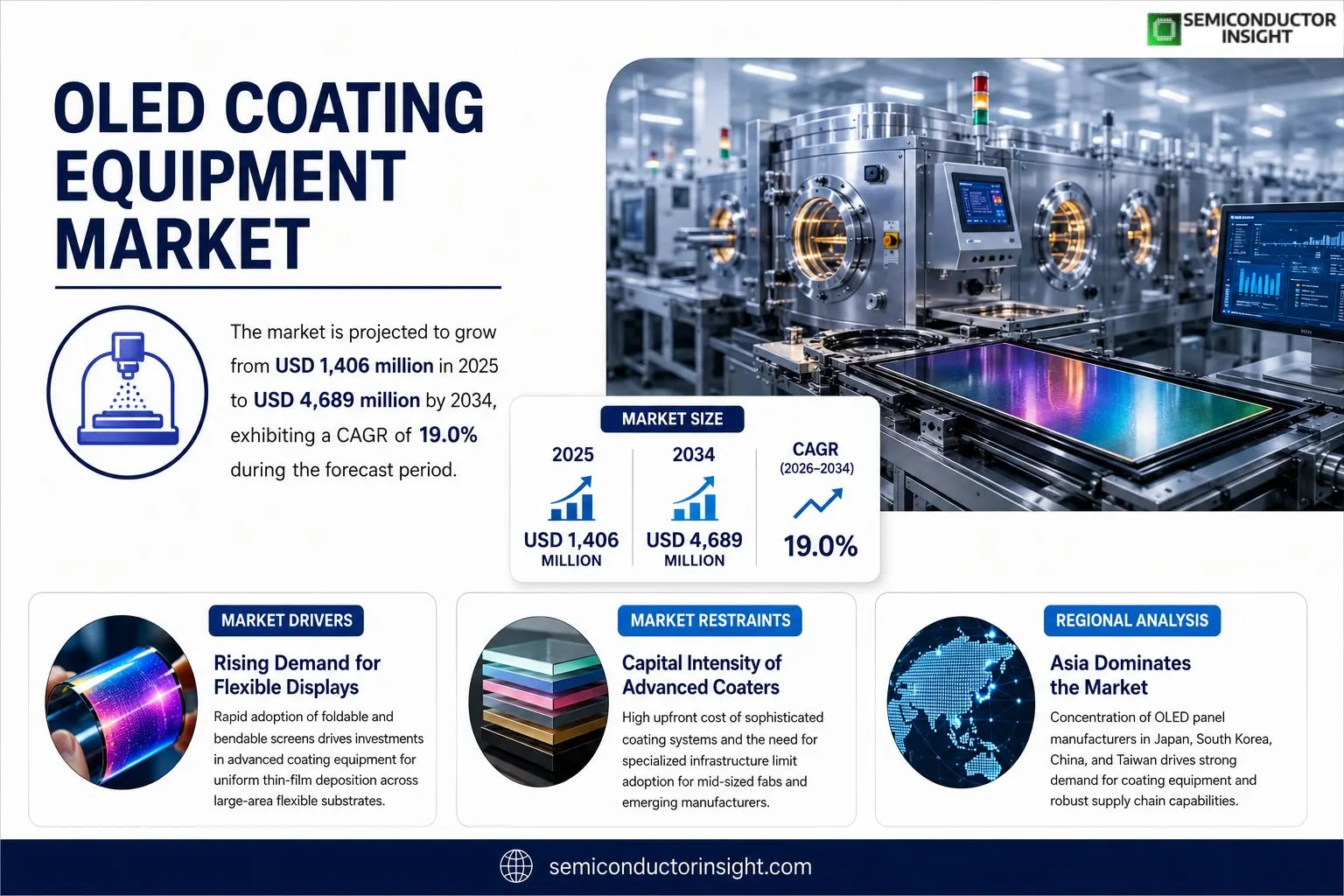
OLED Coating Equipment market was valued at USD 1,406 million in 2025 and is projected to reach USD 4,689 million by 2034, exhibiting a CAGR of 19.0% during the forecast period.
OLED coating equipment serves as the core process tool for manufacturing OLED panels and micro‑OLED devices. It enables precise deposition of organic emissive layers, metal electrodes and, where required, thin‑film encapsulation under tightly controlled vacuum conditions. The technology portfolio includes vacuum thermal evaporation, co‑evaporation, organic vapor phase deposition, inkjet‑printed emissive layers and integrated cluster or inline architectures that combine evaporation, substrate transfer and alignment functions. Primary end‑users comprise display panel manufacturers, OLEDoS producers and research institutes developing advanced display solutions.
MARKET DRIVERS
Rising Demand for Flexible Displays
The surge in consumer preference for bendable and foldable screens is prompting manufacturers to invest heavily in deposition tools that can handle large‑area substrates. OLED coating equipment that offers uniform thin‑film formation across flexible panels becomes a prerequisite for meeting product launch timelines.
Efficiency Gains through Automation
Automated inline coating lines reduce cycle time and lower scrap rates, delivering measurable cost advantages. Plants that integrate robotic handling with real‑time process monitoring report up to 15 % improvement in throughput, a compelling argument for capital allocation.
➤ “Operators who transition to fully automated coating platforms experience a tangible shift from batch‑oriented waste to continuous‑flow productivity,”
These dynamics together create a feedback loop: as manufacturers achieve higher yields, they can price premium flexible products more competitively, further accelerating equipment uptake.
MARKET CHALLENGES
Technical Complexity of Multi‑Layer Structures
Building stacked OLED architectures demands precise control over each organic layer’s thickness and composition. Minor deviations can cause color shift or early failure, raising the skill threshold for equipment operators and maintenance crews.
Other Challenges
Supply‑Chain Volatility
Fluctuations in the availability of high‑purity precursors and specialty gases occasionally force manufacturers to idle coating lines, eroding the anticipated return on investment.
MARKET RESTRAINTS
Capital Intensity of Advanced Coaters
State‑of‑the‑art deposition systems command multimillion‑dollar price tags, a hurdle for midsized fabs that lack deep pockets. The upfront expense, coupled with the need for specialized infrastructure (clean rooms, vibration isolation), deters rapid expansion in regions with limited financing options.
MARKET OPPORTUNITIES
Emerging Applications Beyond Displays
Beyond conventional smartphones and TVs, OLED coating technology is finding traction in automotive heads‑up displays, smart wearables, and medical imaging panels. Each new vertical pushes equipment suppliers to tailor deposition parameters, opening niche revenue streams that complement the core display market.
Geographic Diversification
Investment incentives in Southeast Asia and Eastern Europe are encouraging manufacturers to locate production facilities closer to emerging consumer bases. This relocation trend fuels demand for compact, cost‑effective coating lines that can be deployed in smaller fabs.
OLED Coating Equipment Market Trends
Expansion Beyond Mobile Displays
The equipment sector is experiencing a clear pivot away from its former reliance on smartphone‑grade panels. Suppliers now prioritize large‑area IT OLED lines, automotive instrument clusters, and near‑eye modules for AR/VR headsets. This transition is driven by manufacturers’ desire to capture premium‑price segments and by end‑user demand for higher resolution and flexible form factors. Because the deposition process must simultaneously guarantee sub‑nanometer thickness control and high material efficiency, the market rewards platforms that combine vacuum thermal evaporation with integrated encapsulation chambers. The resulting order books show a balanced mix of mass‑production units for TVs and specialty orders for micro‑OLED displays, signalling a more resilient revenue base for equipment makers.
Other Trends
Regional Competitive Realignment
Japanese firms continue to leverage decades‑long expertise in vacuum stability and precision alignment, securing the bulk of high‑volume line contracts in Japan and South Korea. Korean vendors, closely linked to local AMOLED fabs, have accelerated the rollout of cluster and in‑line architectures that address the rapid capacity expansions of automotive OEMs. Meanwhile, Chinese and Taiwanese players have moved from pure technology followers to credible challengers, especially in the mid‑scale segment where localized service and rapid customization matter more than outright performance margins. European and North American suppliers, while less visible in full‑scale production, dominate niche R&D tools that explore alternative deposition chemistries such as organic vapor phase deposition and ink‑jet emissive‑layer formation.
Technology Diversification and System Integration
Multiple deposition routes are now being pursued in parallel, eroding the monopoly of conventional vacuum thermal evaporation. Ink‑jet approaches champion material savings for small‑substrate AR/VR devices, while OVPD solutions promise higher uniformity for large‑area TV panels. Silicon‑based evaporation equipment, emerging from Chinese innovators, offers a compact footprint that appeals to manufacturers targeting flexible substrates. The strategic implication for equipment vendors is clear: success will hinge on delivering modular, multi‑chamber platforms that can be reconfigured for varying product sizes, material mixes, and throughput requirements. Companies that bundle equipment sales with long‑term process services and spare‑part contracts are positioned to extract higher average selling prices as customers seek end‑to‑end reliability.
COMPETITIVE LANDSCAPE
Key Industry Players
OLED Coating Equipment Market: Competitive Overview
In the high‑vacuum deposition segment, Japanese firms such as Canon Tokki and ULVAC continue to set the benchmark for line stability, material utilization, and pixel‑level precision. Their equipment families combine multi‑chamber transfer, automated substrate handling, and sub‑nanometer thickness control, which translates into higher yield for mass‑production AMOLED panels. Korean suppliers, notably those aligned with the major display manufacturers, have broadened the portfolio to include cluster‑type in‑line architectures that address the growing demand for large‑area TV and automotive displays. The convergence of these capabilitiestight alignment, rapid tact time, and integrated encapsulationcreates a competitive moat that forces newcomers to offer differentiated process routes or superior service responsiveness.Meanwhile, a cohort of Chinese, Taiwanese and European players is reshaping the supply chain by targeting niche and emerging applications. Companies such as Aixtron, SELCOS, and Hefei Sineva introduce alternative deposition chemistriesincluding organic vapor phase deposition and silicon‑based evaporationthat cater to AR/VR near‑eye modules and micro‑OLED research platforms. Smaller specialists like M. Braun Inertgas‑Systeme, TEL, and Angstrom Engineering leverage agile engineering and localized support to win contracts for pilot‑scale validation tools. This diversification of technology pathways and regional service networks is compressing lead times and lowering total cost of ownership for display makers that are expanding beyond smartphones.
List of Key OLED Coating Equipment Companies Profiled
- Canon Tokki
- ULVAC
- Kurt J. Lesker
- Applied Materials
- Aixtron
- M. Braun Inertgas‑Systeme
- Tel
- KITANO SEIKI CO., LTD.
- Sunic System Co., Ltd.
- YAS Co., Ltd.
- SELCOS Co., Ltd.
- Hefei Sineva Intelligent Machine Co., Ltd.
- Jutvac Corporation
- Syskey Technology Co., Ltd.
- Angstrom Engineering Inc.
Segment Analysis:
| Segment Category | Sub-Segments | Key Insights |
| By Type |
|
Vacuum Thermal Evaporation
|
| By Application |
|
AR/VR Near‑Eye Modules
|
| By End User |
|
Display Panel Manufacturers
|
| By Technology Architecture |
|
In‑Line Integrated Lines
|
| By Delivery Format |
|
Pilot‑Scale Validation Platforms
|
Regional Analysis: OLED Coating Equipment Market
Europe
A cluster of high‑volume OLED factories in the Nordics and Central Europe creates a steady demand for precision coating tools, encouraging suppliers to locate engineering hubs close to end users for quicker service response.
EU directives on circular economy push equipment makers to design coating systems that reduce solvent use, aligning product roadmaps with emerging environmental standards.
Proximity to specialty chemical producers and precision optics firms enables a seamless flow of consumables, shortening lead times for critical coating stages.
Joint labs between universities and equipment vendors foster breakthroughs in low‑temperature deposition, a capability that is rapidly becoming a differentiator in the market.
North America
North America’s OLED ecosystem is anchored by a handful of large display manufacturers that rely on flexible coating platforms for high‑end TV and automotive applications. The region benefits from a strong venture‑capital culture that funds niche startups focusing on next‑generation organic materials. However, the fragmented nature of production sites across the United States and Canada introduces logistics challenges, prompting equipment providers to adopt a modular approach that can be relocated with minimal downtime. Intellectual‑property considerations also shape partnership models, as firms seek licensing agreements that protect proprietary coating chemistries while granting access to cutting‑edge hardware. For OLED Coating Equipment Market, these dynamics generate a demand for adaptable machines that can serve both large OEMs and emerging niche players.
Asia‑Pacific
Asia‑Pacific remains the largest consumer of OLED display panels, with production nodes spanning China, South Korea, and Taiwan. The sheer scale of output drives a relentless push for higher throughput and lower per‑unit cost in coating operations. Local governments often provide tax incentives for high‑tech equipment imports, encouraging multinational vendors to establish regional service centers. Yet, rapid capacity expansions can outpace the maturation of local supply chains, leading to occasional bottlenecks in specialty gases and solvents. This tension forces equipment manufacturers to balance aggressive pricing with robust after‑sales support, a formula that defines competitive positioning within OLED Coating Equipment Market across the region.
South America
South America’s OLED activity is modest, confined mainly to pilot lines and research institutions in Brazil and Argentina. Market participants view the region as a testing ground for low‑cost coating technologies that can later be scaled to larger markets. Governmental emphasis on technology transfer and workforce development creates opportunities for equipment providers willing to engage in long‑term training programs. Although volume remains limited, the strategic intent to build a regional manufacturing base is evident, offering a niche yet potentially valuable segment for suppliers aiming to diversify their geographic footprint.
Middle East & Africa
In the Middle East and Africa, OLED adoption is driven primarily by premium display projects in luxury hotels and high‑end commercial signage. Local investors are attracted to the prestige associated with cutting‑edge display technologies, prompting a small but growing demand for turnkey coating solutions. Partnerships with European equipment firms are common, as they bring proven expertise into markets where in‑house capabilities are still nascent. Supply chain constraints, particularly the limited availability of high‑purity chemicals, compel vendors to offer comprehensive service contracts that include logistics management. For OLED Coating Equipment Market, this region represents a boutique opportunity where brand reputation and total‑solution offerings weigh heavily in purchasing decisions.
Report Scope
This market research report provides a comprehensive analysis of the OLED Coating Equipment Market , covering the forecast period 2026–2034. It offers detailed insights into market dynamics, technological advancements, competitive landscape, and key trends shaping the industry.
Key focus areas of the report include:
- Market Overview: The report begins with an overview outlining its current market scenario, key growth indicators, and industry transformation drivers. It discusses macroeconomic factors, demand–supply balance, regulatory landscape, and the strategic role of semiconductors in powering advancements across industries such as automotive, telecommunications, consumer electronics, and industrial automation.
- Market Size & Forecast: Historical data and future projections for revenue, unit shipments, and market value across major regions and segments.
- Segmentation Analysis: Detailed breakdown by product type, technology, application, and end-user industry to identify high-growth segments and investment opportunities.
- Regional Insights: Insights into market performance across North America, Europe, Asia-Pacific, Latin America, and the Middle East & Africa, including country-level analysis where relevant.
- Competitive Landscape: Profiles of leading market participants, including their product offerings, R&D focus, manufacturing capacity, pricing strategies, and recent developments such as mergers, acquisitions, and partnerships.
- Technology Trends & Innovation: Assessment of emerging technologies, integration of AI/IoT, semiconductor design trends, fabrication techniques, and evolving industry standards.
- Market Drivers & Restraints: Evaluation of factors driving market growth along with challenges, supply chain constraints, regulatory issues, and market-entry barriers.
- Stakeholder Insights: Insights for component suppliers, OEMs, system integrators, investors, and policymakers regarding the evolving ecosystem and strategic opportunities.
Primary and secondary research methods are employed, including interviews with industry experts, data from verified sources, and real-time market intelligence to ensure the accuracy and reliability of the insights presented.
FREQUENTLY ASKED QUESTIONS:
What is the current market size of OLED Coating Equipment Market?
-> OLED Coating Equipment Market was valued at USD 1406 million in 2025 and is expected to reach USD 4689 million by 2034, growing at a CAGR of 19.0% over the forecast period.
Which key companies operate in OLED Coating Equipment Market?
-> Key players include Canon Tokki, ULVAC, Kurt J. Lesker, Applied Materials (AMAT), Aixtron, M. Braun Inertgas‑Systeme, TEL, KITANO SEIKI CO., LTD., Sunic System Co., Ltd., YAS Co., Ltd., SELCOS Co., Ltd., Hefei Sineva Intelligent Machine Co., Ltd., Jutvac Corporation, Syskey Technology Co., Ltd., Angstrom Engineering Inc..
What are the key growth drivers?
-> Key growth drivers include technological upgrades (vacuum thermal evaporation, inkjet‑printed emissive layers, OVPD), expanding application portfolio (IT‑OLED, automotive displays, AR/VR near‑eye displays, large‑area TVs), supportive government policies and subsidies in China and South Korea, and increasing demand for high‑precision, high‑value OLED modules.
Which region dominates the market?
-> Asia (East Asia) dominates OLED Coating Equipment Market, driven by the concentration of mass‑production manufacturers and strong supply‑chain capabilities in Japan, South Korea, and China.
What are the emerging trends?
-> Emerging trends include multiple parallel deposition routes (vacuum thermal evaporation, inkjet, OVPD), integration of encapsulation and multi‑chamber architectures, focus on micro‑OLED and near‑eye displays for AR/VR, and increasing localization of supply chains in mainland China and Taiwan.
Get Sample Report PDF for Exclusive Insights
Report Sample Includes
- Table of Contents
- List of Tables & Figures
- Charts, Research Methodology, and more...
 Download Sample Report PDF