
NTC Temperature Sensors for Charging Pile Market Insights
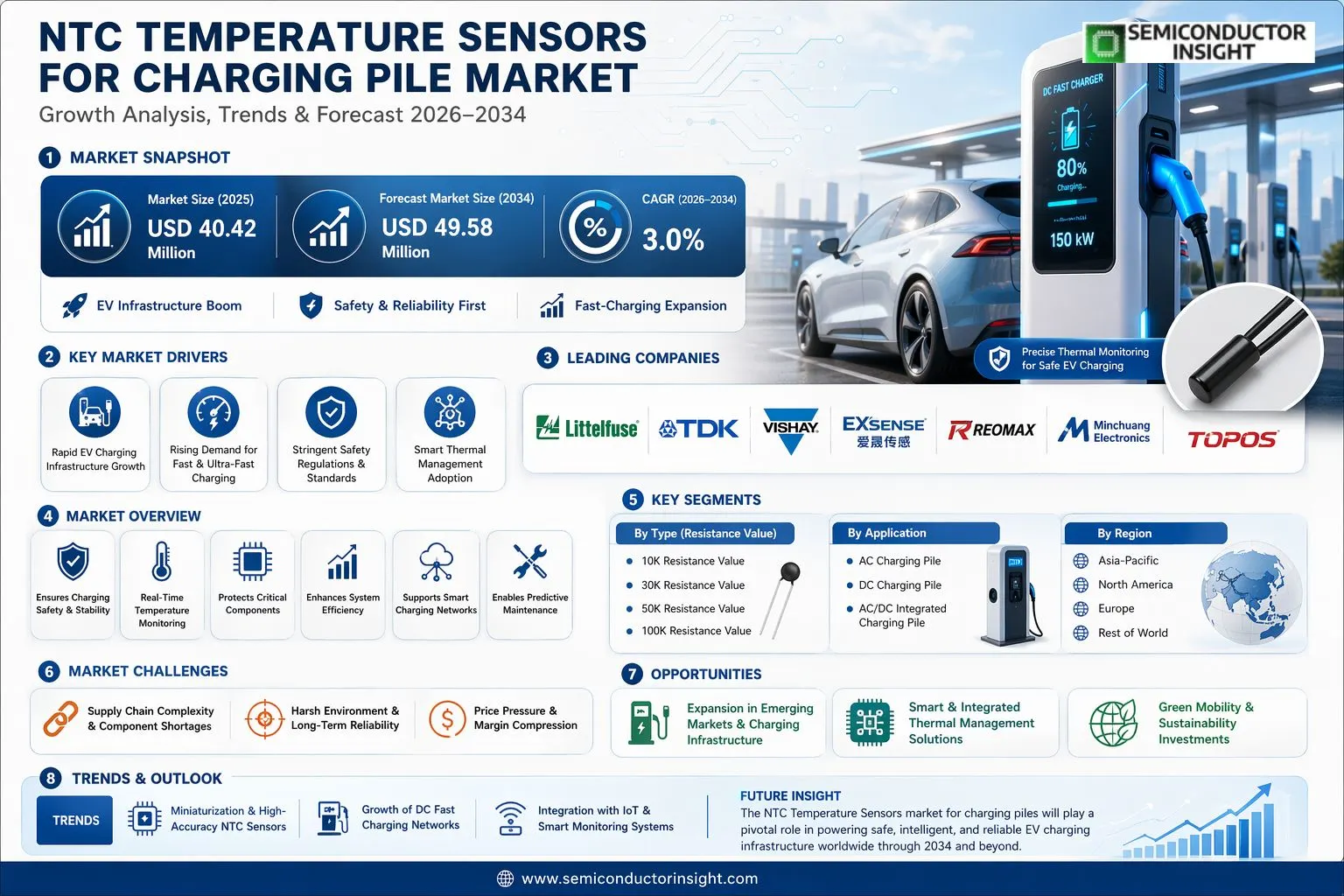
Global NTC Temperature Sensors for Charging Pile market size was valued at USD 40.42 million in 2025. The market is projected to grow from USD 41.63 million in 2026 to USD 49.58 million by 2034, exhibiting a CAGR of 3.0% during the forecast period.
NTC Temperature Sensors for Charging Pile are thermistor-based sensors designed specifically for temperature monitoring in electric vehicle (EV) charging stations. The defining characteristic of an NTC (Negative Temperature Coefficient) temperature sensor is that its resistance value decreases as temperature rises and increases as temperature falls. By continuously measuring these resistance fluctuations, the sensor enables real-time monitoring of equipment thermal conditions, thereby protecting the operational safety and system stability of charging infrastructure. These sensors are available across multiple resistance value configurations, including 10K, 30K, 50K, and 100K variants, catering to AC Charging Piles, DC Charging Piles, and AC/DC Integrated Charging Piles.
The market is gaining steady momentum driven by the accelerating global adoption of electric vehicles and the corresponding expansion of public and private EV charging infrastructure. Growing regulatory mandates for EV adoption across North America, Europe, and Asia are compelling charging pile manufacturers to integrate more precise and reliable thermal management components. Littelfuse, TDK, Vishay, Exsense, Reomax, Minchuang Electronics, Sensicom, Weilian, and TOPOS are among the key global manufacturers operating in this market, collectively shaping competitive dynamics through product innovation and regional expansion strategies.
MARKET DRIVERS
Rapid Expansion of Electric Vehicle Infrastructure Fueling Demand for NTC Temperature Sensors in Charging Piles
Global transition toward electric mobility has emerged as one of the most significant catalysts accelerating the adoption of NTC temperature sensors for charging pile applications. As governments across North America, Europe, and Asia-Pacific introduce increasingly stringent emission reduction mandates and commit to phasing out internal combustion engine vehicles, the deployment of EV charging infrastructure has witnessed unprecedented growth. Charging piles,both AC and DC fast chargers,rely heavily on negative temperature coefficient (NTC) thermistors to continuously monitor thermal conditions across power modules, connectors, and battery interfaces. This monitoring is critical for preventing overheating, ensuring operational efficiency, and extending the lifespan of charging equipment.
Stringent Safety Standards and Thermal Management Requirements Driving NTC Sensor Integration
Safety compliance is a fundamental driver shaping the NTC temperature sensors for charging pile market. International standards such as IEC 61851, UL 2202, and GB/T 20234 mandate precise thermal monitoring throughout charging systems to mitigate risks of electrical fires, insulation failures, and component degradation. NTC thermistors, known for their high sensitivity, compact form factor, and cost-effective performance, are increasingly specified by charging pile manufacturers as the preferred sensing solution. Their ability to detect even minor temperature deviations in real time enables intelligent thermal management systems to adjust charging rates dynamically, safeguarding both the charging infrastructure and the connected electric vehicle.
➤ As DC fast charging technologies advance toward ultra-high power outputs exceeding 350 kW, the thermal loads on charging pile components intensify significantly, making precision NTC temperature sensing not merely a regulatory requirement but an operational necessity for reliable and safe charging performance.
The proliferation of smart charging ecosystems further reinforces the role of NTC temperature sensors within charging pile architectures. Modern charging piles incorporate energy management systems, grid interaction capabilities, and predictive maintenance algorithms, all of which depend on accurate, real-time temperature data streams. NTC sensors provide the granular thermal intelligence that enables these advanced functionalities, positioning them as indispensable components across residential, commercial, and highway fast-charging installations globally.
MARKET CHALLENGES
Calibration Complexity and Non-Linearity of NTC Thermistors Posing Technical Hurdles in Charging Pile Deployments
Despite their widespread adoption, NTC temperature sensors present inherent technical challenges that manufacturers and system integrators must address within the charging pile market. The non-linear resistance-temperature relationship characteristic of NTC thermistors necessitates sophisticated signal conditioning and calibration processes to achieve the measurement accuracy demanded by high-power charging applications. Variations in thermistor characteristics across production batches can introduce measurement inconsistencies, requiring manufacturers to invest in rigorous quality control protocols and advanced compensation algorithms. These technical requirements can increase both development timelines and overall system costs for charging pile OEMs.
Other Challenges
Supply Chain Vulnerabilities and Raw Material Constraints
The production of NTC thermistors depends on specialized ceramic metal oxide materials, including manganese, nickel, and cobalt oxides, which are subject to supply chain disruptions and price volatility. Geopolitical uncertainties and concentration of raw material sourcing in limited geographic regions expose NTC temperature sensor manufacturers serving the charging pile market to procurement risks. These pressures can translate into component shortages during periods of surging EV infrastructure demand, potentially constraining the pace of charging pile deployment.
Competition from Alternative Temperature Sensing Technologies
The NTC temperature sensors for charging pile market faces growing competitive pressure from alternative sensing technologies, including resistance temperature detectors (RTDs), thermocouples, and digital temperature sensor ICs. In high-precision or extreme-temperature applications within certain charging pile segments, these alternatives may offer performance advantages such as superior linearity or broader measurement ranges. Charging pile manufacturers evaluating long-term designs must weigh the cost-performance trade-offs across these technologies, which introduces market share risk for traditional NTC thermistor suppliers.
MARKET RESTRAINTS
Price Sensitivity and Cost Reduction Pressures in the Charging Pile Supply Chain Limiting Premium Sensor Adoption
The highly competitive landscape of the EV charging infrastructure market exerts persistent downward pricing pressure throughout the supply chain, including on component suppliers of NTC temperature sensors for charging piles. Charging pile manufacturers, particularly those targeting mass-market residential and semi-public charging segments, prioritize bill-of-materials cost optimization as a primary design objective. This commercial environment can inhibit the adoption of higher-specification NTC sensor variants that offer enhanced accuracy, improved long-term stability, or extended temperature ranges, as procurement decisions frequently default to the lowest-cost compliant solution. Such dynamics may restrain revenue growth for sensor manufacturers investing in premium product development.
Standardization Gaps and Fragmented Regulatory Frameworks Across Regional Markets
The absence of fully harmonized international standards governing temperature sensing requirements specifically within charging pile systems represents a meaningful restraint on market efficiency. Divergent regional regulatory frameworks,spanning the European Union, the United States, China, and emerging EV markets,require NTC temperature sensor manufacturers to develop and certify application-specific variants tailored to differing compliance requirements. This fragmentation increases product development costs, extends certification timelines, and complicates global supply strategies. Until greater standardization emerges across major charging pile markets, these structural inefficiencies will continue to moderate the pace of market consolidation and scalable growth for sensor suppliers.
MARKET OPPORTUNITIES
Growing Adoption of Ultra-Fast and Wireless Charging Technologies Creating Advanced NTC Sensor Demand
The accelerating development of ultra-fast DC charging platforms and emerging wireless power transfer technologies presents substantial growth opportunities for NTC temperature sensors in the charging pile market. Ultra-fast chargers operating at power levels above 150 kW generate significantly elevated thermal stresses across power electronics, busbars, and cable assemblies, creating demand for high-accuracy, fast-response NTC thermistors capable of supporting dynamic thermal management at greater sensor density. Wireless charging pads for EVs introduce additional thermal monitoring requirements at the coil and power conversion stages, representing a nascent but high-potential application segment for specialized NTC sensing solutions.
Expansion of Public Charging Networks in Emerging Economies Unlocking New Market Frontiers
Emerging economies across Southeast Asia, Latin America, the Middle East, and Africa are in the early stages of establishing public EV charging infrastructure, driven by national electrification policies and growing consumer EV adoption. This infrastructure build-out represents a significant incremental demand opportunity for NTC temperature sensors for charging pile applications. Governments in these regions are increasingly channeling investments into domestic EV ecosystem development, including incentives for charging network operators, which is expected to sustain multi-year demand growth for charging pile components. NTC sensor manufacturers with cost-competitive product portfolios and flexible supply chain capabilities are well positioned to capture early mover advantages in these high-growth geographic markets.
Integration of IoT and Predictive Maintenance Capabilities Elevating the Strategic Value of NTC Sensors
The broader digitalization of charging infrastructure through IoT connectivity and cloud-based energy management platforms is elevating the strategic importance of NTC temperature sensors within charging pile systems. As operators seek to maximize uptime, reduce maintenance costs, and optimize energy utilization across distributed charging networks, real-time temperature data from NTC sensors is increasingly integrated into predictive analytics and remote diagnostics platforms. This functional evolution positions NTC temperature sensors not merely as passive safety components but as active contributors to intelligent charging ecosystem performance. Sensor manufacturers that develop enhanced digital output variants and collaborate with charging management software providers stand to benefit from this convergence of hardware sensing and data-driven operational intelligence.
NTC Temperature Sensors for Charging Pile Market () Trends
Rising Electric Vehicle Adoption Driving Demand for NTC Temperature Sensors in Charging Infrastructure
The NTC Temperature Sensors for Charging Pile market is experiencing steady growth, primarily driven by the accelerating global transition toward electric vehicles and the corresponding expansion of EV charging infrastructure. As governments across North America, Europe, and Asia-Pacific introduce stricter emissions regulations and offer incentives for EV adoption, the deployment of both AC and DC charging piles has intensified considerably. NTC temperature sensors play an essential role in this infrastructure by continuously monitoring thermal conditions within charging stations, ensuring operational safety and system stability. The characteristic behavior of NTC thermistors , where resistance decreases as temperature rises , makes them highly suitable for real-time temperature monitoring in high-current charging environments. Key manufacturers such as Littelfuse, TDK, and Vishay continue to invest in refining sensor accuracy and durability to meet the increasingly demanding requirements of modern charging pile systems.
Other Trends
Shift Toward DC and AC/DC Integrated Charging Piles
One of the most notable trends reshaping the NTC Temperature Sensors for Charging Pile market is the growing preference for DC fast charging and AC/DC integrated charging pile solutions. DC charging piles operate at significantly higher power levels compared to standard AC units, generating greater heat loads that require more precise and reliable thermal management. This has elevated the importance of high-performance NTC temperature sensors capable of functioning accurately under sustained thermal stress. The AC/DC integrated charging pile segment is also gaining traction as operators seek versatile, space-efficient installations, further broadening the application scope for NTC sensors across diverse charging pile configurations.
Growing Preference for Higher Resistance Value Sensors
Within the product type landscape, the NTC Temperature Sensors for Charging Pile market is witnessing increased interest in sensors across multiple resistance value segments, including 10K, 30K, 50K, and 100K resistance value variants. Selection of resistance value is closely tied to the specific thermal range and precision requirements of the charging pile system. As charging pile designs evolve to support higher power outputs and more complex circuit architectures, demand for sensors with well-defined resistance-temperature characteristics is expected to remain robust across all major resistance segments.
Regional Expansion and Competitive Landscape Shaping Market Dynamics
Regionally, Asia , particularly China , represents a dominant force in the NTC Temperature Sensors for Charging Pile market, supported by large-scale government-backed EV infrastructure programs and a strong base of domestic sensor manufacturers including Exsense, Reomax, Minchuang Electronics, Sensicom, Weilian, and TOPOS. North America and Europe are also emerging as significant markets, driven by ambitious EV deployment targets and the rapid buildout of public and private charging networks. The competitive environment is characterized by a mix of established global component manufacturers and specialized regional players, all focused on improving sensor miniaturization, response time, and long-term reliability to align with the evolving technical standards of next-generation charging pile systems.
COMPETITIVE LANDSCAPE
Key Industry Players
NTC Temperature Sensors for Charging Pile Market , Global Competitive Overview and Leading Manufacturer Analysis
Global NTC Temperature Sensors for Charging Pile market, valued at USD 40.42 million in 2025 and projected to reach USD 49.58 million by 2034 at a CAGR of 3.0%, is characterized by a moderately consolidated competitive landscape. Littelfuse, TDK, and Vishay stand out as dominant multinational players, leveraging decades of expertise in passive electronic components and thermistor technology to secure significant revenue shares. These established corporations benefit from vertically integrated manufacturing capabilities, robust global distribution networks, and strong R&D investment, enabling them to serve the rapidly expanding electric vehicle (EV) charging infrastructure segment across North America, Europe, and Asia. Their product portfolios span multiple resistance value configurations , including 10K, 30K, 50K, and 100K , catering to diverse AC Charging Pile, DC Charging Pile, and AC/DC Integrated Charging Pile applications. The top five global players collectively commanded a substantial share of total market revenue in 2025, underscoring the competitive advantage held by technologically advanced, large-scale manufacturers.
Beyond the leading multinationals, a number of specialized and regionally focused manufacturers play a significant role in shaping the competitive dynamics of the NTC Temperature Sensors for Charging Pile market. Chinese manufacturers such as Exsense, Reomax, Minchuang Electronics, Sensicom, Weilian, and TOPOS have emerged as important contributors, particularly within the Asia-Pacific region where China represents one of the largest and fastest-growing markets for EV charging infrastructure. These companies compete on the basis of cost efficiency, application-specific customization, and proximity to major charging pile OEMs and system integrators. As Global push toward electrification accelerates, both established leaders and emerging regional players are investing in product innovation, strategic partnerships, and capacity expansion to capture a greater share of this growing market.
List of Key NTC Temperature Sensors for Charging Pile Companies Profiled
- Littelfuse
- TDK
- Vishay
- Exsense
- Reomax
- Minchuang Electronics
- Sensicom
- Weilian
- TOPOS
Segment Analysis:
| Segment Category | Sub-Segments | Key Insights |
| By Type |
|
10K Resistance Value sensors represent the leading segment within the NTC Temperature Sensors for Charging Pile market, owing to their wide compatibility with mainstream charging pile control circuits and thermal management systems.
|
| By Application |
|
DC Charging Pile emerges as the dominant application segment for NTC Temperature Sensors, driven by the rapid proliferation of fast-charging infrastructure globally to support growing electric vehicle adoption.
|
| By End User |
|
Commercial Charging Station Operators constitute the leading end-user segment, as expanding public and semi-public charging networks across urban and highway corridors drive sustained procurement of temperature sensing components.
|
| By Mounting Technology |
|
Probe-Type NTC Sensors hold a prominent position in the charging pile market due to their versatility in direct contact-based temperature measurement of critical components such as power modules, busbars, and charging cables.
|
| By Sales Channel |
|
Direct Sales (OEM/ODM) channels dominate the NTC Temperature Sensors for Charging Pile market, as large-scale charging pile manufacturers and system integrators prefer long-term direct procurement relationships with sensor suppliers to ensure consistent quality, customized specifications, and reliable supply chain continuity.
|
Regional Analysis: NTC Temperature Sensors for Charging Pile Market
China’s massive state-directed investment in EV charging infrastructure has created an unrivaled demand environment for NTC temperature sensors for charging pile applications. The country’s charging pile rollout spans highways, commercial hubs, and residential zones, each requiring reliable thermal sensing solutions to ensure operational safety, energy efficiency, and regulatory compliance across diverse deployment conditions.
The Asia-Pacific region hosts a vertically integrated supply chain for NTC temperature sensor production, from raw material sourcing to precision component assembly. This structural advantage allows regional manufacturers to respond swiftly to evolving charging pile design requirements, reduce lead times, and maintain cost competitiveness, further entrenching the region’s leadership in Global market landscape.
Across Asia-Pacific, national EV policies and emissions reduction frameworks are directly stimulating charging pile deployment, which in turn fuels adoption of NTC temperature sensors. Countries including India, South Korea, and Vietnam are progressively expanding their EV infrastructure blueprints, creating new regional pockets of demand and broadening the market’s geographic spread within the Asia-Pacific corridor.
Asia-Pacific’s R&D investment in miniaturized, high-accuracy NTC temperature sensors is accelerating product development tailored specifically to next-generation fast-charging and ultra-fast charging pile architectures. Japanese and South Korean sensor manufacturers are particularly active in advancing sensor response times and durability benchmarks, setting regional innovation standards that are increasingly influencing global product development directions.
North America
North America represents a strategically significant and rapidly maturing market for NTC temperature sensors for charging pile applications. The United States, propelled by federal clean energy legislation and state-level EV incentive programs, is witnessing accelerated deployment of public and private charging infrastructure across its major metropolitan corridors and interstate highway networks. This expansion directly elevates demand for precision thermal sensing components embedded within charging pile hardware. The Canadian market is emerging as a complementary growth zone, supported by national zero-emission vehicle strategies and expanding urban charging networks. North American OEMs and Tier-1 automotive suppliers are increasingly prioritizing thermal management reliability within their EV ecosystem solutions, which is driving procurement of advanced NTC temperature sensors. Additionally, the region’s focus on grid resilience and smart charging interoperability is shaping sensor specifications toward greater accuracy and broader operational temperature tolerance, reflecting evolving industry standards.
Europe
Europe occupies a prominent position in the NTC temperature sensors for charging pile market, underpinned by some of the world’s most stringent automotive emissions regulations and an ambitious pan-continental EV infrastructure expansion agenda. The European Union’s Alternative Fuels Infrastructure Regulation is compelling member states to scale charging point density significantly along major transport corridors, creating a structured and sustained demand environment for high-performance NTC temperature sensors. Germany, France, the Netherlands, and the Nordic countries are among the leading adopters, with their advanced automotive industries integrating thermal sensing solutions into both AC and DC fast-charging pile designs. European market participants place strong emphasis on sensor longevity, environmental certifications, and compliance with regional quality standards, encouraging suppliers to develop robust, application-specific NTC sensor variants tailored to the unique demands of the European charging infrastructure landscape.
South America
South America presents an evolving and opportunity-rich frontier for the NTC temperature sensors for charging pile market, with growth trajectories closely tied to the region’s gradual but accelerating EV adoption curve. Brazil leads the regional market, supported by a growing urban EV user base and government-backed initiatives aimed at reducing transportation-related emissions in densely populated cities. Chile and Colombia are also emerging as meaningful contributors, with targeted EV infrastructure programs supporting charging pile installations in key urban centers. While the pace of deployment remains comparatively measured relative to Asia-Pacific and Europe, improving economic conditions and increasing automaker interest in South American markets are fostering a more favorable environment for NTC temperature sensor demand. Local distribution partnerships and regional adaptation of sensor technologies to tropical and high-altitude operating conditions are expected to shape market development strategies through the forecast period.
Middle East & Africa
The Middle East and Africa region is at a nascent but increasingly active stage of development within the NTC temperature sensors for charging pile market. Gulf Cooperation Council nations, particularly the UAE and Saudi Arabia, are making deliberate strides toward EV infrastructure buildout as part of their broader economic diversification and sustainability agendas. Flagship smart city projects and tourism-driven transport electrification initiatives are creating early-stage but growing demand for charging piles equipped with reliable thermal management components including NTC temperature sensors. South Africa represents the primary growth node on the African continent, with urban mobility electrification programs beginning to gain traction. Across the region, extreme ambient temperature conditions present both a technical challenge and a differentiation opportunity for NTC temperature sensor manufacturers, as thermal resilience and wide operating range become critical selection criteria for charging pile operators in these demanding environments.
Report Scope
This market research report provides a comprehensive analysis of the NTC Temperature Sensors for Charging Pile Market, covering the forecast period 2026–2034. It offers detailed insights into market dynamics, technological advancements, competitive landscape, and key trends shaping the industry.
Key focus areas of the report include:
- Market Overview: The report begins with an overview outlining its current market scenario, key growth indicators, and industry transformation drivers. It discusses macroeconomic factors, demand–supply balance, regulatory landscape, and the strategic role of NTC temperature sensors in powering advancements across industries such as electric vehicles, automotive, energy infrastructure, and industrial automation.
- Market Size & Forecast: Historical data and future projections for revenue, unit shipments, and market value across major regions and segments.
- Segmentation Analysis: Detailed breakdown by product type (10K, 30K, 50K, 100K Resistance Value), application (AC Charging Pile, DC Charging Pile, AC/DC Integrated Charging Pile), and end-user industry to identify high-growth segments and investment opportunities.
- Regional Insights: Insights into market performance across North America, Europe, Asia-Pacific, Latin America, and the Middle East & Africa, including country-level analysis where relevant.
- Competitive Landscape: Profiles of leading market participants, including their product offerings, R&D focus, manufacturing capacity, pricing strategies, and recent developments such as mergers, acquisitions, and partnerships.
- Technology Trends & Innovation: Assessment of emerging technologies, integration of AI/IoT, thermistor design trends, fabrication techniques, and evolving industry standards for EV charging infrastructure.
- Market Drivers & Restraints: Evaluation of factors driving market growth along with challenges, supply chain constraints, regulatory issues, and market-entry barriers.
- Stakeholder Insights: Insights for component suppliers, OEMs, system integrators, investors, and policymakers regarding the evolving ecosystem and strategic opportunities.
Primary and secondary research methods are employed, including interviews with industry experts, data from verified sources, and real-time market intelligence to ensure the accuracy and reliability of the insights presented.
FREQUENTLY ASKED QUESTIONS:
What is the current market size of NTC Temperature Sensors for Charging Pile Market?
-> Global NTC Temperature Sensors for Charging Pile Market was valued at USD 40.42 million in 2025 and is expected to reach USD 49.58 million by 2034, growing at a CAGR of 3.0% during the forecast period.
Which key companies operate in NTC Temperature Sensors for Charging Pile Market?
-> Key players include Littelfuse, TDK, Vishay, Exsense, Reomax, Minchuang Electronics, Sensicom, Weilian, and TOPOS, among others. In 2025, Global top five players held a significant share in terms of revenue in Global market.
What are the key growth drivers?
-> Key growth drivers include rapid expansion of electric vehicle charging infrastructure, rising EV adoption globally, increasing demand for temperature monitoring and safety in charging stations, and growing investments in smart charging technologies. NTC temperature sensors play a critical role in protecting the safety and stability of charging station systems by monitoring resistance changes corresponding to temperature variations.
Which region dominates the market?
-> Asia is a leading region in the NTC Temperature Sensors for Charging Pile Market, driven by strong EV adoption in China, Japan, South Korea, and Southeast Asia. North America and Europe are also significant markets supported by growing EV infrastructure investments and regulatory mandates for clean transportation.
What are the emerging trends?
-> Emerging trends include integration of NTC sensors in AC/DC integrated charging piles, miniaturization of thermistor components, adoption of smart temperature monitoring systems, and increasing use of high-resistance value sensors (50K and 100K) for enhanced precision in next-generation EV charging infrastructure.

Get Sample Report PDF for Exclusive Insights
Report Sample Includes
- Table of Contents
- List of Tables & Figures
- Charts, Research Methodology, and more...
 Download Sample Report PDF


