NOR Flash for Cars Market Insights
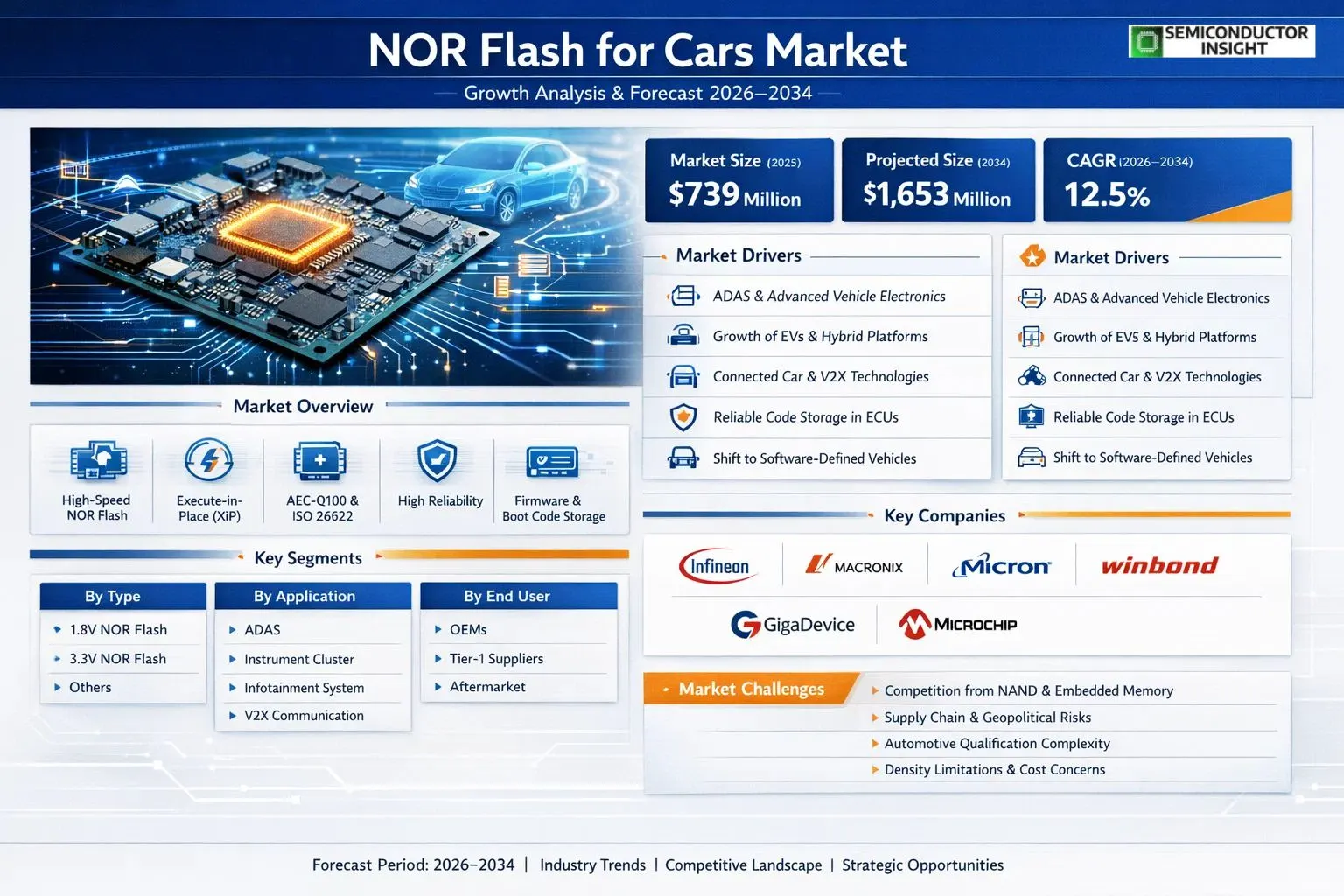
Global NOR Flash for Cars market size was valued at USD 739 million in 2025. The market is projected to grow from USD 830 million in 2026 to USD 1,653 million by 2034, exhibiting a CAGR of 12.5% during the forecast period.
Automotive-grade NOR Flash is a flash memory chip based on NOR technology, which combines the fast read speed and random access capability of NOR Flash with the high reliability and long service life required by automotive-grade products. This chip is typically deployed to store system code, critical data, and configuration files, supporting the normal operation of automotive and industrial equipment. Automotive-grade NOR Flash must conform to stringent automotive and industrial standards, including AEC-Q100 and ISO 26262, ensuring stable and reliable performance across extreme environmental conditions. NOR Flash is extensively utilized across automotive electronics applications, encompassing Advanced Driver Assistance Systems (ADAS), in-vehicle infotainment systems, intelligent driving systems, and navigation systems.
The market is experiencing robust growth driven by the accelerating trend of automotive electrification and intelligence, the rapid proliferation of ADAS platforms, and ongoing innovation in automotive infotainment systems. Furthermore, the rapid expansion of new energy vehicles , particularly in China, which accounts for approximately 32% of the global NOR Flash for Cars market , is reinforcing domestic supply chain localization efforts and intensifying demand. Key players operating in the global NOR Flash for Cars market include Infineon Technologies, Macronix, Winbond, Micron, and GigaDevice, with the top five players collectively holding a market share of approximately 84%.
MARKET DRIVERS
Rising Demand for Advanced In-Vehicle Electronics and ADAS Integration
NOR Flash for Cars Market is experiencing significant momentum driven by the accelerating adoption of advanced driver assistance systems (ADAS) and in-vehicle infotainment (IVI) platforms. Modern automobiles increasingly rely on NOR Flash memory to store critical boot code, firmware, and real-time operating parameters for electronic control units (ECUs). As vehicle architectures evolve toward centralized computing platforms, the demand for reliable, fast-read NOR Flash solutions in automotive-grade applications continues to grow. The shift from conventional mechanical systems to software-defined vehicles has created a substantial increase in the volume of non-volatile memory required per vehicle.
Proliferation of Vehicle Electrification and Connected Car Technologies
The global transition toward electric vehicles (EVs) and hybrid electric vehicles (HEVs) is a primary driver propelling growth in NOR Flash for Cars Market. Battery management systems (BMS), powertrain control modules, and over-the-air (OTA) update infrastructures all require high-endurance, automotive-qualified NOR Flash memory to ensure functional safety and system reliability. Furthermore, the expansion of vehicle-to-everything (V2X) communication and telematics systems demands robust code storage solutions that can operate reliably across wide temperature ranges and in harsh automotive environments. Automotive-grade NOR Flash devices are specifically engineered to meet AEC-Q100 qualification standards, making them indispensable in next-generation connected vehicle platforms.
➤ As vehicles incorporate more ECUs and domain controllers per platform, the average NOR Flash content per vehicle is projected to increase substantially, with premium and electric vehicles requiring significantly higher memory density compared to conventional entry-level segments.
Regulatory requirements mandating functional safety compliance under ISO 26262 further reinforce the role of NOR Flash memory in automotive systems. Its execute-in-place (XiP) capability, which allows microcontrollers to run code directly from the memory without loading it into RAM, is a critical architectural advantage that sustains its relevance in safety-critical automotive applications. These combined technical and regulatory factors continue to make NOR Flash for automotive use cases a strategically essential component for Tier 1 suppliers and OEMs alike.
MARKET CHALLENGES
Competitive Pressure from Alternative Non-Volatile Memory Technologies
One of the foremost challenges confronting NOR Flash for Cars Market is the intensifying competition from alternative non-volatile memory technologies, including NAND Flash and embedded Flash variants integrated directly into system-on-chip (SoC) designs. While NOR Flash retains a clear advantage in execute-in-place functionality and byte-level random read access, NAND Flash offers significantly higher storage densities at lower cost-per-bit, making it attractive for applications involving large data logging, map storage, and multimedia content. Automotive system designers are increasingly evaluating hybrid memory architectures that may reduce standalone NOR Flash consumption in certain vehicle segments, creating a nuanced competitive dynamic within the market.
Other Challenges
Supply Chain Constraints and Geopolitical Risk
NOR Flash for Cars Market is particularly vulnerable to supply chain disruptions given the concentrated nature of NOR Flash manufacturing, which is dominated by a limited number of foundries and semiconductor suppliers globally. Geopolitical tensions affecting semiconductor trade flows, combined with periodic capacity constraints at specialized fabs, have historically led to supply shortages that impact automotive production schedules. Automotive customers, who typically require long product lifecycles and guaranteed supply commitments, face heightened procurement risks when supply availability becomes unpredictable.
Increasing Complexity of Automotive Validation and Qualification Cycles
The stringent automotive qualification process for NOR Flash components , encompassing AEC-Q100 testing, functional safety assessments, and OEM-specific validation requirements , significantly extends time-to-market and increases development costs for memory suppliers. As vehicle platforms become more software-intensive, the validation burden grows correspondingly, presenting a challenge for smaller or newer entrants attempting to compete in the automotive NOR Flash segment. The long design-in cycles also limit suppliers’ flexibility to rapidly transition customers to newer process nodes or product generations.
MARKET RESTRAINTS
Density Limitations Relative to Expanding Automotive Software Requirements
A fundamental restraint in NOR Flash for Cars Market stems from the inherent density limitations of NOR Flash technology relative to the rapidly expanding software footprints of modern automotive systems. As vehicles transition to high-performance compute platforms running complex operating systems, the code storage requirements can exceed the practical density ceiling of cost-effective NOR Flash solutions. This architectural constraint is compelling some automotive platform designers to explore embedded Flash within application processors or supplementary NAND-based storage hierarchies, which may moderate the growth trajectory of discrete NOR Flash in certain high-compute vehicle domains.
Cost Sensitivity in Entry-Level and Mid-Segment Vehicle Platforms
Price sensitivity remains a persistent restraint in NOR Flash for Cars Market, particularly within entry-level and mid-tier vehicle segments where OEMs exercise intense pressure on component bill-of-materials (BOM) costs. NOR Flash, while offering superior random-read performance and reliability, carries a higher cost-per-megabyte compared to NAND Flash alternatives. In cost-constrained automotive programs, procurement decisions may favor integrated or alternative solutions that deliver adequate performance at reduced unit cost, thereby limiting the addressable volume opportunity for standalone NOR Flash components in price-sensitive global markets, including high-volume segments in Asia-Pacific and emerging economies.
Additionally, the relatively mature process technology underlying NOR Flash fabrication limits the pace of cost reduction that suppliers can deliver over time. Unlike NAND Flash, which has benefited from aggressive process scaling and 3D stacking innovations to drive down cost-per-bit, automotive NOR Flash development has prioritized reliability and endurance over density scaling, constraining the cost reduction curve and sustaining price premiums that act as a demand restraint in volume-sensitive automotive applications.
MARKET OPPORTUNITIES
Growth in Software-Defined Vehicle Architectures and OTA Update Capabilities
The transition toward software-defined vehicle (SDV) architectures presents a compelling growth opportunity for NOR Flash for Cars Market. As OEMs increasingly deploy OTA software update capabilities to manage ECU firmware throughout a vehicle’s lifecycle, the demand for high-endurance, reliable NOR Flash memory capable of supporting frequent write-erase cycles in safety-critical contexts is expanding. NOR Flash components with enhanced endurance ratings and advanced error correction capabilities are well-positioned to serve as the primary boot and firmware storage medium in SDV platforms, opening new design-in opportunities across a broadening range of vehicle models and powertrain types.
Expansion of Automotive Safety and Regulatory Mandates Driving Memory Adoption
Evolving global automotive safety regulations, including mandates for advanced emergency braking, lane-keeping assistance, and event data recorders, are creating incremental demand for automotive-qualified NOR Flash solutions. Each new safety feature introduction requires dedicated ECUs or expanded functionality within existing controllers, both of which necessitate reliable non-volatile code storage. NOR Flash for Cars Market stands to benefit as regulatory-driven feature content per vehicle increases across global markets, particularly in regions implementing updated new car assessment programs and functional safety requirements for connected and automated vehicles.
Emerging opportunities also exist in the domain of zonal vehicle architectures, where centralized zone controllers replace distributed ECU networks. These high-integration controllers require larger and more sophisticated NOR Flash configurations to manage aggregated system functions, presenting suppliers with the opportunity to engage at a higher value-add tier within the automotive supply chain. Furthermore, the growing adoption of automotive-grade octal SPI and HyperBus interface NOR Flash , which deliver substantially higher bandwidth than legacy SPI-based solutions , is enabling a new generation of automotive NOR Flash products that align with the performance demands of next-generation vehicle platforms.
NOR Flash for Cars Market () Trends
Rising Automotive Electrification and Intelligence Driving Demand for NOR Flash for Cars
NOR Flash for Cars Market is experiencing robust momentum as the automotive industry undergoes a fundamental shift toward greater electronics integration and intelligent system architectures. Automotive-grade NOR Flash, known for its fast read speeds, random access capability, and in-chip execution (XIP) functionality, has emerged as a critical storage medium for modern vehicles. These chips are widely deployed to store system code, key configuration data, and operational parameters that enable core vehicle functions. As automakers continue to embed more electronic control units across vehicle platforms, the demand for reliable, high-performance NOR Flash solutions compliant with stringent standards such as AEC-Q100 and ISO 26262 continues to accelerate across global markets.
Other Trends
ADAS Adoption Fueling NOR Flash Consumption
One of the most significant trends shaping NOR Flash for Cars Market is the rapid proliferation of Advanced Driver Assistance Systems (ADAS). ADAS currently represents the largest application segment, accounting for approximately 51% of total market share. The growing complexity of ADAS functions , encompassing front cameras, imaging radars, and lidar sensors , necessitates high-density NOR Flash to store and execute algorithms and safety-critical programs. As ADAS technology advances from basic driver alerts to more sophisticated semi-autonomous capabilities, the volume and density requirements for automotive NOR Flash are expected to rise significantly, making this application segment a primary growth engine for the broader market.
Infotainment Innovation and Smart Cockpit Integration
Original equipment manufacturers (OEMs) and automakers are increasingly prioritizing in-vehicle infotainment systems as a key differentiator in the competitive automotive landscape. NOR Flash is being actively deployed within smart cockpit architectures to support innovative in-vehicle information and communication systems. The shift toward connected, personalized driving experiences is encouraging greater integration of NOR Flash within infotainment platforms, instrument clusters, and vehicle-to-everything (V2X) communication modules. The instrument cluster and infotainment system segments continue to represent notable application areas within NOR Flash for Cars Market, alongside the dominant ADAS category.
New Energy Vehicle Expansion and Supply Chain Localization
The rapid growth of the new energy vehicle (NEV) sector, particularly across China , which holds approximately 32% of the global NOR Flash for Cars Market , is generating significant demand for localized, automotive-grade memory solutions. In response to geopolitical pressures and supply chain security concerns, domestic semiconductor manufacturers are accelerating investment in NOR Flash development tailored specifically for automotive applications. NOR Flash remains a critical enabler for fast system startup and instrument parameter storage in NEVs, and its unique technical advantages are driving localization efforts among regional memory suppliers.
Voltage Segmentation and Semiconductor Advancement Supporting Market Evolution
Within NOR Flash for Cars Market, the 1.8V segment currently leads by product type, representing approximately 39% of the total market. This preference reflects the broader industry trend toward lower-power automotive electronic architectures. Meanwhile, continuous advancements in semiconductor manufacturing are enabling higher storage densities and improved performance at progressively optimized production costs. This cost-performance improvement is enhancing the overall value proposition of automotive NOR Flash, making it more accessible across a wider range of vehicle classes and electronic system tiers. Key market participants, including Infineon Technologies, Macronix, Winbond, Micron, and GigaDevice, collectively hold approximately 84% of the global market, underscoring a highly consolidated competitive environment where technological leadership and compliance with automotive reliability standards remain paramount.
COMPETITIVE LANDSCAPEKey Industry Players
NOR Flash for Cars Market , Global Competitive Dynamics, Strategic Positioning, and Key Manufacturer Analysis
The global NOR Flash for Cars market is characterized by a moderately consolidated competitive structure, with the top five players collectively commanding approximately 84% of total market revenue as of 2025. Infineon Technologies leads the competitive landscape by leveraging its deep-rooted expertise in automotive-grade semiconductors and its broad portfolio of AEC-Q100 and ISO 26262-compliant NOR Flash solutions tailored for ADAS, smart cockpit, and instrument cluster applications. Macronix, Winbond, Micron, and GigaDevice round out the dominant tier, each differentiating through product density offerings, voltage segment specialization , particularly the high-demand 1.8V segment which accounts for 39% of the market , and strategic partnerships with leading OEMs and Tier-1 automotive suppliers. China remains the largest regional market with a 32% share, followed by North America at 25% and Europe at 21%, reflecting the geographic diversification of production and consumption across global automotive supply chains.
Beyond the top-tier incumbents, several niche and emerging players are actively intensifying competition, particularly within the rapidly growing Asia-Pacific corridor. Ingenic Semiconductor and Microchip Technology are expanding their automotive-certified NOR Flash portfolios to address the surging demand from new energy vehicle (NEV) platforms and V2X communication modules. Chinese domestic manufacturers, in particular, are accelerating localization efforts to reduce dependence on foreign suppliers amid evolving geopolitical dynamics , a trend actively reshaping procurement strategies among Chinese automakers. The ADAS application segment, which currently accounts for 51% of total NOR Flash for Cars demand, continues to attract the most intense competitive activity, as manufacturers race to deliver higher-density, faster-read solutions capable of supporting next-generation front camera systems, imaging radars, and LiDAR modules. With the global market projected to grow from US$ 739 million in 2025 to US$ 1,653 million by 2034 at a CAGR of 12.5%, competitive pressure around technological innovation, cost optimization, and supply chain resilience is expected to intensify significantly across all player tiers.
List of Key NOR Flash for Cars Companies Profiled
- Infineon Technologies
- Macronix
- Micron Technology
- Winbond Electronics
- GigaDevice Semiconductor
- Ingenic Semiconductor
- Microchip Technology
- ISSI (Integrated Silicon Solution Inc.)
- Fudan Microelectronics
- XTX Technology
- Puya Semiconductor
- FM (Shanghai Fudan Microelectronics Group)
- Boya Micro
- Dosilicon
- Hua Hong Semiconductor
Segment Analysis:
| Segment Category | Sub-Segments | Key Insights |
| By Type |
|
1.8V NOR Flash stands as the leading segment in NOR Flash for Cars Market, driven by its superior compatibility with modern low-power automotive architectures.
|
| By Application |
|
ADAS (Advanced Driver Assistance Systems) represents the dominant application segment, underpinned by the accelerating global shift toward semi-autonomous and autonomous vehicle technologies.
|
| By End User |
|
OEMs (Original Equipment Manufacturers) lead the end-user landscape, as they are primarily responsible for integrating NOR Flash memory at the design and platform level during vehicle development cycles.
|
| By Vehicle Type |
|
New Energy Vehicles (NEVs) have emerged as the fastest-growing vehicle type segment, particularly propelled by China’s dominant position as the world’s leading producer and consumer of electric and hybrid vehicles.
|
| By Density/Capacity |
|
Mid Density (128Mb – 512Mb) NOR Flash currently represents the leading capacity segment, striking an optimal balance between cost-efficiency and the functional requirements of mainstream automotive electronic systems.
|
Regional Analysis: NOR Flash for Cars Market
Asia-Pacific
China’s aggressive push toward electric vehicle adoption has created a significant surge in demand for automotive-grade NOR Flash components. As automakers integrate increasingly complex electronic control units and smart cockpit systems, NOR Flash for Cars Market participants in China are scaling production capacities to meet this growing need. Policy incentives and state-backed investment continue to accelerate this trajectory.
Japan’s automotive semiconductor ecosystem reflects decades of precision engineering and reliability standards. Domestic suppliers to major OEMs have long prioritized NOR Flash solutions that meet stringent automotive safety certifications. Japan remains a critical innovation hub within the Asia-Pacific NOR Flash for Cars Market, particularly for applications requiring high-endurance, fail-safe memory performance in advanced vehicle architectures.
South Korea’s leading semiconductor manufacturers have strategically expanded their automotive memory portfolios, recognizing the growing role of NOR Flash in next-generation vehicle platforms. Investment in automotive-qualified memory chips, combined with close collaboration with global OEMs, positions South Korea as a pivotal contributor to the broader Asia-Pacific NOR Flash for Cars Market growth story through the forecast horizon.
Taiwan’s advanced foundry infrastructure supports a wide range of fabless semiconductor companies developing automotive-grade NOR Flash solutions. The island’s well-established supply chain and process technology leadership enable cost-efficient, high-quality production of memory components tailored for cars. This positions Taiwan as an integral manufacturing backbone within the Asia-Pacific NOR Flash for Cars Market landscape.
North America
North America represents a strategically significant region within NOR Flash for Cars Market, characterized by strong demand from a mature automotive sector and an accelerating transition toward software-defined vehicles. The United States, in particular, is home to pioneering automotive technology companies and startups reshaping vehicle architectures with over-the-air update capabilities, autonomous driving systems, and advanced infotainment platforms , all of which rely on reliable NOR Flash memory. The region benefits from robust research and development activity at both the OEM and Tier-1 supplier level, fostering continuous innovation in automotive memory deployment. Regulatory emphasis on vehicle safety and cybersecurity further drives the adoption of high-reliability NOR Flash solutions compliant with automotive functional safety standards. Canada and Mexico contribute through established manufacturing clusters integrated into North American automotive supply chains, reinforcing regional demand across multiple vehicle segments in NOR Flash for Cars Market.
Europe
Europe holds a prominent position in the global NOR Flash for Cars Market, underpinned by its world-renowned automotive industry and a strong culture of engineering excellence. Germany, France, and Sweden are home to premium automakers and leading Tier-1 suppliers that demand the highest standards of reliability and performance from automotive memory components. The region’s strict regulatory framework around vehicle safety, emissions, and data protection is pushing automakers to adopt more sophisticated electronic systems, directly expanding the role of NOR Flash in European vehicles. The transition toward electrification, driven by European Union policy mandates, is reshaping vehicle electronic architectures and creating new opportunities for NOR Flash for Cars Market participants. European semiconductor companies and research institutions are actively collaborating to develop next-generation automotive-grade memory solutions suited to the evolving demands of connected and autonomous mobility.
South America
South America presents an emerging opportunity within NOR Flash for Cars Market, with Brazil and Argentina leading automotive production and consumption across the continent. While the region’s automotive market operates at a different maturity level compared to Asia-Pacific or North America, growing consumer appetite for feature-rich vehicles and gradual electrification efforts are creating incremental demand for advanced semiconductor components including NOR Flash. Local assembly operations increasingly source globally qualified automotive memory solutions to meet evolving vehicle content requirements. Infrastructure development, rising middle-class vehicle ownership, and regional trade agreements are expected to gradually expand the footprint of NOR Flash for Cars Market in South America over the 2026 to 2034 forecast period, making it a market segment worth monitoring for long-term strategic planning.
Middle East & Africa
The Middle East and Africa region occupies a nascent but gradually evolving position in NOR Flash for Cars Market. Gulf Cooperation Council nations, particularly the UAE and Saudi Arabia, are investing significantly in smart mobility infrastructure and connected vehicle ecosystems as part of broader economic diversification strategies. These initiatives are expected to stimulate demand for automotive-grade NOR Flash solutions, especially in premium and fleet vehicle segments. Africa’s automotive market, while still developing, is experiencing increasing vehicle imports equipped with modern electronics, indirectly contributing to regional NOR Flash consumption. Over the forecast period, expanding urbanization, investments in intelligent transportation systems, and rising consumer expectations for in-vehicle technology are anticipated to gradually elevate the strategic relevance of the Middle East and Africa within the global NOR Flash for Cars Market landscape.
Report Scope
This market research report provides a comprehensive analysis of NOR Flash for Cars Market, covering the forecast period 2026–2034. It offers detailed insights into market dynamics, technological advancements, competitive landscape, and key trends shaping the industry.
Key focus areas of the report include:
- Market Overview: The report begins with an overview outlining its current market scenario, key growth indicators, and industry transformation drivers. It discusses macroeconomic factors, demand–supply balance, regulatory landscape, and the strategic role of semiconductors in powering advancements across industries such as automotive, telecommunications, consumer electronics, and industrial automation.
- Market Size & Forecast: Historical data and future projections for revenue, unit shipments, and market value across major regions and segments.
- Segmentation Analysis: Detailed breakdown by product type, technology, application, and end-user industry to identify high-growth segments and investment opportunities.
- Regional Insights: Insights into market performance across North America, Europe, Asia-Pacific, Latin America, and the Middle East & Africa, including country-level analysis where relevant.
- Competitive Landscape: Profiles of leading market participants, including their product offerings, R&D focus, manufacturing capacity, pricing strategies, and recent developments such as mergers, acquisitions, and partnerships.
- Technology Trends & Innovation: Assessment of emerging technologies, integration of AI/IoT, semiconductor design trends, fabrication techniques, and evolving industry standards.
- Market Drivers & Restraints: Evaluation of factors driving market growth along with challenges, supply chain constraints, regulatory issues, and market-entry barriers.
- Stakeholder Insights: Insights for component suppliers, OEMs, system integrators, investors, and policymakers regarding the evolving ecosystem and strategic opportunities.
Primary and secondary research methods are employed, including interviews with industry experts, data from verified sources, and real-time market intelligence to ensure the accuracy and reliability of the insights presented.
FREQUENTLY ASKED QUESTIONS:
What is the current market size of NOR Flash for Cars Market?
-> Global NOR Flash for Cars Market was valued at USD 739 million in 2025 and is expected to reach USD 1653 million by 2034, growing at a CAGR of 12.5% during the forecast period.
Which key companies operate in NOR Flash for Cars Market?
-> Key players include Infineon Technologies, Macronix, Winbond, Micron, GigaDevice, Ingenic Semiconductor, and Microchip Technology, among others. The top five players collectively hold a market share of approximately 84%.
What are the key growth drivers?
-> Key growth drivers include the rising trend of automotive electronics and intelligence, increasing adoption of ADAS systems, innovation in automotive infotainment systems, rapid development of new energy vehicles, and continuous technological progress and cost optimization in semiconductor manufacturing.
Which region dominates the market?
-> China is the largest market for NOR Flash for Cars with a share of approximately 32%, followed by North America with 25% and Europe with 21% of the global market share.
What are the emerging trends?
-> Emerging trends include growing deployment of NOR Flash in ADAS systems (holding 51% application share), rising demand for 1.8V NOR Flash products (holding 39% type share), localization of automotive memory supply chains in China, and integration of NOR Flash in smart cockpits, V2X systems, and next-generation infotainment platforms.

Get Sample Report PDF for Exclusive Insights
Report Sample Includes
- Table of Contents
- List of Tables & Figures
- Charts, Research Methodology, and more...
 Download Sample Report PDF