Market Insights
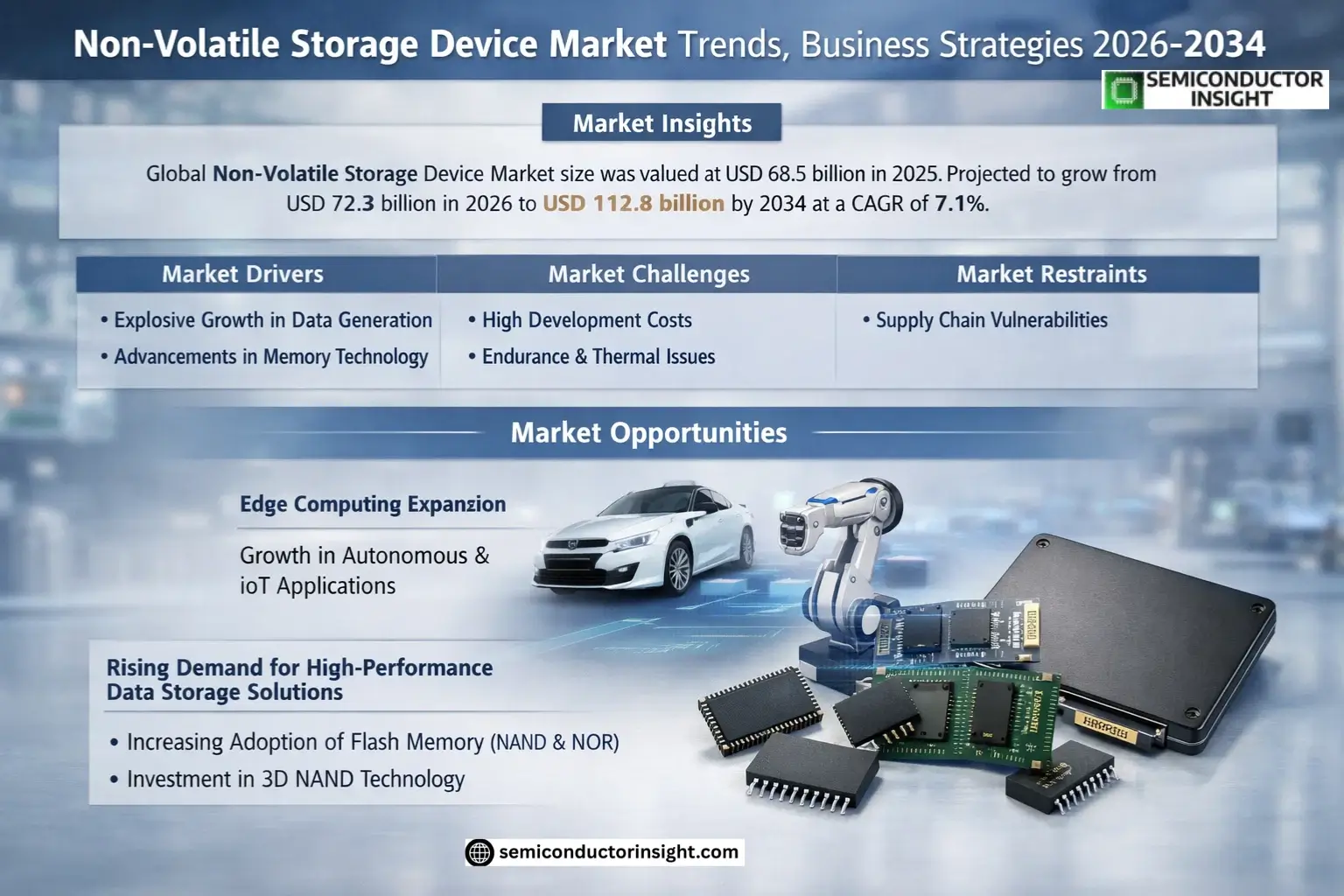
Global Non-Volatile Storage Device Market size was valued at USD 68.5 billion in 2025. The market is projected to grow from USD 72.3 billion in 2026 to USD 112.8 billion by 2034, exhibiting a CAGR of 7.1% during the forecast period.
Non-volatile storage devices are data retention solutions that preserve information even when power is disconnected, making them essential for modern electronics. These devices include technologies such as Electrically Erasable Programmable Read-Only Memory (EEPROM), Flash Memory, Ferroelectric RAM (FRAM), Magnetic RAM (MRAM), and Resistive RAM (ReRAM). Their applications span consumer electronics, automotive systems, industrial automation, and IoT infrastructure.
The market growth is driven by increasing demand for high-speed data storage, advancements in semiconductor technology, and the proliferation of smart devices. Key players like Samsung, Intel, and Micron are investing heavily in next-generation memory solutions to meet evolving industry needs. For instance, in early 2024, Samsung announced a breakthrough in MRAM technology aimed at enhancing AI processing capabilities.
MARKET DRIVERS
Explosive Growth in Data Generation
Global Non-Volatile Storage Device Market is experiencing significant growth driven by the exponential increase in data generation across industries. With IoT devices projected to exceed 75 billion units by 2025, the demand for reliable storage solutions has never been higher. Enterprises are adopting non-volatile memory technologies to manage big data workloads efficiently.
Advancements in Memory Technology
Technological innovations like 3D NAND flash memory and emerging storage class memory solutions are revolutionizing the Non-Volatile Storage Device Market. These developments offer higher density, lower power consumption, and improved performance characteristics compared to traditional storage options.
Government mandates for data retention and the shift to cloud computing are further accelerating adoption across multiple verticals including healthcare, finance, and telecommunications.
MARKET CHALLENGES
High Development Costs
Non-Volatile Storage Device Market faces significant R&D expenses associated with next-generation memory technologies. Fabrication facilities for advanced NAND and 3D XPoint memory require multibillion-dollar investments, creating high barriers to entry.
Other Challenges
Endurance Limitations
Despite improvements, write-cycle limitations remain a concern for non-volatile memory solutions in high-performance computing environments, necessitating sophisticated wear-leveling algorithms.
Thermal Management
Higher density non-volatile storage devices generate substantial heat, requiring innovative cooling solutions that add to system costs and complexity.
MARKET RESTRAINTS
Supply Chain Vulnerabilities
Non-Volatile Storage Device Market remains vulnerable to semiconductor supply chain disruptions, with certain memory technologies relying on specialized manufacturing processes concentrated in specific geographic regions. Recent shortages have highlighted these systemic risks.
MARKET OPPORTUNITIES
Edge Computing Expansion
The proliferation of edge computing presents substantial growth potential for the Non-Volatile Storage Device Market. Low-latency requirements in applications like autonomous vehicles and industrial IoT are driving demand for high-performance, durable on-premise storage solutions.
Non-Volatile Storage Device Market Trends
Rising Demand for High-Performance Data Storage Solutions
Non-Volatile Storage Device Market is experiencing significant growth due to escalating demand across consumer electronics, automotive systems, and industrial applications. Flash memory solutions, particularly NAND and NOR variants, dominate product adoption owing to their reliability and faster access speeds compared to traditional storage media. Leading manufacturers are investing in 3D NAND technology to address capacity limitations while maintaining cost efficiency.
Other Trends
Emerging Memory Technologies Gaining Traction
Resistive RAM (ReRAM) and Magnetic RAM (MRAM) are witnessing increased R&D investment as potential successors to conventional flash memory. These technologies offer superior endurance, lower power consumption, and faster write speeds, making them ideal for IoT devices and edge computing applications. The automotive sector particularly benefits from MRAM’s radiation-resistant properties in advanced driver-assistance systems.
Regional Market Developments
Asia-Pacific continues to lead in Non-Volatile Storage Device production and consumption, with China accounting for nearly 40% of global flash memory output. North America maintains technological leadership in specialized memory solutions, while European markets show strong adoption in automotive and industrial automation sectors. Emerging economies are driving demand for cost-effective storage solutions in mobile devices and consumer electronics.
Supply Chain Optimization and Technological Convergence
The industry is transitioning to advanced packaging technologies like chip-on-wafer and wafer-level packaging to improve memory density and performance. Major players are establishing strategic partnerships with foundries and equipment manufacturers to secure production capacity. The market is also seeing convergence with processing architectures through computational storage solutions that integrate storage and processing capabilities.
COMPETITIVE LANDSCAPE
Key Industry Players
Market Dominance and Strategic Positioning of NVM Leaders
Global Non-Volatile Storage Device Market is led by semiconductor giants Samsung and Intel, which collectively account for over 30% of market share. These companies dominate through advanced NAND flash production and strategic partnerships in data center solutions. Micron Technology follows closely with its 3D XPoint technology, while Western Digital (through its SanDisk acquisition) controls critical IP in flash memory controllers for enterprise applications.
Specialist manufacturers like Winbond and GigaDevice have carved strong positions in NOR flash for IoT applications, with regional leaders such as SMIC International and Fudan Microelectronics gaining traction in the Chinese market. Emerging players like Kioxia (spun off from Toshiba) are making significant R&D investments in next-generation ReRAM technologies for AI workloads.
List of Key Non-Volatile Storage Device Companies Profiled
- Samsung Electronics
- Intel Corporation
- Micron Technology
- STMicroelectronics
- GigaDevice Semiconductor
- Winbond Electronics
- Western Digital
- Seagate Technology
- SMIC International
- Fudan Microelectronics
- Kioxia Holdings
- SK Hynix
- Nanya Technology
- Integrated Silicon Solution Inc.
- Cypress Semiconductor
Segment Analysis:
| Segment Category | Sub-Segments | Key Insights |
| By Type |
|
Flash Memory dominates due to:
|
| By Application |
|
Consumer Electronics leads with key trends:
|
| By End User |
|
OEMs account for majority share because:
|
| By Technology |
|
3D NAND shows strongest growth potential:
|
| By Density |
|
High Density segment is expanding due to:
|
Regional Analysis: Global Non-Volatile Storage Device Market
Asia-Pacific
China leads in NAND flash production with strategic investments from major players like YMTC, supported by government subsidies that foster domestic non-volatile storage device manufacturing capabilities and reduce import dependency.
Samsung and SK Hynix drive innovation in 3D NAND architectures from their Korean R&D centers, pushing boundaries in storage density and energy efficiency for enterprise SSD solutions.
Japanese firms specialize in high-quality controllers and materials for non-volatile storage devices, with companies like Kioxia developing advanced memory solutions for automotive and industrial applications.
India shows promising growth with increasing local data center investments and smartphone penetration, creating new opportunities for non-volatile storage solutions in cloud computing and mobile sectors.
North America
North America maintains strong demand for high-performance non-volatile storage devices, particularly in enterprise data centers and cloud service providers. The region benefits from early adoption of PCIe 4.0/5.0 SSD technologies and advanced storage architectures. Silicon Valley remains the center for storage controller innovation, with major tech companies investing in next-generation memory solutions. Government initiatives supporting domestic semiconductor manufacturing are expected to influence the regional non-volatile storage device market dynamics in coming years.
Europe
European markets show steady growth in industrial and automotive applications for non-volatile storage devices. Strict data privacy regulations drive demand for secure storage solutions, while the automotive sector requires robust memory for connected vehicles. Research institutions across Germany, France, and the Netherlands are pioneering novel storage technologies like resistive RAM, positioning Europe as a leader in alternative non-volatile memory development.
South America
The South American non-volatile storage device market is growing moderately, primarily driven by consumer electronics demand in Brazil and Mexico. Developing IT infrastructure and increasing smartphone adoption create opportunities for flash storage solutions. Regional manufacturers face challenges from import dependencies but benefit from growing local data center investments supporting digital transformation initiatives across industries.
Middle East & Africa
MEA shows selective growth in non-volatile storage adoption, with UAE and South Africa leading in data center deployments. Government investments in smart city projects and digital infrastructure are creating demand for enterprise storage solutions. The region’s harsh environmental conditions drive special requirements for rugged and high-temperature resistant non-volatile memory devices in industrial applications.
Report Scope
This market research report provides a comprehensive analysis of the Non-Volatile Storage Device Market , covering the forecast period 2025–2034. It offers detailed insights into market dynamics, technological advancements, competitive landscape, and key trends shaping the industry.
Key focus areas of the report include:
- Market Overview: The report begins with an overview outlining its current market scenario, key growth indicators, and industry transformation drivers. It discusses macroeconomic factors, demand–supply balance, regulatory landscape, and the strategic role of semiconductors in powering advancements across industries such as consumer electronics, automotive electronics, industrial control, and IoT.
- Market Size & Forecast: Historical data and future projections for revenue, unit shipments, and market value across major regions and segments.
- Segmentation Analysis: Detailed breakdown by product type (EEPROM, Flash Memory, Ferroelectric Memory, etc.), application, and end-user industry to identify high-growth segments and investment opportunities.
- Regional Insights: Insights into market performance across North America, Europe, Asia, South America, and Middle East & Africa, including country-level analysis where relevant.
- Competitive Landscape: Profiles of leading market participants, including their product offerings, R&D focus, manufacturing capacity, pricing strategies, and recent developments such as mergers, acquisitions, and partnerships.
- Technology Trends & Innovation: Assessment of emerging technologies, semiconductor design trends, fabrication techniques, and evolving industry standards.
- Market Drivers & Restraints: Evaluation of factors driving market growth along with challenges, supply chain constraints, regulatory issues, and market-entry barriers.
- Stakeholder Insights: Insights for component suppliers, OEMs, system integrators, investors, and policymakers regarding the evolving ecosystem and strategic opportunities.
Primary and secondary research methods are employed, including interviews with industry experts, data from verified sources, and real-time market intelligence to ensure the accuracy and reliability of the insights presented.
FREQUENTLY ASKED QUESTIONS:
What is the current market size of Non-Volatile Storage Device Market?
-> Non-Volatile Storage Device Market size was valued at USD 68.5 billion in 2025. The market is projected to grow from USD 72.3 billion in 2026 to USD 112.8 billion by 2034, exhibiting a CAGR of 7.1% during the forecast period.
Which key companies operate in Non-Volatile Storage Device Market?
-> Key players include Samsung, Intel, Micron, STMicroelectronics, GigaDevice, Winbond, Western Data, Seagate, SMIC International, and Fudan Microelectronics, among others.
What are the key growth drivers?
-> Key growth drivers include increasing demand for consumer electronics, automotive electronics applications, industrial automation, and IoT devices.
Which region dominates the market?
-> Asia is a key market, with China estimated to reach USD million in 2025, while the U.S. market size is estimated at USD million.
What are the emerging trends?
-> Emerging trends include advancements in EEPROM technology, increasing adoption of flash memory, and development of next-generation non-volatile memory solutions.
Get Sample Report PDF for Exclusive Insights
Report Sample Includes
- Table of Contents
- List of Tables & Figures
- Charts, Research Methodology, and more...
 Download Sample Report PDF