Non-Contact Electrostatic Voltmeter Market Insights
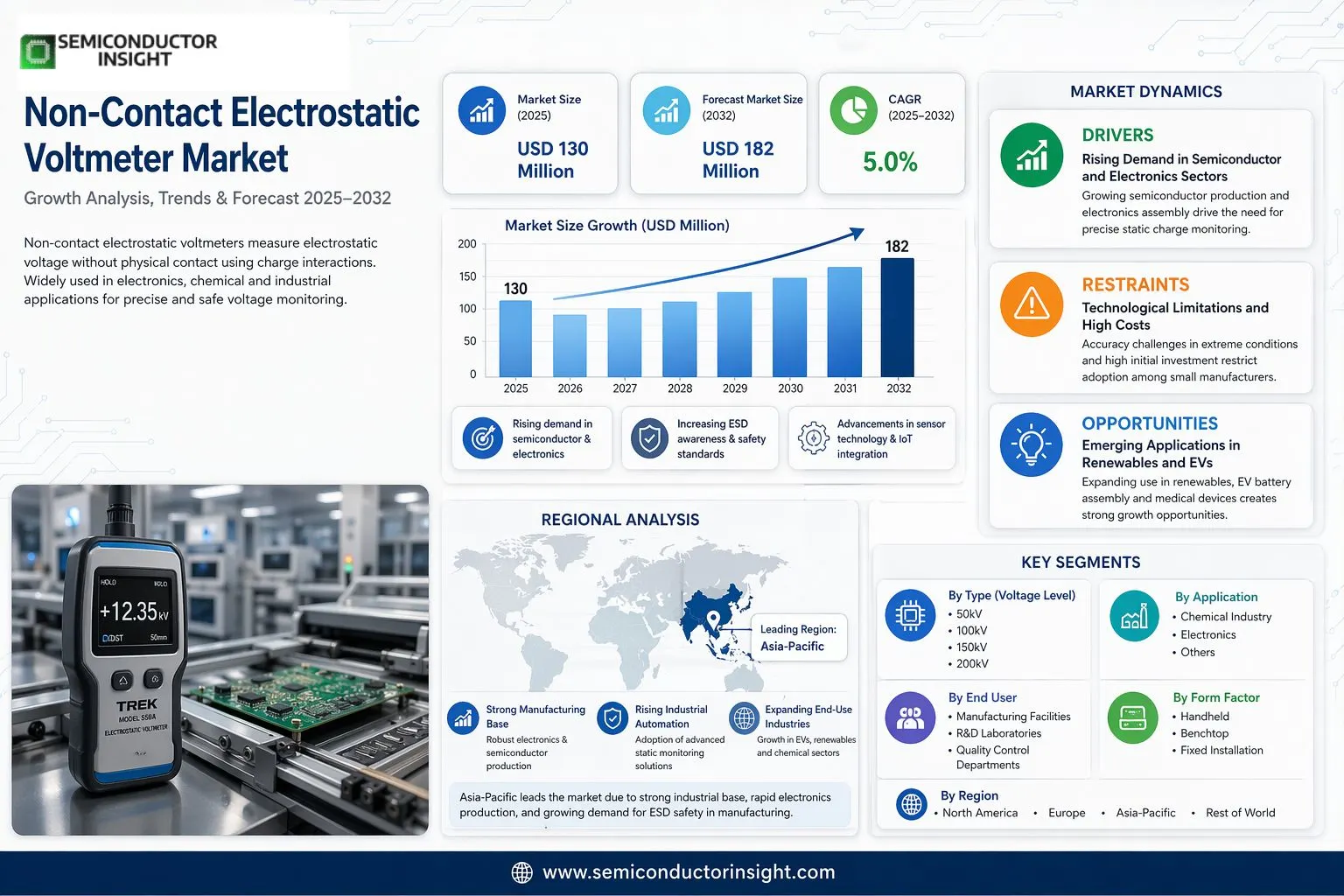
Global Non-Contact Electrostatic Voltmeter market size was valued at USD 130 million in 2025. The market is projected to reach USD 182 million by 2032, exhibiting a CAGR of 5.0% during the forecast period.
Non-contact electrostatic voltmeters are instruments designed to measure and monitor electrostatic voltage without physical contact. These devices leverage the interaction of electrostatic charges for precise, non-invasive readings with high accuracy, making them ideal for detecting various voltage levels. They find widespread application in the chemical industry, electronics manufacturing, and other sectors where static control is essential.
The market is experiencing steady growth driven by rising demand for static charge management in electronics assembly and chemical processing, alongside advancements in sensor technologies. Furthermore, expanding semiconductor production and stricter safety standards in industrial environments are fueling adoption. Key players include Advanced Energy, Acal Bfi, Electro-Tech Systems, Alpha Lab, Wolfgang Warmbier, and Wuhan Dingsheng Electric Power Automation, which together command significant market share through innovative portfolios and global distribution networks.
MARKET DRIVERS
Rising Demand in Semiconductor and Electronics Sectors
Non-Contact Electrostatic Voltmeter Market is propelled by the exponential growth in semiconductor manufacturing, where precise electrostatic charge monitoring is essential to prevent defects in microchips. With global semiconductor sales reaching approximately $574 billion in 2023, industries are increasingly adopting non-contact voltmeters for real-time voltage measurement in cleanroom environments, enhancing yield rates by up to 15%.
Heightened ESD Prevention Awareness
Escalating awareness of electrostatic discharge (ESD) risks across electronics assembly lines has boosted adoption, as these devices enable safe, non-invasive monitoring. The automotive sector, particularly electric vehicle production, contributes significantly, with ESD-related failures costing manufacturers over $10 billion annually worldwide.
➤ Automation and Industry 4.0 integration further accelerates market growth, projecting a CAGR of 6.8% through 2030
Advancements in sensor technology and integration with IoT platforms allow for predictive maintenance, reducing downtime in high-volume production facilities and solidifying the market’s expansion trajectory.
MARKET CHALLENGES
Technological Limitations and Accuracy Concerns
In Non-Contact Electrostatic Voltmeter Market, achieving consistent accuracy across varying environmental conditions remains a hurdle, as humidity and temperature fluctuations can impact measurement precision by 10-20%. Manufacturers face difficulties in developing devices suitable for ultra-high voltage ranges without compromising sensitivity.
Other Challenges
Supply Chain Disruptions
Geopolitical tensions and raw material shortages have increased production costs by 12-15% in recent years, affecting device availability and pricing stability for end-users in key regions like Asia-Pacific.Additionally, skilled personnel shortages for calibration and operation add to operational complexities, with training programs lagging behind market demand and potentially slowing adoption rates.
MARKET RESTRAINTS
Regulatory Compliance and High Costs
Non-Contact Electrostatic Voltmeter Market encounters restraints from stringent regulatory standards in industries like pharmaceuticals and aerospace, requiring extensive certification processes that extend market entry timelines by 18-24 months. Initial investment costs, often exceeding $5,000 per unit, deter small-scale manufacturers from upgrading legacy systems.Technical constraints, such as limited measurement ranges for extreme electrostatic fields over 20 kV, restrict applications in specialized fields like plasma processing, where contact-based alternatives still dominate despite safety risks.Furthermore, market fragmentation with numerous regional players leads to inconsistent quality standards, undermining trust and slowing global standardization efforts essential for broader penetration.
MARKET OPPORTUNITIES
Emerging Applications in Renewables and EVs
Growth in Non-Contact Electrostatic Voltmeter Market is poised through expanding use in renewable energy sectors, particularly solar panel manufacturing, where electrostatic control improves efficiency by minimizing dust attraction and defects. The electric vehicle boom, with production surpassing 10 million units in 2023, opens avenues for integrated monitoring in battery assembly lines.Innovations in wireless and portable models cater to field service applications, while partnerships with automation giants enable smart factory integrations, potentially capturing 25% more market share in Asia-Pacific by 2028.Additionally, rising demand in the medical device sector for ESD-safe environments during precision assembly presents untapped potential, with projections indicating a 7.5% CAGR in this niche through the decade.
Non-Contact Electrostatic Voltmeter Market Trends
Heightened Demand in Electronics and Chemical Sectors
Non-Contact Electrostatic Voltmeter Market reflects a primary trend of growing adoption in the electronics and chemical industries, where precise monitoring of electrostatic voltages is critical. These instruments enable non-contact measurement based on electrostatic charge interactions, delivering high accuracy essential for quality control and safety in production environments. As manufacturing processes become more sophisticated, reliance on such voltmeters increases to prevent electrostatic discharge-related issues, fostering steady market expansion driven by industrial needs for reliable voltage assessment without physical contact.
Other Trends
Diversification Across Voltage Level Segments
Within Non-Contact Electrostatic Voltmeter Market, segmentation by voltage levels—including 50kV, 100kV, 150kV, and 200kV—highlights evolving requirements for varied measurement ranges. The 50kV segment remains prominent due to its suitability for standard industrial applications, while higher ranges like 100kV and above cater to specialized high-voltage scenarios in electronics assembly and chemical processing. This diversification allows manufacturers to address broader use cases, enhancing product versatility and supporting market penetration across different operational scales.
Regional Expansion and Competitive Landscape
Non-Contact Electrostatic Voltmeter Market exhibits notable regional dynamics, with North America—led by the US—and Asia, particularly China, emerging as pivotal areas. Europe’s structured markets in Germany and the UK, alongside Asia’s rapid industrialization in Japan and South Korea, contribute to balanced global distribution. Key players such as Advanced Energy, Acal Bfi, Electro-Tech Systems, Alpha Lab, Wolfgang Warmbier, and Wuhan Dingsheng Electric Power Automation dominate through innovation and established presence. Surveys of manufacturers, suppliers, and experts reveal ongoing developments in product types, pricing strategies, and adaptations to industry challenges like regulatory demands and technological integration. This competitive environment encourages mergers, acquisitions, and R&D focus on upstream materials and downstream applications, positioning Non-Contact Electrostatic Voltmeter Market for sustained relevance in electrostatic management solutions.
COMPETITIVE LANDSCAPE
Key Industry Players
Top Non-Contact Electrostatic Voltmeter Manufacturers Analysis & Strategies
Non-Contact Electrostatic Voltmeter Market exhibits a moderately concentrated structure, with the global top five players—Advanced Energy, Acal Bfi, Electro-Tech Systems, Alpha Lab, and Wolfgang Warmbier—collectively holding a substantial revenue share in 2025. Advanced Energy stands out as the leading manufacturer, leveraging its expertise in high-voltage measurement technologies and integration with Trek-branded electrostatic instruments to capture significant market leadership. This oligopolistic landscape is driven by high barriers to entry, including precision engineering requirements and stringent safety standards for non-contact voltage detection up to 200kV. Key competitive factors include measurement accuracy, response time, and adaptability to applications in chemical and electronics sectors, where demand for reliable electrostatic monitoring fuels steady growth at a projected CAGR of 5.0% through 2032.
Beyond the frontrunners, niche players like Wuhan Dingsheng Electric Power Automation and others contribute through specialized offerings tailored to regional needs, particularly in Asia-Pacific markets. These companies focus on cost-effective solutions for voltage levels such as 50kV and 100kV segments, enhancing competition in emerging applications. Distributors and secondary suppliers reinforce the ecosystem, enabling broader adoption amid industry trends like automation in electronics manufacturing. Recent developments, including mergers and product innovations, underscore efforts to address challenges like price sensitivity and regulatory compliance across North America, Europe, and Asia regions.
List of Key Non-Contact Electrostatic Voltmeter Companies Profiled
- Advanced Energy
- Acal Bfi
- Electro-Tech Systems
- Alpha Lab
- Wolfgang Warmbier
- Wuhan Dingsheng Electric Power Automation
- SIMCO-Ion
- Monroe Electronics
- Keyence Corporation
- Shanghai Anping Static Technology
- Trek Inc.
- Fraser Anti-Static Techniques
- EXAIR Corporation
- Nion Inc.
Segment Analysis:
| Segment Category | Sub-Segments | Key Insights |
| By Type |
|
Voltage Level 50kV
|
| By Application |
|
Electronics
|
| By End User |
|
Manufacturing Facilities
|
| By Form Factor |
|
Handheld
|
| By Distribution Channel |
|
Distributors
|
Regional Analysis: Non-Contact Electrostatic Voltmeter Market
North America
Strong demand stems from semiconductor and electronics sectors requiring precise static control. Industry 4.0 initiatives integrate voltmeters into smart factories for proactive charge management. Regulatory compliance in ESD-sensitive environments accelerates adoption, while investments in automation enhance operational reliability across manufacturing workflows.
Pioneering advancements include ultra-compact sensors and wireless connectivity for versatile applications. Enhanced data analytics from integrated voltmeters support predictive maintenance, reducing downtime. Collaborations with tech firms drive AI-enhanced models for superior accuracy in dynamic production settings.
Dominant use in cleanrooms for pharma and electronics packaging ensures defect-free processes. Aerospace and medical device manufacturing leverage non-contact measurement for high-stakes quality assurance. Flexible deployment in R&D labs supports prototyping of next-gen components.
Leading firms emphasize customization and rapid service, fostering loyalty. Strategic alliances with OEMs expand reach into niche markets. Focus on user-friendly interfaces and durable designs strengthens market positioning amid rising competition.
Europe
Europe exhibits steady growth in Non-Contact Electrostatic Voltmeter Market, propelled by precision engineering traditions and automotive electronics boom. Stringent EU regulations on ESD safety drive adoption in manufacturing hubs like Germany and France. These voltmeters excel in non-destructive testing for printed electronics and battery production, aligning with green manufacturing goals. Investments in digital twins and predictive analytics enhance integration into Industry 4.0 frameworks, optimizing static control in high-volume assembly lines. Diverse applications span pharmaceuticals, where they ensure sterile packaging integrity, and renewables, monitoring charge in solar panel fabrication. Key players prioritize modular designs for easy scalability, while cross-border collaborations boost technological exchange. Challenges like supply chain disruptions are met with localized production strategies, maintaining resilience. The region’s emphasis on sustainability fosters eco-friendly, low-power models, positioning Europe as a quality-focused contender with expanding influence in specialized segments.
Asia-Pacific
Asia-Pacific emerges as a high-growth area in Non-Contact Electrostatic Voltmeter Market, fueled by explosive electronics manufacturing in China, South Korea, and Taiwan. Massive semiconductor fabs demand reliable static monitoring to safeguard yields in chip packaging and display production. Rapid industrialization integrates these devices into flexible electronics and consumer gadgets assembly, supporting just-in-time processes. Government incentives for advanced manufacturing accelerate deployment in 5G infrastructure and EV components. Local innovators develop cost-effective, high-durability models tailored for humid climates, enhancing accessibility. Educational initiatives build skilled workforces for maintenance and customization. While import reliance persists, rising domestic R&D narrows the gap with global leaders. Supply chain proximity to end-users minimizes lead times, driving volume sales. This region’s scale and agility position it for accelerated market share gains amid global shifts.
South America
South America shows nascent but promising potential in Non-Contact Electrostatic Voltmeter Market, centered in Brazil and Mexico’s growing electronics assembly. Automotive and agrotech sectors adopt these tools for static-free processes in wiring harnesses and sensor production. Economic recovery spurs investments in quality control, reducing defects in export-oriented manufacturing. Partnerships with North American suppliers introduce advanced non-contact technologies, bridging capability gaps. Focus on affordable, rugged designs suits diverse industrial environments, from printing to packaging. Workforce training programs enhance operational proficiency, while regional trade agreements facilitate technology transfer. Challenges like infrastructure limitations are offset by modular, portable voltmeters. As industries modernize, South America gears up for broader integration, leveraging natural resources in electronics raw materials to fuel steady expansion.
Middle East & Africa
The Middle East & Africa region witnesses gradual uptake in Non-Contact Electrostatic Voltmeter Market, driven by diversification into electronics and petrochemicals in UAE and South Africa. Oil & gas refineries use them for charge detection in polymer processing, while emerging tech parks in Saudi Arabia support semiconductor pilots. Harsh climates necessitate robust, temperature-stable models for reliable performance. Foreign investments introduce cutting-edge solutions, training local teams for sustained use. Applications in printing and textiles aid quality in export goods. Infrastructure projects integrate static monitoring into smart facilities. Collaborative ventures with Asian suppliers provide cost efficiencies, spurring adoption. Despite nascent stage, strategic visions for industrial hubs promise accelerated growth as awareness and expertise build.
Report Scope
This market research report provides a comprehensive analysis of Non-Contact Electrostatic Voltmeter Market, covering the forecast period 2025–2032. It offers detailed insights into market dynamics, technological advancements, competitive landscape, and key trends shaping the industry.
Key focus areas of the report include:
- Market Overview: The report begins with an overview outlining its current market scenario, key growth indicators, and industry transformation drivers. It discusses macroeconomic factors, demand–supply balance, regulatory landscape, and the strategic role of Non-Contact Electrostatic Voltmeters in powering advancements across industries such as chemical, electronics, and others.
- Market Size & Forecast: Historical data and future projections for revenue, unit shipments, and market value across major regions and segments.
- Segmentation Analysis: Detailed breakdown by product type, technology, application, and end-user industry to identify high-growth segments and investment opportunities.
- Regional Insights: Insights into market performance across North America, Europe, Asia, South America, and the Middle East & Africa, including country-level analysis where relevant.
- Competitive Landscape: Profiles of leading market participants, including their product offerings, R&D focus, manufacturing capacity, pricing strategies, and recent developments such as mergers, acquisitions, and partnerships.
- Technology Trends & Innovation: Assessment of emerging technologies, integration of AI/IoT, semiconductor design trends, fabrication techniques, and evolving industry standards.
- Market Drivers & Restraints: Evaluation of factors driving market growth along with challenges, supply chain constraints, regulatory issues, and market-entry barriers.
- Stakeholder Insights: Insights for component suppliers, OEMs, system integrators, investors, and policymakers regarding the evolving ecosystem and strategic opportunities.
Primary and secondary research methods are employed, including interviews with industry experts, data from verified sources, and real-time market intelligence to ensure the accuracy and reliability of the insights presented.
FREQUENTLY ASKED QUESTIONS:
What is the current market size of Non-Contact Electrostatic Voltmeter Market?
-> Non-Contact Electrostatic Voltmeter Market was valued at USD 130 million in 2025 and is expected to reach USD 182 million by 2032, at a CAGR of 5.0% during the forecast period.
Which key companies operate in Non-Contact Electrostatic Voltmeter Market?
-> Key players include Advanced Energy, Acal Bfi, Electro-Tech Systems, Alpha Lab, Wolfgang Warmbier, and Wuhan Dingsheng Electric Power Automation, among others.
What are the key growth drivers?
-> Key growth drivers include demand in chemical and electronics industries, high measurement accuracy, and non-contact measurement technology.
Which region dominates the market?
-> Asia is the fastest-growing region, while North America remains a dominant market.
What are the emerging trends?
-> Emerging trends include advancements in voltage level segments like 50kV, applications in electronics and chemical sectors, and industry surveys on trends and developments.

Get Sample Report PDF for Exclusive Insights
Report Sample Includes
- Table of Contents
- List of Tables & Figures
- Charts, Research Methodology, and more...
 Download Sample Report PDF