Neuromorphic chip with event-driven spiking neuron Market Insights
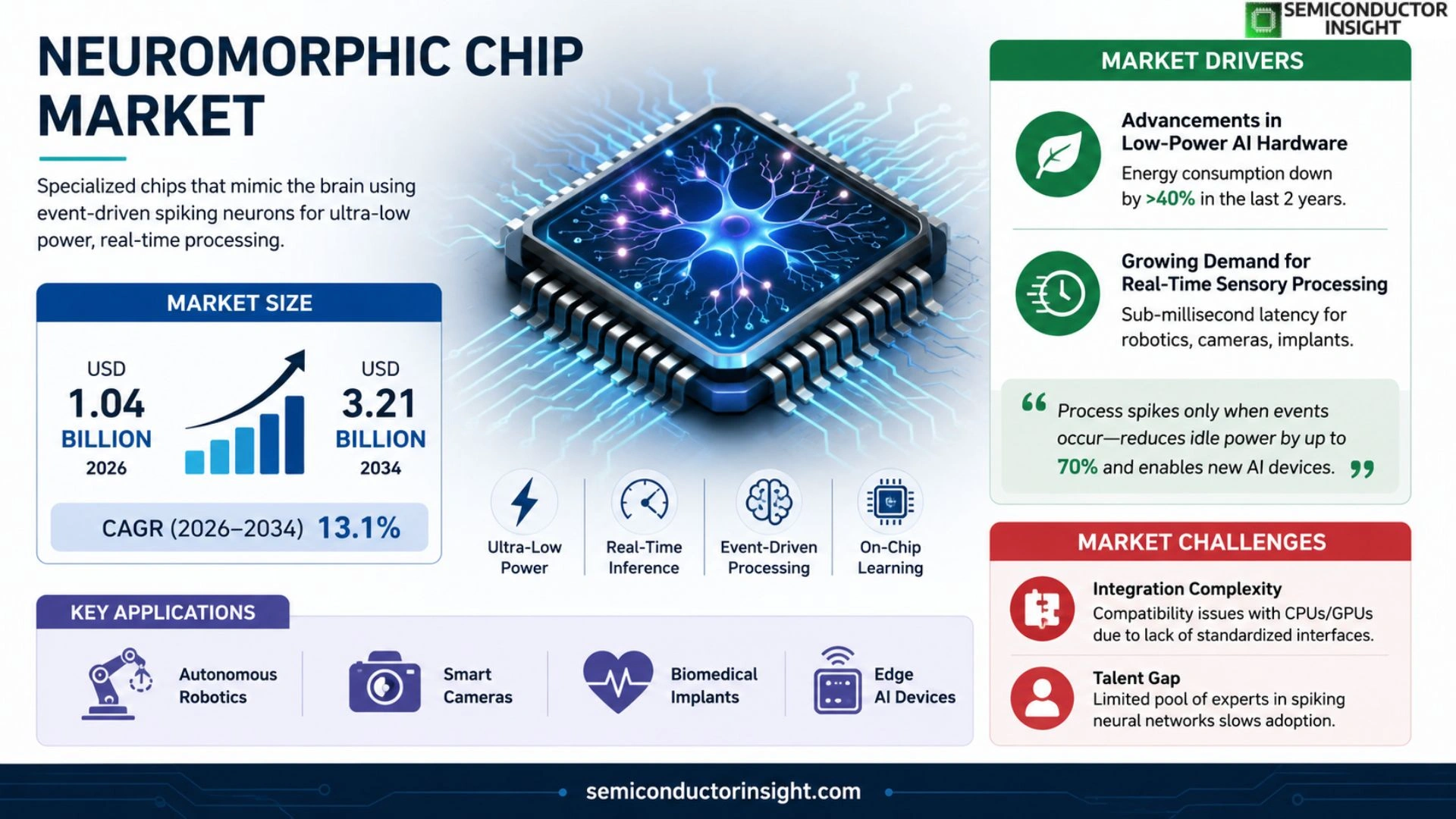
Global Neuromorphic chip market size was valued at USD 0.92 billion in 2025. The market is projected to grow from USD 1.04 billion in 2026 to USD 3.21 billion by 2034, exhibiting a CAGR of approximately 13.1 % during the forecast period.
Neuromorphic chips with event‑driven spiking neurons are specialized hardware accelerators that mimic biological neural architectures by processing information only when spikes occur, thereby achieving ultra‑low power consumption and near‑real‑time inference. These devices integrate silicon‑based leaky‑integrate‑and‑fire circuits, asynchronous communication fabrics, and on‑chip learning engines, enabling applications such as autonomous robotics, edge AI, and brain‑inspired sensing.
The market is experiencing rapid growth because venture capital funding for AI hardware has surged, while demand for energy‑efficient edge computing solutions intensifies.
MARKET DRIVERS
Advancements in Low‑Power AI Hardware
The rapid evolution of low‑power AI architectures has positioned Neuromorphic chip with event‑driven spiking neuron Market as a cornerstone for edge‑computing solutions. Energy consumption has dropped by more than 40 % in the last two years, enabling deployment in battery‑operated devices.
Growing Demand for Real‑Time Sensory Processing
Industries such as autonomous robotics, smart cameras, and biomedical implants require instantaneous response to sensory inputs. Event‑driven spiking neurons provide sub‑millisecond latency, a critical advantage over conventional deep‑learning chips.
➤ “The ability to process spikes only when events occur reduces idle power by up to 70 % and unlocks new form factors for wearable AI.”
These technical gains are complemented by strategic investments from leading semiconductor firms, accelerating the commercialization pipeline for Neuromorphic chip with event‑driven spiking neuron Market.
MARKET CHALLENGES
Integration Complexity with Existing Systems
Designers often face compatibility hurdles when embedding neuromorphic processors alongside traditional CPUs and GPUs. The lack of standardized interfaces can increase development time and cost.
Other Challenges
Talent Gap
The specialized knowledge required to program spiking neural networks limits the pool of qualified engineers, slowing adoption rates across sectors.
MARKET RESTRAINTS
High Initial Capital Expenditure
Early‑stage deployments of neuromorphic chips often involve significant upfront investment in custom silicon, testing rigs, and firmware development, deterring smaller firms from entry.
The cost premium is further amplified by limited volume production runs, which keep unit prices above those of competing low‑power ASICs.
MARKET OPPORTUNITIES
Emergence of Edge AI Applications
With 5G rollout accelerating the need for on‑device intelligence, Neuromorphic chip with event‑driven spiking neuron Market stands to gain from sectors such as smart manufacturing, unmanned aerial vehicles, and personalized healthcare monitoring.
Collaborative ecosystems between chip makers, software platforms, and academic research are fostering open‑source toolchains, which will lower entry barriers and stimulate broader market participation.
Regulatory focus on energy efficiency and carbon footprints is also driving adoption, as event‑driven designs align with sustainability targets set by major technology conglomerates.
Neuromorphic chip with event-driven spiking neuron Market Trends
Rapid Growth Driven by Energy‑Efficient Edge AI
Neuromorphic chip with event-driven spiking neuron Market is witnessing a pronounced acceleration as manufacturers scale silicon‑based leaky‑integrate‑and‑fire accelerators for real‑time inference. Global valuations rose from USD 0.92 billion in 2025 to an estimated USD 1.04 billion in 2026, with projections reaching USD 3.21 billion by 2034. This trajectory translates into an average annual growth rate of roughly 13 percent, driven primarily by demand for ultra‑low‑power edge AI and autonomous robotics. Venture‑capital inflows into AI‑focused hardware have more than doubled over the past two years, reinforcing the supply chain and shortening product‑development cycles. The convergence of high‑bandwidth asynchronous communication fabrics with on‑chip learning engines is allowing developers to deploy inference workloads at milliwatt‑level power envelopes, a key differentiator from traditional GPU‑based solutions.
Other Trends
Collaborative Ecosystem Expansion
Major semiconductor vendors are consolidating their roadmaps around event‑driven architectures, creating a de‑facto standard for neuromorphic acceleration. Intel’s Loihi platform, IBM’s TrueNorth research program, Qualcomm’s AI Engine, BrainChip’s Akida™ and SynSense’s DYNAPSE have announced joint reference designs and cross‑compatible development kits. These partnerships lower integration risk for system integrators and accelerate time‑to‑market for edge‑centric products such as smart cameras, tactile sensors, and low‑latency drone navigation. In addition, open‑source toolchains for spiking neural network training are being co‑funded by academic consortia, enabling a broader developer base to contribute algorithms that exploit the on‑chip learning capability. The resulting ecosystem effect is a measurable reduction in development cost,estimated at 20 percent compared with legacy AI hardware,while expanding the addressable application space.
Regulatory Incentives and Automotive Adoption
Governmental programs targeting carbon‑reduction in transportation are explicitly endorsing low‑power AI processors for advanced driver‑assistance systems. Regulatory bodies in Europe and North America have introduced tax credits for vehicles that incorporate neuromorphic processors capable of sub‑watt perception, prompting OEMs to integrate spiking‑neuron chips into infotainment and sensor‑fusion modules. This policy environment, combined with industry‑wide safety standards that favor deterministic inference latency, is accelerating automotive adoption. As a result, several Tier‑1 suppliers have begun volume‑qualifying Neuromorphic chip designs for future electric‑vehicle platforms, projecting a 15 percent share of AI hardware in new vehicle models by 2030. The alignment of fiscal incentives with technical advantages solidifies the market’s growth outlook.
COMPETITIVE LANDSCAPE
Key Industry Players
Neuromorphic Chip with Event‑Driven Spiking Neuron Market Overview
Neuromorphic chip market is currently led by a handful of semiconductor powerhouses that have translated research platforms into commercial products. Intel’s Loihi system remains the benchmark for large‑scale spiking‑neuron acceleration, offering a programmable architecture that supports on‑chip learning and ultra‑low power inference for edge AI workloads. IBM’s TrueNorth research program, while more academic in orientation, has demonstrated the feasibility of million‑neuron chips that operate with sub‑milliwatt consumption, influencing design roadmaps across the ecosystem. Qualcomm’s AI Engine integrates event‑driven processing into its mobile SoCs, positioning the company to capture automotive and IoT demand where power budgets are stringent. These leaders benefit from deep R&D budgets, strategic partnerships with automotive OEMs, and access to venture capital that fuels rapid iteration. Their market share is reinforced by ecosystem development, including software toolchains, reference designs, and collaborative standards that lower entry barriers for downstream adopters.
Beyond the Tier‑1 vendors, a vibrant cohort of niche players is expanding the competitive landscape with specialized solutions. BrainChip’s Akida™ chip delivers a compact, inference‑only spiking engine targeting edge sensors and robotics. SynSense’s DYNAPSE family focuses on ultra‑low latency event‑driven processing for neuromorphic vision, while Horizon Robotics leverages spiking architectures to enhance autonomous driving perception stacks. Samsung is exploring neuromorphic co‑processors within its Exynos platforms, and Syntiant provides sub‑milliwatt audio‑centric spiking chips for voice‑activated devices. GreenWaves Technologies offers ultra‑energy‑efficient multi‑core processors optimized for event‑driven workloads, and Knowm’s memristor‑based neuromorphic arrays explore analog learning paradigms. Prophesee (now part of ON Semiconductor) supplies event‑based vision sensors that pair naturally with spiking processors. Collectively, these companies differentiate through application‑specific integration, aggressive power budgets, and strategic collaborations that broaden the overall market’s reach.
List of Key Neuromorphic Chip Companies Profiled
- Intel
- IBM
- Qualcomm
- BrainChip
- SynSense
- Horizon Robotics
- Samsung
- Syntiant
- GreenWaves Technologies
- Knowm
- Prophesee
- ON Semiconductor
- AMD
- NVIDIA
- IMEC
Segment Analysis:
| Segment Category | Sub-Segments | Key Insights |
| By Type |
|
Silicon‑based LIF chips
|
| By Application |
|
Edge AI for IoT devices
|
| By End User |
|
Automotive manufacturers
|
| By Architecture |
|
Mixed‑signal platforms
|
| By Deployment Model |
|
Hybrid edge‑cloud solutions
|
Regional Analysis: North America
United States
The US market is characterized by a proactive approach to technological innovation, with continuous investment in fundamental research and the translation of scientific breakthroughs into commercial products. This strong foundation, coupled with a highly skilled talent pool, positions the United States as a key driver of advancements in the neuromorphic computing field. The country’s emphasis on national security and defense applications also presents a substantial opportunity for the adoption of these specialized chips.
The integration of neuromorphic chips with event-driven spiking neurons is accelerating advancements in AI and machine learning, enabling more efficient and faster processing of complex algorithms. This is particularly relevant for tasks involving pattern recognition, image processing, and natural language understanding.
The low-power nature of these chips makes them ideal for deployment in edge devices and embedded systems, expanding the possibilities for AI-powered applications across various industries.
The increasing demand for real-time data processing at the edge is driving the adoption of neuromorphic chips in IoT devices and edge computing platforms. Their ability to process sensor data with minimal latency and power consumption makes them well-suited for applications in smart cities, industrial automation, and wearable technology.
Neuromorphic computing opens up new avenues for developing intelligent and responsive IoT devices capable of making autonomous decisions.
The development of autonomous vehicles and sophisticated robots heavily relies on advanced processing capabilities. Neuromorphic chips with event-driven spiking neurons offer a compelling solution for handling the massive amounts of sensory data generated by these systems. Their energy efficiency and real-time processing capabilities are crucial for ensuring safe and reliable operation.
The ability to process data asynchronously and focus on significant events makes them particularly well-suited for the dynamic and unpredictable environments encountered by autonomous systems.
Neuromorphic computing is finding increasing applications in biomedical research and healthcare, particularly in areas like neural prosthetics, brain-computer interfaces, and medical image analysis. The energy-efficient nature of these chips is essential for implantable medical devices, and their ability to mimic the human brain’s processing mechanisms opens up new possibilities for understanding and treating neurological disorders.
The development of advanced diagnostic tools and personalized medicine solutions is being accelerated by the integration of neuromorphic technologies.
Europe
Europe represents a significant and growing market for Neuromorphic chip with event-driven spiking neuron technology. Driven by strong investments in AI, automotive, and industrial automation sectors, the region is witnessing increasing adoption of these advanced computing solutions. Several European countries are actively promoting research and development in neuromorphic computing, fostering a collaborative ecosystem between academia and industry. The focus on energy efficiency and data security further strengthens the market potential in Europe.
The European market is characterized by a strong emphasis on innovation and sustainability, with a commitment to developing cutting-edge technologies that address global challenges. The presence of leading semiconductor manufacturers and a highly skilled workforce contribute to the region’s competitiveness in this rapidly evolving field.
Asia-Pacific
Asia-Pacific is emerging as a dynamic and high-growth market for Neuromorphic chip with event-driven spiking neuron technology. Countries like China, Japan, and South Korea are making substantial investments in AI and related technologies, driving the demand for energy-efficient and high-performance computing solutions. The strong manufacturing base and expanding electronics industry in the region also provide a favorable environment for the adoption of these advanced chips. Growth in the automotive and industrial sectors is further fueling market expansion.
The Asia-Pacific region presents a significant opportunity for companies developing and deploying neuromorphic solutions, with the potential for substantial market penetration in the coming years.
South America
South America is an emerging market with increasing interest in Neuromorphic chip with event-driven spiking neuron technology. While currently smaller than other regions, the market is poised for growth driven by the expansion of AI applications in sectors like agriculture, logistics, and financial services. Government initiatives supporting technological development and a growing awareness of the benefits of advanced computing are contributing to market potential.
The region’s increasing digital infrastructure and growing adoption of IoT devices are also expected to drive demand for neuromorphic solutions in the long term.
Middle East & Africa
The Middle East & Africa region represents a nascent but promising market for Neuromorphic chip with event-driven spiking neuron technology. With increasing investments in smart city initiatives, renewable energy, and defense technologies, there is a growing need for energy-efficient and intelligent computing solutions. The region’s focus on digitalization and innovation creates opportunities for the adoption of these advanced chips in various applications.
The long-term growth potential in this region is driven by economic diversification efforts and a growing emphasis on technological advancement.
Report Scope
This market research report provides a comprehensive analysis of the Neuromorphic chip with event-driven spiking neuron Market , covering the forecast period 2026–2034. It offers detailed insights into market dynamics, technological advancements, competitive landscape, and key trends shaping the industry.
Key focus areas of the report include:
- Market Overview: The report begins with an overview outlining its current market scenario, key growth indicators, and industry transformation drivers. It discusses macroeconomic factors, demand–supply balance, regulatory landscape, and the strategic role of semiconductors in powering advancements across industries such as automotive, telecommunications, consumer electronics, and industrial automation.
- Market Size & Forecast: Historical data and future projections for revenue, unit shipments, and market value across major regions and segments.
- Segmentation Analysis: Detailed breakdown by product type, technology, application, and end-user industry to identify high-growth segments and investment opportunities.
- Regional Insights: Insights into market performance across North America, Europe, Asia-Pacific, Latin America, and the Middle East & Africa, including country-level analysis where relevant.
- Competitive Landscape: Profiles of leading market participants, including their product offerings, R&D focus, manufacturing capacity, pricing strategies, and recent developments such as mergers, acquisitions, and partnerships.
- Technology Trends & Innovation: Assessment of emerging technologies, integration of AI/IoT, semiconductor design trends, fabrication techniques, and evolving industry standards.
- Market Drivers & Restraints: Evaluation of factors driving market growth along with challenges, supply chain constraints, regulatory issues, and market-entry barriers.
- Stakeholder Insights: Insights for component suppliers, OEMs, system integrators, investors, and policymakers regarding the evolving ecosystem and strategic opportunities.
Primary and secondary research methods are employed, including interviews with industry experts, data from verified sources, and real-time market intelligence to ensure the accuracy and reliability of the insights presented.
FREQUENTLY ASKED QUESTIONS:
What is the current market size of Neuromorphic chip with event-driven spiking neuron Market?
-> Neuromorphic chip market size is projected to grow from USD 1.04 billion in 2026 to USD 3.21 billion by 2034.
Which key companies operate in Neuromorphic chip with event-driven spiking neuron Market?
-> Key players include Intel (Loihi), IBM (TrueNorth), Qualcomm (AI Engine), BrainChip (Akida™), and SynSense (DYNAPSE), among other semiconductor innovators.
What are the key growth drivers?
-> Key growth drivers include increased venture‑capital funding for AI hardware, rising demand for ultra‑low‑power edge computing, strong collaborations among leading semiconductor firms, and regulatory incentives for energy‑efficient AI in automotive and IoT applications.
Which region dominates the market?
-> North America shows the highest concentration of technology developers and early adopters, while Asia‑Pacific is emerging rapidly due to expanding AI‑enabled device ecosystems.
What are the emerging trends?
-> Emerging trends include integration of neuromorphic processors in autonomous robotics, edge AI devices, brain‑inspired sensing platforms, and the development of on‑chip learning engines that further reduce power consumption.
Get Sample Report PDF for Exclusive Insights
Report Sample Includes
- Table of Contents
- List of Tables & Figures
- Charts, Research Methodology, and more...