MARKET INSIGHTS
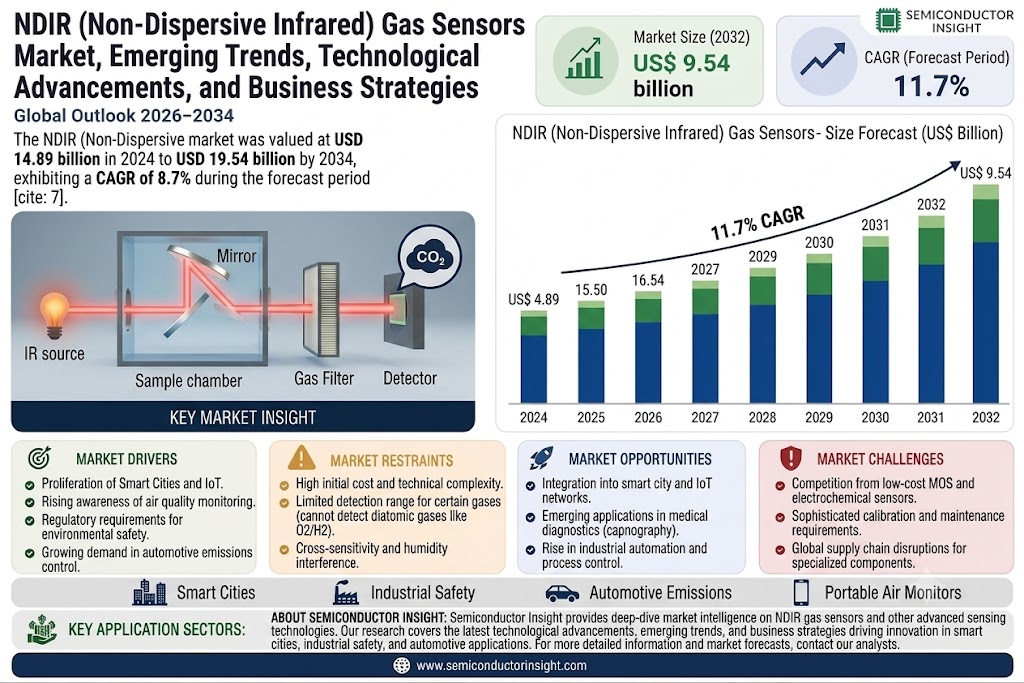
Global NDIR (Non-Dispersive Infrared) Gas Sensors Market was valued at USD 845 million in 2024 to USD 1376 million by 2032, exhibiting a CAGR of 7.3% during the forecast period.
NDIR gas sensors operate based on the principle of infrared absorption, where gas molecules (e.g., CO2, CH4) absorb specific wavelengths of infrared light. These sensors consist of an infrared light source, a sample chamber or optical path, and an infrared detector. The gas to be measured absorbs a portion of the infrared light, and the resulting attenuation is used to determine the gas concentration. This method is highly selective, sensitive, and non-destructive, making it suitable for a wide range of applications.
The market growth is driven by increasing stringency in environmental regulations worldwide, which mandate the monitoring and control of greenhouse gases and pollutants. Additionally, the rising adoption of NDIR sensors in industrial safety systems to detect hazardous gases (like methane in oil & gas or carbon monoxide in parking garages) contributes significantly. The technology’s ability to detect a wide range of gases (over 100 different types) from ppm levels up to percentage levels makes it versatile. However, challenges such as cross-sensitivity to other gases (requiring advanced calibration and compensation algorithms) and the high initial cost of NDIR sensors compared to other types (like electrochemical sensors) may restrain growth in cost-sensitive markets.
Key players are focusing on developing multi-gas detection capabilities and miniaturizing sensors for portable applications. For instance, in 2023, Amphenol Advanced Sensors launched a new series of NDIR sensors with enhanced cross-sensitivity compensation. Similarly, partnerships between sensor manufacturers and software companies aim to integrate artificial intelligence for real-time data analysis and predictive maintenance.
MARKET DRIVERS
Stringent Global Environmental Regulations
The implementation of stringent environmental and safety regulations worldwide is a primary driver for the NDIR gas sensors market. Governments and international bodies are enforcing stricter limits on greenhouse gas emissions, air quality, and industrial safety standards. NDIR sensors are widely adopted for their high accuracy in detecting gases like carbon dioxide (CO2), methane (CH4), and refrigerants, making them essential for compliance monitoring in industrial and environmental applications.
Expansion of HVAC and Building Automation
The growing demand for energy-efficient buildings and smart HVAC systems is fueling the adoption of NDIR CO2 sensors. These sensors are critical for demand-controlled ventilation, improving indoor air quality while optimizing energy consumption. The global push for green building certifications is further accelerating their integration into commercial and residential infrastructure.
➤ The global market for NDIR sensors is projected to grow at a CAGR of over 7% in the next five years, driven by heightened demand from the industrial safety and environmental monitoring sectors.
Furthermore, technological advancements are leading to the development of miniaturized, low-power, and more cost-effective NDIR sensors. This evolution is opening new application areas, including portable gas detectors, consumer electronics, and automotive air quality monitoring, thereby broadening the market’s growth potential.
MARKET CHALLENGES
High Initial Cost and Technical Complexity
The adoption of NDIR technology can be limited by its higher initial cost compared to other gas sensing technologies like electrochemical or metal-oxide-semiconductor (MOS) sensors. The need for an infrared source, detector, and optical components contributes to a more complex and expensive system, which can be a barrier for price-sensitive applications.
Other Challenges
Cross-Sensitivity and Calibration Requirements
NDIR sensors can be susceptible to interference from other gases or environmental factors like humidity and temperature, requiring sophisticated filtering and algorithms. Maintaining accuracy necessitates regular calibration, which adds to the total cost of ownership and can be a logistical challenge for deployed systems.
Competition from Alternative Technologies
Despite their advantages in specificity and longevity, NDIR sensors face strong competition from lower-cost technologies. In applications where ultra-high precision is not critical, alternative sensors may be preferred, pressuring NDIR manufacturers to innovate continually to justify their value proposition.
MARKET RESTRAINTS
Economic Volatility and Supply Chain Constraints
Global economic fluctuations and supply chain disruptions can significantly impact the NDIR gas sensors market. The manufacturing of NDIR sensors relies on specialized components, including infrared emitters and detectors, which can be subject to price volatility and availability issues. This can lead to increased production costs and delayed product deliveries, restraining market growth.
Limited Detection Range for Certain Gases
A key restraint for NDIR technology is its limitation to detecting gases that absorb infrared light, such as CO2, CH4, and hydrocarbons. It is ineffective for detecting diatomic gases like oxygen (O2) or hydrogen (H2), which restricts its application spectrum and creates opportunities for multi-sensor hybrid solutions that combine different technologies.
MARKET OPPORTUNITIES
Rise of Smart Cities and IoT Integration
The expansion of smart city initiatives and the Internet of Things (IoT) presents a significant growth opportunity for NDIR gas sensors. These sensors are increasingly being integrated into networked systems for real-time urban air quality monitoring, smart waste management, and intelligent building controls, creating a large, connected ecosystem for environmental data.
Growth in Automotive and Transportation Sector
The automotive industry represents a burgeoning market for NDIR sensors, particularly for cabin air quality monitoring and emissions control systems in both internal combustion and electric vehicles. The push for enhanced passenger comfort and stricter vehicle emission standards is driving the integration of advanced gas sensing solutions.
Emerging Applications in Medical and Aerospace
New applications in medical devices, such as capnography for monitoring patient breath CO2 levels, and in aerospace for cabin air quality and leak detection, are emerging as high-value niches. The high reliability and accuracy of NDIR technology make it well-suited for these critical applications, opening up specialized market segments.
NDIR (Non-Dispersive Infrared) Gas Sensors Market Trends
Robust Global Growth Fueled by Environmental and Safety Regulations
The global NDIR (Non-Dispersive Infrared) Gas Sensors market, valued at approximately $845 million in 2024, is forecast to reach $1376 million by 2032, representing a compound annual growth rate (CAGR) of 7.3%. This sustained expansion is primarily driven by stringent governmental regulations worldwide concerning air quality monitoring and industrial safety. The inherent advantages of NDIR technology, including its non-contact and non-consuming measurement method, high selectivity, and ability to detect over 100 different gases from ppm to percentage levels, make it the preferred solution for accurate and reliable gas detection across numerous sectors.
Other Trends
Diversification and Specialization of Sensor Types
The market is experiencing segmentation and growth across various gas-specific sensor types. While NDIR CO2 sensors continue to hold a significant share due to their widespread use in indoor air quality monitoring and HVAC systems, there is increasing demand for specialized sensors. NDIR Methane (CH4) sensors are critical for leak detection in the oil and gas industry, and NDIR refrigerant gas sensors are gaining traction for monitoring systems in refrigeration and air conditioning. This trend reflects the market’s response to specific application needs, pushing manufacturers to develop sensors with optimized performance for target gases.
Technological Innovation and Intense Market Competition
The highly fragmented nature of the market fosters intense competition, compelling companies to continuously invest in research and development. Key players like Amphenol Advanced Sensors, Senseair, and Sensirion are focusing on enhancing sensor performance, reducing power consumption, and miniaturizing designs to cater to portable and IoT-enabled devices. However, this rapid pace of technological advancement presents a significant risk; companies that fail to keep up with R&D or effectively scale their sales and marketing efforts risk losing market influence and profitability. The protection of core technologies and retention of skilled technicians are therefore paramount for maintaining a competitive edge in this dynamic landscape.
COMPETITIVE LANDSCAPE
Key Industry Players
A Market Characterized by Global Titans and Specialized Innovators
The global NDIR gas sensor market features a moderately fragmented landscape, characterized by the presence of several established multinational players holding significant market share. Key companies such as Amphenol Advanced Sensors, Senseair (a division of Asahi Kasei Microdevices), and Sensirion lead the market, leveraging their extensive R&D capabilities, global distribution networks, and strong brand recognition. These leaders compete intensely on technology innovation, product reliability, and price, catering to a broad range of applications from industrial safety and environmental monitoring to the medical and HVAC sectors. The competitive dynamics are shaped by continuous technological advancements and the need to comply with stringent international safety and environmental regulations.
Beyond the major players, the market includes numerous specialized and regional companies that compete effectively by focusing on niche applications or specific gas detection needs. Firms like smartGAS Mikrosensorik GmbH, Cubic Sensor and Instrument, and Nano Environmental Technology S.r.l. (N.E.T.) have carved out strong positions by offering high-performance sensors for specialized gases or customized solutions. The market also sees strong participation from companies like Vaisala and Edinburgh Instruments, which apply their expertise in precise environmental measurement to the NDIR segment. This diverse ecosystem ensures robust competition, driving innovation in areas such as miniaturization, power efficiency, and multi-gas detection capabilities, with manufacturers increasingly integrating smart features and IoT connectivity into their offerings.
List of Key NDIR Gas Sensors Companies Profiled
- Amphenol Advanced Sensors
- Senseair (Asahi Kasei Microdevices)
- Murata
- Sensirion
- MKS Instruments
- Vaisala
- Teledyne API
- Honeywell
- ELT SENSOR
- E+E
- Dwyer Instruments
- Trane
- Micro-Hybrid
- Edinburgh Instruments
- Alphasense
- Cubic Sensor and Instrument
- Nano Environmental Technology S.r.l. (N.E.T.)
- Super Systems
- ORIENTAL SYSTEM TECHNOLOGY INC.
- smartGAS Mikrosensorik GmbH
- SST Sensing
- Winsen
- Suzhou Promisense
- Figaro Engineering
Segment Analysis:
| Segment Category | Sub-Segments | Key Insights |
| By Type |
|
NDIR CO2 Sensors are the leading segment, driven by their critical role in environmental monitoring for climate change initiatives and indoor air quality management in commercial and residential buildings. This segment also enjoys robust adoption in applications ranging from automotive cabin air quality control to controlled environments in agriculture, supported by the sensor’s non-contact and non-consuming measurement advantages, which ensure longevity and reliability in continuous monitoring scenarios. |
| By Application |
|
Environmental Protection represents the leading segment, fueled by global regulatory pressures and heightened public awareness concerning air quality and greenhouse gas emissions. The technology’s ability to detect over 100 different gases with high specificity, from parts-per-million to percentage levels, makes it indispensable for compliance monitoring and research. This is complemented by strong demand in the Industrial Safety segment, where NDIR sensors provide critical leak detection for hazardous gases in oil & gas and manufacturing, enhancing workplace safety protocols and risk mitigation strategies. |
| By End User |
|
Manufacturing & Industrial end users form the dominant segment due to the pervasive need for gas detection across process industries, energy production, and occupational safety. This segment values the reliability and precision of NDIR technology for monitoring combustion processes, detecting flammable and toxic gas leaks, and ensuring compliance with stringent industrial safety standards. The trend towards industrial automation and smart factories is further integrating these sensors into IoT platforms for predictive maintenance and real-time safety management, creating a sustained and expanding demand base. |
| By Detection Range |
|
Low Range (ppm levels) sensors are the leading category, essential for applications requiring high sensitivity to detect trace amounts of gases, such as in environmental air quality monitoring for pollutants like CO2 and CO, or for ensuring safe indoor air in buildings. The demand is driven by tightening global emission regulations and a growing emphasis on occupational health. Technological advancements are continuously improving the selectivity and reducing cross-sensitivity in this range, making these sensors more reliable for critical safety and compliance applications where minute concentrations can have significant implications. |
| By Technology Configuration |
|
Dual-Beam/Dual-Wavelength configurations lead the segment, prized for their superior accuracy and stability in challenging environments. This technology uses a reference beam to compensate for signal drift caused by component aging, dust, or temperature fluctuations, which is a critical advantage for long-term deployments in industrial and environmental settings. Their ability to provide more reliable data makes them the preferred choice for applications where measurement integrity is paramount, such as in safety-critical systems and regulatory reporting. The ongoing miniaturization of these systems is also opening new applications in portable and wearable safety devices. |
Regional Analysis: NDIR (Non-Dispersive Infrared) Gas Sensors Market
Asia-Pacific
The primary engine for the Asia-Pacific market is its massive and expanding industrial base. Governments are implementing increasingly strict occupational safety and air emission standards, compelling industries to adopt high-precision NDIR sensors for compliance. This regulatory pressure, combined with a focus on preventing industrial accidents, ensures continuous demand in sectors from oil and gas to chemical processing.
The region is a global hub for electronics and sensor manufacturing, with China being a dominant force. This concentration of production facilities creates a robust supply chain for NDIR sensor components, lowering manufacturing costs and enabling rapid scaling to meet both domestic and international demand, solidifying the region’s competitive advantage.
There is a strong momentum for adopting cutting-edge technologies, including smart sensors and IoT platforms. This drives demand for next-generation NDIR sensors with features like wireless connectivity and data analytics capabilities. Local manufacturers are heavily invested in R&D to produce more compact, energy-efficient, and sensitive NDIR sensors for diverse applications.
Beyond heavy industry, NDIR sensor adoption is growing in automotive emission testing, indoor air quality monitoring in commercial buildings, and agricultural applications like monitoring CO2 levels in greenhouses. This diversification across multiple high-growth sectors provides a resilient and expanding market base that is less susceptible to downturns in any single industry.
North America
North America represents a mature yet highly advanced market for NDIR gas sensors, characterized by stringent regulatory frameworks and a strong emphasis on technological sophistication. The region, particularly the United States, has well-established standards from bodies like OSHA and the EPA that mandate precise gas monitoring across industries, including oil and gas extraction, chemical manufacturing, and wastewater treatment facilities. A key trend is the integration of NDIR sensors into broader Industrial Internet of Things (IIoT) ecosystems for predictive maintenance and real-time environmental data collection. The market is driven by the need for replacement and upgrades of aging sensor infrastructure with newer, more intelligent models that offer enhanced accuracy and connectivity. High R&D investments by established market players focus on miniaturization and multi-gas detection capabilities.
Europe
The European market for NDIR gas sensors is strongly influenced by the European Union’s ambitious environmental and climate policies, such as the Green Deal. This creates substantial demand for sensors used in monitoring greenhouse gas emissions, air quality in urban centers, and industrial process control to ensure compliance. The region has a strong manufacturing base, particularly in Germany, for high-precision industrial equipment, which includes advanced NDIR sensor systems. Safety standards in the chemical and pharmaceutical industries are exceptionally high, driving the adoption of reliable NDIR technology. There is also growing application in the automotive sector for on-board emissions diagnostics and in smart building management systems to optimize energy efficiency and indoor air quality.
South America
The South American market for NDIR gas sensors is an emerging one, with growth primarily fueled by the region’s significant oil, gas, and mining sectors. Countries like Brazil and Chile are seeing increased investment in environmental monitoring infrastructure to address concerns related to industrial pollution. While the market is smaller and less mature compared to other regions, there is a gradual increase in awareness regarding industrial safety and emission control. Adoption is often led by multinational corporations operating in the region who implement global safety standards, creating a trickle-down effect for local companies. The primary challenge remains economic volatility, which can impact capital expenditure on advanced sensor technologies.
Middle East & Africa
The market dynamics in the Middle East & Africa are heavily tied to the oil and gas industry, which is the cornerstone of many economies in the Gulf Cooperation Council (GCC) countries. NDIR sensors are critical for ensuring safety in refineries, petrochemical plants, and gas pipelines. There is also a growing, albeit nascent, focus on environmental monitoring as these nations seek to diversify their economies and improve urban air quality. In Africa, the market is fragmented, with mining operations representing a key application area. The adoption rate is generally slower due to economic constraints and less developed regulatory frameworks, though international projects and investments are gradually introducing advanced sensing technologies.
Report Scope
This market research report provides a comprehensive analysis of the NDIR (Non-Dispersive Infrared) Gas Sensors Market , covering the forecast period 2025–2032. It offers detailed insights into market dynamics, technological advancements, competitive landscape, and key trends shaping the industry.
Key focus areas of the report include:
- Market Overview: The report begins with an overview outlining its current market scenario, key growth indicators, and industry transformation drivers. It discusses macroeconomic factors, demand–supply balance, regulatory landscape, and the strategic role of semiconductors in powering advancements across industries such as automotive, telecommunications, consumer electronics, and industrial automation.
- Market Size & Forecast: Historical data and future projections for revenue, unit shipments, and market value across major regions and segments.
- Segmentation Analysis: Detailed breakdown by product type, technology, application, and end-user industry to identify high-growth segments and investment opportunities.
- Regional Insights: Insights into market performance across North America, Europe, Asia-Pacific, Latin America, and the Middle East & Africa, including country-level analysis where relevant.
- Competitive Landscape: Profiles of leading market participants, including their product offerings, R&D focus, manufacturing capacity, pricing strategies, and recent developments such as mergers, acquisitions, and partnerships.
- Technology Trends & Innovation: Assessment of emerging technologies, integration of AI/IoT, semiconductor design trends, fabrication techniques, and evolving industry standards.
- Market Drivers & Restraints: Evaluation of factors driving market growth along with challenges, supply chain constraints, regulatory issues, and market-entry barriers.
- Stakeholder Insights: Insights for component suppliers, OEMs, system integrators, investors, and policymakers regarding the evolving ecosystem and strategic opportunities.
Primary and secondary research methods are employed, including interviews with industry experts, data from verified sources, and real-time market intelligence to ensure the accuracy and reliability of the insights presented.
FREQUENTLY ASKED QUESTIONS:
What is the current market size of NDIR (Non-Dispersive Infrared) Gas Sensors Market?
-> Global NDIR (Non-Dispersive Infrared) Gas Sensors Market was valued at USD 845 million in 2024 and is projected to reach USD 1376 million by 2032, at a CAGR of 7.3% during the forecast period.
Which key companies operate in NDIR (Non-Dispersive Infrared) Gas Sensors Market?
-> Key players include Amphenol Advanced Sensors, Senseair (Asahi Kasei Microdevices), Murata, Sensirion, MKS Instruments, Vaisala, and Teledyne API, among others.
What are the key growth drivers?
-> Key growth drivers include increasing demand for environmental monitoring, industrial safety applications, and the adoption in medical and residential/commercial safety systems.
Which region dominates the market?
-> Asia is a key region with significant market share, while North America and Europe are also major markets driven by stringent regulations and technological adoption.
What are the emerging trends?
-> Emerging trends include technological R&D upgrades to mitigate cross-sensitivity, expansion of applications into new gas detection, and the need for enterprises to enhance production and sales capabilities in a fragmented market.

Get Sample Report PDF for Exclusive Insights
Report Sample Includes
- Table of Contents
- List of Tables & Figures
- Charts, Research Methodology, and more...
 Download Sample Report PDF