Multivibrator Market Trends, Business Strategies 2026-2034

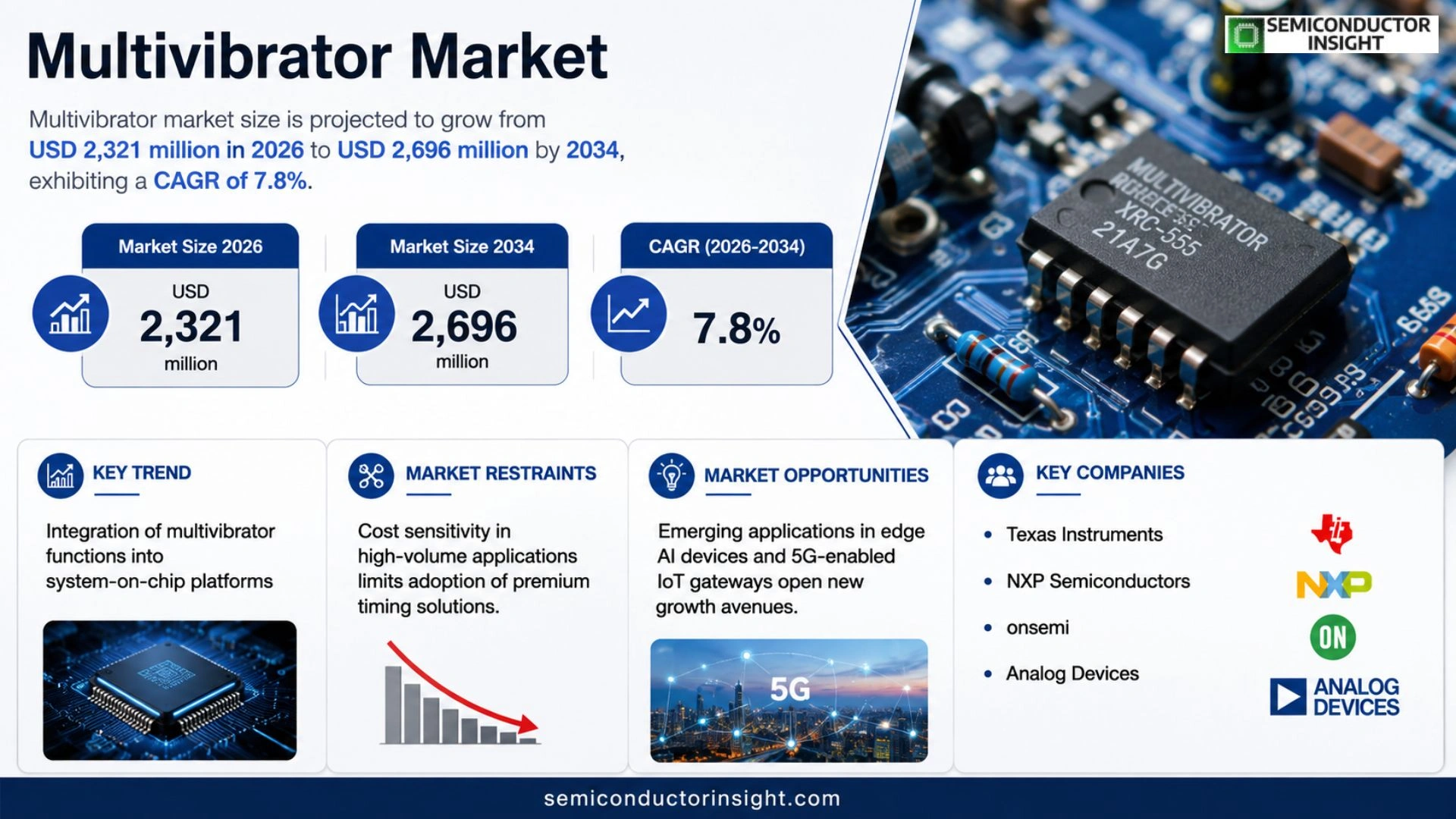
Multivibrator market size is projected to grow from USD 2,321 million in 2026 to USD 2,696 million by 2034, exhibiting a CAGR of 7.8%

PDF Icon Download Sample Report PDF
  • Quick Dispatch

    All Orders

  • Secure Payment

    100% Secure Payment

Price range: $1,500.00 through $4,250.00

Clear

Multivibrator Market Insights

Global Multivibrator market size was valued at USD 1,370 million in 2025. The market is projected to grow from USD 2,321 million in 2026 to USD 2,696 million by 2034, exhibiting a CAGR of 7.8% during the forecast period.

A multivibrator is an electronic switching or oscillator circuit that generates square‑wave pulses by toggling between two states. It can be constructed from discrete transistors, operational amplifiers or logic gates linked through resistor‑capacitor networks, and is classified as astable (continuous oscillation), monostable (single‑pulse) or bistable (flip‑flop).

The demand for multivibrators is being reinforced by expanding industrial automation, electrified transportation and growing embedded‑intelligence requirements, all of which rely on deterministic timing and low‑power pulse generation.
Multivibrator Market Trends

MARKET DRIVERS

Technological Integration in Mixed‑Signal Designs

The rise of mixed‑signal ASICs has forced designers to embed reliable timing cores. Multivibrator circuits offer the simplest way to generate precise pulses, making them a default choice when cost and power are constrained. Manufacturers are therefore redesigning product families to accommodate higher densities of these blocks, which in turn fuels component demand.

Demand from Consumer‑Grade Wearables

Wearable health monitors and fitness trackers rely on low‑power oscillators to synchronize sensor data. As active‑wearable shipments approach 300 million units annually, Multivibrator Market volume climbs in tandem because developers prioritize parts that can be integrated on a single die with minimal BOM impact.

➤ Design cycles shrink by up to 20 % when engineers adopt pre‑validated multivibrator IP, accelerating time‑to‑market for new devices.

These dynamics collectively raise the strategic importance of timing primitives, encouraging semiconductor players to expand their offering catalogs and invest in next‑generation silicon that supports higher frequencies without sacrificing stability.

MARKET CHALLENGES

Regulatory Hurdles in Safety‑Critical Sectors

Automotive and medical equipment are subject to stringent functional‑safety standards. Certification processes often require exhaustive validation of timing blocks, and any deviation can trigger costly redesigns. Consequently, suppliers of Multivibrator Market solutions must allocate additional engineering resources to meet compliance, which can erode margin in price‑sensitive segments.

Other Challenges

Supply‑Chain Volatility

Fluctuating raw‑material prices for silicon wafers translate into unpredictable cost structures for timing ICs, pressuring OEMs to seek alternative architectures or negotiate longer lead times.

MARKET RESTRAINTS

Cost Sensitivity in High‑Volume Applications

Large‑scale deployments, such as smart‑grid metering, demand per‑unit pricing that leaves little room for premium timing solutions. When Multivibrator Market participants attempt to introduce higher‑performance variants, customers often revert to legacy designs that meet baseline specifications at a lower cost, limiting overall market expansion.

MARKET OPPORTUNITIES

Emerging Applications in Edge AI Devices

Edge AI processors require ultra‑low‑latency clock generation to coordinate inference pipelines. Integrating fine‑tuned multivibrator blocks directly into these chips can shave nanoseconds off signal propagation, a benefit that translates into measurable performance gains for autonomous‑driving modules and real‑time video analytics. This niche creates a growth avenue for vendors that can certify their IP for AI‑edge workloads.

Additionally, the rollout of 5G‑enabled IoT gateways is prompting system architects to reconsider timing architectures. By positioning multivibrator‑based timing engines as compatible with high‑frequency RF front‑ends, manufacturers can capture a share of the infrastructure upgrade cycle that is projected to reach several hundred million units worldwide.

Multivibrator Market Trends

Integration of Multivibrator Functions into System‑on‑Chip Platforms

The shift from discrete timing blocks toward on‑chip implementation is reshaping Multivibrator Market. Semiconductor firms are embedding square‑wave generators directly into mixed‑signal ASICs, allowing manufacturers to reduce board count and improve deterministic behavior. This migration is fueled by the need for tighter power budgets and higher temperature margins in modern equipment. Designers now favor embedded solutions because they streamline bill‑of‑materials, accelerate time‑to‑market, and simplify certification processes. Consequently, vendors that offer customizable timing cores or license‑friendly IP see stronger ordering patterns from automotive OEMs and industrial equipment makers.

Other Trends

Supply‑Chain Resilience and Component Longevity

Reliability considerations dominate purchasing decisions for high‑volume end‑users. Companies such as Texas Instruments and Analog Devices maintain long product lifecycles, guaranteeing second‑source availability for legacy designs. This approach mitigates the risk of obsolescence in safety‑critical domains like aerospace and medical devices, where redesign cycles are costly. The broader analog ecosystem supports this stability through mature wafer processes and a steady flow of passive components, keeping unit prices flat while preserving performance margins.

Industrial Automation and Automotive Powertrain Demand

Growth in smart factories and electrified transport is amplifying the need for precise pulse generation. In robotics, timing circuits trigger motor drivers and sensor feedback loops, ensuring repeatable motion profiles. Automotive powertrain modules rely on hardware‑level timing to coordinate inverter switching and battery‑management functions, a requirement reinforced by functional‑safety standards. Because software‑based timing can introduce latency under heavy computational loads, hardware multivibrator blocks remain the preferred solution for deterministic control. This preference translates into higher unit shipments for both discrete and integrated variants across North America, Europe, and the Asia‑Pacific region.

COMPETITIVE LANDSCAPE

Key Industry Players

Multivibrator Market Competitive Overview

Texas Instruments remains the de‑facto anchor of the global multivibrator segment. Its broad analog portfolio couples timing‑critical blocks with a reputation for ultra‑long product lifecycles, which aligns with the procurement policies of automotive OEMs and industrial equipment makers that cannot afford abrupt component obsolescence. TI’s strategy of bundling multivibrator functionality inside widely adopted timer families (e.g., 555‑compatible devices) gives it a pricing advantage while preserving design familiarity across generations of engineers. Moreover, the firm leverages a globally distributed wafer‑fab footprint to guarantee supply continuity, a decisive factor for customers navigating stringent safety‑critical standards. This combination of engineering depth, lifecycle assurance, and supply‑chain resilience sustains TI’s market‑share leadership despite the gradual migration of discrete functions into system‑on‑chip blocks.

Beyond the market leader, a constellation of specialized vendors fills niche yet strategically important segments. NXP and onsemi concentrate on automotive‑grade timing ICs, embedding multivibrator cores within body‑control and power‑management modules that must survive harsh thermal cycles. Analog Devices differentiates through high‑precision, low‑noise designs suited for aerospace instrumentation, while Infineon and STMicroelectronics supply mixed‑signal families targeting industrial automation where deterministic pulse generation underpins safety interlocks. Nexperia, Renesas, and Microchip cater to cost‑sensitive high‑volume consumer and IoT applications, often providing second‑source compatibility to mitigate risk for large manufacturers. Toshiba and Samsung add depth in CMOS‑based solutions that benefit from advanced process nodes, enabling tighter integration with adjacent digital logic. Teledyne’s niche lies in hermetically sealed, radiation‑tolerant packages for defense and space platforms, where reliability eclipses unit cost. Collectively, these players reinforce a market architecture where reliability, application‑specific optimizations, and supply‑chain credibility outweigh pure price competition.

List of Key Multivibrator Companies Profiled

Segment Analysis:

Segment Category Sub-Segments Key Insights
By Type
  • Astable (continuous oscillation)
  • Monostable (single pulse)
  • Bistable (flip‑flop)
Astable Multivibrator is the workhorse for timing cores across many platforms.

  • Provides reliable clock generation without software overhead.
  • Enables simple pulse‑train generation for motor‑control and power‑management circuits.
  • Favoured in safety‑critical designs where deterministic behavior is mandatory.
By Application
  • Industrial Automation
  • Automotive Electronics
  • Aerospace & Defense
  • Consumer Electronics
  • Others
Industrial Automation drives the most sustained demand for robust timing functions.

  • Pulse generators are essential for motor‑control loops and safety interlocks.
  • Deterministic timing supports predictive maintenance and process synchronization.
  • Designs prioritize long product lifecycles and supply‑chain continuity.
By End User
  • Original Equipment Manufacturers (OEMs)
  • System Integrators
  • Original Design Manufacturers (ODMs)
OEMs seek stability and long‑term part availability.

  • Reliability criteria dominate component selection in automotive and aerospace programs.
  • Manufacturers value second‑source options to mitigate supply risk.
  • Embedded multivibrator functions in ASICs reduce board‑level complexity for OEMs.
By Technology
  • TTL/CMOS Integrated Circuits
  • Discrete Transistor Implementations
  • ASIC/Custom Silicon Solutions
TTL/CMOS ICs dominate because of their ease of integration and low power consumption.

  • Standardized packages simplify board design and testing.
  • Wide‑temperature operation aligns with industrial and automotive reliability targets.
  • Continuous process improvements keep cost pressure low while enhancing performance.
By Feedback Topology
  • RC Coupled
  • DC Coupled
  • Schmitt Trigger
RC Coupled remains the preferred topology for classic timing circuits.

  • Simple component count supports cost‑effective mass production.
  • Design flexibility allows fine‑tuning of frequency and pulse width.
  • Compatibility with both discrete and integrated implementations enhances design reuse.

Regional Analysis: Multivibrator Market

Asia‑Pacific

The Asia‑Pacific corridor has become the epicenter for multivibrator design and deployment, driven primarily by a confluence of aggressive product cycles and a maturing semiconductor ecosystem. Manufacturers in China, South Korea, and Taiwan have leveraged dense fab capacities to shorten time‑to‑market, allowing downstream system integrators to iterate faster on timing‑critical applications such as automotive infotainment and industrial automation. Concurrently, regional governments are nurturing advanced packaging initiatives that lower the total cost of ownership for precision timing modules, nudging OEMs toward locally sourced solutions rather than legacy imports. This shift reshapes the supply‑chain topology, prompting global vendors to establish joint ventures or dedicated R&D campuses within the region. The strategic emphasis on energy‑efficient circuitry further amplifies demand for low‑power multivibrators, as smart‑grid deployments and IoT edge nodes proliferate across emerging economies. Collectively, these dynamics create a self‑reinforcing loop where design innovation, cost competitiveness, and policy support feed each other, positioning Asia‑Pacific as the decisive growth engine for the market through the next decade.

Design Innovation
Regional chip designers are embedding configurable multivibrator blocks directly into mixed‑signal ASICs, reducing board‑level component counts and enhancing signal integrity. This move reflects a broader push toward integration that shortens product development timelines and improves reliability in harsh environments.
Supply‑Chain Resilience
By localising wafer production and expanding on‑shoring assembly lines, firms mitigate geopolitical risks that previously forced reliance on distant foundries, thereby ensuring more predictable lead times for critical timing components.
Regulatory Landscape
Recent standards on electromagnetic compatibility in Southeast Asia compel OEMs to select multivibrators with tighter spectral emissions, prompting suppliers to refine design libraries for compliance without sacrificing performance.
Growth Opportunities
The surge in consumer wearables and low‑power medical devices offers fertile ground for niche multivibrator variants that prioritize ultra‑low quiescent current and miniature footprint, aligning with regional design trends.

North America
In North America, Multivibrator segment is shaped by a strong emphasis on high‑frequency applications in aerospace and defense. Companies prioritize ruggedized timing circuits that can endure temperature extremes, which drives a demand for premium‑grade devices backed by extensive qualification programs. Collaborative research initiatives between universities and defense contractors accelerate the emergence of custom‑tuned oscillators, reinforcing the region’s reputation for cutting‑edge performance. While cost pressures remain, the willingness to pay a premium for reliability sustains a market niche that values precision over volume.

Europe
European manufacturers are navigating a regulatory environment that stresses energy efficiency and safety certification. The push toward electric mobility and smart‑factory automation fuels interest in multivibrators that can operate under stringent power budgets while meeting CE and ISO standards. German and French firms, in particular, are integrating timing modules into modular power‑train architectures, where deterministic behavior is essential for system stability. The region’s focus on sustainable production also encourages suppliers to adopt greener fabrication processes, influencing component selection criteria across the supply chain.

South America
South American markets exhibit a pragmatic approach, balancing cost considerations with the need for reliable timing solutions in expanding telecommunications infrastructure. Brazil’s recent investments in 5G rollout have spurred demand for multivibrator‑based clock generators that support high‑throughput base stations. However, limited local fab capacity means many providers rely on imported modules, prompting distributors to emphasize after‑sales support and inventory buffering to mitigate lead‑time uncertainties.

Middle East & Africa
In the Middle East and Africa, Multivibrator landscape is heavily influenced by infrastructure projects in oil‑and‑gas and renewable energy sectors. Timing devices are essential for synchronizing sensor networks that monitor pipeline integrity and solar‑farm performance. Regional players often prioritize robustness against sand‑induced abrasion and high ambient temperatures, leading to a preference for encapsulated packages with extended operational lifespans. The growing focus on digital transformation across the region further amplifies interest in compact, low‑power timing solutions for remote monitoring stations.

Report Scope

This market research report provides a comprehensive analysis of the Multivibrator Market , covering the forecast period 2026–2034. It offers detailed insights into market dynamics, technological advancements, competitive landscape, and key trends shaping the industry.

Key focus areas of the report include:

  • Market Overview: The report begins with an overview outlining its current market scenario, key growth indicators, and industry transformation drivers. It discusses macroeconomic factors, demand–supply balance, regulatory landscape, and the strategic role of semiconductors in powering advancements across industries such as automotive, telecommunications, consumer electronics, and industrial automation.
  • Market Size & Forecast: Historical data and future projections for revenue, unit shipments, and market value across major regions and segments.
  • Segmentation Analysis: Detailed breakdown by product type, technology, application, and end-user industry to identify high-growth segments and investment opportunities.
  • Regional Insights: Insights into market performance across North America, Europe, Asia-Pacific, Latin America, and the Middle East & Africa, including country-level analysis where relevant.
  • Competitive Landscape: Profiles of leading market participants, including their product offerings, R&D focus, manufacturing capacity, pricing strategies, and recent developments such as mergers, acquisitions, and partnerships.
  • Technology Trends & Innovation: Assessment of emerging technologies, integration of AI/IoT, semiconductor design trends, fabrication techniques, and evolving industry standards.
  • Market Drivers & Restraints: Evaluation of factors driving market growth along with challenges, supply chain constraints, regulatory issues, and market-entry barriers.
  • Stakeholder Insights: Insights for component suppliers, OEMs, system integrators, investors, and policymakers regarding the evolving ecosystem and strategic opportunities.

Primary and secondary research methods are employed, including interviews with industry experts, data from verified sources, and real-time market intelligence to ensure the accuracy and reliability of the insights presented.

FREQUENTLY ASKED QUESTIONS:

What is the current market size of Multivibrator Market?

-> Multivibrator market size is projected to grow from USD 2,321 million in 2026 to USD 2,696 million by 2034, exhibiting a CAGR of 7.8%

Which key companies operate in Multivibrator Market?

-> Key players include Texas Instruments, NXP Semiconductors, onsemi, Analog Devices, Toshiba Electronic Devices & Storage, Teledyne Technologies, Nexperia, Infineon Technologies, STMicroelectronics, Renesas Electronics, Microchip Technology, and Samsung Semiconductor, among others.

What are the key growth drivers?

-> Key growth drivers include expansion of industrial automation, electrification of transportation, need for deterministic hardware timing in safety‑critical systems, and increasing adoption of low‑power, wide‑temperature multivibrator functions in embedded platforms.

Which region dominates the market?

-> Asia-Pacific is the fastest‑growing region, while Europe remains a dominant market due to strong automotive and industrial machinery demand.

What are the emerging trends?

-> Emerging trends include integration of multivibrator functionality into system‑on‑chip (SoC) solutions, low‑power design techniques, and heightened focus on reliability for electric‑vehicle power modules and smart manufacturing equipment.
Multivibrator Market Trends, Business Strategies 2026-2034

Get Sample Report PDF for Exclusive Insights

Report Sample Includes

  • Table of Contents
  • List of Tables & Figures
  • Charts, Research Methodology, and more...

PDF Icon Download Sample Report PDF
SKU: e11f48b5ff99
Category:
License Type

Corporate License, Excel License, PDF and Excel Databook License

Download Sample Report

Table of Content

1 Introduction to Research & Analysis Reports
1.1 Multivibrator Market Definition
1.2 Market Segments
1.2.1 Segment by Type
1.2.2 Segment by Feedback / Topology
1.2.3 Segment by Manufacturing Technology
1.2.4 Segment by Application
1.3 Global Multivibrator Market Overview
1.4 Features & Benefits of This Report
1.5 Methodology & Sources of Information
1.5.1 Research Methodology
1.5.2 Research Process
1.5.3 Base Year
1.5.4 Report Assumptions & Caveats
2 Global Multivibrator Overall Market Size
2.1 Global Multivibrator Market Size: 2025 VS 2032
2.2 Global Multivibrator Market Size, Prospects & Forecasts: 2021-2032
2.3 Global Multivibrator Sales: 2021-2032
3 Company Landscape
3.1 Top Multivibrator Players in Global Market
3.2 Top Global Multivibrator Companies Ranked by Revenue
3.3 Global Multivibrator Revenue by Companies
3.4 Global Multivibrator Sales by Companies
3.5 Global Multivibrator Price by Manufacturer (2021-2026)
3.6 Top 3 and Top 5 Multivibrator Companies in Global Market, by Revenue in 2025
3.7 Global Manufacturers Multivibrator Product Type
3.8 Tier 1, Tier 2, and Tier 3 Multivibrator Players in Global Market
3.8.1 List of Global Tier 1 Multivibrator Companies
3.8.2 List of Global Tier 2 and Tier 3 Multivibrator Companies
4 Sights by Type
4.1 Overview
4.1.1 Segment by Type – Global Multivibrator Market Size Markets, 2025 & 2032
4.1.2 Monostable Multivibrator
4.1.3 Astable Multivibrator
4.1.4 Bistable Multivibrator
4.2 Segment by Type – Global Multivibrator Revenue & Forecasts
4.2.1 Segment by Type – Global Multivibrator Revenue, 2021-2026
4.2.2 Segment by Type – Global Multivibrator Revenue, 2027-2032
4.2.3 Segment by Type – Global Multivibrator Revenue Market Share, 2021-2032
4.3 Segment by Type – Global Multivibrator Sales & Forecasts
4.3.1 Segment by Type – Global Multivibrator Sales, 2021-2026
4.3.2 Segment by Type – Global Multivibrator Sales, 2027-2032
4.3.3 Segment by Type – Global Multivibrator Sales Market Share, 2021-2032
4.4 Segment by Type – Global Multivibrator Price (Manufacturers Selling Prices), 2021-2032
5 Sights by Feedback / Topology
5.1 Overview
5.1.1 Segment by Feedback / Topology – Global Multivibrator Market Size Markets, 2025 & 2032
5.1.2 RC Coupled Multivibrator
5.1.3 DC Coupled Multivibrator
5.1.4 Schmitt Trigger Multivibrator
5.2 Segment by Feedback / Topology – Global Multivibrator Revenue & Forecasts
5.2.1 Segment by Feedback / Topology – Global Multivibrator Revenue, 2021-2026
5.2.2 Segment by Feedback / Topology – Global Multivibrator Revenue, 2027-2032
5.2.3 Segment by Feedback / Topology – Global Multivibrator Revenue Market Share, 2021-2032
5.3 Segment by Feedback / Topology – Global Multivibrator Sales & Forecasts
5.3.1 Segment by Feedback / Topology – Global Multivibrator Sales, 2021-2026
5.3.2 Segment by Feedback / Topology – Global Multivibrator Sales, 2027-2032
5.3.3 Segment by Feedback / Topology – Global Multivibrator Sales Market Share, 2021-2032
5.4 Segment by Feedback / Topology – Global Multivibrator Price (Manufacturers Selling Prices), 2021-2032
6 Sights by Manufacturing Technology
6.1 Overview
6.1.1 Segment by Manufacturing Technology – Global Multivibrator Market Size Markets, 2025 & 2032
6.1.2 Bipolar Technology Multivibrator
6.1.3 CMOS Technology Multivibrator
6.1.4 BiCMOS Technology Multivibrator
6.1.5 ASIC/Custom Silicon Multivibrator
6.2 Segment by Manufacturing Technology – Global Multivibrator Revenue & Forecasts
6.2.1 Segment by Manufacturing Technology – Global Multivibrator Revenue, 2021-2026
6.2.2 Segment by Manufacturing Technology – Global Multivibrator Revenue, 2027-2032
6.2.3 Segment by Manufacturing Technology – Global Multivibrator Revenue Market Share, 2021-2032
6.3 Segment by Manufacturing Technology – Global Multivibrator Sales & Forecasts
6.3.1 Segment by Manufacturing Technology – Global Multivibrator Sales, 2021-2026
6.3.2 Segment by Manufacturing Technology – Global Multivibrator Sales, 2027-2032
6.3.3 Segment by Manufacturing Technology – Global Multivibrator Sales Market Share, 2021-2032
6.4 Segment by Manufacturing Technology – Global Multivibrator Price (Manufacturers Selling Prices), 2021-2032
7 Sights by Application
7.1 Overview
7.1.1 Segment by Application – Global Multivibrator Market Size, 2025 & 2032
7.1.2 Consumer Electronics
7.1.3 Aerospace Electronics
7.1.4 Other
7.2 Segment by Application – Global Multivibrator Revenue & Forecasts
7.2.1 Segment by Application – Global Multivibrator Revenue, 2021-2026
7.2.2 Segment by Application – Global Multivibrator Revenue, 2027-2032
7.2.3 Segment by Application – Global Multivibrator Revenue Market Share, 2021-2032
7.3 Segment by Application – Global Multivibrator Sales & Forecasts
7.3.1 Segment by Application – Global Multivibrator Sales, 2021-2026
7.3.2 Segment by Application – Global Multivibrator Sales, 2027-2032
7.3.3 Segment by Application – Global Multivibrator Sales Market Share, 2021-2032
7.4 Segment by Application – Global Multivibrator Price (Manufacturers Selling Prices), 2021-2032
8 Sights Region
8.1 By Region – Global Multivibrator Market Size, 2025 & 2032
8.2 By Region – Global Multivibrator Revenue & Forecasts
8.2.1 By Region – Global Multivibrator Revenue, 2021-2026
8.2.2 By Region – Global Multivibrator Revenue, 2027-2032
8.2.3 By Region – Global Multivibrator Revenue Market Share, 2021-2032
8.3 By Region – Global Multivibrator Sales & Forecasts
8.3.1 By Region – Global Multivibrator Sales, 2021-2026
8.3.2 By Region – Global Multivibrator Sales, 2027-2032
8.3.3 By Region – Global Multivibrator Sales Market Share, 2021-2032
8.4 North America
8.4.1 By Country – North America Multivibrator Revenue, 2021-2032
8.4.2 By Country – North America Multivibrator Sales, 2021-2032
8.4.3 United States Multivibrator Market Size, 2021-2032
8.4.4 Canada Multivibrator Market Size, 2021-2032
8.4.5 Mexico Multivibrator Market Size, 2021-2032
8.5 Europe
8.5.1 By Country – Europe Multivibrator Revenue, 2021-2032
8.5.2 By Country – Europe Multivibrator Sales, 2021-2032
8.5.3 Germany Multivibrator Market Size, 2021-2032
8.5.4 France Multivibrator Market Size, 2021-2032
8.5.5 U.K. Multivibrator Market Size, 2021-2032
8.5.6 Italy Multivibrator Market Size, 2021-2032
8.5.7 Russia Multivibrator Market Size, 2021-2032
8.5.8 Nordic Countries Multivibrator Market Size, 2021-2032
8.5.9 Benelux Multivibrator Market Size, 2021-2032
8.6 Asia
8.6.1 By Region – Asia Multivibrator Revenue, 2021-2032
8.6.2 By Region – Asia Multivibrator Sales, 2021-2032
8.6.3 China Multivibrator Market Size, 2021-2032
8.6.4 Japan Multivibrator Market Size, 2021-2032
8.6.5 South Korea Multivibrator Market Size, 2021-2032
8.6.6 Southeast Asia Multivibrator Market Size, 2021-2032
8.6.7 India Multivibrator Market Size, 2021-2032
8.7 South America
8.7.1 By Country – South America Multivibrator Revenue, 2021-2032
8.7.2 By Country – South America Multivibrator Sales, 2021-2032
8.7.3 Brazil Multivibrator Market Size, 2021-2032
8.7.4 Argentina Multivibrator Market Size, 2021-2032
8.8 Middle East & Africa
8.8.1 By Country – Middle East & Africa Multivibrator Revenue, 2021-2032
8.8.2 By Country – Middle East & Africa Multivibrator Sales, 2021-2032
8.8.3 Turkey Multivibrator Market Size, 2021-2032
8.8.4 Israel Multivibrator Market Size, 2021-2032
8.8.5 Saudi Arabia Multivibrator Market Size, 2021-2032
8.8.6 UAE Multivibrator Market Size, 2021-2032
9 Manufacturers & Brands Profiles
9.1 Texas Instruments
9.1.1 Texas Instruments Company Summary
9.1.2 Texas Instruments Business Overview
9.1.3 Texas Instruments Multivibrator Major Product Offerings
9.1.4 Texas Instruments Multivibrator Sales and Revenue in Global (2021-2026)
9.1.5 Texas Instruments Key News & Latest Developments
9.2 NXP Semiconductors
9.2.1 NXP Semiconductors Company Summary
9.2.2 NXP Semiconductors Business Overview
9.2.3 NXP Semiconductors Multivibrator Major Product Offerings
9.2.4 NXP Semiconductors Multivibrator Sales and Revenue in Global (2021-2026)
9.2.5 NXP Semiconductors Key News & Latest Developments
9.3 onsemi
9.3.1 onsemi Company Summary
9.3.2 onsemi Business Overview
9.3.3 onsemi Multivibrator Major Product Offerings
9.3.4 onsemi Multivibrator Sales and Revenue in Global (2021-2026)
9.3.5 onsemi Key News & Latest Developments
9.4 Analog Devices
9.4.1 Analog Devices Company Summary
9.4.2 Analog Devices Business Overview
9.4.3 Analog Devices Multivibrator Major Product Offerings
9.4.4 Analog Devices Multivibrator Sales and Revenue in Global (2021-2026)
9.4.5 Analog Devices Key News & Latest Developments
9.5 Toshiba Electronic Devices & Storage Corporation
9.5.1 Toshiba Electronic Devices & Storage Corporation Company Summary
9.5.2 Toshiba Electronic Devices & Storage Corporation Business Overview
9.5.3 Toshiba Electronic Devices & Storage Corporation Multivibrator Major Product Offerings
9.5.4 Toshiba Electronic Devices & Storage Corporation Multivibrator Sales and Revenue in Global (2021-2026)
9.5.5 Toshiba Electronic Devices & Storage Corporation Key News & Latest Developments
9.6 Teledyne Technologies (Teledyne MEMS/ICs)
9.6.1 Teledyne Technologies (Teledyne MEMS/ICs) Company Summary
9.6.2 Teledyne Technologies (Teledyne MEMS/ICs) Business Overview
9.6.3 Teledyne Technologies (Teledyne MEMS/ICs) Multivibrator Major Product Offerings
9.6.4 Teledyne Technologies (Teledyne MEMS/ICs) Multivibrator Sales and Revenue in Global (2021-2026)
9.6.5 Teledyne Technologies (Teledyne MEMS/ICs) Key News & Latest Developments
9.7 Nexperia
9.7.1 Nexperia Company Summary
9.7.2 Nexperia Business Overview
9.7.3 Nexperia Multivibrator Major Product Offerings
9.7.4 Nexperia Multivibrator Sales and Revenue in Global (2021-2026)
9.7.5 Nexperia Key News & Latest Developments
9.8 Infineon Technologies
9.8.1 Infineon Technologies Company Summary
9.8.2 Infineon Technologies Business Overview
9.8.3 Infineon Technologies Multivibrator Major Product Offerings
9.8.4 Infineon Technologies Multivibrator Sales and Revenue in Global (2021-2026)
9.8.5 Infineon Technologies Key News & Latest Developments
9.9 STMicroelectronics
9.9.1 STMicroelectronics Company Summary
9.9.2 STMicroelectronics Business Overview
9.9.3 STMicroelectronics Multivibrator Major Product Offerings
9.9.4 STMicroelectronics Multivibrator Sales and Revenue in Global (2021-2026)
9.9.5 STMicroelectronics Key News & Latest Developments
9.10 Renesas Electronics
9.10.1 Renesas Electronics Company Summary
9.10.2 Renesas Electronics Business Overview
9.10.3 Renesas Electronics Multivibrator Major Product Offerings
9.10.4 Renesas Electronics Multivibrator Sales and Revenue in Global (2021-2026)
9.10.5 Renesas Electronics Key News & Latest Developments
9.11 Microchip Technology
9.11.1 Microchip Technology Company Summary
9.11.2 Microchip Technology Business Overview
9.11.3 Microchip Technology Multivibrator Major Product Offerings
9.11.4 Microchip Technology Multivibrator Sales and Revenue in Global (2021-2026)
9.11.5 Microchip Technology Key News & Latest Developments
9.12 Samsung Semiconductor
9.12.1 Samsung Semiconductor Company Summary
9.12.2 Samsung Semiconductor Business Overview
9.12.3 Samsung Semiconductor Multivibrator Major Product Offerings
9.12.4 Samsung Semiconductor Multivibrator Sales and Revenue in Global (2021-2026)
9.12.5 Samsung Semiconductor Key News & Latest Developments
10 Global Multivibrator Production Capacity, Analysis
10.1 Global Multivibrator Production Capacity, 2021-2032
10.2 Multivibrator Production Capacity of Key Manufacturers in Global Market
10.3 Global Multivibrator Production by Region
11 Key Market Trends, Opportunity, Drivers and Restraints
11.1 Market Opportunities & Trends
11.2 Market Drivers
11.3 Market Restraints
12 Multivibrator Supply Chain Analysis
12.1 Multivibrator Industry Value Chain
12.2 Multivibrator Upstream Market
12.3 Multivibrator Downstream and Clients
12.4 Marketing Channels Analysis
12.4.1 Marketing Channels
12.4.2 Multivibrator Distributors and Sales Agents in Global
13 Conclusion
14 Appendix
14.1 Note
14.2 Examples of Clients
14.3 DisclaimerList of Tables
Table 1. Key Players of Multivibrator in Global Market
Table 2. Top Multivibrator Players in Global Market, Ranking by Revenue (2025)
Table 3. Global Multivibrator Revenue by Companies, (US$, Mn), 2021-2026
Table 4. Global Multivibrator Revenue Share by Companies, 2021-2026
Table 5. Global Multivibrator Sales by Companies, (K Units), 2021-2026
Table 6. Global Multivibrator Sales Share by Companies, 2021-2026
Table 7. Key Manufacturers Multivibrator Price (2021-2026) & (US$/Unit)
Table 8. Global Manufacturers Multivibrator Product Type
Table 9. List of Global Tier 1 Multivibrator Companies, Revenue (US$, Mn) in 2025 and Market Share
Table 10. List of Global Tier 2 and Tier 3 Multivibrator Companies, Revenue (US$, Mn) in 2025 and Market Share
Table 11. Segment by Type – Global Multivibrator Revenue, (US$, Mn), 2025 & 2032
Table 12. Segment by Type – Global Multivibrator Revenue (US$, Mn), 2021-2026
Table 13. Segment by Type – Global Multivibrator Revenue (US$, Mn), 2027-2032
Table 14. Segment by Type – Global Multivibrator Sales (K Units), 2021-2026
Table 15. Segment by Type – Global Multivibrator Sales (K Units), 2027-2032
Table 16. Segment by Feedback / Topology – Global Multivibrator Revenue, (US$, Mn), 2025 & 2032
Table 17. Segment by Feedback / Topology – Global Multivibrator Revenue (US$, Mn), 2021-2026
Table 18. Segment by Feedback / Topology – Global Multivibrator Revenue (US$, Mn), 2027-2032
Table 19. Segment by Feedback / Topology – Global Multivibrator Sales (K Units), 2021-2026
Table 20. Segment by Feedback / Topology – Global Multivibrator Sales (K Units), 2027-2032
Table 21. Segment by Manufacturing Technology – Global Multivibrator Revenue, (US$, Mn), 2025 & 2032
Table 22. Segment by Manufacturing Technology – Global Multivibrator Revenue (US$, Mn), 2021-2026
Table 23. Segment by Manufacturing Technology – Global Multivibrator Revenue (US$, Mn), 2027-2032
Table 24. Segment by Manufacturing Technology – Global Multivibrator Sales (K Units), 2021-2026
Table 25. Segment by Manufacturing Technology – Global Multivibrator Sales (K Units), 2027-2032
Table 26. Segment by Application – Global Multivibrator Revenue, (US$, Mn), 2025 & 2032
Table 27. Segment by Application – Global Multivibrator Revenue, (US$, Mn), 2021-2026
Table 28. Segment by Application – Global Multivibrator Revenue, (US$, Mn), 2027-2032
Table 29. Segment by Application – Global Multivibrator Sales, (K Units), 2021-2026
Table 30. Segment by Application – Global Multivibrator Sales, (K Units), 2027-2032
Table 31. By Region – Global Multivibrator Revenue, (US$, Mn), 2025 & 2032
Table 32. By Region – Global Multivibrator Revenue, (US$, Mn), 2021-2026
Table 33. By Region – Global Multivibrator Revenue, (US$, Mn), 2027-2032
Table 34. By Region – Global Multivibrator Sales, (K Units), 2021-2026
Table 35. By Region – Global Multivibrator Sales, (K Units), 2027-2032
Table 36. By Country – North America Multivibrator Revenue, (US$, Mn), 2021-2026
Table 37. By Country – North America Multivibrator Revenue, (US$, Mn), 2027-2032
Table 38. By Country – North America Multivibrator Sales, (K Units), 2021-2026
Table 39. By Country – North America Multivibrator Sales, (K Units), 2027-2032
Table 40. By Country – Europe Multivibrator Revenue, (US$, Mn), 2021-2026
Table 41. By Country – Europe Multivibrator Revenue, (US$, Mn), 2027-2032
Table 42. By Country – Europe Multivibrator Sales, (K Units), 2021-2026
Table 43. By Country – Europe Multivibrator Sales, (K Units), 2027-2032
Table 44. By Region – Asia Multivibrator Revenue, (US$, Mn), 2021-2026
Table 45. By Region – Asia Multivibrator Revenue, (US$, Mn), 2027-2032
Table 46. By Region – Asia Multivibrator Sales, (K Units), 2021-2026
Table 47. By Region – Asia Multivibrator Sales, (K Units), 2027-2032
Table 48. By Country – South America Multivibrator Revenue, (US$, Mn), 2021-2026
Table 49. By Country – South America Multivibrator Revenue, (US$, Mn), 2027-2032
Table 50. By Country – South America Multivibrator Sales, (K Units), 2021-2026
Table 51. By Country – South America Multivibrator Sales, (K Units), 2027-2032
Table 52. By Country – Middle East & Africa Multivibrator Revenue, (US$, Mn), 2021-2026
Table 53. By Country – Middle East & Africa Multivibrator Revenue, (US$, Mn), 2027-2032
Table 54. By Country – Middle East & Africa Multivibrator Sales, (K Units), 2021-2026
Table 55. By Country – Middle East & Africa Multivibrator Sales, (K Units), 2027-2032
Table 56. Texas Instruments Company Summary
Table 57. Texas Instruments Multivibrator Product Offerings
Table 58. Texas Instruments Multivibrator Sales (K Units), Revenue (US$, Mn) and Average Price (US$/Unit) & (2021-2026)
Table 59. Texas Instruments Key News & Latest Developments
Table 60. NXP Semiconductors Company Summary
Table 61. NXP Semiconductors Multivibrator Product Offerings
Table 62. NXP Semiconductors Multivibrator Sales (K Units), Revenue (US$, Mn) and Average Price (US$/Unit) & (2021-2026)
Table 63. NXP Semiconductors Key News & Latest Developments
Table 64. onsemi Company Summary
Table 65. onsemi Multivibrator Product Offerings
Table 66. onsemi Multivibrator Sales (K Units), Revenue (US$, Mn) and Average Price (US$/Unit) & (2021-2026)
Table 67. onsemi Key News & Latest Developments
Table 68. Analog Devices Company Summary
Table 69. Analog Devices Multivibrator Product Offerings
Table 70. Analog Devices Multivibrator Sales (K Units), Revenue (US$, Mn) and Average Price (US$/Unit) & (2021-2026)
Table 71. Analog Devices Key News & Latest Developments
Table 72. Toshiba Electronic Devices & Storage Corporation Company Summary
Table 73. Toshiba Electronic Devices & Storage Corporation Multivibrator Product Offerings
Table 74. Toshiba Electronic Devices & Storage Corporation Multivibrator Sales (K Units), Revenue (US$, Mn) and Average Price (US$/Unit) & (2021-2026)
Table 75. Toshiba Electronic Devices & Storage Corporation Key News & Latest Developments
Table 76. Teledyne Technologies (Teledyne MEMS/ICs) Company Summary
Table 77. Teledyne Technologies (Teledyne MEMS/ICs) Multivibrator Product Offerings
Table 78. Teledyne Technologies (Teledyne MEMS/ICs) Multivibrator Sales (K Units), Revenue (US$, Mn) and Average Price (US$/Unit) & (2021-2026)
Table 79. Teledyne Technologies (Teledyne MEMS/ICs) Key News & Latest Developments
Table 80. Nexperia Company Summary
Table 81. Nexperia Multivibrator Product Offerings
Table 82. Nexperia Multivibrator Sales (K Units), Revenue (US$, Mn) and Average Price (US$/Unit) & (2021-2026)
Table 83. Nexperia Key News & Latest Developments
Table 84. Infineon Technologies Company Summary
Table 85. Infineon Technologies Multivibrator Product Offerings
Table 86. Infineon Technologies Multivibrator Sales (K Units), Revenue (US$, Mn) and Average Price (US$/Unit) & (2021-2026)
Table 87. Infineon Technologies Key News & Latest Developments
Table 88. STMicroelectronics Company Summary
Table 89. STMicroelectronics Multivibrator Product Offerings
Table 90. STMicroelectronics Multivibrator Sales (K Units), Revenue (US$, Mn) and Average Price (US$/Unit) & (2021-2026)
Table 91. STMicroelectronics Key News & Latest Developments
Table 92. Renesas Electronics Company Summary
Table 93. Renesas Electronics Multivibrator Product Offerings
Table 94. Renesas Electronics Multivibrator Sales (K Units), Revenue (US$, Mn) and Average Price (US$/Unit) & (2021-2026)
Table 95. Renesas Electronics Key News & Latest Developments
Table 96. Microchip Technology Company Summary
Table 97. Microchip Technology Multivibrator Product Offerings
Table 98. Microchip Technology Multivibrator Sales (K Units), Revenue (US$, Mn) and Average Price (US$/Unit) & (2021-2026)
Table 99. Microchip Technology Key News & Latest Developments
Table 100. Samsung Semiconductor Company Summary
Table 101. Samsung Semiconductor Multivibrator Product Offerings
Table 102. Samsung Semiconductor Multivibrator Sales (K Units), Revenue (US$, Mn) and Average Price (US$/Unit) & (2021-2026)
Table 103. Samsung Semiconductor Key News & Latest Developments
Table 104. Multivibrator Capacity of Key Manufacturers in Global Market, 2024-2026 (K Units)
Table 105. Global Multivibrator Capacity Market Share of Key Manufacturers, 2024-2026
Table 106. Global Multivibrator Production by Region, 2021-2026 (K Units)
Table 107. Global Multivibrator Production by Region, 2027-2032 (K Units)
Table 108. Multivibrator Market Opportunities & Trends in Global Market
Table 109. Multivibrator Market Drivers in Global Market
Table 110. Multivibrator Market Restraints in Global Market
Table 111. Multivibrator Raw Materials
Table 112. Multivibrator Raw Materials Suppliers in Global Market
Table 113. Typical Multivibrator Downstream
Table 114. Multivibrator Downstream Clients in Global Market
Table 115. Multivibrator Distributors and Sales Agents in Global Market

List of Figures
Figure 1. Multivibrator Product Picture
Figure 2. Multivibrator Segment by Type in 2025
Figure 3. Multivibrator Segment by Feedback / Topology in 2025
Figure 4. Multivibrator Segment by Manufacturing Technology in 2025
Figure 5. Multivibrator Segment by Application in 2025
Figure 6. Global Multivibrator Market Overview: 2025
Figure 7. Key Caveats
Figure 8. Global Multivibrator Market Size: 2025 VS 2032 (US$, Mn)
Figure 9. Global Multivibrator Revenue: 2021-2032 (US$, Mn)
Figure 10. Multivibrator Sales in Global Market: 2021-2032 (K Units)
Figure 11. The Top 3 and 5 Players Market Share by Multivibrator Revenue in 2025
Figure 12. Segment by Type – Global Multivibrator Revenue, (US$, Mn), 2025 & 2032
Figure 13. Segment by Type – Global Multivibrator Revenue Market Share, 2021-2032
Figure 14. Segment by Type – Global Multivibrator Sales Market Share, 2021-2032
Figure 15. Segment by Type – Global Multivibrator Price (US$/Unit), 2021-2032
Figure 16. Segment by Feedback / Topology – Global Multivibrator Revenue, (US$, Mn), 2025 & 2032
Figure 17. Segment by Feedback / Topology – Global Multivibrator Revenue Market Share, 2021-2032
Figure 18. Segment by Feedback / Topology – Global Multivibrator Sales Market Share, 2021-2032
Figure 19. Segment by Feedback / Topology – Global Multivibrator Price (US$/Unit), 2021-2032
Figure 20. Segment by Manufacturing Technology – Global Multivibrator Revenue, (US$, Mn), 2025 & 2032
Figure 21. Segment by Manufacturing Technology – Global Multivibrator Revenue Market Share, 2021-2032
Figure 22. Segment by Manufacturing Technology – Global Multivibrator Sales Market Share, 2021-2032
Figure 23. Segment by Manufacturing Technology – Global Multivibrator Price (US$/Unit), 2021-2032
Figure 24. Segment by Application – Global Multivibrator Revenue, (US$, Mn), 2025 & 2032
Figure 25. Segment by Application – Global Multivibrator Revenue Market Share, 2021-2032
Figure 26. Segment by Application – Global Multivibrator Sales Market Share, 2021-2032
Figure 27. Segment by Application -Global Multivibrator Price (US$/Unit), 2021-2032
Figure 28. By Region – Global Multivibrator Revenue, (US$, Mn), 2025 & 2032
Figure 29. By Region – Global Multivibrator Revenue Market Share, 2021 VS 2025 VS 2032
Figure 30. By Region – Global Multivibrator Revenue Market Share, 2021-2032
Figure 31. By Region – Global Multivibrator Sales Market Share, 2021-2032
Figure 32. By Country – North America Multivibrator Revenue Market Share, 2021-2032
Figure 33. By Country – North America Multivibrator Sales Market Share, 2021-2032
Figure 34. United States Multivibrator Revenue, (US$, Mn), 2021-2032
Figure 35. Canada Multivibrator Revenue, (US$, Mn), 2021-2032
Figure 36. Mexico Multivibrator Revenue, (US$, Mn), 2021-2032
Figure 37. By Country – Europe Multivibrator Revenue Market Share, 2021-2032
Figure 38. By Country – Europe Multivibrator Sales Market Share, 2021-2032
Figure 39. Germany Multivibrator Revenue, (US$, Mn), 2021-2032
Figure 40. France Multivibrator Revenue, (US$, Mn), 2021-2032
Figure 41. U.K. Multivibrator Revenue, (US$, Mn), 2021-2032
Figure 42. Italy Multivibrator Revenue, (US$, Mn), 2021-2032
Figure 43. Russia Multivibrator Revenue, (US$, Mn), 2021-2032
Figure 44. Nordic Countries Multivibrator Revenue, (US$, Mn), 2021-2032
Figure 45. Benelux Multivibrator Revenue, (US$, Mn), 2021-2032
Figure 46. By Region – Asia Multivibrator Revenue Market Share, 2021-2032
Figure 47. By Region – Asia Multivibrator Sales Market Share, 2021-2032
Figure 48. China Multivibrator Revenue, (US$, Mn), 2021-2032
Figure 49. Japan Multivibrator Revenue, (US$, Mn), 2021-2032
Figure 50. South Korea Multivibrator Revenue, (US$, Mn), 2021-2032
Figure 51. Southeast Asia Multivibrator Revenue, (US$, Mn), 2021-2032
Figure 52. India Multivibrator Revenue, (US$, Mn), 2021-2032
Figure 53. By Country – South America Multivibrator Revenue Market Share, 2021-2032
Figure 54. By Country – South America Multivibrator Sales, Market Share, 2021-2032
Figure 55. Brazil Multivibrator Revenue, (US$, Mn), 2021-2032
Figure 56. Argentina Multivibrator Revenue, (US$, Mn), 2021-2032
Figure 57. By Country – Middle East & Africa Multivibrator Revenue, Market Share, 2021-2032
Figure 58. By Country – Middle East & Africa Multivibrator Sales, Market Share, 2021-2032
Figure 59. Turkey Multivibrator Revenue, (US$, Mn), 2021-2032
Figure 60. Israel Multivibrator Revenue, (US$, Mn), 2021-2032
Figure 61. Saudi Arabia Multivibrator Revenue, (US$, Mn), 2021-2032
Figure 62. UAE Multivibrator Revenue, (US$, Mn), 2021-2032
Figure 63. Global Multivibrator Production Capacity (K Units), 2021-2032
Figure 64. The Percentage of Production Multivibrator by Region, 2025 VS 2032
Figure 65. Multivibrator Industry Value Chain
Figure 66. Marketing Channels