Multimode Fiber Optic Transceivers Market Overview
The multimode fiber optic transceiver has functions such as address filtering, network segmentation and intelligent alarm, which can improve network work efficiency and network operation reliability. It can realize high-speed long-distance interconnection of up to 5 kilometers without relay computer data network. The product performance is stable and reliable, the design conforms to the Ethernet standard, and there are lightning protection measures. It is especially suitable for various broadband data networks and fields that require high-reliability data transmission or the establishment of IP data transmission private networks.
This report provides a deep insight into the global Multimode Fiber Optic Transceivers market covering all its essential aspects. This ranges from a macro overview of the market to micro details of the market size, competitive landscape, development trend, niche market, key market drivers and challenges, SWOT analysis, value chain analysis, etc.
The analysis helps the reader to shape the competition within the industries and strategies for the competitive environment to enhance the potential profit. Furthermore, it provides a simple framework for evaluating and accessing the position of the business organization. The report structure also focuses on the competitive landscape of the Global Multimode Fiber Optic Transceivers Market, this report introduces in detail the market share, market performance, product situation, operation situation, etc. of the main players, which helps the readers in the industry to identify the main competitors and deeply understand the competition pattern of the market.
In a word, this report is a must-read for industry players, investors, researchers, consultants, business strategists, and all those who have any kind of stake or are planning to foray into the Multimode Fiber Optic Transceivers market in any manner.
Multimode Fiber Optic Transceivers Market Analysis:
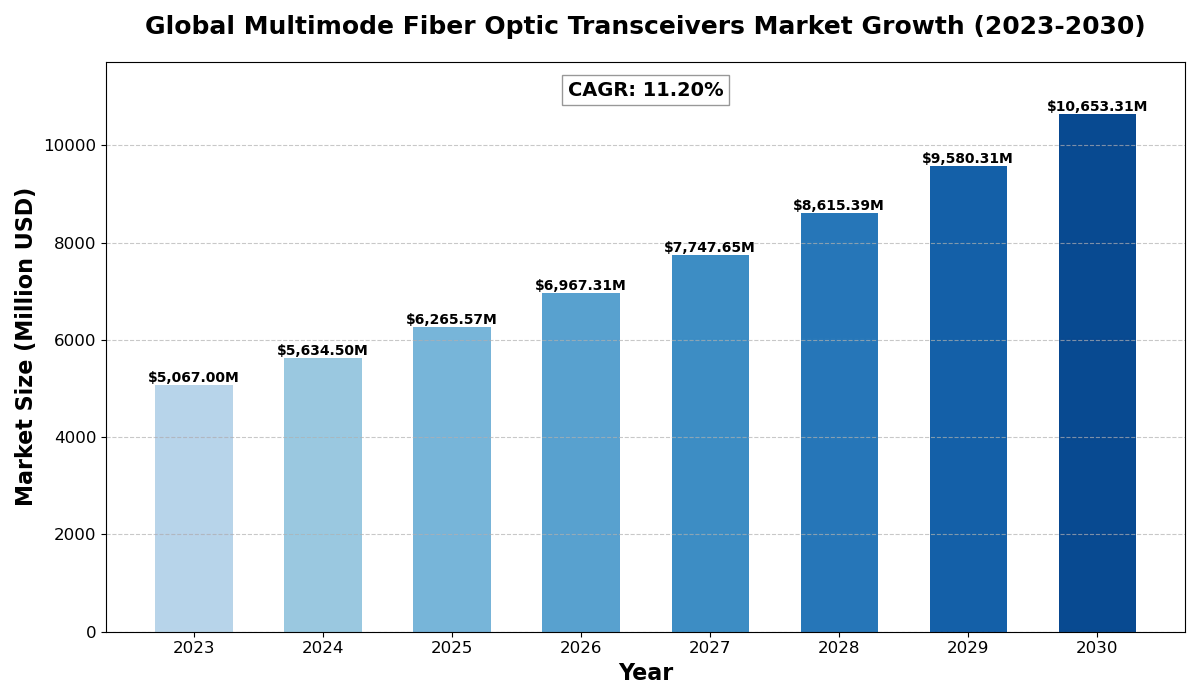
The global Multimode Fiber Optic Transceivers Market size was estimated at USD 5067 million in 2023 and is projected to reach USD 10653.31 million by 2030, exhibiting a CAGR of 11.20% during the forecast period.
North America Multimode Fiber Optic Transceivers market size was USD 1320.32 million in 2023, at a CAGR of 9.60% during the forecast period of 2025 through 2030.
Multimode Fiber Optic Transceivers Key Market Trends :
- Increasing Demand for High-Speed Data Transmission
The rise of cloud computing, 5G deployment, and data centers is driving the need for high-speed, reliable data transmission solutions, boosting the demand for multimode fiber optic transceivers. - Advancements in Optical Communication Technologies
Innovations in fiber optics, such as wavelength-division multiplexing (WDM) and higher bandwidth solutions, are enhancing the efficiency and speed of multimode fiber optic transceivers. - Growing Adoption of Data Centers
The rapid expansion of data centers worldwide, fueled by increasing data consumption, is contributing significantly to market growth. - Rising Investments in Smart Infrastructure
Governments and enterprises are investing in smart cities and IoT-based infrastructure, increasing the demand for fiber optic connectivity solutions. - Increasing Deployment in Telecommunication Networks
The continuous expansion of telecommunication networks, especially in emerging economies, is propelling the adoption of multimode fiber optic transceivers.
Multimode Fiber Optic Transceivers Market Regional Analysis :
-
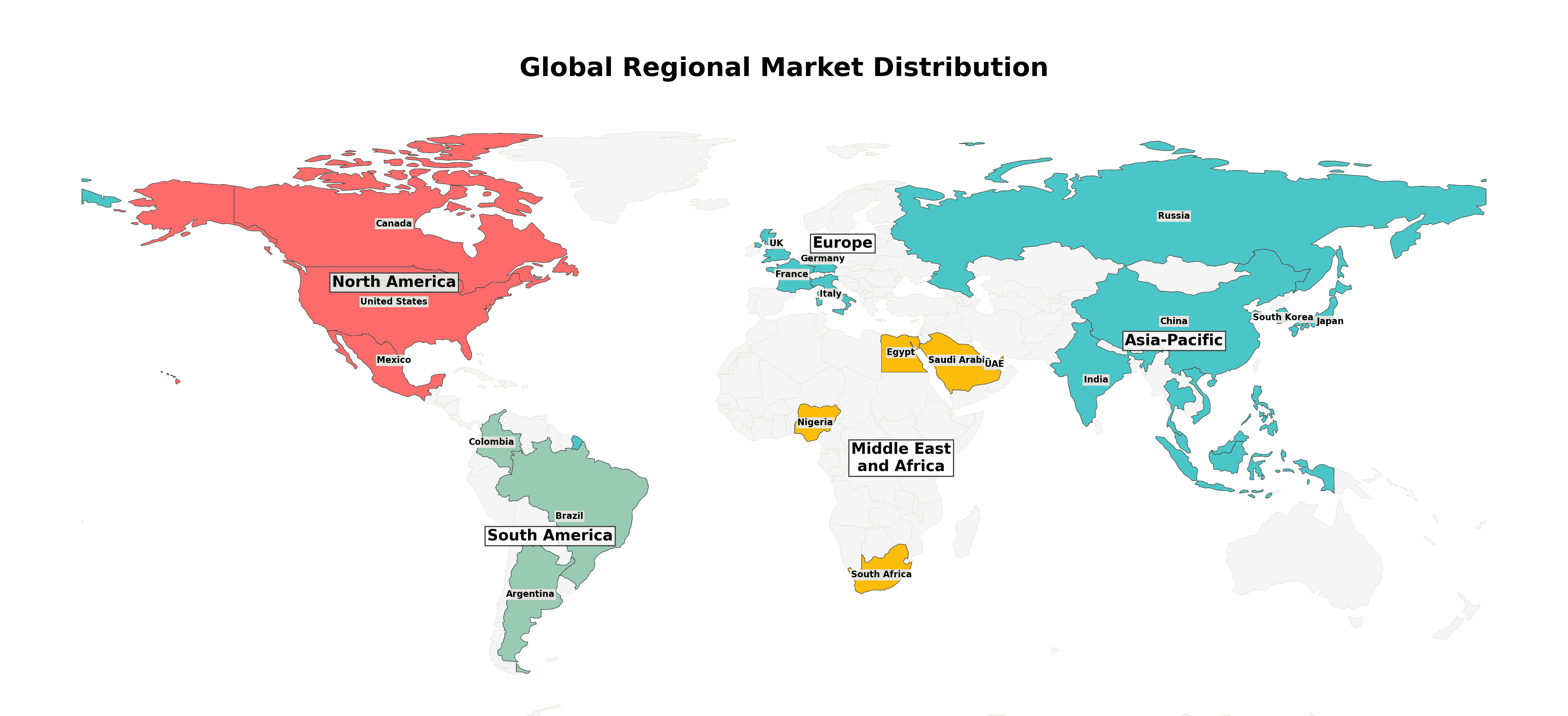
North America:
Strong demand driven by EVs, 5G infrastructure, and renewable energy, with the U.S. leading the market.
-
Europe:
Growth fueled by automotive electrification, renewable energy, and strong regulatory support, with Germany as a key player.
-
Asia-Pacific:
Dominates the market due to large-scale manufacturing in China and Japan, with growing demand from EVs, 5G, and semiconductors.
-
South America:
Emerging market, driven by renewable energy and EV adoption, with Brazil leading growth.
-
Middle East & Africa:
Gradual growth, mainly due to investments in renewable energy and EV infrastructure, with Saudi Arabia and UAE as key contributors.
Multimode Fiber Optic Transceivers Market Segmentation :
The research report includes specific segments by region (country), manufacturers, Type, and Application. Market segmentation creates subsets of a market based on product type, end-user or application, Geographic, and other factors. By understanding the market segments, the decision-maker can leverage this targeting in the product, sales, and marketing strategies. Market segments can power your product development cycles by informing how you create product offerings for different segments.
Key Company
- II-VI
- Perle Systems
- Lumentum
- Sumitomo Electric Industries
- Accelink
- Applied Optoelectronics
- Fujitsu Optical Components
- Innolight
- Mellanox
- NeoPhotonics
- Ciena
- Cisco
- Hisense Broadband
- NEC
Market Segmentation (by Type)
- SFP
- SFF
- XFP
- CXP
- Others
Market Segmentation (by Application)
- Telecommunication
- Data Center
- Others
Drivers
- Growing Internet Traffic and Data Consumption
With the surge in internet users, video streaming, and cloud-based applications, the need for high-speed fiber optic solutions is increasing. - Expansion of 5G Networks
The rollout of 5G technology is accelerating the demand for fiber optic transceivers to support high-bandwidth and low-latency networks. - Rise in AI and IoT Applications
AI-driven technologies and IoT-based solutions require high-speed data transmission, fueling the adoption of multimode fiber optic transceivers.
Restraints
- High Initial Investment and Maintenance Costs
The installation and maintenance of fiber optic networks can be expensive, limiting adoption in cost-sensitive regions. - Complex Installation and Technical Challenges
Deploying multimode fiber optic transceivers requires skilled professionals and complex installation procedures, which can be a barrier to growth. - Limited Transmission Distance Compared to Single-Mode Fiber
While multimode fiber offers high-speed transmission, its range is limited compared to single-mode fiber, restricting its application in long-distance networks.
Opportunities
- Expansion of Cloud Computing and Edge Computing
The growing adoption of cloud services and edge computing solutions is driving the need for high-speed fiber optic connectivity. - Technological Advancements in Optical Transceivers
Continuous innovations in optical transceiver technologies are improving efficiency, reducing costs, and enhancing performance. - Rising Demand in Emerging Economies
Developing countries are investing in fiber-optic infrastructure, creating significant growth opportunities for market players.
Challenges
- Supply Chain Disruptions
Global supply chain issues, including semiconductor shortages, may impact the availability of fiber optic transceivers. - High Competition Among Key Players
The market is highly competitive, with companies continuously innovating to gain a competitive edge, leading to pricing pressure. - Regulatory and Compliance Challenges
Compliance with evolving telecommunication and data transmission regulations can pose challenges for manufacturers and service providers.
Key Benefits of This Market Research:
- Industry drivers, restraints, and opportunities covered in the study
- Neutral perspective on the market performance
- Recent industry trends and developments
- Competitive landscape & strategies of key players
- Potential & niche segments and regions exhibiting promising growth covered
- Historical, current, and projected market size, in terms of value
- In-depth analysis of the Multimode Fiber Optic Transceivers Market
- Overview of the regional outlook of the Multimode Fiber Optic Transceivers Market:
Key Reasons to Buy this Report:
- Access to date statistics compiled by our researchers. These provide you with historical and forecast data, which is analyzed to tell you why your market is set to change
- This enables you to anticipate market changes to remain ahead of your competitors
- You will be able to copy data from the Excel spreadsheet straight into your marketing plans, business presentations, or other strategic documents
- The concise analysis, clear graph, and table format will enable you to pinpoint the information you require quickly
- Provision of market value (USD Billion) data for each segment and sub-segment
- Indicates the region and segment that is expected to witness the fastest growth as well as to dominate the market
- Includes in-depth analysis of the market from various perspectives through Porters five forces analysis
- Provides insight into the market through Value Chain
- Market dynamics scenario, along with growth opportunities of the market in the years to come
- 6-month post-sales analyst support
Customization of the Report
In case of any queries or customization requirements, please connect with our sales team, who will ensure that your requirements are met.
FAQs
Q: What are the key driving factors and opportunities in the Multimode Fiber Optic Transceivers market?
A: The key driving factors include the growing demand for high-speed internet, the expansion of 5G networks, and the rise in AI and IoT applications. Opportunities lie in cloud computing expansion, technological advancements, and increasing demand in emerging economies.
Q: Which region is projected to have the largest market share?
A: North America is expected to dominate the market due to its advanced telecommunication infrastructure, increasing investments in data centers, and high adoption of optical communication solutions.
Q: Who are the top players in the global Multimode Fiber Optic Transceivers market?
A: Key market players include II-VI, Perle Systems, Lumentum, Sumitomo Electric Industries, Accelink, Applied Optoelectronics, Fujitsu Optical Components, Innolight, Mellanox, NeoPhotonics, Ciena, Cisco, Hisense Broadband, and NEC.
Q: What are the latest technological advancements in the industry?
A: Recent advancements include higher bandwidth solutions, wavelength-division multiplexing (WDM), low-power consumption designs, and AI-driven fiber optic network optimization.
Q: What is the current size of the global Multimode Fiber Optic Transceivers market?
A: The market was valued at USD 5067 million in 2023 and is projected to reach USD 10653.31 million by 2030, growing at a CAGR of 11.20% during the forecast period.

Get Sample Report PDF for Exclusive Insights
Report Sample Includes
- Table of Contents
- List of Tables & Figures
- Charts, Research Methodology, and more...
 Download Sample Report PDF