Multimodal AI Market Insights
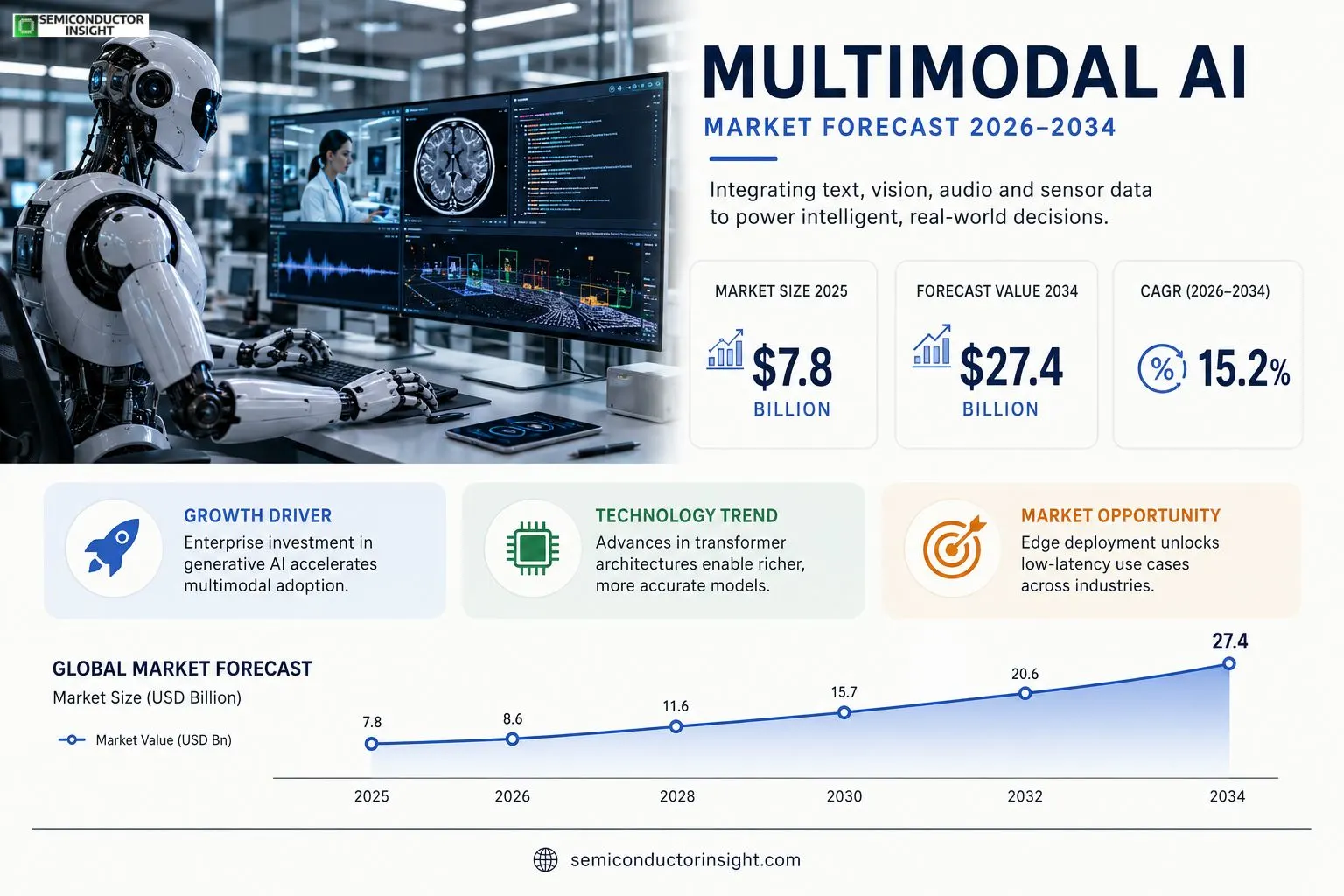
Global Multimodal AI market size was valued at USD 7.8 billion in 2025. The market is projected to grow from USD 8.6 billion in 2026 to USD 27.4 billion by 2034, exhibiting a CAGR of 15.2% during the forecast period.
Multimodal artificial intelligence integrates textual, visual, auditory and sensor data so models can understand and generate content across multiple modalities simultaneously.The market is expanding rapidly because enterprises are allocating substantial capital toward generative‑AI platforms while sectors such as healthcare, automotive and entertainment demand more natural human‑machine interaction. Furthermore, advances in transformer architectures and large‑scale pre‑training have lowered development barriers; leading players like OpenAI, Google DeepMind, Meta AI and Microsoft continue to launch sophisticated multimodal solutions that further drive adoption.
MARKET DRIVERS
Technological Convergence Accelerates Adoption
Multimodal AI Market is being propelled by rapid advances in sensor fusion, natural language processing, and computer vision. Enterprises are integrating these capabilities to create unified user experiences, resulting in 30% faster time‑to‑value for AI‑enabled solutions.
Enterprise Demand for Context‑Aware Insights
Businesses across finance, healthcare, and retail seek contextual analytics that combine text, image, and audio data. This demand lifts revenue forecasts for multimodal platforms by double‑digit growth year over year.
➤ “Cross‑modal models reduce data silos and boost decision accuracy by up to 25%,” says a leading AI consultancy.
Investment inflows from venture capital and strategic corporate funds are strengthening the ecosystem, enabling startups to scale and larger vendors to expand their multimodal portfolios.
MARKET CHALLENGES
Data Heterogeneity Increases Integration Complexity
Organizations must harmonize disparate data formats,video, text, sensor streams,requiring sophisticated preprocessing pipelines. This technical overhead can delay project timelines and increase operational costs.
Other Challenges
Regulatory and Ethical Concerns
Privacy regulations such as GDPR and CCPA impose strict controls on multimodal data collection, while bias mitigation in cross‑modal models remains an active research area.
MARKET RESTRAINTS
High Compute and Infrastructure Costs
Training large multimodal models demands significant GPU/TPU resources, leading to capital expenditures that exceed $5 million for enterprise‑scale deployments.Additionally, the scarcity of skilled engineers proficient in both deep learning and data engineering narrows the talent pool, slowing innovation cycles.
MARKET OPPORTUNITIES
Expansion into Edge Computing Environments
Deploying multimodal AI inference at the edge reduces latency for applications like autonomous vehicles and smart factories, opening a multi‑billion‑dollar market segment over the next five years.Emerging standards for model interoperability and open‑source frameworks present collaborative pathways for smaller players to enter the market, fostering a more diversified ecosystem.
Multimodal AI Market Trends
Enterprise Investment in Generative Multimodal Platforms
Enterprises are allocating increasing capital to generative‑AI solutions that combine text, image, audio and sensor inputs. This shift reflects the need for more natural human‑machine interaction across digital channels. Vendors are bundling multimodal capabilities into cloud‑native suites, reducing integration complexity for customers. As a result, adoption cycles have shortened, and proof‑of‑concept deployments are moving quickly into production environments. The trend underscores a broader strategic emphasis on AI‑driven personalization and decision support, positioning multimodal technologies as core components of digital transformation roadmaps.
Other Trends
Sector‑Specific Adoption
Healthcare providers are leveraging multimodal models to fuse radiology images, clinical notes and biometric sensor streams, enabling earlier disease detection and more precise treatment recommendations. Automotive manufacturers are embedding multimodal perception systems into advanced driver‑assistance solutions, improving situational awareness by processing visual, auditory and lidar data simultaneously. In entertainment, creators are using multimodal generation tools to produce synchronized video, text and sound assets, accelerating content pipelines. These sector‑driven use cases illustrate how Multimodal AI Market is expanding beyond generic enterprise applications into specialized verticals with distinct data‑fusion requirements.
Advances in Transformer Architectures
Recent research breakthroughs in transformer scaling and cross‑modal attention have lowered the computational barriers to training large multimodal models. OpenAI, Google DeepMind, Meta AI and Microsoft are releasing pre‑trained encoders that support seamless transfer learning across modalities, allowing smaller firms to adopt state‑of‑the‑art capabilities without massive infrastructure investments. This democratization fuels a feedback loop: broader adoption generates richer multimodal datasets, which in turn improve model robustness and accuracy. The cumulative effect is a rapid acceleration of feature richness in AI‑driven products, reinforcing the strategic importance of multimodal approaches for future innovation.
COMPETITIVE LANDSCAPEKey Industry Players
Multimodal AI Competitive Landscape Overview
Multimodal AI Market is presently anchored by a small cohort of platform leaders that combine deep research budgets with expansive cloud ecosystems. OpenAI’s GPT‑4o and Google DeepMind’s Gemini series set the technical benchmark by fusing text, vision, and audio through large‑scale transformer pre‑training, while Microsoft and Meta AI commercialize these models within enterprise SaaS and consumer social products. Market structure reflects a tiered hierarchy: tier‑one firms supply foundational models and API services; tier‑two integrators embed these models into vertical solutions such as healthcare imaging analysis or automotive driver‑assist platforms. The rapid capital influx, illustrated by a projected CAGR of over 15 % through 2034, reinforces the dominance of these incumbents, whose pricing power and data‑moats create high barriers for new entrants.Beyond the headline vendors, a robust set of niche innovators enriches the ecosystem with specialized capabilities. Anthropic emphasizes safety‑centric instruction tuning, while NVIDIA leverages its GPU acceleration stack to deliver real‑time multimodal inference. Baidu and Alibaba pioneer Chinese‑language multimodal services, and Salesforce integrates generative agents into CRM workflows. Adobe focuses on creative‑generation tools, and IBM Research explores enterprise‑grade multimodal analytics. Tencent’s AI Lab and Amazon Web Services round out the competitive roster, providing region‑specific compliance solutions and scalable infrastructure that enable smaller startups to enter the market.
List of Key Multimodal AI Companies Profiled
- OpenAI
- Google DeepMind
- Microsoft
- Meta AI
- Anthropic
- NVIDIA
- Alibaba
- Baidu
- Salesforce
- Adobe
- IBM
- Tencent
- Amazon Web Services
Segment Analysis:
| Segment Category | Sub-Segments | Key Insights |
| By Type |
|
Text‑Visual Fusion
|
| By Application |
|
Healthcare diagnostics
|
| By End User |
|
Enterprises
|
| By Industry |
|
Automotive
|
| By Deployment Model |
|
Edge/on‑premise solutions
|
Regional Analysis: North America
United States
The healthcare sector in the US is witnessing a rapid integration of multimodal AI for tasks such as medical image analysis, patient monitoring, and personalized treatment plans. This integration is improving diagnostic accuracy and patient outcomes.
Financial institutions are leveraging multimodal AI for fraud detection, risk assessment, and customer service enhancement. The ability to analyze various data streams – including text, images, and audio – is proving crucial for these applications.
The development of autonomous vehicles and robotics heavily relies on multimodal AI for perception and decision-making. This area is experiencing substantial investment and innovation in the US.
Retailers are utilizing multimodal AI to personalize customer experiences, optimize supply chains, and improve inventory management through visual and textual data analysis.
Europe
The European market for Multimodal AI Market is characterized by a strong emphasis on ethical AI and data privacy regulations, setting it apart from other regions. Initiatives like the AI Act are shaping the development and deployment of these technologies. Key areas of focus include industrial automation, smart cities, and natural language understanding. Several countries, including the UK, Germany, and France, are investing heavily in multimodal AI research and development to maintain their competitive edge.
Asia-Pacific
Asia-Pacific represents a dynamic and rapidly expanding market for Multimodal AI Market, driven by increasing digital adoption and a large pool of skilled talent. Countries like China, Japan, and South Korea are leading the way in multimodal AI innovation, with significant investments in areas like computer vision, robotics, and smart manufacturing. The region’s focus on IoT and edge computing is further accelerating the growth of multimodal AI applications.
South America
Multimodal AI Market in South America is still in its nascent stages but exhibits significant growth potential. Early adopters are focused on applications in agriculture, financial services, and retail, where multimodal AI can improve efficiency and customer engagement. The increasing availability of affordable computing power and growing data infrastructure are expected to drive further adoption.
Middle East & Africa
The Middle East & Africa region presents a promising, albeit developing, market for Multimodal AI Market. Investments in smart infrastructure, healthcare, and security are creating opportunities for multimodal AI solutions. The region’s focus on digital transformation and the growing adoption of mobile technologies are key drivers of growth.
Report Scope
This market research report provides a comprehensive analysis of the Multimodal AI Market , covering the forecast period 2026–2034. It offers detailed insights into market dynamics, technological advancements, competitive landscape, and key trends shaping the industry.
Key focus areas of the report include:
- Market Overview: The report begins with an overview outlining its current market scenario, key growth indicators, and industry transformation drivers. It discusses macroeconomic factors, demand–supply balance, regulatory landscape, and the strategic role of semiconductors in powering advancements across industries such as automotive, telecommunications, consumer electronics, and industrial automation.
- Market Size & Forecast: Historical data and future projections for revenue, unit shipments, and market value across major regions and segments.
- Segmentation Analysis: Detailed breakdown by product type, technology, application, and end-user industry to identify high-growth segments and investment opportunities.
- Regional Insights: Insights into market performance across North America, Europe, Asia-Pacific, Latin America, and the Middle East & Africa, including country-level analysis where relevant.
- Competitive Landscape: Profiles of leading market participants, including their product offerings, R&D focus, manufacturing capacity, pricing strategies, and recent developments such as mergers, acquisitions, and partnerships.
- Technology Trends & Innovation: Assessment of emerging technologies, integration of AI/IoT, semiconductor design trends, fabrication techniques, and evolving industry standards.
- Market Drivers & Restraints: Evaluation of factors driving market growth along with challenges, supply chain constraints, regulatory issues, and market-entry barriers.
- Stakeholder Insights: Insights for component suppliers, OEMs, system integrators, investors, and policymakers regarding the evolving ecosystem and strategic opportunities.
Primary and secondary research methods are employed, including interviews with industry experts, data from verified sources, and real-time market intelligence to ensure the accuracy and reliability of the insights presented.
FREQUENTLY ASKED QUESTIONS:
What is the current market size of Multimodal AI Market?
-> Multimodal AI Market was valued at USD 7.8 billion in 2025 and is expected to reach USD 27.4 billion by 2034, reflecting a robust growth trajectory.
Which key companies operate in Multimodal AI Market?
-> Key players include OpenAI, Google DeepMind, Meta AI, and Microsoft, among others.
What are the key growth drivers?
-> Key growth drivers include substantial enterprise investment in generative‑AI platforms, rising demand for multimodal interaction in healthcare, automotive, and entertainment, and rapid advancements in transformer architectures and large‑scale pre‑training.
Which region dominates the market?
-> The reference does not specify a single dominant region; market dynamics appear to be global with strong activity across North America, Europe, and Asia‑Pacific.
What are the emerging trends?
-> Emerging trends include integration of textual, visual, auditory, and sensor data in unified models, advancement of large‑scale multimodal transformers, and increasing deployment of multimodal solutions across enterprise applications.
Get Sample Report PDF for Exclusive Insights
Report Sample Includes
- Table of Contents
- List of Tables & Figures
- Charts, Research Methodology, and more...
 Download Sample Report PDF