Multi-layer Stacking HBM3E Market, Trends, Business Strategies 2026-2034

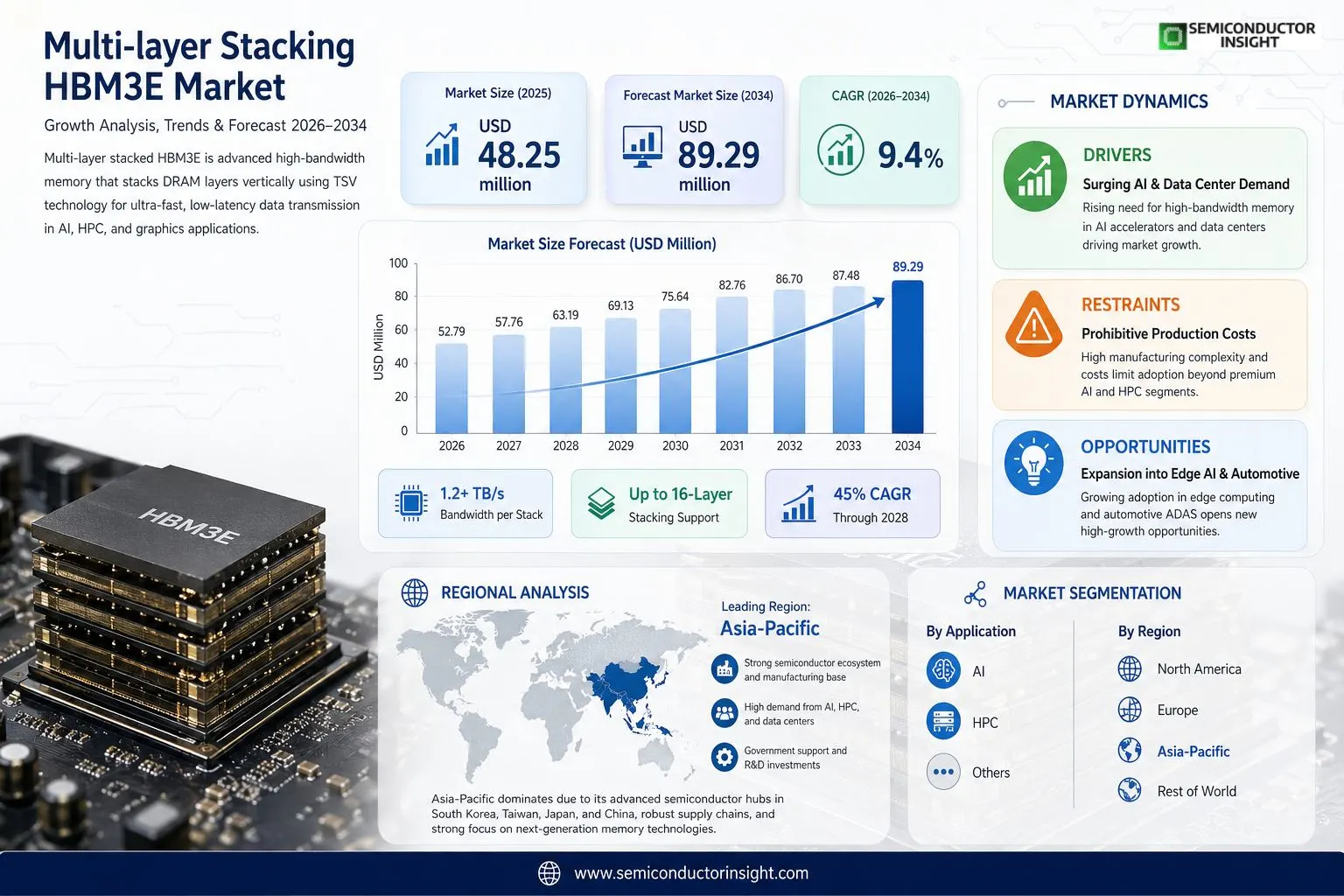
Global Multi-layer Stacking HBM3E market was valued at USD 48.25 million in 2025 and is projected to reach USD 89.29 million by 2034, at a CAGR of 9.4% during the forecast period

PDF Icon Download Sample Report PDF
  • Quick Dispatch

    All Orders

  • Secure Payment

    100% Secure Payment

Price range: $1,500.00 through $4,250.00

Clear

Multi-layer Stacking HBM3E Market Insights

Global Multi-layer Stacking HBM3E market size was valued at USD 48.25 million in 2025. The market is projected to reach USD 89.29 million by 2034, exhibiting a CAGR of 9.4% during the forecast period.

Multi-layer stacked HBM3E represents the latest advancement in high bandwidth memory (HBM) technology, serving as a critical storage solution for high-performance computing and graphics processing. It stacks multiple layers of DRAM chips vertically, leveraging through-silicon via (TSV) technology for ultra-fast inter-chip connections. This design delivers exceptional bandwidth and low-latency data transmission. As the enhanced iteration of the HBM series, HBM3E significantly boosts performance and capacity over its predecessor, HBM3.

The market is experiencing rapid growth driven by surging demand in artificial intelligence accelerators, high-performance computing clusters, and data-intensive graphics applications. Furthermore, relentless advancements in AI training models and supercomputing infrastructure are accelerating adoption. Key industry initiatives continue to propel expansion. For instance, in March 2024, SK Hynix commenced mass production of the world’s first 12-layer HBM3E, achieving up to 1.28 TB/s bandwidth per stack. SK Hynix, Samsung Electronics, and Micron are prominent leaders in the market, offering cutting-edge portfolios tailored to these high-stakes demands.
Multi Layer Stacking HBM3E Market

MARKET DRIVERS

Surging AI and Data Center Demand

Multi-layer Stacking HBM3E Market is propelled by escalating requirements for high-bandwidth memory in AI accelerators and GPU architectures. With data centers expanding to support generative AI models, HBM3E’s multi-layer stacking delivers over 1.2 TB/s bandwidth per stack, enabling faster training cycles. This has driven a projected 45% CAGR through 2028, as hyperscalers prioritize performance density.

Advancements in 3D Packaging Technologies

Innovations in through-silicon vias (TSV) and hybrid bonding have enhanced yield rates for multi-layer HBM3E configurations, supporting up to 16-high stacks. These developments reduce latency and power consumption by 20% compared to HBM3, attracting adoption in high-performance computing (HPC) environments. Semiconductor leaders are investing heavily, with production ramp-ups noted in Q3 2024.

➤ Global AI chip shipments incorporating HBM3E rose 60% YoY in 2024, underscoring multi-layer stacking’s critical role.

Furthermore, the integration of HBM3E in next-gen networking equipment amplifies market momentum, as 800G Ethernet switches demand superior memory hierarchies for real-time processing.

MARKET CHALLENGES

Complexity in High-Stack Manufacturing

Multi-layer Stacking HBM3E Market faces hurdles in scaling 12-16 layer dies due to alignment precision errors exceeding 1 micron, which inflate defect rates to 15-20% in early runs. This necessitates advanced metrology tools, straining fab capacities amid global chip shortages.

Other Challenges

Supply Chain Vulnerabilities

Dependence on specialized materials like high-purity copper and interposers exposes the market to geopolitical disruptions, with lead times stretching to 24 weeks in 2024.Thermal management issues persist, as multi-layer stacks generate heat densities over 50W/mm², requiring novel cooling solutions that add 10-15% to system costs. Yield improvements are gradual, limiting widespread deployment.

MARKET RESTRAINTS

Prohibitive Production Costs

High costs in Multi-layer Stacking HBM3E Market stem from intricate wafer processing, where multi-layer stacking elevates ASPs to $30-40 per GB, deterring mid-tier adopters. Capital expenditures for 2nm-class nodes surpass $20 billion per fab, constraining supplier expansion.Competition from GDDR7 and LPDDR5X alternatives offers lower-cost options for non-extreme bandwidth needs, capping HBM3E penetration outside premium AI segments at under 5% of total DRAM shipments.\Regulatory pressures on energy efficiency further restrain growth, as HBM3E’s 30% higher power draw per TB challenges sustainability mandates in Europe and North America data centers.

MARKET OPPORTUNITIES


Expansion into Edge AI and Automotive

Multi-layer Stacking HBM3E Market holds promise in edge computing, where compact AI inference devices require HBM3E’s density for real-time analytics. Automotive ADAS systems could integrate 8-high stacks by 2026, targeting a $5B sub-market.Collaborations between memory giants and foundries are accelerating HBM3E ecosystem maturity, with volume shipments expected to quadruple by 2027 amid 5G-driven telco upgrades.Emerging HPC clusters for climate modeling and drug discovery present untapped demand, potentially adding 25% to market volumes as governments fund exascale initiatives.

Multi-layer Stacking HBM3E Market Trends

Advancements in Layer Stacking Technology

Multi-layer Stacking HBM3E Market is witnessing significant evolution through innovations in stacking configurations, including 8-layer, 12-layer, and 16-layer options. These developments leverage through-silicon via (TSV) technology to stack multiple DRAM layers, delivering superior bandwidth and reduced latency essential for high-performance computing. Compared to previous HBM generations, HBM3E enhances capacity and speed, positioning it as a critical solution for demanding data transmission needs in advanced electronics.

Other Trends

Growth Driven by AI and HPC Applications

Demand in Multi-layer Stacking HBM3E Market is surging due to expanding applications in artificial intelligence (AI) and high-performance computing (HPC). These sectors require massive parallel processing capabilities, where multi-layer HBM3E provides the high-bandwidth memory necessary for accelerating complex workloads. Industry surveys highlight AI as a primary driver, with HPC following closely, as developers seek solutions that support intricate neural network training and simulations.

Competitive Landscape and Regional Dynamics

Leading manufacturers such as SK Hynix, Samsung Electronics, and Micron dominate Multi-layer Stacking HBM3E Market, focusing on product enhancements and capacity expansions. Their strategies include optimizing production for diverse stacking types and targeting key regions like Asia-Pacific, where countries including China, Japan, and South Korea exhibit strong market activity. North America, particularly the U.S., also shows robust engagement, supported by Europe and emerging areas in South America and the Middle East. This competitive environment fosters continuous improvements in yield rates and integration, addressing challenges like manufacturing complexity while capitalizing on opportunities in downstream markets.

COMPETITIVE LANDSCAPE

Key Industry Players

Dominance of Core Memory Leaders in Multi-layer Stacking HBM3E Arena

Multi-layer Stacking HBM3E Market is characterized by a highly concentrated oligopolistic structure, where SK Hynix holds the dominant position as the leading manufacturer. Having pioneered mass production of 12-layer HBM3E modules, SK Hynix commands the largest revenue share, estimated at over 50% among top players, fueled by its through-silicon via (TSV) expertise and integration advantages for high-performance computing (HPC) and AI workloads. Samsung Electronics follows closely as a formidable challenger, advancing its 12-layer HBM3E portfolio to capture growing demand in graphics and data-intensive applications. Together with Micron Technology, these three giants account for the global top five players’ approximate revenue share, steering market evolution through capacity expansions and yield improvements amid a projected CAGR of 9.4% from 2025 to 2034.

Beyond the primary DRAM leaders, niche players in advanced packaging and assembly bolster the Multi-layer Stacking HBM3E supply chain, addressing complex stacking requirements for 8-layer, 12-layer, and 16-layer configurations. Firms like ASE Technology and Amkor Technology excel in outsourced semiconductor assembly and test (OSAT), providing critical TSV and interposer solutions that enable high-bandwidth, low-latency performance. Additional significant contributors include Tongfu Microelectronics and JCET Group, which are scaling operations in Asia to meet regional demands, particularly from China’s burgeoning AI sector. These specialized entities enhance competition by focusing on cost efficiencies, customization for emerging 16-layer stacks, and partnerships with OEMs, ensuring a resilient ecosystem despite high entry barriers posed by technological sophistication and capital intensity.

List of Key Multi-layer Stacking HBM3E Companies Profiled

  • SK hynix
  • Samsung Electronics
  • Micron Technology
  • ASE Technology Holding
  • Amkor Technology
  • Siliconware Precision Industries (SPIL)
  • Powertech Technology Inc.
  • Tongfu Microelectronics
  • JCET Group
  • Huatian Technology
  • KYEC (King Yuan Electronics)
  • Chipbond Technology
  • UTAC Group
  • Fenghua Advanced Technology
  • Tianshui Huatian

Segment Analysis:

Segment Category Sub-Segments Key Insights
By Type
  • 8-layer Stacking
  • 12-layer Stacking
  • 16-layer Stacking
  • Others
8-layer Stacking dominates as the leading configuration.

  • Delivers a proven balance of high bandwidth and reliable thermal dissipation essential for demanding computing tasks.
  • Facilitates smoother transition from prior HBM generations with compatible manufacturing processes.
  • Preferred by developers for its cost-efficiency while supporting intensive data throughput in graphics and processing units.
  • Enables widespread adoption through established supply chains and yield optimization.
By Application
  • AI
  • HPC
  • Others
AI emerges as the frontrunner in applications.

  • Critical for accelerating model training and inference in generative and large-scale AI systems.
  • Capitalizes on ultra-low latency and massive parallelism for handling complex neural network computations.
  • Fuels innovation in data centers where memory bandwidth directly impacts processing efficiency.
  • Attracts investment from leading tech firms optimizing for next-generation AI workloads.
By End User
  • Hyperscale Cloud Providers
  • Enterprise Data Centers
  • HPC Facilities & Research Institutions
Hyperscale Cloud Providers lead the end-user landscape.

  • Prioritize scalable memory solutions to support expansive AI infrastructure rollouts.
  • Benefit from high-density stacking to maximize server rack efficiency and reduce latency in cloud services.
  • Drive vendor partnerships for customized HBM3E integrations tailored to virtualized environments.
  • Enable rapid deployment of compute-intensive applications serving global user bases.
By Deployment Model
  • Cloud Deployments
  • On-Premise
  • Hybrid & Edge
Cloud Deployments represent the primary deployment paradigm.

  • Optimizes for elastic scaling in environments with fluctuating high-bandwidth demands.
  • Supports seamless integration with distributed computing frameworks for AI and analytics.
  • Addresses power and space constraints through advanced stacking for dense configurations.
  • Accelerates time-to-market for service providers expanding compute offerings.
By Platform
  • GPU Platforms
  • AI ASIC Accelerators
  • HPC CPU Servers
GPU Platforms hold the leading position across platforms.

  • Leverages superior bandwidth for parallel graphics rendering and AI tensor operations.
  • Benefits from mature ecosystem compatibility enhancing developer productivity.
  • Critical enabler for real-time processing in both training and inference pipelines.
  • Promotes advancements in multi-GPU configurations for extreme compute scenarios.

Regional Analysis: Multi-layer Stacking HBM3E Market

Asia-Pacific

Asia-Pacific leads Multi-layer Stacking HBM3E Market, driven by robust semiconductor ecosystems and innovation hubs. Countries like South Korea and Taiwan host major manufacturers pioneering multi-layer stacking techniques, enhancing memory density and bandwidth for AI and high-performance computing applications. Strategic investments in R&D facilities bolster production capabilities, enabling faster adoption of advanced HBM3E solutions. Government initiatives supporting chip sovereignty further accelerate market expansion. Supply chain integration from wafer fabrication to packaging gives regional players a competitive edge, fostering collaborations with global tech giants. The region’s focus on next-generation memory architectures positions it as the epicenter for Multi-layer Stacking HBM3E developments, with agile manufacturing responding swiftly to surging demands in data centers and edge computing. Ecosystem maturity ensures seamless scaling, while skilled workforce expertise drives continuous refinements in stacking processes, solidifying Asia-Pacific’s dominance in this high-stakes market segment.

Key Manufacturing Hubs
South Korea and Taiwan serve as primary hubs, where advanced foundries excel in multi-layer stacking for HBM3E. Proximity of suppliers streamlines production, reducing lead times and costs in Multi-layer Stacking HBM3E Market.
R&D Innovations
Intensive research yields breakthroughs in thermal management and yield optimization for stacked HBM3E dies. Collaborative university-industry partnerships accelerate technology maturation.
Supply Chain Strength
Vertically integrated chains from silicon to modules enhance reliability. Regional policies promote localization, fortifying resilience in Multi-layer Stacking HBM3E Market.
Demand DriversBooming AI infrastructure and hyperscale data centers fuel adoption. Enterprise shifts to high-bandwidth memory underscore Asia-Pacific’s pivotal role.

North America
North America exhibits strong growth in Multi-layer Stacking HBM3E Market, propelled by tech giants investing in AI accelerators and supercomputing. Design houses collaborate with Asian fabricators to integrate advanced HBM3E into GPUs and custom silicon. Venture capital inflows support startups innovating in memory controllers, enhancing system-level performance. Regulatory focus on domestic production spurs partnerships, though dependency on imports poses challenges. Hyperscalers drive demand through cloud expansions, positioning the region as a key consumer and innovator.

Europe
Europe advances steadily in Multi-layer Stacking HBM3E Market, emphasizing energy-efficient computing and automotive applications. Research consortia develop stacking technologies for edge AI and 5G infrastructure. EU funding accelerates prototypes, fostering competitiveness against Asian dominance. Automotive sector integration for ADAS systems highlights HBM3E’s role in real-time processing. Supply chain diversification efforts mitigate risks, with growing emphasis on sustainable manufacturing practices.

South America
South America emerges as a nascent player in Multi-layer Stacking HBM3E Market, with Brazil leading through data center builds and telecom upgrades. Partnerships with global firms introduce HBM3E into cloud services and industrial IoT. Infrastructure investments bridge technology gaps, though import reliance limits scale. Regional focus on digital transformation spurs adoption in finance and energy sectors, laying groundwork for future expansion.

Middle East & Africa
Middle East & Africa show promising traction in Multi-layer Stacking HBM3E Market, driven by sovereign data initiatives in the Gulf. Oil-rich nations diversify into tech, funding AI hubs with HBM3E-powered systems. Africa’s telecom growth integrates high-bandwidth memory for mobile edge computing. Collaborative ventures with Asian suppliers build local expertise, though infrastructure hurdles persist. Strategic visions position the region for accelerated involvement.

Report Scope

This market research report provides a comprehensive analysis of the Multi-layer Stacking HBM3E Market , covering the forecast period 2026–2034. It offers detailed insights into market dynamics, technological advancements, competitive landscape, and key trends shaping the industry.

Key focus areas of the report include:

  • Market Overview: The report begins with an overview outlining its current market scenario, key growth indicators, and industry transformation drivers. It discusses macroeconomic factors, demand–supply balance, regulatory landscape, and the strategic role of semiconductors in powering advancements across industries such as automotive, telecommunications, consumer electronics, and industrial automation.
  • Market Size & Forecast: Historical data and future projections for revenue, unit shipments, and market value across major regions and segments.
  • Segmentation Analysis: Detailed breakdown by product type, technology, application, and end-user industry to identify high-growth segments and investment opportunities.
  • Regional Insights: Insights into market performance across North America, Europe, Asia-Pacific, Latin America, and the Middle East & Africa, including country-level analysis where relevant.
  • Competitive Landscape: Profiles of leading market participants, including their product offerings, R&D focus, manufacturing capacity, pricing strategies, and recent developments such as mergers, acquisitions, and partnerships.
  • Technology Trends & Innovation: Assessment of emerging technologies, integration of AI/IoT, semiconductor design trends, fabrication techniques, and evolving industry standards.
  • Market Drivers & Restraints: Evaluation of factors driving market growth along with challenges, supply chain constraints, regulatory issues, and market-entry barriers.
  • Stakeholder Insights: Insights for component suppliers, OEMs, system integrators, investors, and policymakers regarding the evolving ecosystem and strategic opportunities.

Primary and secondary research methods are employed, including interviews with industry experts, data from verified sources, and real-time market intelligence to ensure the accuracy and reliability of the insights presented.

FREQUENTLY ASKED QUESTIONS:

What is the current market size of Multi-layer Stacking HBM3E Market?

-> Global Multi-layer Stacking HBM3E market was valued at USD 48.25 million in 2025 and is projected to reach USD 89.29 million by 2034, at a CAGR of 9.4% during the forecast period.

Which key companies operate in Multi-layer Stacking HBM3E Market?

-> Key players include SK Hynix, Samsung Electronics, Micron, among others.

What are the key growth drivers?

-> Key growth drivers include demand for high-performance computing, AI applications, graphics processing, and advancements in high-bandwidth memory technology.

Which region dominates the market?

-> Asia is the fastest-growing region due to key manufacturers in South Korea and China, while North America holds significant share.

What are the emerging trends?

-> Emerging trends include 8-layer, 12-layer, and 16-layer stacking configurations, through-silicon via (TSV) technology, and enhanced performance in HBM3E over HBM3.

Multi-layer Stacking HBM3E Market, Trends, Business Strategies 2026-2034

Get Sample Report PDF for Exclusive Insights

Report Sample Includes

  • Table of Contents
  • List of Tables & Figures
  • Charts, Research Methodology, and more...

PDF Icon Download Sample Report PDF
SKU: 3df3d2068fdd
Category:
License Type

Corporate License, Excel License, PDF and Excel Databook License

Download Sample Report

Table of Content

1 Introduction to Research & Analysis Reports
1.1 Multi-layer Stacking HBM3E Market Definition
1.2 Market Segments
1.2.1 Segment by Type
1.2.2 Segment by Application
1.3 Global Multi-layer Stacking HBM3E Market Overview
1.4 Features & Benefits of This Report
1.5 Methodology & Sources of Information
1.5.1 Research Methodology
1.5.2 Research Process
1.5.3 Base Year
1.5.4 Report Assumptions & Caveats
2 Global Multi-layer Stacking HBM3E Overall Market Size
2.1 Global Multi-layer Stacking HBM3E Market Size: 2025 VS 2034
2.2 Global Multi-layer Stacking HBM3E Market Size, Prospects & Forecasts: 2021-2034
2.3 Global Multi-layer Stacking HBM3E Sales: 2021-2034
3 Company Landscape
3.1 Top Multi-layer Stacking HBM3E Players in Global Market
3.2 Top Global Multi-layer Stacking HBM3E Companies Ranked by Revenue
3.3 Global Multi-layer Stacking HBM3E Revenue by Companies
3.4 Global Multi-layer Stacking HBM3E Sales by Companies
3.5 Global Multi-layer Stacking HBM3E Price by Manufacturer (2021-2026)
3.6 Top 3 and Top 5 Multi-layer Stacking HBM3E Companies in Global Market, by Revenue in 2025
3.7 Global Manufacturers Multi-layer Stacking HBM3E Product Type
3.8 Tier 1, Tier 2, and Tier 3 Multi-layer Stacking HBM3E Players in Global Market
3.8.1 List of Global Tier 1 Multi-layer Stacking HBM3E Companies
3.8.2 List of Global Tier 2 and Tier 3 Multi-layer Stacking HBM3E Companies
4 Sights by Type
4.1 Overview
4.1.1 Segment by Type – Global Multi-layer Stacking HBM3E Market Size Markets, 2025 & 2034
4.1.2 8-layer Stacking
4.1.3 12-layer Stacking
4.1.4 16-layer Stacking
4.1.5 Other
4.2 Segment by Type – Global Multi-layer Stacking HBM3E Revenue & Forecasts
4.2.1 Segment by Type – Global Multi-layer Stacking HBM3E Revenue, 2021-2026
4.2.2 Segment by Type – Global Multi-layer Stacking HBM3E Revenue, 2027-2034
4.2.3 Segment by Type – Global Multi-layer Stacking HBM3E Revenue Market Share, 2021-2034
4.3 Segment by Type – Global Multi-layer Stacking HBM3E Sales & Forecasts
4.3.1 Segment by Type – Global Multi-layer Stacking HBM3E Sales, 2021-2026
4.3.2 Segment by Type – Global Multi-layer Stacking HBM3E Sales, 2027-2034
4.3.3 Segment by Type – Global Multi-layer Stacking HBM3E Sales Market Share, 2021-2034
4.4 Segment by Type – Global Multi-layer Stacking HBM3E Price (Manufacturers Selling Prices), 2021-2034
5 Sights by Application
5.1 Overview
5.1.1 Segment by Application – Global Multi-layer Stacking HBM3E Market Size, 2025 & 2034
5.1.2 AI
5.1.3 HPC
5.1.4 Other
5.2 Segment by Application – Global Multi-layer Stacking HBM3E Revenue & Forecasts
5.2.1 Segment by Application – Global Multi-layer Stacking HBM3E Revenue, 2021-2026
5.2.2 Segment by Application – Global Multi-layer Stacking HBM3E Revenue, 2027-2034
5.2.3 Segment by Application – Global Multi-layer Stacking HBM3E Revenue Market Share, 2021-2034
5.3 Segment by Application – Global Multi-layer Stacking HBM3E Sales & Forecasts
5.3.1 Segment by Application – Global Multi-layer Stacking HBM3E Sales, 2021-2026
5.3.2 Segment by Application – Global Multi-layer Stacking HBM3E Sales, 2027-2034
5.3.3 Segment by Application – Global Multi-layer Stacking HBM3E Sales Market Share, 2021-2034
5.4 Segment by Application – Global Multi-layer Stacking HBM3E Price (Manufacturers Selling Prices), 2021-2034
6 Sights Region
6.1 By Region – Global Multi-layer Stacking HBM3E Market Size, 2025 & 2034
6.2 By Region – Global Multi-layer Stacking HBM3E Revenue & Forecasts
6.2.1 By Region – Global Multi-layer Stacking HBM3E Revenue, 2021-2026
6.2.2 By Region – Global Multi-layer Stacking HBM3E Revenue, 2027-2034
6.2.3 By Region – Global Multi-layer Stacking HBM3E Revenue Market Share, 2021-2034
6.3 By Region – Global Multi-layer Stacking HBM3E Sales & Forecasts
6.3.1 By Region – Global Multi-layer Stacking HBM3E Sales, 2021-2026
6.3.2 By Region – Global Multi-layer Stacking HBM3E Sales, 2027-2034
6.3.3 By Region – Global Multi-layer Stacking HBM3E Sales Market Share, 2021-2034
6.4 North America
6.4.1 By Country – North America Multi-layer Stacking HBM3E Revenue, 2021-2034
6.4.2 By Country – North America Multi-layer Stacking HBM3E Sales, 2021-2034
6.4.3 United States Multi-layer Stacking HBM3E Market Size, 2021-2034
6.4.4 Canada Multi-layer Stacking HBM3E Market Size, 2021-2034
6.4.5 Mexico Multi-layer Stacking HBM3E Market Size, 2021-2034
6.5 Europe
6.5.1 By Country – Europe Multi-layer Stacking HBM3E Revenue, 2021-2034
6.5.2 By Country – Europe Multi-layer Stacking HBM3E Sales, 2021-2034
6.5.3 Germany Multi-layer Stacking HBM3E Market Size, 2021-2034
6.5.4 France Multi-layer Stacking HBM3E Market Size, 2021-2034
6.5.5 U.K. Multi-layer Stacking HBM3E Market Size, 2021-2034
6.5.6 Italy Multi-layer Stacking HBM3E Market Size, 2021-2034
6.5.7 Russia Multi-layer Stacking HBM3E Market Size, 2021-2034
6.5.8 Nordic Countries Multi-layer Stacking HBM3E Market Size, 2021-2034
6.5.9 Benelux Multi-layer Stacking HBM3E Market Size, 2021-2034
6.6 Asia
6.6.1 By Region – Asia Multi-layer Stacking HBM3E Revenue, 2021-2034
6.6.2 By Region – Asia Multi-layer Stacking HBM3E Sales, 2021-2034
6.6.3 China Multi-layer Stacking HBM3E Market Size, 2021-2034
6.6.4 Japan Multi-layer Stacking HBM3E Market Size, 2021-2034
6.6.5 South Korea Multi-layer Stacking HBM3E Market Size, 2021-2034
6.6.6 Southeast Asia Multi-layer Stacking HBM3E Market Size, 2021-2034
6.6.7 India Multi-layer Stacking HBM3E Market Size, 2021-2034
6.7 South America
6.7.1 By Country – South America Multi-layer Stacking HBM3E Revenue, 2021-2034
6.7.2 By Country – South America Multi-layer Stacking HBM3E Sales, 2021-2034
6.7.3 Brazil Multi-layer Stacking HBM3E Market Size, 2021-2034
6.7.4 Argentina Multi-layer Stacking HBM3E Market Size, 2021-2034
6.8 Middle East & Africa
6.8.1 By Country – Middle East & Africa Multi-layer Stacking HBM3E Revenue, 2021-2034
6.8.2 By Country – Middle East & Africa Multi-layer Stacking HBM3E Sales, 2021-2034
6.8.3 Turkey Multi-layer Stacking HBM3E Market Size, 2021-2034
6.8.4 Israel Multi-layer Stacking HBM3E Market Size, 2021-2034
6.8.5 Saudi Arabia Multi-layer Stacking HBM3E Market Size, 2021-2034
6.8.6 UAE Multi-layer Stacking HBM3E Market Size, 2021-2034
7 Manufacturers & Brands Profiles
7.1 SK Hynix
7.1.1 SK Hynix Company Summary
7.1.2 SK Hynix Business Overview
7.1.3 SK Hynix Multi-layer Stacking HBM3E Major Product Offerings
7.1.4 SK Hynix Multi-layer Stacking HBM3E Sales and Revenue in Global (2021-2026)
7.1.5 SK Hynix Key News & Latest Developments
7.2 Samsung Electronic
7.2.1 Samsung Electronic Company Summary
7.2.2 Samsung Electronic Business Overview
7.2.3 Samsung Electronic Multi-layer Stacking HBM3E Major Product Offerings
7.2.4 Samsung Electronic Multi-layer Stacking HBM3E Sales and Revenue in Global (2021-2026)
7.2.5 Samsung Electronic Key News & Latest Developments
7.3 Micron
7.3.1 Micron Company Summary
7.3.2 Micron Business Overview
7.3.3 Micron Multi-layer Stacking HBM3E Major Product Offerings
7.3.4 Micron Multi-layer Stacking HBM3E Sales and Revenue in Global (2021-2026)
7.3.5 Micron Key News & Latest Developments
8 Global Multi-layer Stacking HBM3E Production Capacity, Analysis
8.1 Global Multi-layer Stacking HBM3E Production Capacity, 2021-2034
8.2 Multi-layer Stacking HBM3E Production Capacity of Key Manufacturers in Global Market
8.3 Global Multi-layer Stacking HBM3E Production by Region
9 Key Market Trends, Opportunity, Drivers and Restraints
9.1 Market Opportunities & Trends
9.2 Market Drivers
9.3 Market Restraints
10 Multi-layer Stacking HBM3E Supply Chain Analysis
10.1 Multi-layer Stacking HBM3E Industry Value Chain
10.2 Multi-layer Stacking HBM3E Upstream Market
10.3 Multi-layer Stacking HBM3E Downstream and Clients
10.4 Marketing Channels Analysis
10.4.1 Marketing Channels
10.4.2 Multi-layer Stacking HBM3E Distributors and Sales Agents in Global
11 Conclusion
12 Appendix
12.1 Note
12.2 Examples of Clients
12.3 DisclaimerList of Tables
Table 1. Key Players of Multi-layer Stacking HBM3E in Global Market
Table 2. Top Multi-layer Stacking HBM3E Players in Global Market, Ranking by Revenue (2025)
Table 3. Global Multi-layer Stacking HBM3E Revenue by Companies, (US$, Mn), 2021-2026
Table 4. Global Multi-layer Stacking HBM3E Revenue Share by Companies, 2021-2026
Table 5. Global Multi-layer Stacking HBM3E Sales by Companies, (K Units), 2021-2026
Table 6. Global Multi-layer Stacking HBM3E Sales Share by Companies, 2021-2026
Table 7. Key Manufacturers Multi-layer Stacking HBM3E Price (2021-2026) & (US$/Unit)
Table 8. Global Manufacturers Multi-layer Stacking HBM3E Product Type
Table 9. List of Global Tier 1 Multi-layer Stacking HBM3E Companies, Revenue (US$, Mn) in 2025 and Market Share
Table 10. List of Global Tier 2 and Tier 3 Multi-layer Stacking HBM3E Companies, Revenue (US$, Mn) in 2025 and Market Share
Table 11. Segment by Type – Global Multi-layer Stacking HBM3E Revenue, (US$, Mn), 2025 & 2034
Table 12. Segment by Type – Global Multi-layer Stacking HBM3E Revenue (US$, Mn), 2021-2026
Table 13. Segment by Type – Global Multi-layer Stacking HBM3E Revenue (US$, Mn), 2027-2034
Table 14. Segment by Type – Global Multi-layer Stacking HBM3E Sales (K Units), 2021-2026
Table 15. Segment by Type – Global Multi-layer Stacking HBM3E Sales (K Units), 2027-2034
Table 16. Segment by Application – Global Multi-layer Stacking HBM3E Revenue, (US$, Mn), 2025 & 2034
Table 17. Segment by Application – Global Multi-layer Stacking HBM3E Revenue, (US$, Mn), 2021-2026
Table 18. Segment by Application – Global Multi-layer Stacking HBM3E Revenue, (US$, Mn), 2027-2034
Table 19. Segment by Application – Global Multi-layer Stacking HBM3E Sales, (K Units), 2021-2026
Table 20. Segment by Application – Global Multi-layer Stacking HBM3E Sales, (K Units), 2027-2034
Table 21. By Region – Global Multi-layer Stacking HBM3E Revenue, (US$, Mn), 2025 & 2034
Table 22. By Region – Global Multi-layer Stacking HBM3E Revenue, (US$, Mn), 2021-2026
Table 23. By Region – Global Multi-layer Stacking HBM3E Revenue, (US$, Mn), 2027-2034
Table 24. By Region – Global Multi-layer Stacking HBM3E Sales, (K Units), 2021-2026
Table 25. By Region – Global Multi-layer Stacking HBM3E Sales, (K Units), 2027-2034
Table 26. By Country – North America Multi-layer Stacking HBM3E Revenue, (US$, Mn), 2021-2026
Table 27. By Country – North America Multi-layer Stacking HBM3E Revenue, (US$, Mn), 2027-2034
Table 28. By Country – North America Multi-layer Stacking HBM3E Sales, (K Units), 2021-2026
Table 29. By Country – North America Multi-layer Stacking HBM3E Sales, (K Units), 2027-2034
Table 30. By Country – Europe Multi-layer Stacking HBM3E Revenue, (US$, Mn), 2021-2026
Table 31. By Country – Europe Multi-layer Stacking HBM3E Revenue, (US$, Mn), 2027-2034
Table 32. By Country – Europe Multi-layer Stacking HBM3E Sales, (K Units), 2021-2026
Table 33. By Country – Europe Multi-layer Stacking HBM3E Sales, (K Units), 2027-2034
Table 34. By Region – Asia Multi-layer Stacking HBM3E Revenue, (US$, Mn), 2021-2026
Table 35. By Region – Asia Multi-layer Stacking HBM3E Revenue, (US$, Mn), 2027-2034
Table 36. By Region – Asia Multi-layer Stacking HBM3E Sales, (K Units), 2021-2026
Table 37. By Region – Asia Multi-layer Stacking HBM3E Sales, (K Units), 2027-2034
Table 38. By Country – South America Multi-layer Stacking HBM3E Revenue, (US$, Mn), 2021-2026
Table 39. By Country – South America Multi-layer Stacking HBM3E Revenue, (US$, Mn), 2027-2034
Table 40. By Country – South America Multi-layer Stacking HBM3E Sales, (K Units), 2021-2026
Table 41. By Country – South America Multi-layer Stacking HBM3E Sales, (K Units), 2027-2034
Table 42. By Country – Middle East & Africa Multi-layer Stacking HBM3E Revenue, (US$, Mn), 2021-2026
Table 43. By Country – Middle East & Africa Multi-layer Stacking HBM3E Revenue, (US$, Mn), 2027-2034
Table 44. By Country – Middle East & Africa Multi-layer Stacking HBM3E Sales, (K Units), 2021-2026
Table 45. By Country – Middle East & Africa Multi-layer Stacking HBM3E Sales, (K Units), 2027-2034
Table 46. SK Hynix Company Summary
Table 47. SK Hynix Multi-layer Stacking HBM3E Product Offerings
Table 48. SK Hynix Multi-layer Stacking HBM3E Sales (K Units), Revenue (US$, Mn) and Average Price (US$/Unit) & (2021-2026)
Table 49. SK Hynix Key News & Latest Developments
Table 50. Samsung Electronic Company Summary
Table 51. Samsung Electronic Multi-layer Stacking HBM3E Product Offerings
Table 52. Samsung Electronic Multi-layer Stacking HBM3E Sales (K Units), Revenue (US$, Mn) and Average Price (US$/Unit) & (2021-2026)
Table 53. Samsung Electronic Key News & Latest Developments
Table 54. Micron Company Summary
Table 55. Micron Multi-layer Stacking HBM3E Product Offerings
Table 56. Micron Multi-layer Stacking HBM3E Sales (K Units), Revenue (US$, Mn) and Average Price (US$/Unit) & (2021-2026)
Table 57. Micron Key News & Latest Developments
Table 58. Multi-layer Stacking HBM3E Capacity of Key Manufacturers in Global Market, 2024-2026 (K Units)
Table 59. Global Multi-layer Stacking HBM3E Capacity Market Share of Key Manufacturers, 2024-2026
Table 60. Global Multi-layer Stacking HBM3E Production by Region, 2021-2026 (K Units)
Table 61. Global Multi-layer Stacking HBM3E Production by Region, 2027-2034 (K Units)
Table 62. Multi-layer Stacking HBM3E Market Opportunities & Trends in Global Market
Table 63. Multi-layer Stacking HBM3E Market Drivers in Global Market
Table 64. Multi-layer Stacking HBM3E Market Restraints in Global Market
Table 65. Multi-layer Stacking HBM3E Raw Materials
Table 66. Multi-layer Stacking HBM3E Raw Materials Suppliers in Global Market
Table 67. Typical Multi-layer Stacking HBM3E Downstream
Table 68. Multi-layer Stacking HBM3E Downstream Clients in Global Market
Table 69. Multi-layer Stacking HBM3E Distributors and Sales Agents in Global Market

List of Figures
Figure 1. Multi-layer Stacking HBM3E Product Picture
Figure 2. Multi-layer Stacking HBM3E Segment by Type in 2025
Figure 3. Multi-layer Stacking HBM3E Segment by Application in 2025
Figure 4. Global Multi-layer Stacking HBM3E Market Overview: 2025
Figure 5. Key Caveats
Figure 6. Global Multi-layer Stacking HBM3E Market Size: 2025 VS 2034 (US$, Mn)
Figure 7. Global Multi-layer Stacking HBM3E Revenue: 2021-2034 (US$, Mn)
Figure 8. Multi-layer Stacking HBM3E Sales in Global Market: 2021-2034 (K Units)
Figure 9. The Top 3 and 5 Players Market Share by Multi-layer Stacking HBM3E Revenue in 2025
Figure 10. Segment by Type – Global Multi-layer Stacking HBM3E Revenue, (US$, Mn), 2025 & 2034
Figure 11. Segment by Type – Global Multi-layer Stacking HBM3E Revenue Market Share, 2021-2034
Figure 12. Segment by Type – Global Multi-layer Stacking HBM3E Sales Market Share, 2021-2034
Figure 13. Segment by Type – Global Multi-layer Stacking HBM3E Price (US$/Unit), 2021-2034
Figure 14. Segment by Application – Global Multi-layer Stacking HBM3E Revenue, (US$, Mn), 2025 & 2034
Figure 15. Segment by Application – Global Multi-layer Stacking HBM3E Revenue Market Share, 2021-2034
Figure 16. Segment by Application – Global Multi-layer Stacking HBM3E Sales Market Share, 2021-2034
Figure 17. Segment by Application -Global Multi-layer Stacking HBM3E Price (US$/Unit), 2021-2034
Figure 18. By Region – Global Multi-layer Stacking HBM3E Revenue, (US$, Mn), 2025 & 2034
Figure 19. By Region – Global Multi-layer Stacking HBM3E Revenue Market Share, 2021 VS 2025 VS 2034
Figure 20. By Region – Global Multi-layer Stacking HBM3E Revenue Market Share, 2021-2034
Figure 21. By Region – Global Multi-layer Stacking HBM3E Sales Market Share, 2021-2034
Figure 22. By Country – North America Multi-layer Stacking HBM3E Revenue Market Share, 2021-2034
Figure 23. By Country – North America Multi-layer Stacking HBM3E Sales Market Share, 2021-2034
Figure 24. United States Multi-layer Stacking HBM3E Revenue, (US$, Mn), 2021-2034
Figure 25. Canada Multi-layer Stacking HBM3E Revenue, (US$, Mn), 2021-2034
Figure 26. Mexico Multi-layer Stacking HBM3E Revenue, (US$, Mn), 2021-2034
Figure 27. By Country – Europe Multi-layer Stacking HBM3E Revenue Market Share, 2021-2034
Figure 28. By Country – Europe Multi-layer Stacking HBM3E Sales Market Share, 2021-2034
Figure 29. Germany Multi-layer Stacking HBM3E Revenue, (US$, Mn), 2021-2034
Figure 30. France Multi-layer Stacking HBM3E Revenue, (US$, Mn), 2021-2034
Figure 31. U.K. Multi-layer Stacking HBM3E Revenue, (US$, Mn), 2021-2034
Figure 32. Italy Multi-layer Stacking HBM3E Revenue, (US$, Mn), 2021-2034
Figure 33. Russia Multi-layer Stacking HBM3E Revenue, (US$, Mn), 2021-2034
Figure 34. Nordic Countries Multi-layer Stacking HBM3E Revenue, (US$, Mn), 2021-2034
Figure 35. Benelux Multi-layer Stacking HBM3E Revenue, (US$, Mn), 2021-2034
Figure 36. By Region – Asia Multi-layer Stacking HBM3E Revenue Market Share, 2021-2034
Figure 37. By Region – Asia Multi-layer Stacking HBM3E Sales Market Share, 2021-2034
Figure 38. China Multi-layer Stacking HBM3E Revenue, (US$, Mn), 2021-2034
Figure 39. Japan Multi-layer Stacking HBM3E Revenue, (US$, Mn), 2021-2034
Figure 40. South Korea Multi-layer Stacking HBM3E Revenue, (US$, Mn), 2021-2034
Figure 41. Southeast Asia Multi-layer Stacking HBM3E Revenue, (US$, Mn), 2021-2034
Figure 42. India Multi-layer Stacking HBM3E Revenue, (US$, Mn), 2021-2034
Figure 43. By Country – South America Multi-layer Stacking HBM3E Revenue Market Share, 2021-2034
Figure 44. By Country – South America Multi-layer Stacking HBM3E Sales, Market Share, 2021-2034
Figure 45. Brazil Multi-layer Stacking HBM3E Revenue, (US$, Mn), 2021-2034
Figure 46. Argentina Multi-layer Stacking HBM3E Revenue, (US$, Mn), 2021-2034
Figure 47. By Country – Middle East & Africa Multi-layer Stacking HBM3E Revenue, Market Share, 2021-2034
Figure 48. By Country – Middle East & Africa Multi-layer Stacking HBM3E Sales, Market Share, 2021-2034
Figure 49. Turkey Multi-layer Stacking HBM3E Revenue, (US$, Mn), 2021-2034
Figure 50. Israel Multi-layer Stacking HBM3E Revenue, (US$, Mn), 2021-2034
Figure 51. Saudi Arabia Multi-layer Stacking HBM3E Revenue, (US$, Mn), 2021-2034
Figure 52. UAE Multi-layer Stacking HBM3E Revenue, (US$, Mn), 2021-2034
Figure 53. Global Multi-layer Stacking HBM3E Production Capacity (K Units), 2021-2034
Figure 54. The Percentage of Production Multi-layer Stacking HBM3E by Region, 2025 VS 2034
Figure 55. Multi-layer Stacking HBM3E Industry Value Chain
Figure 56. Marketing Channels