Multi-functional Firewall Devices Market Insights
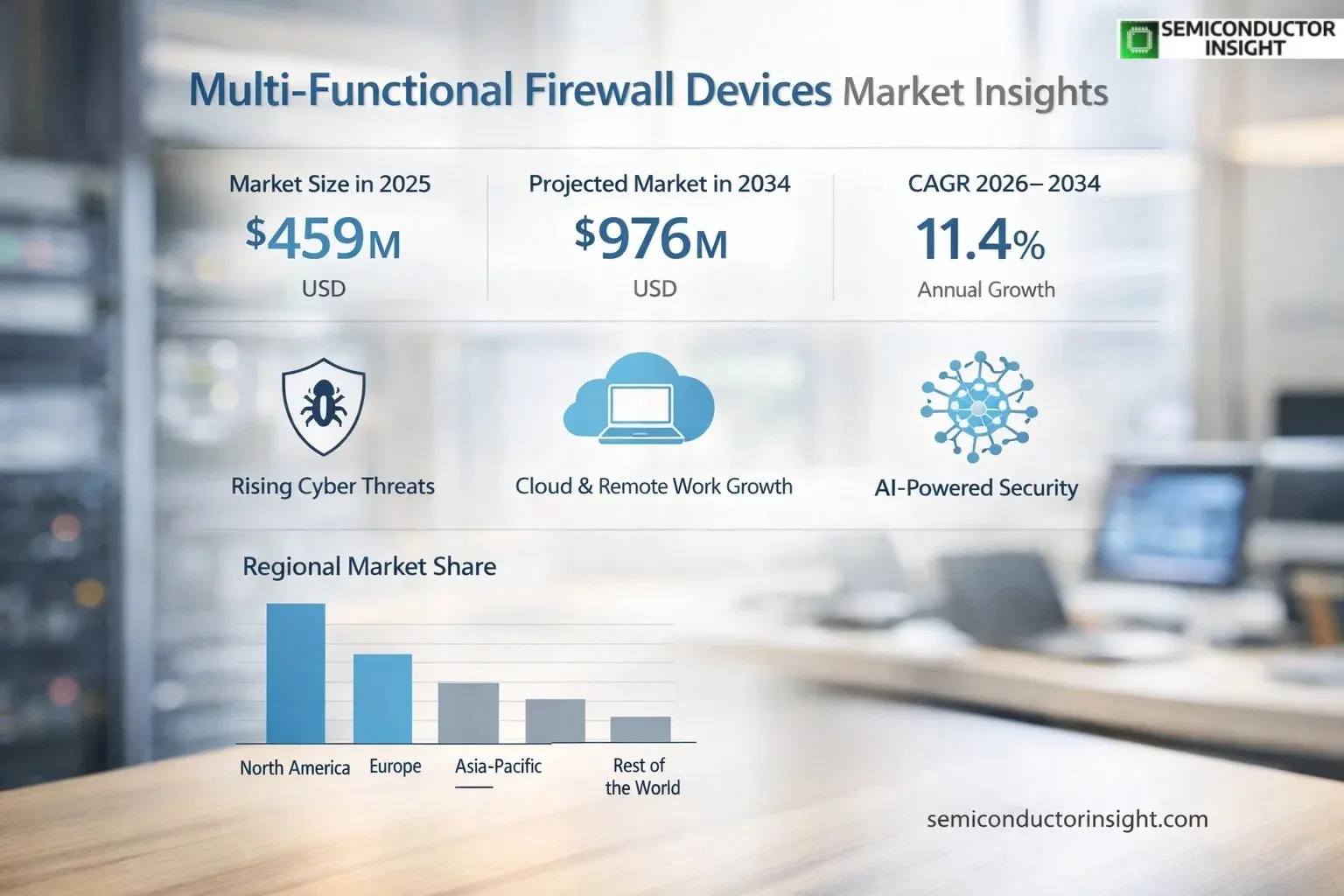
Global multi-functional firewall devices market size was valued at USD 459 million in 2025. The market is projected to grow from USD 512 million in 2026 to USD 976 million by 2034, exhibiting a CAGR of 11.4% during the forecast period.
Multi-functional firewall devices are advanced network security appliances that integrate multiple security features into a single platform. These solutions combine traditional firewall capabilities with intrusion detection and prevention (IDS/IPS), secure VPN connectivity, application control, content filtering, and email security. Often categorized as Unified Threat Management (UTM) or Next-Generation Firewalls (NGFW), these systems provide comprehensive protection against evolving cyber threats while simplifying network administration through centralized management.
Market growth is driven by increasing cyberattack sophistication, with organizations experiencing a 15% annual rise in security incidents according to recent industry data. The shift toward cloud-based infrastructure and remote work models has accelerated demand for integrated security solutions, particularly in the BFSI and healthcare sectors where regulatory compliance requirements are stringent. Technological advancements in AI-driven threat detection and automated policy management are further propelling adoption rates among enterprises seeking to reduce operational complexity while maintaining robust security postures.
MARKET DRIVERS
Increasing Cyber Threats Driving Demand
Global multi-functional firewall devices market is experiencing significant growth due to the escalating frequency and sophistication of cyberattacks. Organizations across sectors are prioritizing network security investments, with multi-functional firewalls offering comprehensive protection against malware, ransomware, and intrusion attempts.
Cloud Adoption and Remote Work Expansion
The rapid shift to cloud computing and hybrid work models has created new security perimeters that require advanced firewall solutions. Multi-functional firewall devices provide centralized management and granular control for distributed networks, making them essential for modern IT infrastructures.
➤ Recent data shows that 78% of enterprises now deploy multi-functional firewall devices as part of their core security architecture
Regulatory compliance requirements such as GDPR and HIPAA are further accelerating adoption, as these devices help organizations meet stringent data protection standards.
MARKET CHALLENGES
High Implementation Complexity
Deploying multi-functional firewall devices often requires significant expertise and configuration efforts, creating barriers for small and mid-sized businesses. Integration with existing security ecosystems presents additional technical challenges that can delay implementation timelines.
Other Challenges
Cost Constraints
The premium pricing of advanced multi-functional firewall solutions limits adoption among cost-sensitive organizations, particularly in developing markets.
Performance Trade-offs
Some enterprises report reduced network throughput when enabling all security features simultaneously, requiring careful capacity planning.
MARKET RESTRAINTS
Market Saturation in Mature Economies
Growth rates in North America and Western Europe are slowing as penetration of multi-functional firewall devices reaches 85% among large enterprises. Vendors face increasing pressure to differentiate their offerings beyond basic feature sets.
MARKET OPPORTUNITIES
5G Network Deployments
Global rollout of 5G networks is creating new demand for high-performance multi-functional firewall devices capable of handling increased traffic volumes and low-latency security processing.
AI-powered Threat Detection
Integration of machine learning capabilities presents a significant growth avenue, with next-generation multi-functional firewalls expected to deliver predictive threat prevention and automated response features.
Multi-functional Firewall Devices Market Trends
Growing Adoption of Cloud-Based Security Solutions
The Multi-functional Firewall Devices market is experiencing significant growth due to increasing migration to cloud infrastructure. Enterprises are prioritizing integrated security solutions that offer firewall protection alongside VPN, IDS/IPS, and application control in hybrid cloud environments. Major providers like Palo Alto Networks and Fortinet have introduced cloud-native firewall offerings with centralized management consoles.
Other Trends
Integration with Zero Trust Security Architecture
Modern Multi-functional Firewall Devices now incorporate Zero Trust Network Access (ZTNA) capabilities, moving beyond traditional perimeter-based security. This aligns with the industry shift toward identity-centric access control models, particularly for remote workforce security in sectors like BFSI and healthcare.
Advancements in Threat Intelligence Sharing
Leading vendors are enhancing their Multi-functional Firewall Devices with automated threat intelligence feeds and machine learning-based anomaly detection. Real-time sharing of threat signatures across networked devices has become standard among solutions from Check Point and Cisco, improving response times to emerging cyber threats.
Increasing Demand from Small and Medium Enterprises
SMBs are driving adoption of cost-effective UTM solutions that combine multiple security functions in a single appliance. Manufacturers are responding with simplified, subscription-based models for firewall devices that include automatic updates and managed security services.
Regulatory Compliance Driving Market Growth
Stringent data protection regulations such as GDPR and HIPAA continue to fuel investments in advanced firewall technologies. The government sector shows particularly strong demand for multi-functional devices that provide comprehensive audit trails and compliance reporting capabilities.
COMPETITIVE LANDSCAPE
Key Industry Players
Market Dominance and Strategic Positioning in Multi-functional Firewall Devices Space
The multi-functional firewall devices market is characterized by the dominance of established cybersecurity players, with Check Point, Cisco, and Palo Alto Networks collectively commanding significant market share. Fortinet has emerged as a formidable competitor through its integrated security fabric approach, while Dell SonicWALL maintains strong footholds in SMB segments. These leaders differentiate through advanced threat prevention capabilities, cloud-based management, and AI-driven security features in their unified threat management solutions.
Asia-Pacific manufacturers like Huawei, DPtech, and Ruijie Networks are gaining traction with cost-competitive offerings tailored for regional markets. Juniper Networks continues to innovate in high-performance enterprise firewall solutions, while specialists like IT Central Station provide niche performance benchmarking services. The market also sees growing participation from networking hardware providers such as H3C and TP-LINK expanding into security appliances.
List of Key Multi-functional Firewall Devices Companies Profiled
- Check Point Software Technologies
- Cisco Systems
- Palo Alto Networks
- Fortinet
- Dell Technologies (SonicWALL)
- IT Central Station
- Juniper Networks
- Huawei Technologies
- DPtech
- Ruijie Networks
- H3C Technologies
- TP-LINK Technologies
- Barracuda Networks
- Sophos
- WatchGuard Technologies
Segment Analysis:
| Segment Category | Sub-Segments | Key Insights |
| By Type |
|
Next-Generation Firewalls (NGFW)
|
| By Application |
|
BFSI Sector
|
| By End User |
|
Large Enterprises
|
| By Deployment |
|
Hybrid Deployment
|
| By Security Level |
|
Enterprise Security
|
Regional Analysis: Multi-functional Firewall Devices Market
U.S. banks and financial institutions extensively deploy multi-functional firewalls with integrated intrusion prevention and data loss prevention features to meet FINRA and SEC compliance requirements. The sector accounts for nearly 30% of regional demand, with growing adoption of hybrid deployment models.
Post-pandemic investments in healthcare IT security have accelerated deployment of advanced firewall solutions across hospitals and pharma companies. Multi-functional devices now commonly incorporate HIPAA-compliant audit logging and medical IoT security features specific to the sector.
Enterprises increasingly demand firewall solutions with native cloud workload protection capabilities. Vendors are developing unified management consoles for hybrid environments, with particular growth in AWS and Azure-compatible multi-functional firewall offerings.
Mid-market adoption is growing through managed security service providers offering multi-functional firewall-as-a-service. Simplified management interfaces and bundled threat intelligence subscriptions make advanced features accessible to resource-constrained smaller organizations.
Europe
The European multi-functional firewall devices market demonstrates strong growth driven by GDPR compliance requirements and increasing sophistication of cyber threats. Germany and the UK represent the largest national markets, with particular demand from manufacturing and professional services sectors. The region shows unique adoption patterns favoring locally-developed solutions with robust data sovereignty guarantees. European organizations increasingly prioritize firewall solutions that combine traditional perimeter protection with advanced functionality like encrypted traffic inspection and identity-based access controls. The EU’s focus on digital sovereignty is prompting development of region-specific firewall solutions with enhanced privacy features.
Asia-Pacific
Asia-Pacific emerges as the fastest-growing market for multi-functional firewall devices, led by digital transformation initiatives in China, India, and Southeast Asia. The region sees surging demand for integrated security solutions capable of addressing expanding attack surfaces in hybrid cloud environments. Japan and South Korea lead in adoption of next-generation firewall features, while developing markets prioritize cost-effective unified threat management appliances. Regional vendors are gaining share by customizing solutions for local regulatory environments and offering multilingual support. The APAC market uniquely blends requirements for traditional network security with protection for emerging technologies like 5G and industrial IoT.
South America
South America’s multi-functional firewall market shows steady growth despite economic volatility, with Brazil accounting for nearly half of regional demand. Financial services and energy sectors drive adoption, seeking solutions that combine network segmentation with advanced malware protection. The region demonstrates preference for multi-functional devices with simplified licensing models and strong local support networks. Challenges include budget constraints and lack of cybersecurity expertise, prompting increased adoption of managed firewall services. Government initiatives to improve national cybersecurity postures are creating new opportunities for integrated security solutions.
Middle East & Africa
The Middle East shows accelerated adoption of multi-functional firewall devices, particularly in GCC countries undertaking smart city initiatives. UAE and Saudi Arabia lead in deployment of next-generation firewall capabilities across critical infrastructure sectors. Africa presents growing opportunities in key markets like South Africa and Nigeria, though adoption remains constrained by limited IT budgets. The region exhibits unique demand for firewall solutions that combine traditional security functions with specialized features for oil/gas and telecommunications networks. Local content requirements in certain countries are driving partnerships between global vendors and regional system integrators.
Report Scope
This market research report provides a comprehensive analysis of the Multi-functional Firewall Devices Market , covering the forecast period 2026–2034. It offers detailed insights into market dynamics, technological advancements, competitive landscape, and key trends shaping the industry.
Key focus areas of the report include:
- Market Overview: The report begins with an overview outlining its current market scenario, key growth indicators, and industry transformation drivers. It discusses macroeconomic factors, demand–supply balance, regulatory landscape, and the strategic role of network security solutions in powering advancements across industries such as BFSI, healthcare, government, and IT/telecom.
- Market Size & Forecast: Historical data and future projections for revenue, unit shipments, and market value across major regions and segments.
- Segmentation Analysis: Detailed breakdown by product type, technology, application, and end-user industry to identify high-growth segments and investment opportunities.
- Regional Insights: Insights into market performance across North America, Europe, Asia-Pacific, Latin America, and the Middle East & Africa, including country-level analysis where relevant.
- Competitive Landscape: Profiles of leading market participants, including their product offerings, R&D focus, manufacturing capacity, pricing strategies, and recent developments such as mergers, acquisitions, and partnerships.
- Technology Trends & Innovation: Assessment of emerging technologies, integration of AI/ML capabilities, unified threat management features, and evolving cybersecurity standards.
- Market Drivers & Restraints: Evaluation of factors driving market growth along with challenges, supply chain constraints, regulatory issues, and market-entry barriers.
- Stakeholder Insights: Insights for component suppliers, OEMs, system integrators, investors, and policymakers regarding the evolving cybersecurity ecosystem and strategic opportunities.
Primary and secondary research methods are employed, including interviews with industry experts, data from verified sources, and real-time market intelligence to ensure the accuracy and reliability of the insights presented.
FREQUENTLY ASKED QUESTIONS:
What is the current market size of Multi-functional Firewall Devices Market?
-> Global Multi-functional Firewall Devices Market was valued at USD 459 million in 2025 and is expected to reach USD 976 million by 2034, growing at a CAGR of 11.4% during 2026-2034.
Which key companies operate in Multi-functional Firewall Devices Market?
-> Key players include Check Point, Cisco, Palo Alto Networks, Fortinet, Dell SonicWALL, IT Central Station, Juniper, Huawei, DPtech, and Ruijie Networks. The top five players accounted for approximately % market share in 2025.
What are the key growth drivers?
-> Key growth drivers include rising cyber threats, increasing adoption of unified threat management solutions, growing demand from BFSI and government sectors, and technological advancements in next-generation firewalls.
Which region dominates the market?
-> North America currently holds significant market share (U.S. estimated at $ million in 2025), while Asia-Pacific (particularly China) is expected to show the highest growth rate.
What are the emerging trends?
-> Emerging trends include AI-powered threat detection, integration of cloud security features, hybrid deployment models, and increasing adoption of 10 Gigabit firewalls.

Get Sample Report PDF for Exclusive Insights
Report Sample Includes
- Table of Contents
- List of Tables & Figures
- Charts, Research Methodology, and more...
 Download Sample Report PDF