Market Insights
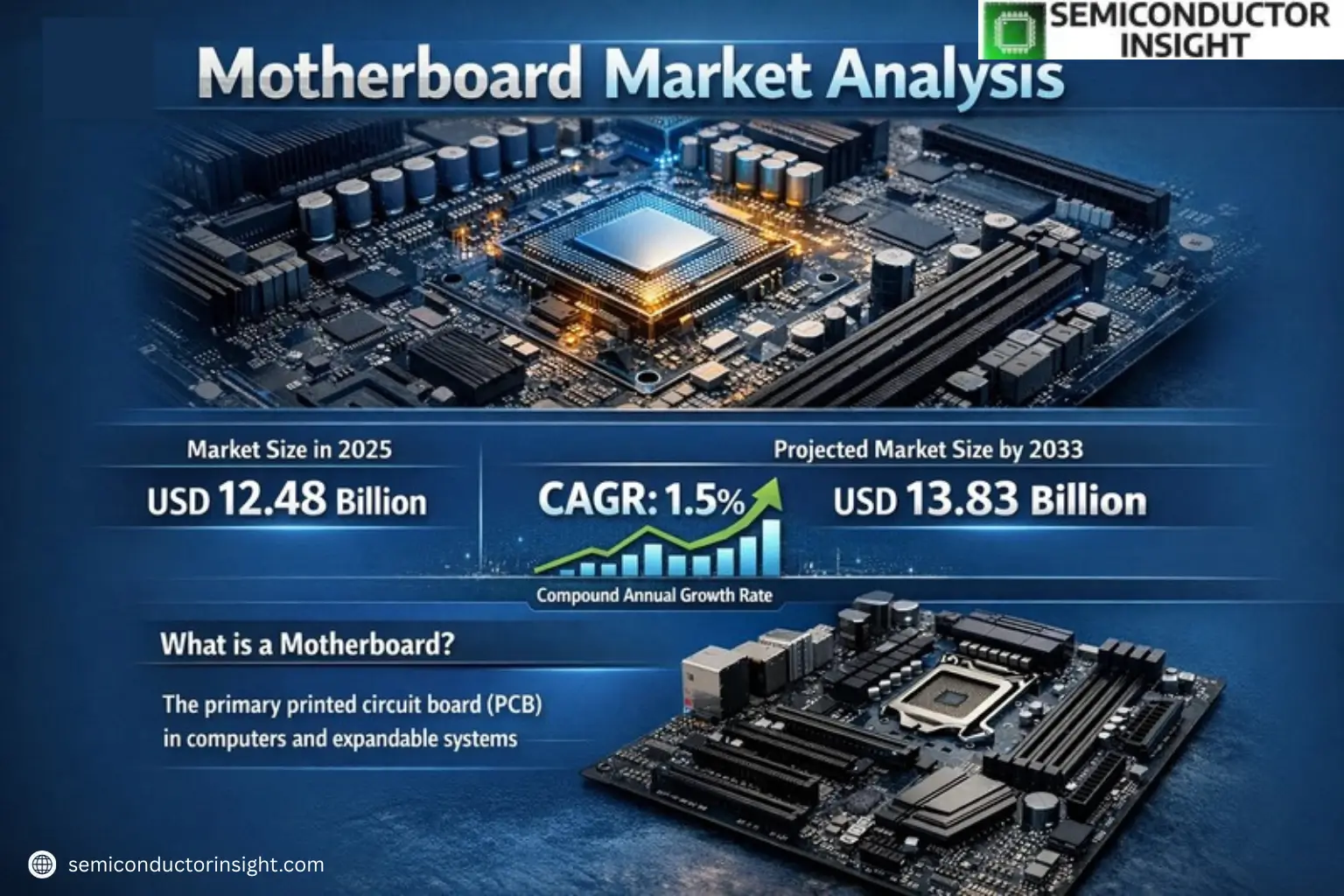
Global Motherboard Market size was valued at USD 12.48 billion in 2025 and is projected to reach USD 13.83 billion by 2033, exhibiting a CAGR of 1.5% during the forecast period.
A motherboard, also known as the mainboard or system board, serves as the primary printed circuit board (PCB) in computers and expandable systems. It facilitates communication between critical components such as the central processing unit (CPU), memory modules, and peripheral devices through integrated controllers and connectors. Unlike simpler backplanes, motherboards incorporate essential subsystems including processor sockets, chipset I/O interfaces, and expansion slots for comprehensive functionality.
The market demonstrates steady growth driven by sustained demand across commercial applications, particularly in data centers and enterprise IT infrastructure. Server motherboards dominate product segments with a 45% market share, reflecting increasing cloud computing adoption. Geographically, China leads with over 50% market penetration due to concentrated electronics manufacturing, while North America and Europe collectively account for approximately 25%. Key industry players like Asus, Gigabyte Technology, and Micro-Star International maintain competitive positions through continuous innovation in high-performance computing solutions.
MARKET DRIVERS
Rising Demand for High-Performance Computing
Global Motherboard Market is witnessing steady growth driven by increasing demand for high-performance computing across industries. The proliferation of gaming PCs, data centers, and AI applications has created robust demand for advanced motherboard solutions. Recent reports indicate motherboard shipments grew by 8% year-over-year, with premium segment growth exceeding 12%.
Technological Advancements in Chipset Design
Innovations in chipset architectures and socket designs are enabling motherboard manufacturers to deliver enhanced features. The transition to PCIe 5.0 and DDR5 memory standards is driving replacement cycles, with over 35% of new motherboards now supporting these technologies. The integration of advanced thermal solutions and power delivery systems continues to push performance boundaries.
Enterprise adoption of workstation-class motherboards is accelerating, particularly in sectors requiring heavy computational workloads like engineering simulations and financial modeling.
MARKET CHALLENGES
Component Shortages and Supply Chain Disruptions
Motherboard Market faces persistent challenges from global semiconductor shortages and logistics bottlenecks. Lead times for critical components like VRM chipsets and network controllers have extended to 26+ weeks in some cases, impacting production schedules. Manufacturers are navigating a 15-20% increase in component costs that’s difficult to fully pass to consumers.
Other Challenges
Rapid Technological Obsolescence
The fast pace of CPU socket changes and memory standard transitions creates inventory management challenges. Approximately 60% of motherboard manufacturers report carrying excess inventory of legacy products as users migrate to newer platforms.
MARKET RESTRAINTS
Declining Desktop PC Market Share
The shift toward mobile computing continues to restrain Motherboard Market growth, with desktop PC shipments declining by 7% in the last fiscal year. While premium and enthusiast segments remain strong, mainstream motherboard sales have contracted by approximately 11% as users opt for laptops and all-in-one systems.
MARKET OPPORTUNITIES
Emerging Server and Data Center Demand
The server motherboard segment presents significant growth potential, projected to expand at 14.5% CAGR through 2027. Hyperscale data center operators are driving demand for specialized server boards with optimized power efficiency and thermal characteristics. The adoption of ARM-based server platforms is creating new design opportunities for motherboard manufacturers.
Global Motherboard Market Trends
Steady Growth in Motherboard Market Revenue
Global Motherboard Market was valued at USD 12,480 million in 2025 and is projected to reach USD 13,830 million by 2033, growing at a CAGR of 1.5% during the forecast period. This growth is driven by increasing demand for computing hardware across commercial and industrial sectors, as well as continuous technological advancements in motherboard architecture.
Other Trends
Dominance of Server Motherboards
Server motherboards currently hold about 45% market share, making them the largest product segment. The growth of data centers and cloud computing services has significantly boosted demand for high-performance server motherboards with enhanced processing capabilities and reliability.
Geographical Market Distribution
China leads the Motherboard Market with over 50% share, followed by the United States and Europe at approximately 25% combined. This distribution reflects China’s strong manufacturing capabilities and the country’s position as a global electronics production hub.
Competitive Landscape Analysis
Asus, Gigabyte Technology, and Micro-Star International currently dominate the Motherboard Market, collectively holding over 25% market share. These companies continue to innovate with features like improved thermal solutions, enhanced power delivery systems, and support for newer processor technologies.
Application Segment Trends
The commercial sector remains the largest application segment for motherboards, followed by industrial applications. Demand from the gaming industry is also growing steadily, contributing to innovation in high-performance gaming motherboards with improved overclocking capabilities.
Technology and Form Factor Developments
Recent motherboard developments focus on supporting newer CPU architectures, DDR5 memory compatibility, and PCIe Gen 5.0 interfaces. Manufacturers are also optimizing board layouts to accommodate smaller form factors while maintaining functionality, responding to the growing popularity of compact PC builds.
COMPETITIVE LANDSCAPE
Key Industry Players
Taiwanese and Chinese manufacturers dominate the Motherboard Market with innovation-driven competition
Global Motherboard Market remains highly concentrated, with the top three manufacturers – Asus, Gigabyte Technology, and Micro-Star International (MSI) collectively holding over 25% market share. Asus maintains technology leadership through its premium ROG (Republic of Gamers) series, while Gigabyte excels in server and workstation motherboards. Taiwanese manufacturers benefit from strong supply chain integration and R&D capabilities, producing both consumer and industrial-grade solutions.
Niche segments show specialization among players like Super Micro (high-density server boards) and Advantech (industrial applications). Intel remains influential through chipset standards, while specialized manufacturers like Kontron and Abaco serve defense and aerospace sectors. The gaming segment has seen increased competition with ASRock and Colorful Group expanding their premium offerings.
List of Key Motherboard Companies Profiled
- Asus
- Gigabyte Technology
- Micro-Star International Co., Ltd (MSI)
- Super Micro
- Advantech
- Intel Corporation
- Tyan (MiTAC)
- Kontron
- Abaco Systems
- ASRock
- Artesyn Embedded
- Colorful Group
- ADLINK Technology
- DFI
- Biostar
Segment Analysis:
| Segment Category | Sub-Segments | Key Insights |
| By Type |
|
Server Motherboards dominate due to:
|
| By Application |
|
Commercial Applications lead the market because:
|
| By End User |
|
Enterprise Segment shows strongest growth due to:
|
| By Form Factor |
|
ATX Format remains market leader due to:
|
| By Socket Type |
|
LGA Sockets dominate the market because:
|
Regional Analysis: Global Motherboard Market
The concentrated presence of electronics manufacturers and ODMs across China and Taiwan creates an unbeatable motherboard production cluster, with complete supply chains reducing time-to-market for new motherboard designs.
Rapid urbanization and expanding middle-class populations drive sustained demand for computing devices across India, Southeast Asia, and China, making Asia-Pacific the fastest-growing motherboard consumer market.
Taiwanese companies lead motherboard innovation with frequent chipset updates and feature-rich designs, while Chinese firms excel at cost-optimized solutions for emerging markets.
Massive investments in 5G networks and hyperscale data centers across the region create sustained demand for server motherboards and high-performance computing solutions.
North America
North America represents a high-value Motherboard Market focused on premium and performance-oriented products. The region boasts strong demand from gaming PC enthusiasts, content creators, and enterprise IT infrastructure. U.S.-based motherboard manufacturers differentiate through innovative designs and partnerships with leading processor vendors. The growing trend of remote work and cloud computing continues to drive motherboard upgrades in corporate environments. Strict quality standards and environmental regulations shape motherboard development priorities in this mature but innovation-driven market.
Europe
Europe maintains steady motherboard demand with emphasis on energy efficiency and sustainability. German and Nordic countries lead in enterprise adoption while Southern Europe shows growing gaming PC interest. The region benefits from strong R&D capabilities in embedded systems and industrial computing applications. EU electronics regulations influence motherboard design parameters across the continent, creating demand for durable, repairable designs with reduced environmental impact. Western Europe remains a key market for premium motherboard brands.
South America
The South American Motherboard Market shows promising growth potential despite current economic challenges. Brazil dominates regional demand with increasing computer literacy and digital transformation efforts. Price sensitivity remains high, driving demand for entry-level and refurbished motherboards. Local assembly operations are growing in Mexico and Brazil, supported by government incentives for electronics manufacturing. Gaming motherboard demand rises steadily among urban youth populations across major cities in the region.
Middle East & Africa
MEA presents emerging opportunities in the Motherboard Market, particularly in Gulf Cooperation Council countries. The region shows growing IT infrastructure investments and rising PC penetration rates. Dubai serves as a regional hub for high-end motherboard distribution, while African markets increasingly adopt affordable computing solutions. Specialized motherboard requirements for harsh environments and power fluctuation tolerance create niche opportunities. Government initiatives for digital transformation gradually accelerate motherboard adoption across the region.
Report Scope
This market research report provides a comprehensive analysis of the Motherboard Market, covering the forecast period 2025–2033. It offers detailed insights into market dynamics, technological advancements, competitive landscape, and key trends shaping the industry.
Key focus areas of the report include:
- Market Overview: The report begins with an overview outlining its current market scenario, key growth indicators, and industry transformation drivers. It discusses macroeconomic factors, demand–supply balance, regulatory landscape, and the strategic role of semiconductors in powering advancements across industries such as automotive, telecommunications, consumer electronics, and industrial automation.
- Market Size & Forecast: Historical data and future projections for revenue, unit shipments, and market value across major regions and segments.
- Segmentation Analysis: Detailed breakdown by product type, technology, application, and end-user industry to identify high-growth segments and investment opportunities.
- Regional Insights: Insights into market performance across North America, Europe, Asia-Pacific, Latin America, and the Middle East & Africa, including country-level analysis where relevant.
- Competitive Landscape: Profiles of leading market participants, including their product offerings, R&D focus, manufacturing capacity, pricing strategies, and recent developments such as mergers, acquisitions, and partnerships.
- Technology Trends & Innovation: Assessment of emerging technologies, integration of AI/IoT, semiconductor design trends, fabrication techniques, and evolving industry standards.
- Market Drivers & Restraints: Evaluation of factors driving market growth along with challenges, supply chain constraints, regulatory issues, and market-entry barriers.
- Stakeholder Insights: Insights for component suppliers, OEMs, system integrators, investors, and policymakers regarding the evolving ecosystem and strategic opportunities.
Primary and secondary research methods are employed, including interviews with industry experts, data from verified sources, and real-time market intelligence to ensure the accuracy and reliability of the insights presented.
FREQUENTLY ASKED QUESTIONS:
What is the current market size of Motherboard Market?
-> Motherboard Market size was valued at USD 12.48 billion in 2025 and is projected to reach USD 13.83 billion by 2033, exhibiting a CAGR of 1.5% during the forecast period.
Which key companies operate in Motherboard Market?
-> Key players include Asus, Gigabyte Technology, Micro-Star International Co., Ltd, Advantech, Intel, and ASRock, among others. The top three manufacturers hold over 25% market share.
What are the key growth drivers?
-> Key growth drivers include increasing demand for computing devices, server infrastructure expansion, and advancements in gaming hardware.
Which region dominates the market?
-> China is the largest market with over 50% share, followed by United States and Europe with approximately 25% share each.
What are the emerging trends?
-> Emerging trends include increased demand for server motherboards, growth in gaming hardware, and technological advancements in PCB design.
What is the market segmentation by product type?
-> The market is segmented into PC Motherboards (non-dominant), Mobile PC Motherboards, Server Motherboards (45% share), and Gaming Motherboards.
What are the primary application areas?
-> The largest application segment is Commercial, followed by Industrial and Personal use.

Get Sample Report PDF for Exclusive Insights
Report Sample Includes
- Table of Contents
- List of Tables & Figures
- Charts, Research Methodology, and more...
 Download Sample Report PDF