SEMICONDUCTOR INSIGHT
MARKET RESEARCH REPORT

Monitor Photodiode (MPD) Chip Market

2026 to 2034
MARKET INTELLIGENCE
ACROSS KEY REGIONS
2026 EDITION
OPTOELECTRONICS Semiconductor Market Research

Monitor Photodiode (MPD) Chip Market

Size, Share & Industry Analysis, By Type (Edge Illuminated, Top Illuminated, Others), By Application (Smart Surveillance Systems, Industrial Automation, Autonomous Driving, Others), By Wavelength Band (850–1100nm, 1270–1620nm, Other Specialty Bands), By Packaging (Bare Die, Chip-on-Carrier, Integrated Optical Module), and Regional Forecast, 2026-2034

◷
UPDATED 14 October 2026
▤
REPORT LENGTH Detailed Report
▣
REPORT CODE 4793b3160833
▯
FORMATS PDF

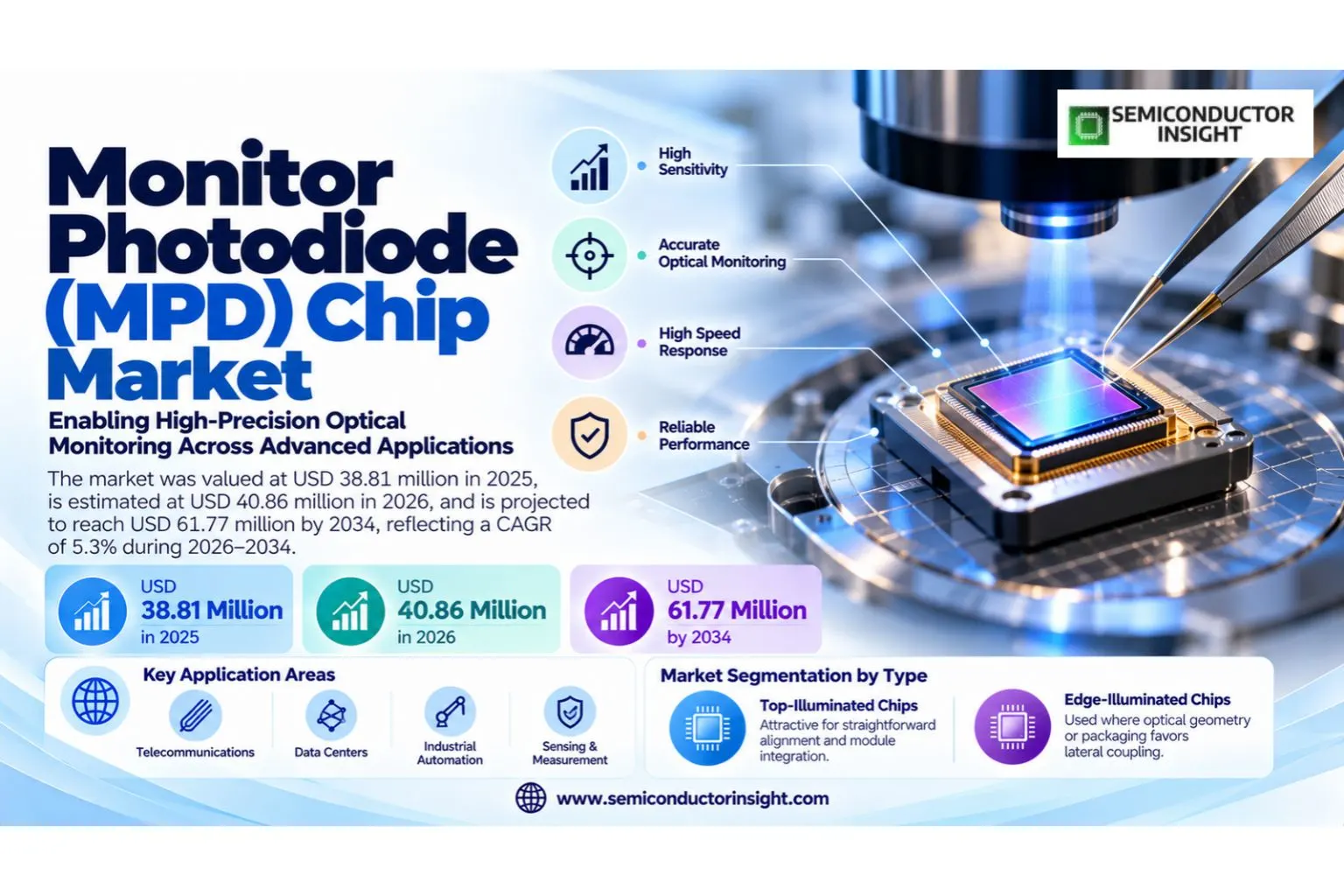
The market was valued at USD 38.81 million in 2025, is estimated at USD 40.86 million in 2026, and is projected to reach USD 61.77 million by 2034, reflecting a CAGR of 5.3% during 2026–2034.

Get the sample PDF with study scope, segmentation and methodology details.

Key Statistics

2025 Market Size
USD 38.81 million
2034 Projected Market Size
USD 61.77 million
CAGR (2026–2034)
5.3%
Largest Market in 2025
Asia Pacific

Key Takeaways

  • The market is valued at USD 38.81 million in 2025 and is projected to reach USD 61.77 million by 2034, representing a 5.3% CAGR over 2026–2034.
  • Edge Illuminated is a major product segment, while adjacent technology variants are expanding as performance, integration and cost requirements evolve.
  • Smart Surveillance Systems is a leading application area, supported by rising deployment across Industrial Automation, Autonomous Driving.
  • Asia Pacific is the largest market in 2025, reflecting the current concentration of demand, manufacturing capacity and ecosystem maturity.

Monitor Photodiode (MPD) Chip Market Overview

The market was valued at USD 38.81 million in 2025, is estimated at USD 40.86 million in 2026, and is projected to reach USD 61.77 million by 2034, reflecting a CAGR of 5.3% during 2026–2034.

Monitor Photodiode (MPD) Chip devices detect a controlled fraction of optical power inside laser modules, transceivers and sensing systems. In a typical laser package, the MPD samples light from the laser’s back facet and feeds a control loop that stabilizes output power as temperature, device aging and drive current change. Commercial adoption of Monitor Photodiode (MPD) Chip products therefore depends on how effectively suppliers translate core device performance into compact, manufacturable systems that meet application-specific reliability, cost and integration requirements.

Commercial demand is driven by optical communications, industrial photonics and increasingly by compact sensing modules. Key performance parameters include responsivity, dark current, active-area geometry, wavelength range, temperature stability and package compatibility. High reliability matters because a small monitor diode can determine the stability of an entire laser transmitter. Across the value chain, customers are placing greater weight on lifecycle support, interoperability and predictable production quality, which is shifting competition away from headline specifications alone and toward complete platform performance.

Segment Analysis: By Type

Top-illuminated chips are attractive for straightforward alignment and module integration, while edge-illuminated structures are used where optical geometry or packaging favors lateral coupling. Within this segmentation axis, purchasing decisions are increasingly shaped by qualification requirements, integration complexity, power or thermal constraints, and the ability of suppliers to support several product generations without forcing major system redesigns.

Type Market relevance
Edge Illuminated Useful for lateral optical paths and compact assemblies.
Top Illuminated Simple alignment and common monitor-PD configuration.
Others Specialized geometries for niche systems.

Segment Analysis: By Application

The market spans optical control and sensing functions across industrial, communications, surveillance and automotive systems, with telecom monitoring remaining an important technical foundation. Within this segmentation axis, purchasing decisions are increasingly shaped by qualification requirements, integration complexity, power or thermal constraints, and the ability of suppliers to support several product generations without forcing major system redesigns.

Application Market relevance
Smart Surveillance Systems Optical sensing and monitoring.
Industrial Automation Machine and process monitoring.
Autonomous Driving LiDAR and optical control use cases.
Others Telecom, test and specialty photonics.

Segment Analysis: By Wavelength Band

The 1270–1620nm band is critical for fiber-optic communications because InGaAs photodiodes provide strong responsivity across common telecom wavelengths. Within this segmentation axis, purchasing decisions are increasingly shaped by qualification requirements, integration complexity, power or thermal constraints, and the ability of suppliers to support several product generations without forcing major system redesigns.

Wavelength Band Market relevance
850–1100nm Silicon and specialty detection regimes.
1270–1620nm Core InGaAs telecom monitoring band.
Other Specialty Bands Application-specific detection bands.

Segment Analysis: By Packaging

Bare die offers maximum integration flexibility, while chip-on-carrier and integrated modules reduce assembly risk for customers without photonic packaging capability. Within this segmentation axis, purchasing decisions are increasingly shaped by qualification requirements, integration complexity, power or thermal constraints, and the ability of suppliers to support several product generations without forcing major system redesigns.

Packaging Market relevance
Bare Die Highest design flexibility.
Chip-on-Carrier Simplifies handling and wire bonding.
Integrated Optical Module Lowest integration burden for system OEMs.

Regional Analysis

Asia Pacific leads through optoelectronic component manufacturing and telecom equipment scale, while North America and Europe remain important design and high-reliability application markets. Regional share is influenced not only by end-market demand but also by local manufacturing depth, component qualification, engineering support and the speed with which new Monitor Photodiode (MPD) Chip platforms move from design-in to volume deployment.

Region 2025 Position Growth Outlook Demand Profile
Asia Pacific Largest Strong Optical component manufacturing led
North America High-value market Moderate-strong Datacom, test and industrial led
Europe Specialty photonics market Moderate Telecom, sensing and industrial led
South America Emerging Selective Telecom and industrial led
Middle East & Africa Developing Selective Telecom and sensing led

Detailed Regional Blocks

Why is Asia Pacific important to this market?

Largest  |  Strong  |  Optical component manufacturing led

Asia Pacific leads because China, Japan and Taiwan manufacture large volumes of laser modules, transceivers and photonic components that use monitor photodiodes. In Asia Pacific, buyers also weigh supplier responsiveness, certification, logistics and long-term availability, so ecosystem maturity can be as important as nominal product performance when programs move into sustained production.

Country / Subregion Role Market Context
China Largest component manufacturing base Telecom and industrial photonics support unit volume.
Japan High-reliability optoelectronics Precision photonic components support premium demand.
Taiwan Transceiver and module hub Networking equipment creates recurring MPD demand.
  • Coherent offers InGaAs top-illuminated monitor PD chips across 1270–1620nm for communications modules.
  • Transceiver assembly density rewards monitor diodes with low dark current and easy alignment.
  • Local module manufacturing shortens the path between photodiode qualification and volume production.

Why is North America important to this market?

High-value market  |  Moderate-strong  |  Datacom, test and industrial led

North America is a high-value market because cloud networking, optical test and industrial laser systems demand reliable photodiodes with documented performance. In North America, buyers also weigh supplier responsiveness, certification, logistics and long-term availability, so ecosystem maturity can be as important as nominal product performance when programs move into sustained production.

Country / Subregion Role Market Context
United States Largest regional market Datacom and industrial photonics support premium MPDs.
Canada Photonics research and telecom Specialty optical systems create demand.
Mexico Electronics manufacturing Module assembly creates smaller downstream demand.
  • Coherent specifies GR-468 qualification for one of its monitor photodiode chip formats, aligning with telecom reliability requirements.
  • High-speed datacom growth increases the number of monitored laser channels in optical modules.
  • Industrial laser systems use monitor diodes for closed-loop output stabilization.

Why is Europe important to this market?

Specialty photonics market  |  Moderate  |  Telecom, sensing and industrial led

Europe has a strong specialist photonics ecosystem in Germany, Switzerland and the UK, supporting MPD demand in communications, industrial lasers and precision sensing. In Europe, buyers also weigh supplier responsiveness, certification, logistics and long-term availability, so ecosystem maturity can be as important as nominal product performance when programs move into sustained production.

Country / Subregion Role Market Context
Germany Industrial photonics Laser and automation systems support monitor diodes.
Switzerland Precision optoelectronics Specialist photodiode expertise supports high-value demand.
United Kingdom Telecom and research Photonics design creates selective demand.
  • European industrial lasers require stable optical-output feedback over long operating lives.
  • Telecom equipment makers value low dark current and broad wavelength response.
  • Specialty volumes emphasize consistency and reliability over lowest unit cost.

Why is South America important to this market?

Emerging  |  Selective  |  Telecom and industrial led

South America is a smaller market where demand enters mainly through imported optical modules and industrial photonic systems. In South America, buyers also weigh supplier responsiveness, certification, logistics and long-term availability, so ecosystem maturity can be as important as nominal product performance when programs move into sustained production.

Country / Subregion Role Market Context
Brazil Largest regional market Telecom networks and industry create demand.
Chile Telecom and mining niche Optical sensing creates selected use.
Argentina Research niche Academic photonics supports small volumes.
  • Most MPD chips are imported inside complete laser or transceiver modules.
  • Telecom network expansion creates indirect unit growth.
  • Local component-level integration remains limited.

Why is Middle East & Africa important to this market?

Developing  |  Selective  |  Telecom and sensing led

Middle East and Africa demand is developing through fiber networks, industrial monitoring and specialist sensing, but direct photodiode-chip integration remains limited. In Middle East & Africa, buyers also weigh supplier responsiveness, certification, logistics and long-term availability, so ecosystem maturity can be as important as nominal product performance when programs move into sustained production.

Country / Subregion Role Market Context
United Arab Emirates Telecom infrastructure High-speed networks support optical modules.
Saudi Arabia Digital infrastructure growth Fiber deployment increases photonics demand.
South Africa Regional telecom hub Networking and industrial systems create selected demand.
  • Fiber expansion increases the installed base of monitored optical transmitters.
  • Most value is imported inside transceiver assemblies.
  • Specialty industrial sensing provides smaller direct-chip opportunities.

Competitive Landscape

The market is concentrated among specialist optoelectronic suppliers such as Coherent, Albis, LuxNet and San’an. Competition centers on responsivity, dark current, active-area uniformity, wavelength range, reliability qualification and the ability to supply die formats compatible with automated optical assembly.

Company Position Relevant capability
Coherent Key participant InGaAs monitor photodiodes covering 1270–1620nm with low dark current and telecom-oriented qualification.
Albis Optoelectronics Key participant Specialist high-speed and monitor photodiode supplier for optical communications.
LuxNet Key participant Optoelectronic component supplier serving transceiver and laser-module applications.
San’an Optoelectronics Key participant Competes through product breadth, integration capability, qualification and customer support.
Broadcom Key participant Competes through product breadth, integration capability, qualification and customer support.
Hamamatsu Photonics Key participant Competes through product breadth, integration capability, qualification and customer support.

Production Capacity Analysis

MPD capacity uses III-V epitaxy, photodiode wafer processing, passivation, dicing and precision test. Yields depend on low dark current and uniform responsivity across relatively small die. Scaling output without degrading quality requires disciplined process control, stable upstream materials and test coverage that catches performance drift before products reach customers.

Asia provides much of the module-assembly scale, while specialist photodiode design and wafer capability is distributed across Europe, North America and Asia. Effective capacity also depends on known-good-die test and optical characterization. Regional supply resilience is therefore increasingly tied to second-source planning, local technical support and the ability to qualify alternate production routes without changing system behavior.

Market Dynamics

The market is mature in telecom laser monitoring but continues to benefit from rising optical channel counts. Each additional laser channel in a transceiver or sensing module can create another monitor-photodiode function. This changes how vendors position products: system-level value, integration simplicity and operating efficiency increasingly determine design wins alongside the core semiconductor or component specification.

Integration pressure is reducing package size and increasing expectations for bare-die quality. Suppliers that provide reliable die with stable responsivity across temperature can capture more value in dense optical modules where rework is expensive. Customers are consequently evaluating total ownership cost and qualification risk over a full product lifecycle, rather than focusing only on the initial purchase price or a single benchmark.

Market Drivers

Factor Analyst Interpretation
Optical-network growth More transceiver channels increase laser-monitoring requirements.
Closed-loop laser control MPDs help maintain stable optical output over temperature and aging.
Industrial photonics Lasers used in automation and sensing require reliable feedback.
Module miniaturization Smaller optoelectronic assemblies favor compact bare-die monitor photodiodes.

Market Restraints

Factor Analyst Interpretation
Small absolute market size MPDs are low-cost components inside larger optical modules.
Integration into laser packages Customers may source pre-integrated laser/PD assemblies rather than discrete chips.
Strict reliability expectations Telecom and industrial systems demand low failure rates over long lifetimes.
III-V manufacturing complexity InGaAs processes require specialized epitaxy and wafer handling.

Market Opportunities

Factor Analyst Interpretation
Higher-channel-count optics AI and datacom transceivers increase monitored laser channels.
Co-packaged optics Denser optical engines can require compact integrated monitoring functions.
Automotive lidar Laser-power feedback creates specialized MPD opportunities.
Self-hermetic die Simplified packaging can reduce module cost while maintaining reliability.

Supply Chain Analysis

The supply chain starts with III-V epitaxy and photodiode wafer processing, followed by optical test, dicing and either bare-die shipment or module integration. Quality control is critical because low-value die can determine the stability of much higher-value lasers. Quality assurance, traceability and coordination between component makers, module integrators and OEMs are critical because failures discovered late in the chain can be far more expensive than the underlying component itself.

Supply Chain Stage Role in the Market
InGaAs epitaxy and wafer fabrication Compound-semiconductor layers and junctions create the photodiode.
Wafer test and dicing Responsivity, dark current and breakdown are screened before shipment.
Laser-module integration The MPD is aligned with a laser or optical path and wire bonded into the package.
System control loop Electronics use MPD current to stabilize optical output power.

Recent Developments

Date Development Source
2026 Coherent continues to offer top-illuminated InGaAs monitor photodiode chips with 1270–1620nm response, low dark current and GR-468-qualified options. Coherent
2026 Coherent's current monitor-PD family offers both compact square active areas and larger circular active areas to support different optical alignment requirements. Coherent
2026 Telecom and datacom systems continue increasing optical channel counts, raising the need for compact reliable monitoring inside laser modules. Coherent

Report Scope & Segmentation

Scope Item Coverage
Base Year 2025
Estimated Year 2026
Forecast Period 2026–2034
2025 Market Size USD 38.81 million
2026 Estimated Size USD 40.86 million
2034 Forecast Size USD 61.77 million
CAGR (2026–2034) 5.3%
Largest Market in 2025 Asia Pacific
Category Optoelectronics / Photodiodes / Optical Monitoring
By Type Edge Illuminated, Top Illuminated, Others
By Application Smart Surveillance Systems, Industrial Automation, Autonomous Driving, Others
By Wavelength Band 850–1100nm, 1270–1620nm, Other Specialty Bands
By Packaging Bare Die, Chip-on-Carrier, Integrated Optical Module

Frequently Asked Questions

What is the 2025 market size of the Monitor Photodiode (MPD) Chip market?

The market is valued at USD 38.81 million in 2025.

What is the projected 2034 market size of the Monitor Photodiode (MPD) Chip market?

The market is projected to reach USD 61.77 million by 2034.

What is the CAGR of the Monitor Photodiode (MPD) Chip market from 2026 to 2034?

The market is expected to expand at a CAGR of 5.3% during 2026–2034.

Which region leads the Monitor Photodiode (MPD) Chip market?

Asia Pacific is the largest market in 2025 based on the current demand, manufacturing and deployment structure.

Which type segment is important in the Monitor Photodiode (MPD) Chip market?

Edge Illuminated is a major segment, while adjacent product variants are gaining share as performance and integration requirements evolve.

What is the main application for Monitor Photodiode (MPD) Chip products?

Smart Surveillance Systems is a leading application, with additional growth coming from Industrial Automation, Autonomous Driving.

What drives growth in the Monitor Photodiode (MPD) Chip market?

More transceiver channels increase laser-monitoring requirements.

What is a key restraint for the Monitor Photodiode (MPD) Chip market?

MPDs are low-cost components inside larger optical modules.

Which companies participate in the Monitor Photodiode (MPD) Chip market?

Key participants include Coherent, Albis Optoelectronics, LuxNet, San’an Optoelectronics, Broadcom, alongside other specialized suppliers and system companies.

What technology trend is shaping the Monitor Photodiode (MPD) Chip market?

AI and datacom transceivers increase monitored laser channels.

Research Sources & Evidence Base

View research sources used for this overview.
  • Coherent — Top-Illuminated Monitor Photodiode Chips: Wavelength, active area, responsivity, dark current and qualification details. Source

Monitor Photodiode (MPD) Chip Market Size, Share & Industry Analysis, By Type (Edge Illuminated, Top Illuminated, Others), By Application (Smart Surveillance Systems, Industrial Automation, Autonomous Driving, Others), By Wavelength Band (850–1100nm, 1270–1620nm, Other Specialty Bands), By Packaging (Bare Die, Chip-on-Carrier, Integrated Optical Module), and Regional Forecast, 2026-2034

Get Sample Report PDF for Exclusive Insights

Report Sample Includes

  • Table of Contents
  • List of Tables & Figures
  • Charts, Research Methodology, and more...

PDF Icon Download Sample Report PDF

Download Sample Report

Table of Content

Table of Contents
1 Research Methodology and Statistical Scope
1.1 Market Definition and Statistical Scope of Monitor Photodiode (MPD) Chip
1.2 Key Market Segments
1.2.1 Monitor Photodiode (MPD) Chip Segment by Type
1.2.2 Monitor Photodiode (MPD) Chip Segment by Application
1.3 Methodology & Sources of Information
1.3.1 Research Methodology
1.3.2 Research Process
1.3.3 Market Breakdown and Data Triangulation
1.3.4 Base Year
1.3.5 Report Assumptions & Caveats
2 Monitor Photodiode (MPD) Chip Market Overview
2.1 Global Market Overview
2.1.1 Global Monitor Photodiode (MPD) Chip Market Size (M USD) Estimates and Forecasts (2026-2034)
2.1.2 Global Monitor Photodiode (MPD) Chip Sales Estimates and Forecasts (2026-2034)
2.2 Market Segment Executive Summary
2.3 Global Market Size by Region
3 Monitor Photodiode (MPD) Chip Market Competitive Landscape
3.1 Global Monitor Photodiode (MPD) Chip Sales by Manufacturers (2019-2025)
3.2 Global Monitor Photodiode (MPD) Chip Revenue Market Share by Manufacturers (2019-2025)
3.3 Monitor Photodiode (MPD) Chip Market Share by Company Type (Tier 1, Tier 2, and Tier 3)
3.4 Global Monitor Photodiode (MPD) Chip Average Price by Manufacturers (2019-2025)
3.5 Manufacturers Monitor Photodiode (MPD) Chip Sales Sites, Area Served, Product Type
3.6 Monitor Photodiode (MPD) Chip Market Competitive Situation and Trends
3.6.1 Monitor Photodiode (MPD) Chip Market Concentration Rate
3.6.2 Global 5 and 10 Largest Monitor Photodiode (MPD) Chip Players Market Share by Revenue
3.6.3 Mergers & Acquisitions, Expansion
4 Monitor Photodiode (MPD) Chip Industry Chain Analysis
4.1 Monitor Photodiode (MPD) Chip Industry Chain Analysis
4.2 Market Overview of Key Raw Materials
4.3 Midstream Market Analysis
4.4 Downstream Customer Analysis
5 The Development and Dynamics of Monitor Photodiode (MPD) Chip Market
5.1 Key Development Trends
5.2 Driving Factors
5.3 Market Challenges
5.4 Market Restraints
5.5 Industry News
5.5.1 New Product Developments
5.5.2 Mergers & Acquisitions
5.5.3 Expansions
5.5.4 Collaboration/Supply Contracts
5.6 Industry Policies
6 Monitor Photodiode (MPD) Chip Market Segmentation by Type
6.1 Evaluation Matrix of Segment Market Development Potential (Type)
6.2 Global Monitor Photodiode (MPD) Chip Sales Market Share by Type (2019-2025)
6.3 Global Monitor Photodiode (MPD) Chip Market Size Market Share by Type (2019-2025)
6.4 Global Monitor Photodiode (MPD) Chip Price by Type (2019-2025)
7 Monitor Photodiode (MPD) Chip Market Segmentation by Application
7.1 Evaluation Matrix of Segment Market Development Potential (Application)
7.2 Global Monitor Photodiode (MPD) Chip Market Sales by Application (2019-2025)
7.3 Global Monitor Photodiode (MPD) Chip Market Size (M USD) by Application (2019-2025)
7.4 Global Monitor Photodiode (MPD) Chip Sales Growth Rate by Application (2019-2025)
8 Monitor Photodiode (MPD) Chip Market Segmentation by Region
8.1 Global Monitor Photodiode (MPD) Chip Sales by Region
8.1.1 Global Monitor Photodiode (MPD) Chip Sales by Region
8.1.2 Global Monitor Photodiode (MPD) Chip Sales Market Share by Region
8.2 North America
8.2.1 North America Monitor Photodiode (MPD) Chip Sales by Country
8.2.2 U.S.
8.2.3 Canada
8.2.4 Mexico
8.3 Europe
8.3.1 Europe Monitor Photodiode (MPD) Chip Sales by Country
8.3.2 Germany
8.3.3 France
8.3.4 U.K.
8.3.5 Italy
8.3.6 Russia
8.4 Asia Pacific
8.4.1 Asia Pacific Monitor Photodiode (MPD) Chip Sales by Region
8.4.2 China
8.4.3 Japan
8.4.4 South Korea
8.4.5 India
8.4.6 Southeast Asia
8.5 South America
8.5.1 South America Monitor Photodiode (MPD) Chip Sales by Country
8.5.2 Brazil
8.5.3 Argentina
8.5.4 Columbia
8.6 Middle East and Africa
8.6.1 Middle East and Africa Monitor Photodiode (MPD) Chip Sales by Region
8.6.2 Saudi Arabia
8.6.3 UAE
8.6.4 Egypt
8.6.5 Nigeria
8.6.6 South Africa
9 Key Companies Profile
9.1 II-VI
9.1.1 II-VI Monitor Photodiode (MPD) Chip Basic Information
9.1.2 II-VI Monitor Photodiode (MPD) Chip Product Overview
9.1.3 II-VI Monitor Photodiode (MPD) Chip Product Market Performance
9.1.4 II-VI Business Overview
9.1.5 II-VI Monitor Photodiode (MPD) Chip SWOT Analysis
9.1.6 II-VI Recent Developments
9.2 Albis Optoelectronics
9.2.1 Albis Optoelectronics Monitor Photodiode (MPD) Chip Basic Information
9.2.2 Albis Optoelectronics Monitor Photodiode (MPD) Chip Product Overview
9.2.3 Albis Optoelectronics Monitor Photodiode (MPD) Chip Product Market Performance
9.2.4 Albis Optoelectronics Business Overview
9.2.5 Albis Optoelectronics Monitor Photodiode (MPD) Chip SWOT Analysis
9.2.6 Albis Optoelectronics Recent Developments
9.3 LuxNet
9.3.1 LuxNet Monitor Photodiode (MPD) Chip Basic Information
9.3.2 LuxNet Monitor Photodiode (MPD) Chip Product Overview
9.3.3 LuxNet Monitor Photodiode (MPD) Chip Product Market Performance
9.3.4 LuxNet Monitor Photodiode (MPD) Chip SWOT Analysis
9.3.5 LuxNet Business Overview
9.3.6 LuxNet Recent Developments
9.4 San’an Optoelectronics
9.4.1 San’an Optoelectronics Monitor Photodiode (MPD) Chip Basic Information
9.4.2 San’an Optoelectronics Monitor Photodiode (MPD) Chip Product Overview
9.4.3 San’an Optoelectronics Monitor Photodiode (MPD) Chip Product Market Performance
9.4.4 San’an Optoelectronics Business Overview
9.4.5 San’an Optoelectronics Recent Developments
10 Monitor Photodiode (MPD) Chip Market Forecast by Region
10.1 Global Monitor Photodiode (MPD) Chip Market Size Forecast
10.2 Global Monitor Photodiode (MPD) Chip Market Forecast by Region
10.2.1 North America Market Size Forecast by Country
10.2.2 Europe Monitor Photodiode (MPD) Chip Market Size Forecast by Country
10.2.3 Asia Pacific Monitor Photodiode (MPD) Chip Market Size Forecast by Region
10.2.4 South America Monitor Photodiode (MPD) Chip Market Size Forecast by Country
10.2.5 Middle East and Africa Forecasted Consumption of Monitor Photodiode (MPD) Chip by Country
11 Forecast Market by Type and by Application (2025-2030)
11.1 Global Monitor Photodiode (MPD) Chip Market Forecast by Type (2025-2030)
11.1.1 Global Forecasted Sales of Monitor Photodiode (MPD) Chip by Type (2025-2030)
11.1.2 Global Monitor Photodiode (MPD) Chip Market Size Forecast by Type (2025-2030)
11.1.3 Global Forecasted Price of Monitor Photodiode (MPD) Chip by Type (2025-2030)
11.2 Global Monitor Photodiode (MPD) Chip Market Forecast by Application (2025-2030)
11.2.1 Global Monitor Photodiode (MPD) Chip Sales (K Units) Forecast by Application
11.2.2 Global Monitor Photodiode (MPD) Chip Market Size (M USD) Forecast by Application (2025-2030)
12 Conclusion and Key FindingsList of Tables
Table 1. Introduction of the Type
Table 2. Introduction of the Application
Table 3. Market Size (M USD) Segment Executive Summary
Table 4. Monitor Photodiode (MPD) Chip Market Size Comparison by Region (M USD)
Table 5. Global Monitor Photodiode (MPD) Chip Sales (K Units) by Manufacturers (2019-2025)
Table 6. Global Monitor Photodiode (MPD) Chip Sales Market Share by Manufacturers (2019-2025)
Table 7. Global Monitor Photodiode (MPD) Chip Revenue (M USD) by Manufacturers (2019-2025)
Table 8. Global Monitor Photodiode (MPD) Chip Revenue Share by Manufacturers (2019-2025)
Table 9. Company Type (Tier 1, Tier 2, and Tier 3) & (based on the Revenue in Monitor Photodiode (MPD) Chip as of 2022)
Table 10. Global Market Monitor Photodiode (MPD) Chip Average Price (USD/Unit) of Key Manufacturers (2019-2025)
Table 11. Manufacturers Monitor Photodiode (MPD) Chip Sales Sites and Area Served
Table 12. Manufacturers Monitor Photodiode (MPD) Chip Product Type
Table 13. Global Monitor Photodiode (MPD) Chip Manufacturers Market Concentration Ratio (CR5 and HHI)
Table 14. Mergers & Acquisitions, Expansion Plans
Table 15. Industry Chain Map of Monitor Photodiode (MPD) Chip
Table 16. Market Overview of Key Raw Materials
Table 17. Midstream Market Analysis
Table 18. Downstream Customer Analysis
Table 19. Key Development Trends
Table 20. Driving Factors
Table 21. Monitor Photodiode (MPD) Chip Market Challenges
Table 22. Global Monitor Photodiode (MPD) Chip Sales by Type (K Units)
Table 23. Global Monitor Photodiode (MPD) Chip Market Size by Type (M USD)
Table 24. Global Monitor Photodiode (MPD) Chip Sales (K Units) by Type (2019-2025)
Table 25. Global Monitor Photodiode (MPD) Chip Sales Market Share by Type (2019-2025)
Table 26. Global Monitor Photodiode (MPD) Chip Market Size (M USD) by Type (2019-2025)
Table 27. Global Monitor Photodiode (MPD) Chip Market Size Share by Type (2019-2025)
Table 28. Global Monitor Photodiode (MPD) Chip Price (USD/Unit) by Type (2019-2025)
Table 29. Global Monitor Photodiode (MPD) Chip Sales (K Units) by Application
Table 30. Global Monitor Photodiode (MPD) Chip Market Size by Application
Table 31. Global Monitor Photodiode (MPD) Chip Sales by Application (2019-2025) & (K Units)
Table 32. Global Monitor Photodiode (MPD) Chip Sales Market Share by Application (2019-2025)
Table 33. Global Monitor Photodiode (MPD) Chip Sales by Application (2019-2025) & (M USD)
Table 34. Global Monitor Photodiode (MPD) Chip Market Share by Application (2019-2025)
Table 35. Global Monitor Photodiode (MPD) Chip Sales Growth Rate by Application (2019-2025)
Table 36. Global Monitor Photodiode (MPD) Chip Sales by Region (2019-2025) & (K Units)
Table 37. Global Monitor Photodiode (MPD) Chip Sales Market Share by Region (2019-2025)
Table 38. North America Monitor Photodiode (MPD) Chip Sales by Country (2019-2025) & (K Units)
Table 39. Europe Monitor Photodiode (MPD) Chip Sales by Country (2019-2025) & (K Units)
Table 40. Asia Pacific Monitor Photodiode (MPD) Chip Sales by Region (2019-2025) & (K Units)
Table 41. South America Monitor Photodiode (MPD) Chip Sales by Country (2019-2025) & (K Units)
Table 42. Middle East and Africa Monitor Photodiode (MPD) Chip Sales by Region (2019-2025) & (K Units)
Table 43. II-VI Monitor Photodiode (MPD) Chip Basic Information
Table 44. II-VI Monitor Photodiode (MPD) Chip Product Overview
Table 45. II-VI Monitor Photodiode (MPD) Chip Sales (K Units), Revenue (M USD), Price (USD/Unit) and Gross Margin (2019-2025)
Table 46. II-VI Business Overview
Table 47. II-VI Monitor Photodiode (MPD) Chip SWOT Analysis
Table 48. II-VI Recent Developments
Table 49. Albis Optoelectronics Monitor Photodiode (MPD) Chip Basic Information
Table 50. Albis Optoelectronics Monitor Photodiode (MPD) Chip Product Overview
Table 51. Albis Optoelectronics Monitor Photodiode (MPD) Chip Sales (K Units), Revenue (M USD), Price (USD/Unit) and Gross Margin (2019-2025)
Table 52. Albis Optoelectronics Business Overview
Table 53. Albis Optoelectronics Monitor Photodiode (MPD) Chip SWOT Analysis
Table 54. Albis Optoelectronics Recent Developments
Table 55. LuxNet Monitor Photodiode (MPD) Chip Basic Information
Table 56. LuxNet Monitor Photodiode (MPD) Chip Product Overview
Table 57. LuxNet Monitor Photodiode (MPD) Chip Sales (K Units), Revenue (M USD), Price (USD/Unit) and Gross Margin (2019-2025)
Table 58. LuxNet Monitor Photodiode (MPD) Chip SWOT Analysis
Table 59. LuxNet Business Overview
Table 60. LuxNet Recent Developments
Table 61. San’an Optoelectronics Monitor Photodiode (MPD) Chip Basic Information
Table 62. San’an Optoelectronics Monitor Photodiode (MPD) Chip Product Overview
Table 63. San’an Optoelectronics Monitor Photodiode (MPD) Chip Sales (K Units), Revenue (M USD), Price (USD/Unit) and Gross Margin (2019-2025)
Table 64. San’an Optoelectronics Business Overview
Table 65. San’an Optoelectronics Recent Developments
Table 66. Global Monitor Photodiode (MPD) Chip Sales Forecast by Region (2025-2030) & (K Units)
Table 67. Global Monitor Photodiode (MPD) Chip Market Size Forecast by Region (2025-2030) & (M USD)
Table 68. North America Monitor Photodiode (MPD) Chip Sales Forecast by Country (2025-2030) & (K Units)
Table 69. North America Monitor Photodiode (MPD) Chip Market Size Forecast by Country (2025-2030) & (M USD)
Table 70. Europe Monitor Photodiode (MPD) Chip Sales Forecast by Country (2025-2030) & (K Units)
Table 71. Europe Monitor Photodiode (MPD) Chip Market Size Forecast by Country (2025-2030) & (M USD)
Table 72. Asia Pacific Monitor Photodiode (MPD) Chip Sales Forecast by Region (2025-2030) & (K Units)
Table 73. Asia Pacific Monitor Photodiode (MPD) Chip Market Size Forecast by Region (2025-2030) & (M USD)
Table 74. South America Monitor Photodiode (MPD) Chip Sales Forecast by Country (2025-2030) & (K Units)
Table 75. South America Monitor Photodiode (MPD) Chip Market Size Forecast by Country (2025-2030) & (M USD)
Table 76. Middle East and Africa Monitor Photodiode (MPD) Chip Consumption Forecast by Country (2025-2030) & (Units)
Table 77. Middle East and Africa Monitor Photodiode (MPD) Chip Market Size Forecast by Country (2025-2030) & (M USD)
Table 78. Global Monitor Photodiode (MPD) Chip Sales Forecast by Type (2025-2030) & (K Units)
Table 79. Global Monitor Photodiode (MPD) Chip Market Size Forecast by Type (2025-2030) & (M USD)
Table 80. Global Monitor Photodiode (MPD) Chip Price Forecast by Type (2025-2030) & (USD/Unit)
Table 81. Global Monitor Photodiode (MPD) Chip Sales (K Units) Forecast by Application (2025-2030)
Table 82. Global Monitor Photodiode (MPD) Chip Market Size Forecast by Application (2025-2030) & (M USD)
List of Figures
Figure 1. Product Picture of Monitor Photodiode (MPD) Chip
Figure 2. Data Triangulation
Figure 3. Key Caveats
Figure 4. Global Monitor Photodiode (MPD) Chip Market Size (M USD), 2026-2034
Figure 5. Global Monitor Photodiode (MPD) Chip Market Size (M USD) (2026-2034)
Figure 6. Global Monitor Photodiode (MPD) Chip Sales (K Units) & (2026-2034)
Figure 7. Evaluation Matrix of Segment Market Development Potential (Type)
Figure 8. Evaluation Matrix of Segment Market Development Potential (Application)
Figure 9. Evaluation Matrix of Regional Market Development Potential
Figure 10. Monitor Photodiode (MPD) Chip Market Size by Country (M USD)
Figure 11. Monitor Photodiode (MPD) Chip Sales Share by Manufacturers in 2023
Figure 12. Global Monitor Photodiode (MPD) Chip Revenue Share by Manufacturers in 2023
Figure 13. Monitor Photodiode (MPD) Chip Market Share by Company Type (Tier 1, Tier 2 and Tier 3): 2023
Figure 14. Global Market Monitor Photodiode (MPD) Chip Average Price (USD/Unit) of Key Manufacturers in 2023
Figure 15. The Global 5 and 10 Largest Players: Market Share by Monitor Photodiode (MPD) Chip Revenue in 2023
Figure 16. Evaluation Matrix of Segment Market Development Potential (Type)
Figure 17. Global Monitor Photodiode (MPD) Chip Market Share by Type
Figure 18. Sales Market Share of Monitor Photodiode (MPD) Chip by Type (2019-2025)
Figure 19. Sales Market Share of Monitor Photodiode (MPD) Chip by Type in 2023
Figure 20. Market Size Share of Monitor Photodiode (MPD) Chip by Type (2019-2025)
Figure 21. Market Size Market Share of Monitor Photodiode (MPD) Chip by Type in 2023
Figure 22. Evaluation Matrix of Segment Market Development Potential (Application)
Figure 23. Global Monitor Photodiode (MPD) Chip Market Share by Application
Figure 24. Global Monitor Photodiode (MPD) Chip Sales Market Share by Application (2019-2025)
Figure 25. Global Monitor Photodiode (MPD) Chip Sales Market Share by Application in 2023
Figure 26. Global Monitor Photodiode (MPD) Chip Market Share by Application (2019-2025)
Figure 27. Global Monitor Photodiode (MPD) Chip Market Share by Application in 2023
Figure 28. Global Monitor Photodiode (MPD) Chip Sales Growth Rate by Application (2019-2025)
Figure 29. Global Monitor Photodiode (MPD) Chip Sales Market Share by Region (2019-2025)
Figure 30. North America Monitor Photodiode (MPD) Chip Sales and Growth Rate (2019-2025) & (K Units)
Figure 31. North America Monitor Photodiode (MPD) Chip Sales Market Share by Country in 2023
Figure 32. U.S. Monitor Photodiode (MPD) Chip Sales and Growth Rate (2019-2025) & (K Units)
Figure 33. Canada Monitor Photodiode (MPD) Chip Sales (K Units) and Growth Rate (2019-2025)
Figure 34. Mexico Monitor Photodiode (MPD) Chip Sales (Units) and Growth Rate (2019-2025)
Figure 35. Europe Monitor Photodiode (MPD) Chip Sales and Growth Rate (2019-2025) & (K Units)
Figure 36. Europe Monitor Photodiode (MPD) Chip Sales Market Share by Country in 2023
Figure 37. Germany Monitor Photodiode (MPD) Chip Sales and Growth Rate (2019-2025) & (K Units)
Figure 38. France Monitor Photodiode (MPD) Chip Sales and Growth Rate (2019-2025) & (K Units)
Figure 39. U.K. Monitor Photodiode (MPD) Chip Sales and Growth Rate (2019-2025) & (K Units)
Figure 40. Italy Monitor Photodiode (MPD) Chip Sales and Growth Rate (2019-2025) & (K Units)
Figure 41. Russia Monitor Photodiode (MPD) Chip Sales and Growth Rate (2019-2025) & (K Units)
Figure 42. Asia Pacific Monitor Photodiode (MPD) Chip Sales and Growth Rate (K Units)
Figure 43. Asia Pacific Monitor Photodiode (MPD) Chip Sales Market Share by Region in 2023
Figure 44. China Monitor Photodiode (MPD) Chip Sales and Growth Rate (2019-2025) & (K Units)
Figure 45. Japan Monitor Photodiode (MPD) Chip Sales and Growth Rate (2019-2025) & (K Units)
Figure 46. South Korea Monitor Photodiode (MPD) Chip Sales and Growth Rate (2019-2025) & (K Units)
Figure 47. India Monitor Photodiode (MPD) Chip Sales and Growth Rate (2019-2025) & (K Units)
Figure 48. Southeast Asia Monitor Photodiode (MPD) Chip Sales and Growth Rate (2019-2025) & (K Units)
Figure 49. South America Monitor Photodiode (MPD) Chip Sales and Growth Rate (K Units)
Figure 50. South America Monitor Photodiode (MPD) Chip Sales Market Share by Country in 2023
Figure 51. Brazil Monitor Photodiode (MPD) Chip Sales and Growth Rate (2019-2025) & (K Units)
Figure 52. Argentina Monitor Photodiode (MPD) Chip Sales and Growth Rate (2019-2025) & (K Units)
Figure 53. Columbia Monitor Photodiode (MPD) Chip Sales and Growth Rate (2019-2025) & (K Units)
Figure 54. Middle East and Africa Monitor Photodiode (MPD) Chip Sales and Growth Rate (K Units)
Figure 55. Middle East and Africa Monitor Photodiode (MPD) Chip Sales Market Share by Region in 2023
Figure 56. Saudi Arabia Monitor Photodiode (MPD) Chip Sales and Growth Rate (2019-2025) & (K Units)
Figure 57. UAE Monitor Photodiode (MPD) Chip Sales and Growth Rate (2019-2025) & (K Units)
Figure 58. Egypt Monitor Photodiode (MPD) Chip Sales and Growth Rate (2019-2025) & (K Units)
Figure 59. Nigeria Monitor Photodiode (MPD) Chip Sales and Growth Rate (2019-2025) & (K Units)
Figure 60. South Africa Monitor Photodiode (MPD) Chip Sales and Growth Rate (2019-2025) & (K Units)
Figure 61. Global Monitor Photodiode (MPD) Chip Sales Forecast by Volume (2026-2034) & (K Units)
Figure 62. Global Monitor Photodiode (MPD) Chip Market Size Forecast by Value (2026-2034) & (M USD)
Figure 63. Global Monitor Photodiode (MPD) Chip Sales Market Share Forecast by Type (2025-2030)
Figure 64. Global Monitor Photodiode (MPD) Chip Market Share Forecast by Type (2025-2030)
Figure 65. Global Monitor Photodiode (MPD) Chip Sales Forecast by Application (2025-2030)
Figure 66. Global Monitor Photodiode (MPD) Chip Market Share Forecast by Application (2025-2030)