Market Insights
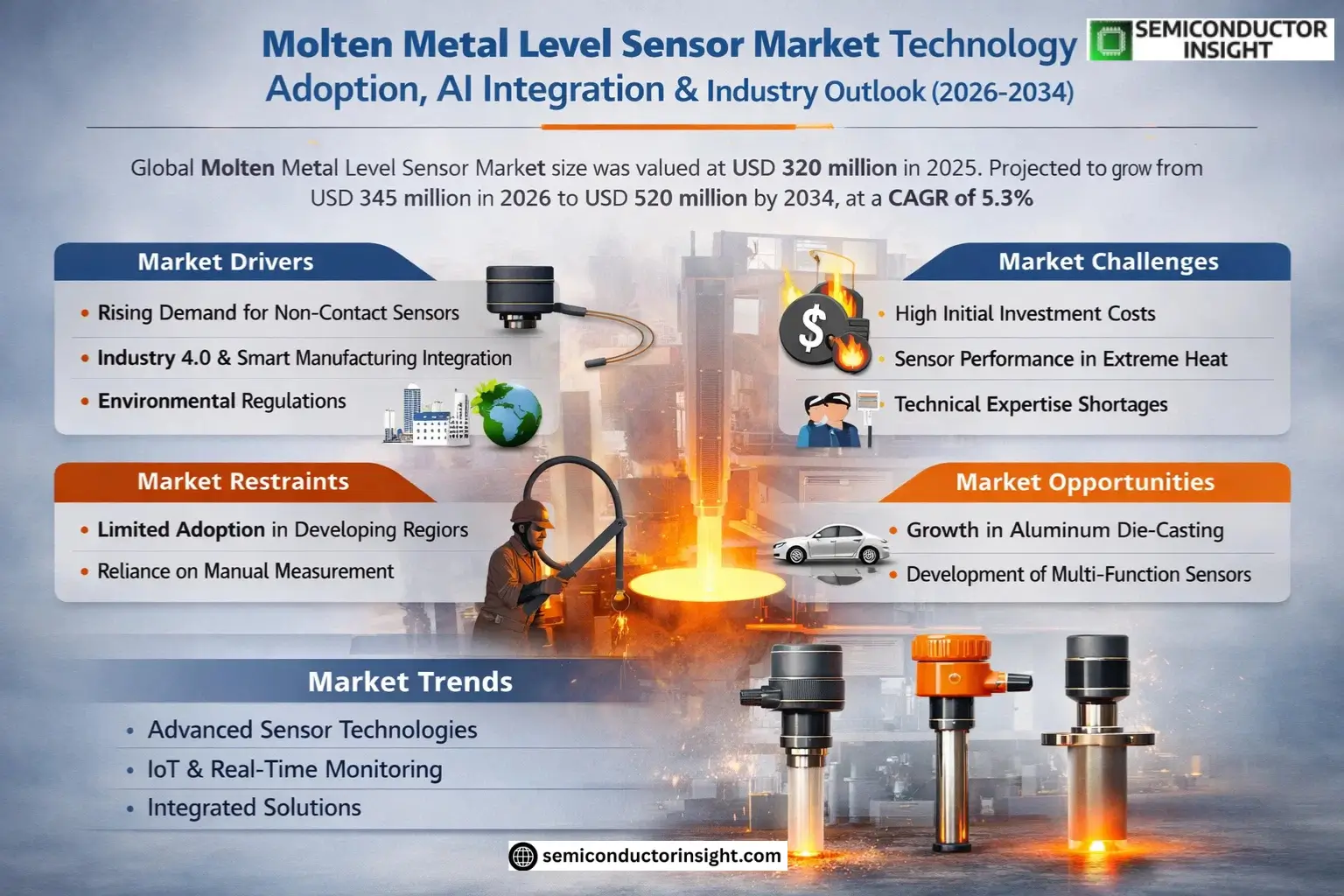
Global Molten Metal Level Sensor Market size was valued at USD 320 million in 2025. The market is projected to grow from USD 345 million in 2026 to USD 520 million by 2034, exhibiting a CAGR of 5.3% during the forecast period.
Molten metal level sensors are specialized devices designed to measure and monitor the height of molten metals in industrial applications. These sensors play a critical role in ensuring operational efficiency and safety in high-temperature environments such as foundries, steel plants, and aluminum smelters. They utilize various technologies including capacitance, conductivity, and radar-based sensing to provide real-time data for process control.
The market growth is driven by increasing automation in metal production facilities and stringent safety regulations governing molten metal handling. While the steel industry remains the dominant end-user, emerging applications in aluminum die-casting and zinc processing are creating new opportunities. Key players like Siemens and Pepperl+Fuchs are investing in advanced sensor technologies that can withstand extreme temperatures up to 1,800°C while maintaining measurement accuracy.
MARKET DRIVERS
Growing Demand for Non-Contact Molten Metal Level Sensors
Molten Metal Level Sensor Market is experiencing growth due to increasing adoption in steel, aluminum, and foundry industries. Non-contact sensors reduce safety risks by minimizing worker exposure to extreme temperatures, driving their preference in hazardous environments.
Industry 4.0 and Smart Manufacturing Integration
Advancements in IIoT-enabled molten metal level sensors enable real-time monitoring and predictive maintenance. Manufacturers are investing in automated systems to improve process efficiency and reduce metal wastage by 12-18%.
Stringent environmental regulations regarding emissions control are accelerating the replacement of outdated measurement systems with high-precision sensors.
MARKET CHALLENGES
High Initial Investment Costs
Advanced molten metal level sensor systems require significant capital expenditure, with some electromagnetic models costing 35-40% more than traditional mechanical alternatives. This creates adoption barriers for small-scale foundries.
Other Challenges
Sensor Performance in Extreme Conditions
Maintaining measurement accuracy in temperatures exceeding 1500°C requires specialized materials and cooling systems, increasing product development complexity.
Technical Expertise Requirements
Proper installation and calibration of molten metal level sensors demands skilled technicians, with workforce shortages reported in emerging markets.
MARKET RESTRAINTS
Limited Adoption in Developing Regions
Price sensitivity and preference for manual measurement methods restrain Molten Metal Level Sensor Market growth in developing economies, where nearly 60% of small foundries still rely on manual dipping methods.
MARKET OPPORTUNITIES
Expansion in Light Metal Casting Applications
The aluminum die-casting sector represents a USD 2.3 billion opportunity for molten metal level sensor manufacturers, with demand growing at 6.8% CAGR due to automotive lightweighting trends.
Development of Multi-Function Sensor Systems
Integration of temperature, composition analysis and level measurement in single molten metal sensor units creates value-added solutions preferred by tier-1 metal producers.
Molten Metal Level Sensor Market Trends
Advancements in Sensor Technology Driving Market Growth
Molten Metal Level Sensor Market is witnessing significant technological advancements, particularly in capacitance and radar-based sensors. Manufacturers are focusing on developing sensors with higher precision, improved thermal resistance, and enhanced durability to withstand extreme industrial environments. The integration of IoT capabilities for real-time monitoring and data analytics is becoming a standard feature among leading suppliers.
Other Trends
Increasing Automation in Metallurgical Processes
The growing adoption of automated systems in foundries and metal processing plants is fueling demand for reliable molten metal level sensors. These sensors play a critical role in automation by providing continuous level measurements that enable precise control of pouring operations, reducing waste and improving product quality.
Stringent Safety Regulations
Regulatory bodies worldwide are implementing stricter safety standards for metal processing facilities. This has led to increased investments in advanced sensor technologies that can prevent hazardous situations caused by incorrect metal levels, creating new opportunities for market growth.
Expansion in Emerging Markets
Rapid industrialization in Asia-Pacific countries, particularly China and India, is driving demand for molten metal level sensors. The expansion of automotive and heavy industries in these regions requires modern foundry equipment with precise measurement capabilities, presenting significant growth potential for sensor manufacturers.
Competitive Landscape and Innovation
Key players like Siemens, Pepperl+Fuchs, and AMETEK Land are focusing on product innovation and strategic partnerships to strengthen their market position. The industry is seeing increased competition in developing cost-effective solutions without compromising measurement accuracy or durability in harsh operational conditions.
COMPETITIVE LANDSCAPE
Key Industry Players
Technological Innovation and Strategic Partnerships Drive Market Competition
Molten Metal Level Sensor Market is dominated by multinational industrial automation leaders, with Siemens, Pepperl+Fuchs, and Endress+Hauser Group collectively holding significant market share. These companies leverage their extensive distribution networks and R&D capabilities to deliver precision sensors for extreme temperature applications. Siemens maintains its leadership position through continuous innovation in radar-based level measurement systems, while Endress+Hauser specializes in high-temperature capacitive sensors suitable for aluminum and zinc processing.
Specialized manufacturers like Rayteq and AMETEK Land have carved strong niches in non-ferrous metal applications, offering advanced solutions for continuous casting processes. Emerging players such as OndoSense are gaining traction with innovative optical measurement technologies, particularly in Asian markets. The competitive landscape shows increasing consolidation, with several mid-sized manufacturers forming strategic alliances to expand their application expertise and geographic footprint.
List of Key Molten Metal Level Sensor Companies Profiled
- Siemens AG
- Rayteq Sensor Technology
- Pepperl+Fuchs
- AMETEK Land
- Endress+Hauser Group
- SICK AG
- OndoSense GmbH
- Ditech srl
- Acuity Inc.
- KROHNE Messtechnik
- Baumer Group
- IFM Electronic
- Teledyne Technologies
- Honeywell Process Solutions
- Vega Grieshaber KG
Segment Analysis:
| Segment Category | Sub-Segments | Key Insights |
| By Type |
|
Capacitance Level Sensors dominate due to:
|
| By Application |
|
Metallurgy applications show strongest demand growth because:
|
| By End User |
|
Steel Mills represent the most established user segment due to:
|
| By Technology |
|
Non-Contact Type sensors demonstrate strongest adoption:
|
| By Installation |
|
Fixed Installation dominates due to:
|
Regional Analysis: Molten Metal Level Sensor Market
China’s molten metal sensor demand grows with its position as global steel leader, requiring precise level control in continuous casting operations. The metal processing sector increasingly adopts non-contact radar sensors to improve safety.
Japanese manufacturers lead in developing high-precision molten metal sensors with AI integration. Advanced foundries utilize sensor data for predictive quality control in automotive component production.
India shows rapid adoption of molten metal level measurement systems as its aluminum sector expands. Local sensor manufacturers focus on cost-effective solutions suitable for small-to-medium foundries.
Indonesia and Vietnam emerge as important markets with new steel plants integrating modern molten metal level monitoring solutions to meet international quality standards in export-oriented production.
North America
The North American molten metal sensor market thrives on advanced manufacturing practices and strict workplace safety regulations. U.S. foundries prioritize non-invasive sensing technologies to minimize operator exposure to molten metal hazards. The region sees growing adoption of IoT-enabled sensors that integrate with plant-wide monitoring systems. Automotive and aerospace sectors drive demand for high-accuracy sensors in specialty alloy production. Canadian aluminum smelters increasingly implement sensor-based automation to improve energy efficiency.
Europe
European manufacturers emphasize precision and reliability in molten metal level measurement to maintain competitive advantage in high-value metal products. German engineering firms develop sophisticated sensor solutions for continuous casting applications. The EU’s focus on energy-efficient metal production spurs innovation in sensor-assisted process optimization. Scandinavian countries lead in implementing environmentally sustainable sensor technologies for aluminum production, while Italy’s foundry sector adopts smart sensors for artisanal metalworking applications.
Middle East & Africa
The GCC region’s aluminum industry represents the primary driver for molten metal sensor adoption, with major smelters implementing advanced level control systems. South Africa’s mining sector creates demand for rugged sensors in precious metal processing. Market growth faces challenges from limited local technical expertise in sensor maintenance and calibration, creating opportunities for international suppliers offering comprehensive service packages.
South America
Brazil dominates the regional molten metal sensor market through its substantial iron and steel production capacity. Local manufacturers prioritize sensor solutions that withstand harsh industrial environments typical of regional operations. Chile’s copper industry presents growth opportunities for specialized molten metal measurement systems, though market expansion faces constraints from economic volatility in key metal-producing countries.
Report Scope
This market research report provides a comprehensive analysis of the Molten Metal Level Sensor Market, covering the forecast period 2025–2034. It offers detailed insights into market dynamics, technological advancements, competitive landscape, and key trends shaping the industry.
Key focus areas of the report include:
- Market Overview: The report begins with an overview outlining its current market scenario, key growth indicators, and industry transformation drivers. It discusses macroeconomic factors, demand–supply balance, regulatory landscape, and the strategic role of molten metal level sensors in powering advancements across industries such as metallurgy, casting, and industrial automation.
- Market Size & Forecast: Historical data and future projections for revenue, unit shipments, and market value across major regions and segments.
- Segmentation Analysis: Detailed breakdown by product type (Capacitance Level Sensor, Conductivity Level Sensor, Radar Level Sensor, Others) and application (Metallurgy, Casting, Others) to identify high-growth segments.
- Regional Insights: Insights into market performance across North America, Europe, Asia, South America, and Middle East & Africa, including country-level analysis where relevant.
- Competitive Landscape: Profiles of leading market participants, including their product offerings, market share, and recent developments such as mergers, acquisitions, and partnerships.
- Technology Trends & Innovation: Assessment of emerging technologies and evolving industry standards in molten metal level sensing.
- Market Drivers & Restraints: Evaluation of factors driving market growth along with challenges, supply chain constraints, and regulatory issues.
- Stakeholder Insights: Strategic insights for manufacturers, suppliers, investors, and policymakers regarding market opportunities.
Primary and secondary research methods are employed to ensure the accuracy and reliability of the insights presented.
FREQUENTLY ASKED QUESTIONS:
What is the current market size of Molten Metal Level Sensor Market?
-> Molten Metal Level Sensor Market size was valued at USD 320 million in 2025. The market is projected to grow from USD 345 million in 2026 to USD 520 million by 2034, exhibiting a CAGR of 5.3% during the forecast period.
Which key companies operate in Molten Metal Level Sensor Market?
-> Key players include Siemens, Rayteq, Pepperl+Fuchs, AMETEK Land, Endress+Hauser Group, SICK AG, OndoSense, Ditech, Acuity, among others. The top five players held approximately % market share in 2025.
What are the key growth drivers?
-> Key growth drivers include rising demand for accurate liquid level control in metallurgy and casting industries, increasing automation, and technological advancements in sensor technology.
Which region dominates the market?
-> Asia is a key growth region, with China projected to reach USD million by 2034. North America (particularly the U.S. with estimated USD million market size in 2025) also holds significant market share.
What are the key product segments?
-> The Capacitance Level Sensor segment is projected to reach USD million by 2034, growing at a significant CAGR over the forecast period.
Get Sample Report PDF for Exclusive Insights
Report Sample Includes
- Table of Contents
- List of Tables & Figures
- Charts, Research Methodology, and more...