Molecular communication for nano-scale intra-body networks Market Insights
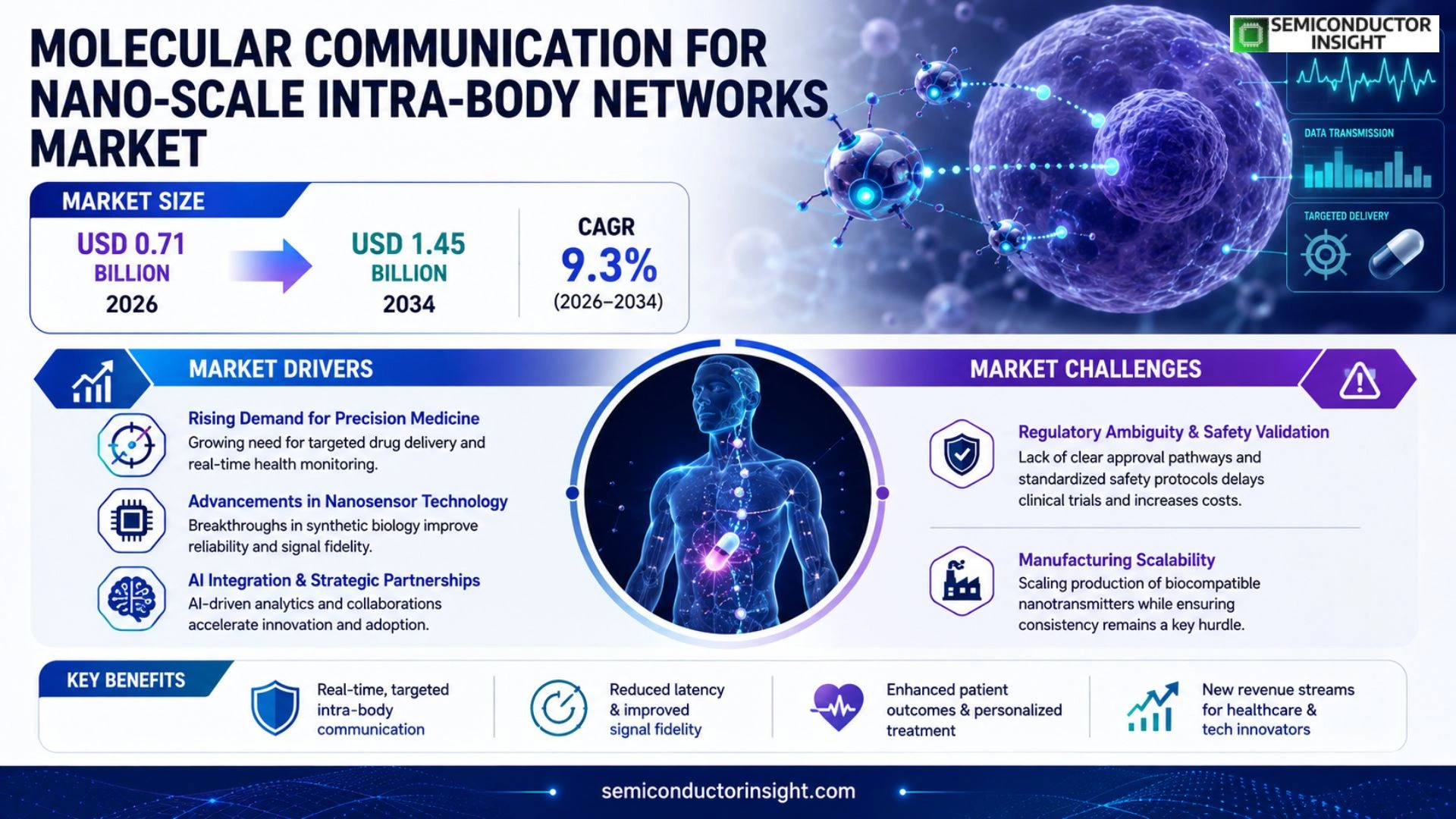
Global Molecular Communication for nano-scale intra-body networks market size was valued at USD 0.68 billion in 2025. The market is projected to grow from USD 0.71 billion in 2026 to USD 1.45 billion by 2034, exhibiting a CAGR of 9.3% during the forecast period.
Molecular communication refers to the transmission of information using biochemical signals,such as ions, neurotransmitters, or engineered DNA strands,between nanoscale devices operating inside the human body. This paradigm enables ultra‑low‑power data exchange for applications ranging from targeted drug delivery and health monitoring to smart prosthetics, where conventional electromagnetic links are impractical.
The market is accelerating because of rising investment in nanomedicine, growing demand for minimally invasive diagnostics, and breakthroughs in synthetic biology that improve signal reliability. Furthermore, collaborations between biotech firms and academic labs,exemplified by recent joint programs between MIT’s Microsystems Technology Laboratories and a leading pharmaceutical company,are expanding commercial pipelines. Key players such as NanoCom Corp., BioNanoTech Ltd., and Samsung Advanced Institute of Technology are actively developing platforms that integrate molecular transceivers with wearable health systems.
MARKET DRIVERS
Rising Demand for Precision Medicine
Molecular communication for nano-scale intra-body networks Market is propelled by an increasing need for targeted drug delivery and real‑time health monitoring. Healthcare providers are adopting nano‑sensors that can relay biochemical information directly to therapeutic agents, creating a new revenue stream for technology firms.
Advancements in Nanosensor Technology
Recent breakthroughs in synthetic biology have enabled the design of highly selective nano transmitters that operate reliably within complex physiological environments. These innovations reduce latency and improve signal fidelity, making molecular communication a viable alternative to traditional electromagnetic approaches.
➤ Industry analysts note that integration of AI‑driven analytics with nano‑scale communication platforms is accelerating prototype validation cycles.
Collectively, the convergence of personalized healthcare models, improved nanomaterial performance, and strategic partnerships is creating a robust growth engine for the sector.
MARKET CHALLENGES
Regulatory Ambiguity and Safety Validation
Regulatory bodies have yet to establish clear pathways for approving nano‑scale intra‑body communication devices. The absence of standardized safety protocols leads to prolonged clinical trial timelines and increased development costs for Molecular communication for nano-scale intra-body networks Market.
Other Challenges
Manufacturing Scalability
Scaling production of biocompatible nanotransmitters while maintaining batch‑to‑batch consistency remains a technical bottleneck that limits market penetration.
MARKET RESTRAINTS
High Development Costs
The cost intensity of research, extensive pre‑clinical testing, and specialized fabrication facilities imposes a financial restraint on new entrants. Investors often require extensive proof‑of‑concept data before committing capital, which can dampen the pace of commercialization for Molecular communication for nano-scale intra-body networks Market.
MARKET OPPORTUNITIES
Emerging Therapeutic Applications
Opportunities are expanding in areas such as smart insulin delivery, on‑demand chemotherapy activation, and neural interface technologies. Companies that can demonstrate reliable molecular signaling in vivo are positioned to capture early‑stage contracts with major pharmaceutical firms, unlocking substantial revenue potential for Molecular communication for nano-scale intra-body networks Market.
Molecular communication for nano-scale intra-body networks Market Trends
Advancements in Synthetic Biological Transceivers
The core of Molecular communication for nano-scale intra-body networks Market is the rapid evolution of synthetic biological transceivers that can encode, transmit, and decode biochemical messages with high fidelity. Recent research has yielded engineered DNA‑based carriers capable of multiplexed signaling, while ion‑channel modulators provide ultra‑low‑power actuation. These technologies reduce latency and improve signal‑to‑noise ratios, enabling reliable data exchange for in‑body therapeutic devices. As a result, developers are shifting from proof‑of‑concept prototypes to scalable architectures that can be embedded within implantable sensors and drug‑delivery nanorobots.
Other Trends
Integration with Wearable Health Platforms
Manufacturers are linking molecular communication modules to external wearable hubs that aggregate physiological data and provide bidirectional feedback. This hybrid approach leverages the low‑energy advantages of nano‑scale signaling inside the body while using conventional wireless links for long‑range connectivity. Early deployments in glucose monitoring and cardiac rhythm tracking demonstrate how seamless data flow between internal nanodevices and surface wearables can enhance real‑time clinical decision making.
Strategic Partnerships Driving Commercialization
Collaboration between biotech firms, academic laboratories, and major technology institutes is accelerating market entry. Joint programs between university microscopy centers and pharmaceutical innovators have produced pilot‑scale production lines for molecular transceiver chips. Simultaneously, leading electronics companies are investing in integrating these chips with existing health‑tech ecosystems, creating a pipeline that moves from laboratory validation to regulated medical products. These alliances are expected to expand the range of approved applications, especially in targeted drug delivery and smart prosthetic control, positioning the market for sustained growth over the next decade.
COMPETITIVE LANDSCAPE
Key Industry Players
Competitive Dynamics in Molecular Communication for Nano‑Scale Intra‑Body Networks
The market is currently led by a handful of well‑capitalized innovators that dominate platform development and strategic alliances. NanoCom Corp. commands a sizable share by delivering end‑to‑end molecular transceiver kits integrated with FDA‑approved drug delivery devices. Samsung Advanced Institute of Technology leverages its semiconductor expertise to embed nanotransmitters in wearable health monitors, while BioNanoTech Ltd. focuses on synthetic‑biology‑derived signal molecules that enable ultra‑low‑power communication. These leaders benefit from deep R&D pipelines, cross‑industry joint ventures, and early access to clinical testing sites, creating a top‑down market structure where barrier‑to‑entry remains high for newcomers.
Beyond the leaders, a vibrant cohort of niche players contributes specialized capabilities that enrich the ecosystem. IBM Research explores quantum‑enhanced molecular encoding, and the University of Cambridge spin‑out MolecularLink provides modular DNA‑based codecs. Other significant contributors include Harvard‑affiliated NanoSense Labs, Swiss startup SynBioComm, Japanese firm Hitachi Nanosystems, French company PhareTech, Indian firm NanoMedius, Chinese pioneer SinoBio Nano, and the European consortium EU‑NanoComm. Their focus ranges from proprietary nanofluidic channels to AI‑driven signal decoding, addressing market segments such as personalized diagnostics, smart prosthetics, and minimally invasive monitoring.
List of Key Molecular Communication for Nano‑Scale Intra‑Body Networks Companies Profiled
- NanoCom Corp.
- NanoCom Corp.
- Samsung Advanced Institute of Technology
- Samsung Advanced Institute of Technology
- BioNanoTech Ltd.
- BioNanoTech Ltd.
- IBM Research – Molecular Communications Lab
- University of Cambridge – MolecularLink
- Harvard NanoSense Labs
- SynBioComm (Switzerland)
- Hitachi Nanosystems
- PhareTech (France)
- NanoMedius (India)
- SinoBio Nano (China)
- EU‑NanoComm Consortium
Segment Analysis:
| Segment Category | Sub-Segments | Key Insights |
| By Type |
|
Ion‑based communication
|
| By Application |
|
Targeted drug delivery
|
| By End User |
|
Pharmaceutical companies
|
| By Technology |
|
Synthetic biology platforms
|
| By Functional Area |
|
Signal detection
|
Regional Analysis: North America
The technological advancements in areas like biocompatible materials and nanoscale devices are directly contributing to the feasibility and efficacy of molecular communication systems within the human body. Government initiatives supporting biomedical research and development further enhance the market potential. The strong venture capital ecosystem also plays a vital role in funding startups and fostering innovation in this space.
Ongoing research and development are yielding breakthroughs in molecular recognition, signal transduction, and power management, crucial for reliable molecular communication.
The development of more sophisticated nano-devices and biocompatible materials is a key enabler.
Navigating the regulatory approval pathways for novel medical technologies is critical. Clear and efficient regulatory frameworks are needed to facilitate the introduction of molecular communication systems into clinical practice.
Collaboration between regulatory bodies and industry stakeholders is essential.
Significant investments in biomedical research and development are fueling innovation in molecular communication. Venture capital funding and corporate R&D spending are driving progress towards commercialization.
The increasing focus on personalized medicine is attracting substantial investment.
The market is characterized by a mix of established medical device companies and emerging biotech startups. Collaborative partnerships and strategic alliances are becoming increasingly common.
Competition is focused on developing more effective and reliable molecular communication systems.
Europe
Europe presents a promising market for molecular communication for nano-scale intra-body networks, driven by its strong emphasis on healthcare innovation and a supportive regulatory environment. The region’s well-established medical device industry and significant investments in biomedical research create a fertile ground for the advancement and adoption of this technology. The growing awareness of the potential for early disease diagnosis and personalized treatment is further boosting market interest. Several European countries are actively funding research initiatives focused on nanotechnology and molecular diagnostics, which are integral components of molecular communication systems. The emphasis on data privacy and security, as reflected in regulations like GDPR, presents both challenges and opportunities for the development of secure molecular communication networks.
The focus on sustainable healthcare solutions also aligns with the potential of molecular communication to enable minimally invasive and more efficient medical interventions. Collaborative efforts between academic institutions and industry players are accelerating the development of practical applications.
Asia-Pacific
The Asia-Pacific region is expected to witness rapid growth in Molecular communication for nano-scale intra-body networks Market, underpinned by a burgeoning healthcare sector, increasing disposable incomes, and a rising prevalence of chronic diseases. Countries like China, Japan, and South Korea are investing heavily in biomedical research and development, creating a favorable environment for technological advancements. The region’s large and aging population represents a significant market opportunity for early disease detection and preventative healthcare solutions enabled by molecular communication. Government initiatives promoting innovation and the development of domestic medical technology are further accelerating market growth. The increasing adoption of advanced medical devices and the growing demand for personalized healthcare are key drivers.
The significant investment in nanotechnology and biotechnology across the region is translating into tangible progress in molecular communication systems.
South America
South America represents an emerging market for molecular communication for nano-scale intra-body networks, with considerable potential for growth. The increasing focus on improving healthcare access and affordability, coupled with growing investments in medical infrastructure, are creating opportunities for the adoption of advanced medical technologies. The rising prevalence of infectious diseases and chronic conditions is driving demand for innovative diagnostic and therapeutic solutions. While the market is currently smaller compared to North America and Asia-Pacific, the long-term growth prospects are promising, particularly in countries with expanding healthcare systems and increasing R&D spending in biomedical sciences.
Government initiatives aimed at strengthening the healthcare sector and promoting technological innovation will play a crucial role in fostering market development.
Middle East & Africa
The Middle East & Africa region presents a relatively nascent but potentially high-growth market for molecular communication for nano-scale intra-body networks. Increasing investments in healthcare infrastructure and a growing awareness of advanced medical technologies are expected to drive market expansion. The region’s aging population and rising prevalence of chronic diseases, such as diabetes and cardiovascular ailments, are creating a significant demand for innovative diagnostic and therapeutic solutions. Government initiatives aimed at improving healthcare outcomes and fostering technological development are also contributing to market growth. The increasing adoption of telemedicine and remote patient monitoring could further facilitate the deployment of molecular communication systems in the region.
However, challenges such as limited R&D spending and regulatory complexities may hinder the pace of market development.
Report Scope
This market research report provides a comprehensive analysis of the Molecular communication for nano-scale intra-body networks Market , covering the forecast period 2026–2034. It offers detailed insights into market dynamics, technological advancements, competitive landscape, and key trends shaping the industry.
Key focus areas of the report include:
- Market Overview: The report begins with an overview outlining its current market scenario, key growth indicators, and industry transformation drivers. It discusses macroeconomic factors, demand–supply balance, regulatory landscape, and the strategic role of semiconductors in powering advancements across industries such as automotive, telecommunications, consumer electronics, and industrial automation.
- Market Size & Forecast: Historical data and future projections for revenue, unit shipments, and market value across major regions and segments.
- Segmentation Analysis: Detailed breakdown by product type, technology, application, and end-user industry to identify high-growth segments and investment opportunities.
- Regional Insights: Insights into market performance across North America, Europe, Asia-Pacific, Latin America, and the Middle East & Africa, including country-level analysis where relevant.
- Competitive Landscape: Profiles of leading market participants, including their product offerings, R&D focus, manufacturing capacity, pricing strategies, and recent developments such as mergers, acquisitions, and partnerships.
- Technology Trends & Innovation: Assessment of emerging technologies, integration of AI/IoT, semiconductor design trends, fabrication techniques, and evolving industry standards.
- Market Drivers & Restraints: Evaluation of factors driving market growth along with challenges, supply chain constraints, regulatory issues, and market-entry barriers.
- Stakeholder Insights: Insights for component suppliers, OEMs, system integrators, investors, and policymakers regarding the evolving ecosystem and strategic opportunities.
Primary and secondary research methods are employed, including interviews with industry experts, data from verified sources, and real-time market intelligence to ensure the accuracy and reliability of the insights presented.
FREQUENTLY ASKED QUESTIONS:
What is the current market size of Molecular communication for nano-scale intra-body networks Market?
-> Molecular Communication for nano-scale intra-body networks market size is projected to grow from USD 0.71 billion in 2026 to USD 1.45 billion by 2034, exhibiting a CAGR of 9.3%
Which key companies operate in Molecular communication for nano-scale intra-body networks Market?
-> Key players include NanoCom Corp., BioNanoTech Ltd., and Samsung Advanced Institute of Technology, among others.
What are the key growth drivers?
-> Key growth drivers include rising investment in nanomedicine, growing demand for minimally invasive diagnostics, and breakthroughs in synthetic biology that enhance signal reliability.
Which region dominates the market?
-> The reference material does not specify a single dominant region for this market.
What are the emerging trends?
-> Emerging trends include collaborative programs between biotech firms and academic laboratories, integration of molecular transceivers with wearable health systems, and continued advances in synthetic biology for more reliable biochemical signaling.
Get Sample Report PDF for Exclusive Insights
Report Sample Includes
- Table of Contents
- List of Tables & Figures
- Charts, Research Methodology, and more...
 Download Sample Report PDF