MOCVD Systems Market Technology Adoption, AI Integration and Industry Outlook (2026-2034)

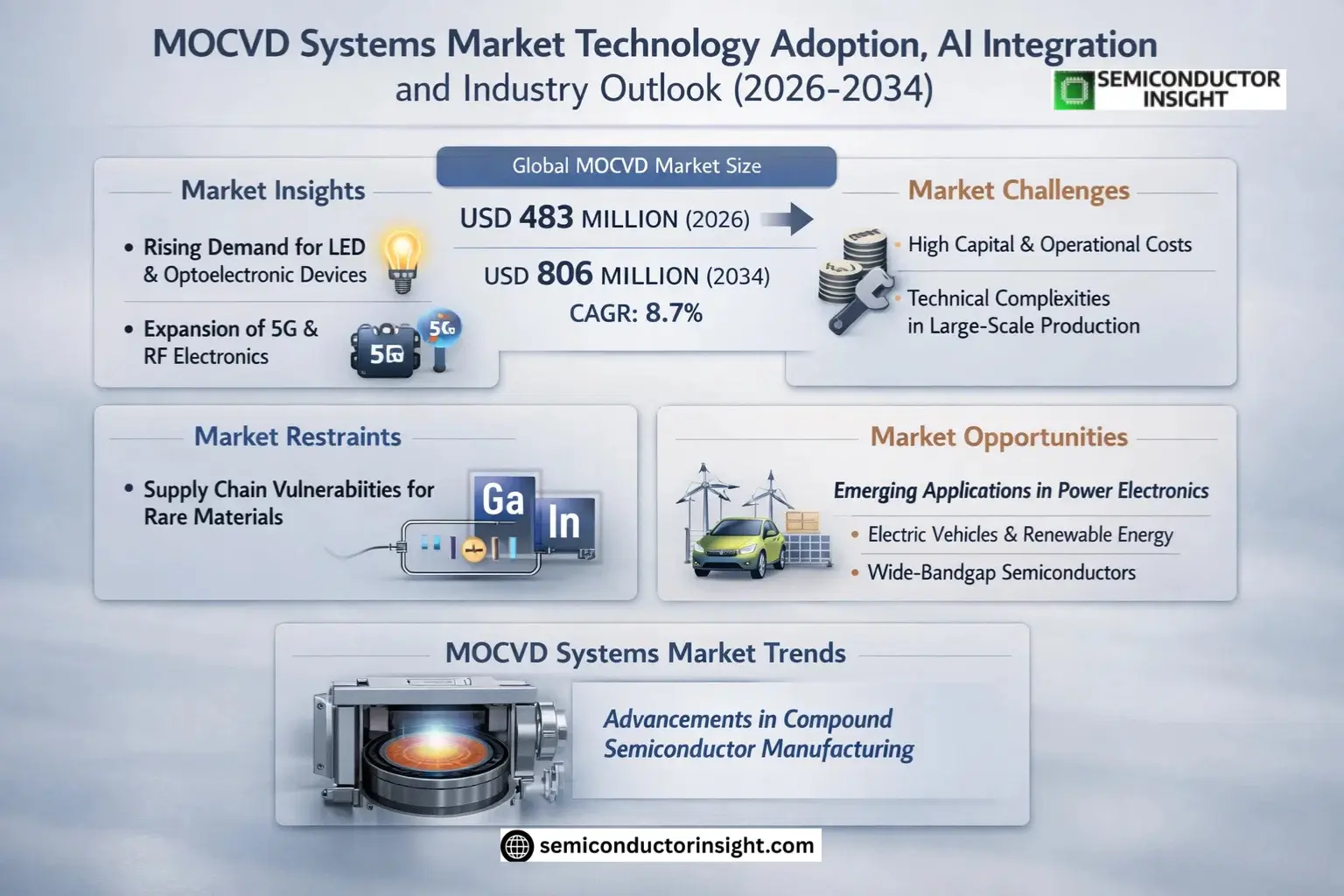
MOCVD Systems Market size was valued at USD 447 million in 2025. The market is projected to grow from USD 483 million in 2026 to USD 806 million by 2034, exhibiting a CAGR of 8.7% during the forecast period.

PDF Icon Download Sample Report PDF
  • Quick Dispatch

    All Orders

  • Secure Payment

    100% Secure Payment

Price range: $1,500.00 through $4,250.00

Clear

Market Insights

Global MOCVD Systems Market size was valued at USD 447 million in 2025. The market is projected to grow from USD 483 million in 2026 to USD 806 million by 2034, exhibiting a CAGR of 8.7% during the forecast period.

MOCVD (Metal-Organic Chemical Vapor Deposition) systems are critical tools in semiconductor manufacturing, enabling precise growth of compound semiconductor layers on substrates. These systems utilize metal-organic precursors and hydride gases to deposit high-quality thin films of materials such as gallium nitride (GaN), indium phosphide (InP), and gallium arsenide (GaAs). The technology plays a vital role in producing optoelectronic devices, including LEDs, laser diodes, and power electronics components.

The market growth is driven by increasing demand for energy-efficient lighting solutions, advancements in display technologies like Mini/Micro LED, and expanding applications in power electronics for electric vehicles and renewable energy systems. While the industry faces cyclical demand patterns tied to semiconductor capital expenditures, long-term prospects remain strong due to ongoing technological innovations and emerging applications in photonics and RF devices. Key players such as AIXTRON Technologies and Veeco Instruments continue to enhance system capabilities through improved throughput, larger wafer handling, and advanced process control features.
MOCVD Systems Market Trends

MARKET DRIVERS

Growing Demand for LED and Optoelectronic Devices

MOCVD Systems Market is primarily driven by the increasing adoption of LED lighting solutions worldwide. A significant shift from traditional lighting to energy-efficient LEDs, especially in automotive and general lighting applications, is boosting demand. The optoelectronics sector, including laser diodes and photodetectors, also heavily relies on MOCVD technology for semiconductor fabrication.

Expansion of 5G and RF Electronics

With the rapid deployment of 5G networks, the production of RF and power electronics using MOCVD systems has gained momentum. Gallium nitride (GaN) and silicon carbide (SiC) based devices manufactured via MOCVD are critical for high-frequency and high-power applications in telecommunications infrastructure.

Advancements in display technologies, particularly micro-LEDs for next-gen TVs and AR/VR devices, are creating additional growth opportunities for MOCVD equipment manufacturers.

MARKET CHALLENGES

High Capital and Operational Costs

MOCVD systems require substantial initial investments and maintenance, making adoption cost-prohibitive for small-scale semiconductor manufacturers. The complex process optimization and need for ultra-high purity precursors further increase operational expenses.

Other Challenges

Technical Complexities in Large-Scale Production
Achieving uniform deposition across large wafers remains a significant technical hurdle, particularly for emerging applications like power electronics and photovoltaics. Process control and yield optimization require continuous R&D investments.

MARKET RESTRAINTS

Supply Chain Vulnerabilities for Rare Materials

MOCVD Systems Market faces constraints due to geopolitical factors affecting the supply of critical raw materials such as gallium and indium. Price volatility of these rare metals directly impacts production costs and equipment pricing strategies.

MARKET OPPORTUNITIES

Emerging Applications in Power Electronics

The transition to electric vehicles and renewable energy systems is creating substantial opportunities for MOCVD systems in manufacturing wide-bandgap semiconductors. GaN and SiC power devices show 40% higher efficiency compared to traditional silicon-based components, driving market expansion.

MOCVD Systems Market Trends
Advancements in Compound Semiconductor Manufacturing

MOCVD Systems Market is experiencing significant growth driven by increasing demand for high-performance compound semiconductors. These systems enable precise deposition of materials like GaN and InP, which are critical for LED production, power electronics, and optoelectronic devices. Manufacturers are focusing on enhancing throughput and uniformity while reducing defects in epitaxial layers.

Other Trends

Mini/Micro LED Adoption Accelerates

The display industry’s shift toward Mini/Micro LED technology is creating substantial demand for advanced MOCVD Systems capable of handling smaller pixel pitches and higher pixel densities. This trend is particularly strong in consumer electronics for premium displays and automotive lighting applications.

Emerging Applications in Power Electronics

GaN-based power devices for electric vehicles and renewable energy systems are driving new requirements in MOCVD technology. Systems must now accommodate thicker epilayers and maintain precise doping control for high-voltage applications. The automotive sector’s electrification push is creating sustained demand for reliable power semiconductor manufacturing solutions.

Other Trends

Regional Manufacturing Hubs Expand

East Asia remains the dominant region for MOCVD System installations, with China accounting for significant LED production capacity. However, North America and Europe are showing increased activity in high-end laser diode and RF device manufacturing, creating regional specialization in system requirements and process technologies.

Process Monitoring and Automation Advancements

Leading MOCVD System manufacturers are incorporating real-time monitoring and closed-loop control systems to improve yield and consistency. The integration of AI-driven process optimization and multi-wafer handling capabilities is becoming standard for high-volume production environments.

COMPETITIVE LANDSCAPE

Key Industry Players

Advanced MOCVD Systems Shaping Semiconductor Manufacturing

MOCVD Systems Market is dominated by AIXTRON and Veeco Instruments, which collectively hold over 65% market share. These industry leaders maintain technological superiority through continuous R&D investments in multi-wafer reactors and automated process controls. The market exhibits high barriers to entry due to complex system integration requirements and long customer qualification cycles, resulting in an oligopolistic structure where top players enjoy strong pricing power and recurring revenue from service contracts.

Second-tier competitors like Advanced Micro-Fabrication Equipment and Topecsh have gained traction by specializing in niche applications such as GaN power devices and VCSEL production. Emerging Chinese manufacturers are increasing competition through government-backed initiatives, though they still lag in process expertise for high-end applications. The competitive landscape is further shaped by strategic collaborations between MOCVD suppliers and key semiconductor manufacturers to co-develop application-specific solutions.

List of Key MOCVD Systems Companies Profiled

  • AIXTRON SE
  • Veeco Instruments Inc.
  • Advanced Micro-Fabrication Equipment Inc. (AMEC)
  • Topecsh
  • Taiyo Nippon Sanso Corporation
  • NuFlare Technology Inc.
  • DCA Instruments Oy
  • ULVAC Technologies
  • SVTA Technologies Inc.
  • CVD Equipment Corporation
  • ASM International NV
  • Epigress AB
  • JUSUNG Engineering Co., Ltd.
  • Nanjing Advanced Semiconductor Technology
  • Wafertrain

Segment Analysis:

Segment Category Sub-Segments Key Insights
By Type
  • GaN-based MOCVD
  • GaAs/InP-based MOCVD
GaN-based MOCVD dominates due to extensive use in LED manufacturing and power electronics. Growth drivers include:

  • Increasing demand for energy-efficient lighting solutions and mini/micro LED displays
  • Expansion of electric vehicle infrastructure requiring high-voltage GaN power devices
  • Superior performance in high-frequency RF applications for 5G networks
By Application
  • LED
  • Power Devices
  • Lasers
  • RF Devices
  • Others
LED Applications represent the largest segment with critical factors including:

  • Global transition to energy-efficient lighting solutions and advanced display technologies
  • Growing adoption of micro-LEDs in consumer electronics and automotive displays
  • Expanding applications in specialty lighting including horticulture and medical devices
By End User
  • Semiconductor Manufacturers
  • Research Institutions
  • Foundries
Semiconductor Manufacturers lead in adoption due to:

  • Continuous capacity expansions to meet demand for compound semiconductor devices
  • Need for production-scale systems with high throughput capabilities
  • Integration of advanced process control for high-yield manufacturing
By Substrate Size
  • ≤2 inch
  • 3-4 inch
  • 6 inch
  • 8 inch
6 inch substrates show strongest growth potential due to:

  • Optimal balance between production efficiency and process maturity
  • Economic benefits from larger wafer processing across multiple applications
  • Transition of power electronics from smaller wafer sizes for cost reduction
By Chamber Configuration
  • Single-chamber
  • Dual-chamber
  • Multi-chamber
Multi-chamber Systems are gaining prominence with key advantages:

  • Higher throughput capabilities for volume manufacturing requirements
  • Flexibility in processing different material systems or device structures
  • Improved wafer-to-wafer uniformity through advanced cluster configurations

Regional Analysis: MOCVD Systems Market

Asia-Pacific

The Asia-Pacific region dominates the MOCVD Systems Market, driven by massive semiconductor manufacturing expansion in China, South Korea, and Taiwan. Leading foundries and LED producers are investing heavily in next-generation MOCVD equipment to support gallium nitride and silicon carbide applications. The region benefits from strong government support for compound semiconductor R&D and vertically integrated supply chains. China’s 14th Five-Year Plan specifically targets compound semiconductor advancements, creating sustained demand for advanced MOCVD platforms. Japan maintains leadership in specialized MOCVD configurations for optoelectronic applications, while Southeast Asian nations are emerging as new manufacturing hubs for cost-sensitive LED production.

Technology Innovation Hub
Taiwan’s semiconductor ecosystem drives cutting-edge MOCVD adoption for 5G RF components and microLED displays, with TSMC and AU Optronics pioneering new deposition techniques.
Manufacturing Infrastructure
China’s Yangtze River Delta hosts the world’s highest concentration of MOCVD systems, with specialized industrial parks supporting everything from R&D to mass production of gallium nitride devices.
Government-Led Initiatives
South Korea’s semiconductor national project includes substantial subsidies for MOCVD equipment upgrades, particularly for power electronics and photonics applications in the Ulsan cluster.
Emerging Applications
Japanese manufacturers are adapting MOCVD systems for novel applications including UV-C disinfection devices and automotive LiDAR sensors, creating specialized market niches.

North America
The North American MOCVD Systems Market benefits from strong defense and aerospace sector demand for ruggedized compound semiconductors. Silicon Valley’s photonics startups are driving adoption of compact MOCVD systems for quantum computing and optical communications applications. Department of Defense funding for gallium nitride technology development ensures steady demand from research institutions and defense contractors. Canada’s emerging photonics corridor between Ottawa and Waterloo is establishing new MOCVD infrastructure for optoelectronic device development.

Europe
European MOCVD adoption focuses on specialized applications in automotive LiDAR and industrial sensors. Germany’s Fraunhofer Institutes lead in developing energy-efficient MOCVD processes, while the UK’s Compound Semiconductor Centre pioneers novel deposition techniques. The EU’s Chips Act includes provisions for compound semiconductor manufacturing, potentially boosting MOCVD system demand. Scandinavia shows increasing MOCVD adoption for power electronics in renewable energy systems.

Middle East & Africa
The Middle East is investing in MOCVD capabilities for next-generation photonics in telecommunications infrastructure. Israel’s robust semiconductor startup ecosystem drives demand for research-grade MOCVD systems. Saudi Arabia’s Vision 2030 includes compound semiconductor manufacturing goals, creating new opportunities for MOCVD vendors. South Africa maintains niche capabilities in specialized optoelectronic applications.

South America
Brazil dominates South America’s limited MOCVD landscape with government-funded research centers focusing on LED and sensor technologies. Argentina’s National Atomic Energy Commission operates specialized MOCVD systems for radiation-hardened semiconductor development. The region shows potential for growth in automotive and industrial semiconductor applications as supply chains diversify.

Report Scope

This market research report provides a comprehensive analysis of the MOCVD Systems Market, covering the forecast period 2025–2034. It offers detailed insights into market dynamics, technological advancements, competitive landscape, and key trends shaping the industry.

Key focus areas of the report include:

  • Market Overview: The report begins with an overview outlining its current market scenario, key growth indicators, and industry transformation drivers. It discusses macroeconomic factors, demand–supply balance, regulatory landscape, and the strategic role of semiconductors in powering advancements across industries such as automotive, telecommunications, consumer electronics, and industrial automation.
  • Market Size & Forecast: Historical data and future projections for revenue, unit shipments, and market value across major regions and segments.
  • Segmentation Analysis: Detailed breakdown by product type, technology, application, and end-user industry to identify high-growth segments and investment opportunities.
  • Regional Insights: Insights into market performance across North America, Europe, Asia-Pacific, Latin America, and the Middle East & Africa, including country-level analysis where relevant.
  • Competitive Landscape: Profiles of leading market participants, including their product offerings, R&D focus, manufacturing capacity, pricing strategies, and recent developments such as mergers, acquisitions, and partnerships.
  • Technology Trends & Innovation: Assessment of emerging technologies, integration of AI/IoT, semiconductor design trends, fabrication techniques, and evolving industry standards.
  • Market Drivers & Restraints: Evaluation of factors driving market growth along with challenges, supply chain constraints, regulatory issues, and market-entry barriers.
  • Stakeholder Insights: Insights for component suppliers, OEMs, system integrators, investors, and policymakers regarding the evolving ecosystem and strategic opportunities.

Primary and secondary research methods are employed, including interviews with industry experts, data from verified sources, and real-time market intelligence to ensure the accuracy and reliability of the insights presented.

FREQUENTLY ASKED QUESTIONS:

-> MOCVD Systems Market size was valued at USD 447 million in 2025. The market is projected to grow from USD 483 million in 2026 to USD 806 million by 2034, exhibiting a CAGR of 8.7% during the forecast period.

Which key companies operate in MOCVD Systems Market?

-> Key players include AIXTRON Technologies, Advanced Micro-Fabrication Equipment, Topecsh, Veeco Instruments, Taiyo Nippon Sanso, and NuFlare Technology.

What are the key growth drivers?

-> Key growth drivers include rising demand for energy-efficient lighting, expansion of high-speed optical communication networks, and adoption of GaN power devices in automotive and renewable energy applications.

Which region dominates the market?

-> Asia-Pacific dominates the market with strong presence in LED, display, and power/RF value chains, while North America and Europe lead in high-end laser applications and R&D initiatives.

What are the emerging trends?

-> Emerging trends include transition to Mini/Micro LED technology, expansion of 3D sensing applications, and growing adoption of GaN power devices in fast charging and energy infrastructure.
MOCVD Systems Market Technology Adoption, AI Integration and Industry Outlook (2026-2034)

Get Sample Report PDF for Exclusive Insights

Report Sample Includes

  • Table of Contents
  • List of Tables & Figures
  • Charts, Research Methodology, and more...
PDF Icon Download Sample Report PDF
SKU: a76e3d52d921
Category:
License Type

Corporate License, Excel License, PDF and Excel Databook License

Table of Content

1 Introduction to Research & Analysis Reports
1.1 MOCVD Systems Market Definition
1.2 Market Segments
1.2.1 Segment by Type
1.2.2 Segment by Substrate/Wafer Diameter
1.2.3 Segment by Chamber Count
1.2.4 Segment by Application
1.3 Global MOCVD Systems Market Overview
1.4 Features & Benefits of This Report
1.5 Methodology & Sources of Information
1.5.1 Research Methodology
1.5.2 Research Process
1.5.3 Base Year
1.5.4 Report Assumptions & Caveats
2 Global MOCVD Systems Overall Market Size
2.1 Global MOCVD Systems Market Size: 2025 VS 2034
2.2 Global MOCVD Systems Market Size, Prospects & Forecasts: 2021-2034
2.3 Global MOCVD Systems Sales: 2021-2034
3 Company Landscape
3.1 Top MOCVD Systems Players in Global Market
3.2 Top Global MOCVD Systems Companies Ranked by Revenue
3.3 Global MOCVD Systems Revenue by Companies
3.4 Global MOCVD Systems Sales by Companies
3.5 Global MOCVD Systems Price by Manufacturer (2021-2026)
3.6 Top 3 and Top 5 MOCVD Systems Companies in Global Market, by Revenue in 2025
3.7 Global Manufacturers MOCVD Systems Product Type
3.8 Tier 1, Tier 2, and Tier 3 MOCVD Systems Players in Global Market
3.8.1 List of Global Tier 1 MOCVD Systems Companies
3.8.2 List of Global Tier 2 and Tier 3 MOCVD Systems Companies
4 Sights by Type
4.1 Overview
4.1.1 Segment by Type – Global MOCVD Systems Market Size Markets, 2025 & 2034
4.1.2 GaN-based MOCVD
4.1.3 GaAs/InP-based MOCVD
4.2 Segment by Type – Global MOCVD Systems Revenue & Forecasts
4.2.1 Segment by Type – Global MOCVD Systems Revenue, 2021-2026
4.2.2 Segment by Type – Global MOCVD Systems Revenue, 2027-2034
4.2.3 Segment by Type – Global MOCVD Systems Revenue Market Share, 2021-2034
4.3 Segment by Type – Global MOCVD Systems Sales & Forecasts
4.3.1 Segment by Type – Global MOCVD Systems Sales, 2021-2026
4.3.2 Segment by Type – Global MOCVD Systems Sales, 2027-2034
4.3.3 Segment by Type – Global MOCVD Systems Sales Market Share, 2021-2034
4.4 Segment by Type – Global MOCVD Systems Price (Manufacturers Selling Prices), 2021-2034
5 Sights by Substrate/Wafer Diameter
5.1 Overview
5.1.1 Segment by Substrate/Wafer Diameter – Global MOCVD Systems Market Size Markets, 2025 & 2034
5.1.2 ?2 inch
5.1.3 3–4 inch
5.1.4 6 inch
5.1.5 8 inch
5.2 Segment by Substrate/Wafer Diameter – Global MOCVD Systems Revenue & Forecasts
5.2.1 Segment by Substrate/Wafer Diameter – Global MOCVD Systems Revenue, 2021-2026
5.2.2 Segment by Substrate/Wafer Diameter – Global MOCVD Systems Revenue, 2027-2034
5.2.3 Segment by Substrate/Wafer Diameter – Global MOCVD Systems Revenue Market Share, 2021-2034
5.3 Segment by Substrate/Wafer Diameter – Global MOCVD Systems Sales & Forecasts
5.3.1 Segment by Substrate/Wafer Diameter – Global MOCVD Systems Sales, 2021-2026
5.3.2 Segment by Substrate/Wafer Diameter – Global MOCVD Systems Sales, 2027-2034
5.3.3 Segment by Substrate/Wafer Diameter – Global MOCVD Systems Sales Market Share, 2021-2034
5.4 Segment by Substrate/Wafer Diameter – Global MOCVD Systems Price (Manufacturers Selling Prices), 2021-2034
6 Sights by Chamber Count
6.1 Overview
6.1.1 Segment by Chamber Count – Global MOCVD Systems Market Size Markets, 2025 & 2034
6.1.2 Single-chamber
6.1.3 Dual-chamber
6.1.4 Multi-chamber
6.2 Segment by Chamber Count – Global MOCVD Systems Revenue & Forecasts
6.2.1 Segment by Chamber Count – Global MOCVD Systems Revenue, 2021-2026
6.2.2 Segment by Chamber Count – Global MOCVD Systems Revenue, 2027-2034
6.2.3 Segment by Chamber Count – Global MOCVD Systems Revenue Market Share, 2021-2034
6.3 Segment by Chamber Count – Global MOCVD Systems Sales & Forecasts
6.3.1 Segment by Chamber Count – Global MOCVD Systems Sales, 2021-2026
6.3.2 Segment by Chamber Count – Global MOCVD Systems Sales, 2027-2034
6.3.3 Segment by Chamber Count – Global MOCVD Systems Sales Market Share, 2021-2034
6.4 Segment by Chamber Count – Global MOCVD Systems Price (Manufacturers Selling Prices), 2021-2034
7 Sights by Application
7.1 Overview
7.1.1 Segment by Application – Global MOCVD Systems Market Size, 2025 & 2034
7.1.2 LED
7.1.3 Power Devices
7.1.4 Lasers
7.1.5 RF Devices
7.1.6 Others
7.2 Segment by Application – Global MOCVD Systems Revenue & Forecasts
7.2.1 Segment by Application – Global MOCVD Systems Revenue, 2021-2026
7.2.2 Segment by Application – Global MOCVD Systems Revenue, 2027-2034
7.2.3 Segment by Application – Global MOCVD Systems Revenue Market Share, 2021-2034
7.3 Segment by Application – Global MOCVD Systems Sales & Forecasts
7.3.1 Segment by Application – Global MOCVD Systems Sales, 2021-2026
7.3.2 Segment by Application – Global MOCVD Systems Sales, 2027-2034
7.3.3 Segment by Application – Global MOCVD Systems Sales Market Share, 2021-2034
7.4 Segment by Application – Global MOCVD Systems Price (Manufacturers Selling Prices), 2021-2034
8 Sights Region
8.1 By Region – Global MOCVD Systems Market Size, 2025 & 2034
8.2 By Region – Global MOCVD Systems Revenue & Forecasts
8.2.1 By Region – Global MOCVD Systems Revenue, 2021-2026
8.2.2 By Region – Global MOCVD Systems Revenue, 2027-2034
8.2.3 By Region – Global MOCVD Systems Revenue Market Share, 2021-2034
8.3 By Region – Global MOCVD Systems Sales & Forecasts
8.3.1 By Region – Global MOCVD Systems Sales, 2021-2026
8.3.2 By Region – Global MOCVD Systems Sales, 2027-2034
8.3.3 By Region – Global MOCVD Systems Sales Market Share, 2021-2034
8.4 North America
8.4.1 By Country – North America MOCVD Systems Revenue, 2021-2034
8.4.2 By Country – North America MOCVD Systems Sales, 2021-2034
8.4.3 United States MOCVD Systems Market Size, 2021-2034
8.4.4 Canada MOCVD Systems Market Size, 2021-2034
8.4.5 Mexico MOCVD Systems Market Size, 2021-2034
8.5 Europe
8.5.1 By Country – Europe MOCVD Systems Revenue, 2021-2034
8.5.2 By Country – Europe MOCVD Systems Sales, 2021-2034
8.5.3 Germany MOCVD Systems Market Size, 2021-2034
8.5.4 France MOCVD Systems Market Size, 2021-2034
8.5.5 U.K. MOCVD Systems Market Size, 2021-2034
8.5.6 Italy MOCVD Systems Market Size, 2021-2034
8.5.7 Russia MOCVD Systems Market Size, 2021-2034
8.5.8 Nordic Countries MOCVD Systems Market Size, 2021-2034
8.5.9 Benelux MOCVD Systems Market Size, 2021-2034
8.6 Asia
8.6.1 By Region – Asia MOCVD Systems Revenue, 2021-2034
8.6.2 By Region – Asia MOCVD Systems Sales, 2021-2034
8.6.3 China MOCVD Systems Market Size, 2021-2034
8.6.4 Japan MOCVD Systems Market Size, 2021-2034
8.6.5 South Korea MOCVD Systems Market Size, 2021-2034
8.6.6 Southeast Asia MOCVD Systems Market Size, 2021-2034
8.6.7 India MOCVD Systems Market Size, 2021-2034
8.7 South America
8.7.1 By Country – South America MOCVD Systems Revenue, 2021-2034
8.7.2 By Country – South America MOCVD Systems Sales, 2021-2034
8.7.3 Brazil MOCVD Systems Market Size, 2021-2034
8.7.4 Argentina MOCVD Systems Market Size, 2021-2034
8.8 Middle East & Africa
8.8.1 By Country – Middle East & Africa MOCVD Systems Revenue, 2021-2034
8.8.2 By Country – Middle East & Africa MOCVD Systems Sales, 2021-2034
8.8.3 Turkey MOCVD Systems Market Size, 2021-2034
8.8.4 Israel MOCVD Systems Market Size, 2021-2034
8.8.5 Saudi Arabia MOCVD Systems Market Size, 2021-2034
8.8.6 UAE MOCVD Systems Market Size, 2021-2034
9 Manufacturers & Brands Profiles
9.1 AIXTRON Technologies
9.1.1 AIXTRON Technologies Company Summary
9.1.2 AIXTRON Technologies Business Overview
9.1.3 AIXTRON Technologies MOCVD Systems Major Product Offerings
9.1.4 AIXTRON Technologies MOCVD Systems Sales and Revenue in Global (2021-2026)
9.1.5 AIXTRON Technologies Key News & Latest Developments
9.2 Advanced Micro-Fabrication Equipment
9.2.1 Advanced Micro-Fabrication Equipment Company Summary
9.2.2 Advanced Micro-Fabrication Equipment Business Overview
9.2.3 Advanced Micro-Fabrication Equipment MOCVD Systems Major Product Offerings
9.2.4 Advanced Micro-Fabrication Equipment MOCVD Systems Sales and Revenue in Global (2021-2026)
9.2.5 Advanced Micro-Fabrication Equipment Key News & Latest Developments
9.3 Topecsh
9.3.1 Topecsh Company Summary
9.3.2 Topecsh Business Overview
9.3.3 Topecsh MOCVD Systems Major Product Offerings
9.3.4 Topecsh MOCVD Systems Sales and Revenue in Global (2021-2026)
9.3.5 Topecsh Key News & Latest Developments
9.4 Veeco Instruments
9.4.1 Veeco Instruments Company Summary
9.4.2 Veeco Instruments Business Overview
9.4.3 Veeco Instruments MOCVD Systems Major Product Offerings
9.4.4 Veeco Instruments MOCVD Systems Sales and Revenue in Global (2021-2026)
9.4.5 Veeco Instruments Key News & Latest Developments
9.5 Taiyo Nippon Sanso
9.5.1 Taiyo Nippon Sanso Company Summary
9.5.2 Taiyo Nippon Sanso Business Overview
9.5.3 Taiyo Nippon Sanso MOCVD Systems Major Product Offerings
9.5.4 Taiyo Nippon Sanso MOCVD Systems Sales and Revenue in Global (2021-2026)
9.5.5 Taiyo Nippon Sanso Key News & Latest Developments
9.6 NuFlare Technology
9.6.1 NuFlare Technology Company Summary
9.6.2 NuFlare Technology Business Overview
9.6.3 NuFlare Technology MOCVD Systems Major Product Offerings
9.6.4 NuFlare Technology MOCVD Systems Sales and Revenue in Global (2021-2026)
9.6.5 NuFlare Technology Key News & Latest Developments
10 Global MOCVD Systems Production Capacity, Analysis
10.1 Global MOCVD Systems Production Capacity, 2021-2034
10.2 MOCVD Systems Production Capacity of Key Manufacturers in Global Market
10.3 Global MOCVD Systems Production by Region
11 Key Market Trends, Opportunity, Drivers and Restraints
11.1 Market Opportunities & Trends
11.2 Market Drivers
11.3 Market Restraints
12 MOCVD Systems Supply Chain Analysis
12.1 MOCVD Systems Industry Value Chain
12.2 MOCVD Systems Upstream Market
12.3 MOCVD Systems Downstream and Clients
12.4 Marketing Channels Analysis
12.4.1 Marketing Channels
12.4.2 MOCVD Systems Distributors and Sales Agents in Global
13 Conclusion
14 Appendix
14.1 Note
14.2 Examples of Clients
14.3 DisclaimerList of Tables
Table 1. Key Players of MOCVD Systems in Global Market
Table 2. Top MOCVD Systems Players in Global Market, Ranking by Revenue (2025)
Table 3. Global MOCVD Systems Revenue by Companies, (US$, Mn), 2021-2026
Table 4. Global MOCVD Systems Revenue Share by Companies, 2021-2026
Table 5. Global MOCVD Systems Sales by Companies, (Units), 2021-2026
Table 6. Global MOCVD Systems Sales Share by Companies, 2021-2026
Table 7. Key Manufacturers MOCVD Systems Price (2021-2026) & (K US$/Unit)
Table 8. Global Manufacturers MOCVD Systems Product Type
Table 9. List of Global Tier 1 MOCVD Systems Companies, Revenue (US$, Mn) in 2025 and Market Share
Table 10. List of Global Tier 2 and Tier 3 MOCVD Systems Companies, Revenue (US$, Mn) in 2025 and Market Share
Table 11. Segment by Type – Global MOCVD Systems Revenue, (US$, Mn), 2025 & 2034
Table 12. Segment by Type – Global MOCVD Systems Revenue (US$, Mn), 2021-2026
Table 13. Segment by Type – Global MOCVD Systems Revenue (US$, Mn), 2027-2034
Table 14. Segment by Type – Global MOCVD Systems Sales (Units), 2021-2026
Table 15. Segment by Type – Global MOCVD Systems Sales (Units), 2027-2034
Table 16. Segment by Substrate/Wafer Diameter – Global MOCVD Systems Revenue, (US$, Mn), 2025 & 2034
Table 17. Segment by Substrate/Wafer Diameter – Global MOCVD Systems Revenue (US$, Mn), 2021-2026
Table 18. Segment by Substrate/Wafer Diameter – Global MOCVD Systems Revenue (US$, Mn), 2027-2034
Table 19. Segment by Substrate/Wafer Diameter – Global MOCVD Systems Sales (Units), 2021-2026
Table 20. Segment by Substrate/Wafer Diameter – Global MOCVD Systems Sales (Units), 2027-2034
Table 21. Segment by Chamber Count – Global MOCVD Systems Revenue, (US$, Mn), 2025 & 2034
Table 22. Segment by Chamber Count – Global MOCVD Systems Revenue (US$, Mn), 2021-2026
Table 23. Segment by Chamber Count – Global MOCVD Systems Revenue (US$, Mn), 2027-2034
Table 24. Segment by Chamber Count – Global MOCVD Systems Sales (Units), 2021-2026
Table 25. Segment by Chamber Count – Global MOCVD Systems Sales (Units), 2027-2034
Table 26. Segment by Application – Global MOCVD Systems Revenue, (US$, Mn), 2025 & 2034
Table 27. Segment by Application – Global MOCVD Systems Revenue, (US$, Mn), 2021-2026
Table 28. Segment by Application – Global MOCVD Systems Revenue, (US$, Mn), 2027-2034
Table 29. Segment by Application – Global MOCVD Systems Sales, (Units), 2021-2026
Table 30. Segment by Application – Global MOCVD Systems Sales, (Units), 2027-2034
Table 31. By Region – Global MOCVD Systems Revenue, (US$, Mn), 2025 & 2034
Table 32. By Region – Global MOCVD Systems Revenue, (US$, Mn), 2021-2026
Table 33. By Region – Global MOCVD Systems Revenue, (US$, Mn), 2027-2034
Table 34. By Region – Global MOCVD Systems Sales, (Units), 2021-2026
Table 35. By Region – Global MOCVD Systems Sales, (Units), 2027-2034
Table 36. By Country – North America MOCVD Systems Revenue, (US$, Mn), 2021-2026
Table 37. By Country – North America MOCVD Systems Revenue, (US$, Mn), 2027-2034
Table 38. By Country – North America MOCVD Systems Sales, (Units), 2021-2026
Table 39. By Country – North America MOCVD Systems Sales, (Units), 2027-2034
Table 40. By Country – Europe MOCVD Systems Revenue, (US$, Mn), 2021-2026
Table 41. By Country – Europe MOCVD Systems Revenue, (US$, Mn), 2027-2034
Table 42. By Country – Europe MOCVD Systems Sales, (Units), 2021-2026
Table 43. By Country – Europe MOCVD Systems Sales, (Units), 2027-2034
Table 44. By Region – Asia MOCVD Systems Revenue, (US$, Mn), 2021-2026
Table 45. By Region – Asia MOCVD Systems Revenue, (US$, Mn), 2027-2034
Table 46. By Region – Asia MOCVD Systems Sales, (Units), 2021-2026
Table 47. By Region – Asia MOCVD Systems Sales, (Units), 2027-2034
Table 48. By Country – South America MOCVD Systems Revenue, (US$, Mn), 2021-2026
Table 49. By Country – South America MOCVD Systems Revenue, (US$, Mn), 2027-2034
Table 50. By Country – South America MOCVD Systems Sales, (Units), 2021-2026
Table 51. By Country – South America MOCVD Systems Sales, (Units), 2027-2034
Table 52. By Country – Middle East & Africa MOCVD Systems Revenue, (US$, Mn), 2021-2026
Table 53. By Country – Middle East & Africa MOCVD Systems Revenue, (US$, Mn), 2027-2034
Table 54. By Country – Middle East & Africa MOCVD Systems Sales, (Units), 2021-2026
Table 55. By Country – Middle East & Africa MOCVD Systems Sales, (Units), 2027-2034
Table 56. AIXTRON Technologies Company Summary
Table 57. AIXTRON Technologies MOCVD Systems Product Offerings
Table 58. AIXTRON Technologies MOCVD Systems Sales (Units), Revenue (US$, Mn) and Average Price (K US$/Unit) & (2021-2026)
Table 59. AIXTRON Technologies Key News & Latest Developments
Table 60. Advanced Micro-Fabrication Equipment Company Summary
Table 61. Advanced Micro-Fabrication Equipment MOCVD Systems Product Offerings
Table 62. Advanced Micro-Fabrication Equipment MOCVD Systems Sales (Units), Revenue (US$, Mn) and Average Price (K US$/Unit) & (2021-2026)
Table 63. Advanced Micro-Fabrication Equipment Key News & Latest Developments
Table 64. Topecsh Company Summary
Table 65. Topecsh MOCVD Systems Product Offerings
Table 66. Topecsh MOCVD Systems Sales (Units), Revenue (US$, Mn) and Average Price (K US$/Unit) & (2021-2026)
Table 67. Topecsh Key News & Latest Developments
Table 68. Veeco Instruments Company Summary
Table 69. Veeco Instruments MOCVD Systems Product Offerings
Table 70. Veeco Instruments MOCVD Systems Sales (Units), Revenue (US$, Mn) and Average Price (K US$/Unit) & (2021-2026)
Table 71. Veeco Instruments Key News & Latest Developments
Table 72. Taiyo Nippon Sanso Company Summary
Table 73. Taiyo Nippon Sanso MOCVD Systems Product Offerings
Table 74. Taiyo Nippon Sanso MOCVD Systems Sales (Units), Revenue (US$, Mn) and Average Price (K US$/Unit) & (2021-2026)
Table 75. Taiyo Nippon Sanso Key News & Latest Developments
Table 76. NuFlare Technology Company Summary
Table 77. NuFlare Technology MOCVD Systems Product Offerings
Table 78. NuFlare Technology MOCVD Systems Sales (Units), Revenue (US$, Mn) and Average Price (K US$/Unit) & (2021-2026)
Table 79. NuFlare Technology Key News & Latest Developments
Table 80. MOCVD Systems Capacity of Key Manufacturers in Global Market, 2024-2026 (Units)
Table 81. Global MOCVD Systems Capacity Market Share of Key Manufacturers, 2024-2026
Table 82. Global MOCVD Systems Production by Region, 2021-2026 (Units)
Table 83. Global MOCVD Systems Production by Region, 2027-2034 (Units)
Table 84. MOCVD Systems Market Opportunities & Trends in Global Market
Table 85. MOCVD Systems Market Drivers in Global Market
Table 86. MOCVD Systems Market Restraints in Global Market
Table 87. MOCVD Systems Raw Materials
Table 88. MOCVD Systems Raw Materials Suppliers in Global Market
Table 89. Typical MOCVD Systems Downstream
Table 90. MOCVD Systems Downstream Clients in Global Market
Table 91. MOCVD Systems Distributors and Sales Agents in Global Market

List of Figures
Figure 1. MOCVD Systems Product Picture
Figure 2. MOCVD Systems Segment by Type in 2025
Figure 3. MOCVD Systems Segment by Substrate/Wafer Diameter in 2025
Figure 4. MOCVD Systems Segment by Chamber Count in 2025
Figure 5. MOCVD Systems Segment by Application in 2025
Figure 6. Global MOCVD Systems Market Overview: 2025
Figure 7. Key Caveats
Figure 8. Global MOCVD Systems Market Size: 2025 VS 2034 (US$, Mn)
Figure 9. Global MOCVD Systems Revenue: 2021-2034 (US$, Mn)
Figure 10. MOCVD Systems Sales in Global Market: 2021-2034 (Units)
Figure 11. The Top 3 and 5 Players Market Share by MOCVD Systems Revenue in 2025
Figure 12. Segment by Type – Global MOCVD Systems Revenue, (US$, Mn), 2025 & 2034
Figure 13. Segment by Type – Global MOCVD Systems Revenue Market Share, 2021-2034
Figure 14. Segment by Type – Global MOCVD Systems Sales Market Share, 2021-2034
Figure 15. Segment by Type – Global MOCVD Systems Price (K US$/Unit), 2021-2034
Figure 16. Segment by Substrate/Wafer Diameter – Global MOCVD Systems Revenue, (US$, Mn), 2025 & 2034
Figure 17. Segment by Substrate/Wafer Diameter – Global MOCVD Systems Revenue Market Share, 2021-2034
Figure 18. Segment by Substrate/Wafer Diameter – Global MOCVD Systems Sales Market Share, 2021-2034
Figure 19. Segment by Substrate/Wafer Diameter – Global MOCVD Systems Price (K US$/Unit), 2021-2034
Figure 20. Segment by Chamber Count – Global MOCVD Systems Revenue, (US$, Mn), 2025 & 2034
Figure 21. Segment by Chamber Count – Global MOCVD Systems Revenue Market Share, 2021-2034
Figure 22. Segment by Chamber Count – Global MOCVD Systems Sales Market Share, 2021-2034
Figure 23. Segment by Chamber Count – Global MOCVD Systems Price (K US$/Unit), 2021-2034
Figure 24. Segment by Application – Global MOCVD Systems Revenue, (US$, Mn), 2025 & 2034
Figure 25. Segment by Application – Global MOCVD Systems Revenue Market Share, 2021-2034
Figure 26. Segment by Application – Global MOCVD Systems Sales Market Share, 2021-2034
Figure 27. Segment by Application -Global MOCVD Systems Price (K US$/Unit), 2021-2034
Figure 28. By Region – Global MOCVD Systems Revenue, (US$, Mn), 2025 & 2034
Figure 29. By Region – Global MOCVD Systems Revenue Market Share, 2021 VS 2025 VS 2034
Figure 30. By Region – Global MOCVD Systems Revenue Market Share, 2021-2034
Figure 31. By Region – Global MOCVD Systems Sales Market Share, 2021-2034
Figure 32. By Country – North America MOCVD Systems Revenue Market Share, 2021-2034
Figure 33. By Country – North America MOCVD Systems Sales Market Share, 2021-2034
Figure 34. United States MOCVD Systems Revenue, (US$, Mn), 2021-2034
Figure 35. Canada MOCVD Systems Revenue, (US$, Mn), 2021-2034
Figure 36. Mexico MOCVD Systems Revenue, (US$, Mn), 2021-2034
Figure 37. By Country – Europe MOCVD Systems Revenue Market Share, 2021-2034
Figure 38. By Country – Europe MOCVD Systems Sales Market Share, 2021-2034
Figure 39. Germany MOCVD Systems Revenue, (US$, Mn), 2021-2034
Figure 40. France MOCVD Systems Revenue, (US$, Mn), 2021-2034
Figure 41. U.K. MOCVD Systems Revenue, (US$, Mn), 2021-2034
Figure 42. Italy MOCVD Systems Revenue, (US$, Mn), 2021-2034
Figure 43. Russia MOCVD Systems Revenue, (US$, Mn), 2021-2034
Figure 44. Nordic Countries MOCVD Systems Revenue, (US$, Mn), 2021-2034
Figure 45. Benelux MOCVD Systems Revenue, (US$, Mn), 2021-2034
Figure 46. By Region – Asia MOCVD Systems Revenue Market Share, 2021-2034
Figure 47. By Region – Asia MOCVD Systems Sales Market Share, 2021-2034
Figure 48. China MOCVD Systems Revenue, (US$, Mn), 2021-2034
Figure 49. Japan MOCVD Systems Revenue, (US$, Mn), 2021-2034
Figure 50. South Korea MOCVD Systems Revenue, (US$, Mn), 2021-2034
Figure 51. Southeast Asia MOCVD Systems Revenue, (US$, Mn), 2021-2034
Figure 52. India MOCVD Systems Revenue, (US$, Mn), 2021-2034
Figure 53. By Country – South America MOCVD Systems Revenue Market Share, 2021-2034
Figure 54. By Country – South America MOCVD Systems Sales, Market Share, 2021-2034
Figure 55. Brazil MOCVD Systems Revenue, (US$, Mn), 2021-2034
Figure 56. Argentina MOCVD Systems Revenue, (US$, Mn), 2021-2034
Figure 57. By Country – Middle East & Africa MOCVD Systems Revenue, Market Share, 2021-2034
Figure 58. By Country – Middle East & Africa MOCVD Systems Sales, Market Share, 2021-2034
Figure 59. Turkey MOCVD Systems Revenue, (US$, Mn), 2021-2034
Figure 60. Israel MOCVD Systems Revenue, (US$, Mn), 2021-2034
Figure 61. Saudi Arabia MOCVD Systems Revenue, (US$, Mn), 2021-2034
Figure 62. UAE MOCVD Systems Revenue, (US$, Mn), 2021-2034
Figure 63. Global MOCVD Systems Production Capacity (Units), 2021-2034
Figure 64. The Percentage of Production MOCVD Systems by Region, 2025 VS 2034
Figure 65. MOCVD Systems Industry Value Chain
Figure 66. Marketing Channels