Market Insights
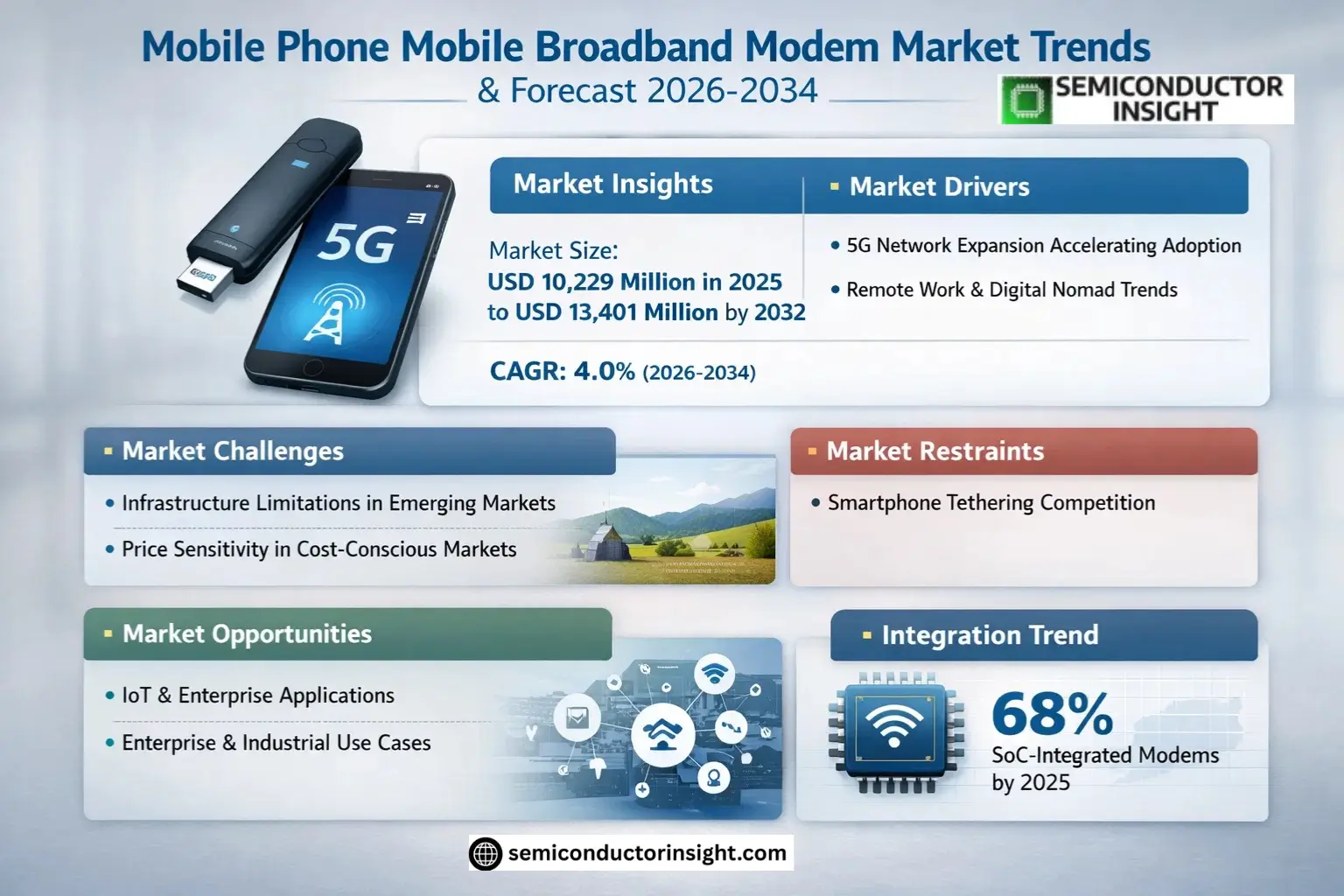
Global Mobile Phone Mobile Broadband Modem Market was valued at USD 10,229 million in 2025 and is projected to reach USD 13,401 million by 2032, exhibiting a CAGR of 4.0% during the forecast period.
A Mobile Phone Mobile Broadband Modem commonly referred to as a cellular baseband/modem is the subsystem that enables smartphones to connect to carrier networks, ensuring reliable data and voice services. It converts digital signals into radio waves and implements end-to-end cellular protocols for seamless connectivity across varying network conditions. The technology has evolved from discrete 2G/3G chipsets to highly integrated 4G and 5G solutions, optimizing power efficiency and performance.
The market growth is driven by increasing smartphone adoption, advancements in 5G infrastructure, and rising demand for high-speed connectivity. Key players such as Qualcomm, MediaTek, and Samsung dominate the sector with innovations in modem architecture, including standalone and SoC-integrated designs. In 2025, global shipments reached 1.241 billion units, with production capacity hitting 1.5 billion units.
MARKET DRIVERS
5G Network Expansion Accelerating Adoption
Global rollout of 5G networks is significantly boosting demand for Mobile Phone Mobile Broadband Modem devices. Telecom operators are investing over USD 200 billion annually in infrastructure, enabling faster mobile internet speeds and more reliable connections. This transition is creating a substantial market for compatible modems that can leverage 5G capabilities.
Remote Work and Digital Nomad Trends
The shift towards remote work arrangements has increased by 140% since 2020, creating sustained demand for portable connectivity solutions. Mobile broadband modems offer professionals the flexibility to maintain high-speed internet access across multiple locations without relying on fixed-line connections.
Manufacturers are responding to market needs by developing compact, energy-efficient models with enhanced battery life, making them ideal for mobile professionals and frequent travelers.
MARKET CHALLENGES
Infrastructure Limitations in Emerging Markets
While urban areas show strong adoption, rural regions in developing countries face significant challenges with network coverage and internet speeds. Approximately 30% of potential mobile broadband modem users in these markets cannot access reliable high-speed connectivity.
Other Challenges
Price Sensitivity in Cost-Conscious Markets
Competition from smartphone tethering features and low-cost data plans creates pricing pressure on standalone modem devices, particularly in price-sensitive emerging economies.
MARKET RESTRAINTS
Smartphone Tethering Competition
The increasing capability of smartphones to function as personal hotspots has reduced demand for dedicated mobile broadband modem devices among casual users. Modern smartphones now support download speeds comparable to entry-level standalone modems, affecting market growth in consumer segments.
MARKET OPPORTUNITIES
IoT and Enterprise Applications
The Internet of Things ecosystem presents significant growth potential for mobile broadband modems, particularly in industrial and commercial applications. Enterprise deployments for fleet management, remote monitoring, and digital signage systems are projected to drive 25% of modem sales by 2025.
Mobile Phone Mobile Broadband Modem Market Trends
Integration and System-Level Optimization Dominate Market Evolution
Mobile Phone Mobile Broadband Modem Market is experiencing a shift toward deeper system integration, with mainstream devices increasingly adopting SoC-embedded modem architectures. This trend optimizes power efficiency, cost structures, and thermal management while maintaining robust connectivity. Recent data shows 68% of modems shipped in 2025 were integrated into application processors, reflecting this industry-wide transition.
Other Trends
5G Modem Differentiation Extends Beyond Throughput
Vendors are focusing on holistic connectivity experiences rather than peak bandwidth metrics. Key differentiators now include weak-signal performance, carrier aggregation efficiency, uplink stability, and multi-mode support across 4G LTE and 5G NR standards. This reflects growing emphasis on real-world usage scenarios over theoretical maximum speeds.
RF Front-End Complexity Reshapes Modem Development Cycles
Advanced antenna systems and RF component integration are extending modem development timelines by 20-30% compared to previous generations. The industry is responding with standardized validation frameworks and automated testing protocols to maintain production schedules while ensuring compatibility across 50+ cellular bands in global deployments.
Energy Efficiency Gains Strategic Priority
Modem power consumption has become a critical competitive factor, with leading solutions achieving 40% reduction in active power draw versus previous generations. This is driven by intelligent network selection algorithms and application-aware quality-of-service management that balances performance with battery life constraints.
Carrier Certification Requirements Extend Time-to-Market
Regional operator certifications now account for 18-24 weeks in modem commercialization cycles, creating challenges for global product launches. Manufacturers are addressing this through modular software architectures and region-specific RF front-end configurations that streamline carrier acceptance processes.
COMPETITIVE LANDSCAPE
Key Industry Players
Mobile Broadband Modem Market Dominated by Integrated SoC Solutions
Global Mobile Phone Mobile Broadband Modem Market is highly concentrated, with Qualcomm leading as the dominant player holding over 40% market share. The competitive landscape is characterized by deep integration of modem capabilities within application processors, with SoC-Integrated modems capturing over 65% of shipments in 2025. The market has shifted toward holistic connectivity solutions that balance performance, power efficiency, and carrier-specific optimization.
Niche players continue to compete through specialized offerings such as UNISOC in entry-level segments and Samsung’s Exynos modems for regional OEMs. Chinese manufacturers including Huawei HiSilicon and UNISOC have strengthened their positions through domestic market dominance and cost-competitive solutions. The rise of 5G has intensified competition in mmWave and sub-6GHz modem technologies, creating new opportunities for differentiation.
List of Key Mobile Broadband Modem Companies Profiled
- Qualcomm Technologies
- MediaTek
- Samsung System LSI
- Huawei HiSilicon
- Apple (Custom Silicon)
- UNISOC (Shanghai)
- Intel Corporation
- Skyworks Solutions
- Qorvo
- Broadcom Limited
- Murata Manufacturing
- Xilinx
- Marvell Technology Group
- Nordic Semiconductor
- Sequans Communications
Segment Analysis:
| Segment Category | Sub-Segments | Key Insights |
| By Type |
|
5G NR Sub-6 Modem dominates as the preferred choice for global smartphone manufacturers due to its optimal balance between performance and network compatibility:
|
| By Application |
|
Android Mobile Phone represents the leading application segment with significant modem diversity:
|
| By End User |
|
Consumer Electronics remains the primary driver of modem innovation and volume:
|
| By Modem Architecture |
|
SoC-Integrated Modem has become the dominant architecture for most smartphone applications:
|
| By Performance Tier |
|
Mainstream performance tier represents the sweet spot for modem solutions:
|
Regional Analysis: Global Mobile Phone Mobile Broadband Modem Market
Asia-Pacific leads in 5G infrastructure deployment, with telecom operators aggressively building next-gen networks. This creates sustained demand for 5G-compatible mobile broadband modems across consumer and enterprise segments, particularly in tech-forward markets.
The region hosts the world’s most extensive electronics manufacturing base, enabling cost-competitive production of mobile broadband devices. Local OEMs benefit from established supply chains and proximity to component suppliers, allowing rapid product iterations.
Untapped rural markets present significant growth opportunities as mobile carriers expand coverage. Affordable data plans and budget modem options are driving adoption among price-sensitive consumers in Southeast Asia and South Asia.
Government policies favoring local manufacturing and digital infrastructure development create a favorable business environment. Initiatives like India’s PLI scheme and China’s digital economy plans directly benefit mobile broadband modem suppliers.
North America
The North American Mobile Phone Mobile Broadband Modem Market is characterized by high device penetration and premium product demand. The U.S. and Canada show strong preference for feature-rich modems with advanced connectivity options. Enterprise adoption remains robust, particularly for business continuity solutions and IoT applications. Telecom operators maintain focus on network quality and reliability, creating demand for carrier-certified devices. The region sees growing integration of mobile broadband solutions with smart home ecosystems, driving replacement cycles. Strict data privacy regulations influence product development strategies, with manufacturers emphasizing security features in modem designs.
Europe
European markets prioritize energy-efficient and sustainable mobile broadband solutions, with eco-design regulations shaping product offerings. Western Europe maintains steady demand for high-performance modems in both consumer and industrial applications. Eastern Europe presents growth opportunities with improving digital infrastructure. The region sees increasing adoption of mobile broadband for remote work solutions, particularly in hybrid work environments. EU-wide standardization initiatives facilitate cross-border service compatibility, benefiting modem manufacturers operating at regional scale. Competition remains intense with strong presence of both local and global brands.
South America
Mobile broadband modem adoption in South America benefits from improving 4G coverage and early 5G deployments in urban centers. Brazil and Mexico lead market growth with expanding mobile internet user bases. Economic volatility influences purchasing patterns, with consumers favoring durable mid-range devices. Mobile operators bundle modems with data plans to drive adoption. Market expansion is constrained by uneven infrastructure development, with rural areas lagging in connectivity. Local assembly operations are emerging to bypass import tariffs and improve cost competitiveness in key markets.
Middle East & Africa
The MEA region shows growing demand for mobile broadband solutions amid digital transformation efforts. Gulf countries lead in 5G modem adoption with high disposable incomes and tech-savvy consumer bases. Sub-Saharan Africa relies heavily on mobile internet access due to limited fixed-line infrastructure, creating opportunities for affordable modem solutions. Market growth faces challenges from economic disparities and political instability in certain countries. Telecom operators increasingly offer modem financing options to improve accessibility across income segments.
Report Scope
This market research report provides a comprehensive analysis of the Mobile Phone Mobile Broadband Modem Market , covering the forecast period 2025–2032. It offers detailed insights into market dynamics, technological advancements, competitive landscape, and key trends shaping the industry.
Key focus areas of the report include:
- Market Overview: The report begins with an overview outlining its current market scenario, key growth indicators, and industry transformation drivers. It discusses macroeconomic factors, demand–supply balance, regulatory landscape, and the strategic role of semiconductors in powering advancements across industries such as automotive, telecommunications, consumer electronics, and industrial automation.
- Market Size & Forecast: Historical data and future projections for revenue, unit shipments, and market value across major regions and segments.
- Segmentation Analysis: Detailed breakdown by product type, technology, application, and end-user industry to identify high-growth segments and investment opportunities.
- Regional Insights: Insights into market performance across North America, Europe, Asia-Pacific, Latin America, and the Middle East & Africa, including country-level analysis where relevant.
- Competitive Landscape: Profiles of leading market participants, including their product offerings, R&D focus, manufacturing capacity, pricing strategies, and recent developments such as mergers, acquisitions, and partnerships.
- Technology Trends & Innovation: Assessment of emerging technologies, integration of AI/IoT, semiconductor design trends, fabrication techniques, and evolving industry standards.
- Market Drivers & Restraints: Evaluation of factors driving market growth along with challenges, supply chain constraints, regulatory issues, and market-entry barriers.
- Stakeholder Insights: Insights for component suppliers, OEMs, system integrators, investors, and policymakers regarding the evolving ecosystem and strategic opportunities.
Primary and secondary research methods are employed, including interviews with industry experts, data from verified sources, and real-time market intelligence to ensure the accuracy and reliability of the insights presented.
FREQUENTLY ASKED QUESTIONS:
What is the current market size of Mobile Phone Mobile Broadband Modem Market?
-> Mobile Phone Mobile Broadband Modem Market was valued at USD 10,229 million in 2025 and is projected to reach USD 13,401 million by 2032, exhibiting a CAGR of 4.0% during the forecast period.
Which key companies operate in Mobile Phone Mobile Broadband Modem Market?
-> Key players include Qualcomm, MediaTek, Samsung, Huawei HiSilicon, Apple, and UNISOC, among others.
What are the key growth drivers?
-> Key growth drivers include rising demand for 5G connectivity, increasing smartphone penetration, and advancements in modem architecture integration.
Which region dominates the market?
-> Asia is the dominant market, accounting for the largest share of global shipments, while North America leads in 5G adoption.
What are the emerging trends?
-> Emerging trends include integration of AI for smarter connectivity, satellite fallback capabilities, and multi-device continuity features.
Get Sample Report PDF for Exclusive Insights
Report Sample Includes
- Table of Contents
- List of Tables & Figures
- Charts, Research Methodology, and more...
 Download Sample Report PDF