Mobile OIS Controller IC Market Insights
Mobile OIS Controller IC market was valued at USD 721 million in 2025 and is projected to reach USD 539 million by 2034, exhibiting a CAGR of –4.1% during the forecast period.
A mobile 6‑axis inertial measurement unit (IMU) combines a three‑axis accelerometer and a three‑axis gyroscope into a single MEMS chip or package. It continuously delivers attitude, angular‑rate and linear‑acceleration data for smartphones and related devices under strict power‑and‑size limits, enabling functions such as screen rotation, step detection, gaming gestures, indoor navigation, head tracking and optical image stabilization in camera modules.
The competitive environment centers on performance metrics,low noise, wide bandwidth, temperature stability,and on integration features like sensor‑fusion algorithms, AI cores or dual‑SPI interfaces. Companies such as Bosch Sensortec, TDK InvenSense and STMicroelectronics emphasize real‑time motion detection and optical image stabilization for flagship smartphones, while Chinese challengers like QST’s QMI8658 and Senodia’s SH series promote dual‑SPI and OIS support for premium designs. Because OEMs increasingly target always‑on experiences and higher‑resolution imaging, suppliers that combine precision sensing with low power consumption are securing design‑in wins across both iOS and Android platforms.
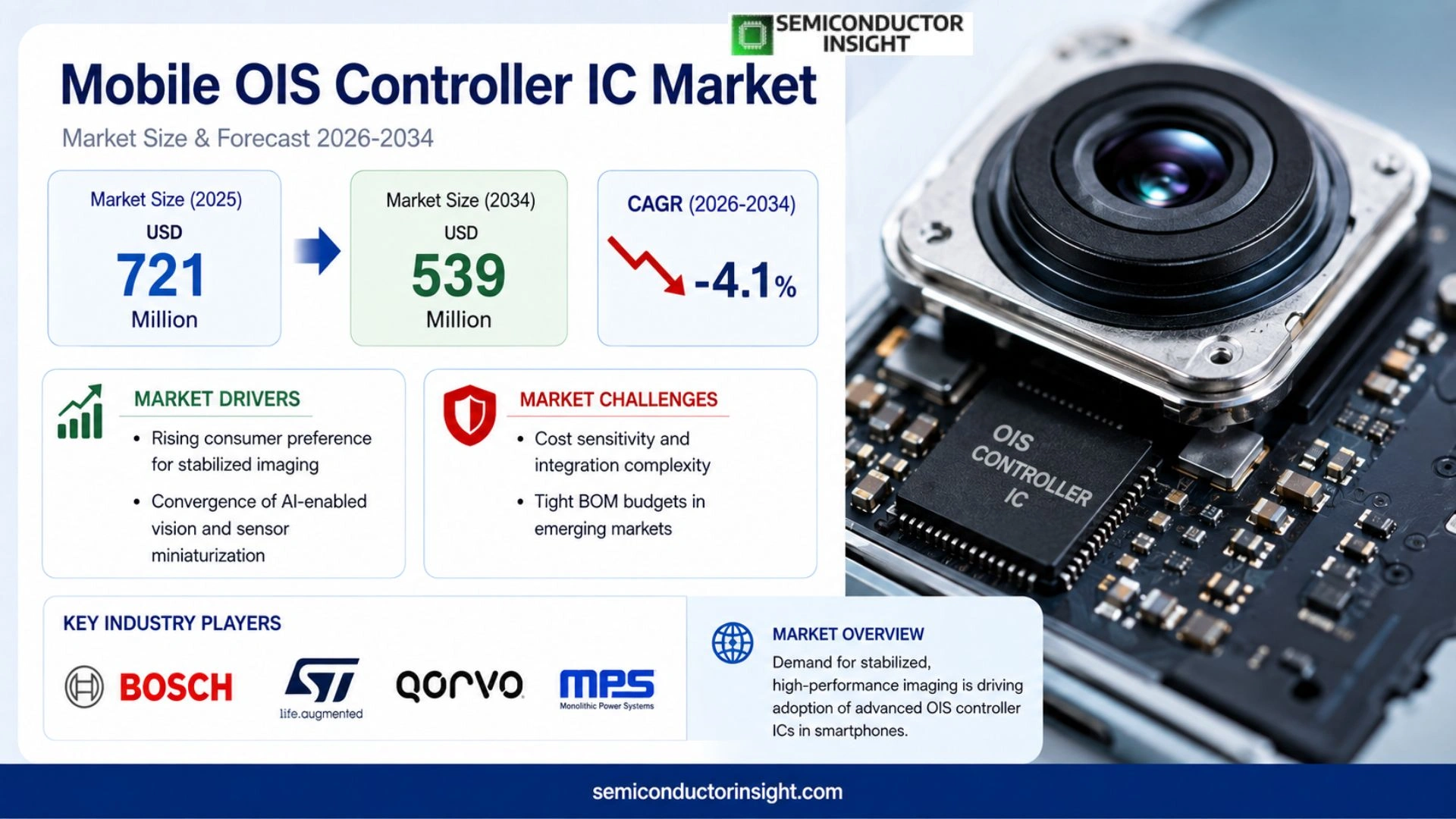
MARKET DRIVERS
Rising Consumer Preference for Stabilized Imaging
The proliferation of high‑megapixel sensors in flagship smartphones has turned image stability from a luxury into a baseline expectation. Consumers now compare photo sharpness across brands as rigorously as they compare battery life, prompting OEMs to embed Mobile OIS Controller IC solutions that can counteract hand‑shake at sub‑micron levels. This pressure accelerates the adoption cycle for newer controller generations.
Convergence of AI‑Enabled Vision and Sensor Miniaturization
Advanced computational photography relies on fast feedback loops between the image sensor and the OIS actuator. As AI‑driven HDR and night‑mode algorithms demand frame‑by‑frame adjustments, manufacturers are integrating Mobile OIS Controller IC Market offerings directly into SoC packages, shrinking board space while preserving performance margins. The design synergy reduces latency and delivers smoother video capture, reinforcing demand for integrated controller IP.
➤ “Stabilization technology has become the decisive factor for premium smartphone camera rankings, and controller ICs are the silent workhorse behind that shift.”
These dynamics compel component suppliers to expand their product portfolios, offering programmable gain stages, adaptive damping, and low‑power sleep modes. Suppliers that can deliver such versatility will capture a larger share of Mobile OIS Controller IC Market, while laggards risk obsolescence as brand‑level differentiation narrows.
MARKET CHALLENGES
Cost Sensitivity and Integration Complexity
Smartphone bill‑of‑materials budgets are compressed by aggressive pricing strategies, especially in emerging markets. The added die area and testing requirements of OIS controllers inflate per‑unit costs, forcing OEMs to negotiate tighter margins with silicon vendors. At the same time, integrating high‑precision MEMS drivers with power‑management units demands cross‑disciplinary engineering, lengthening development cycles.
Other Challenges
Manufacturing Yield Pressures
Yield optimization for MEMS‑based actuators remains a bottleneck; even minor variations in damping characteristics can trigger re‑spoil rates that erode profitability. Suppliers must invest in advanced wafer‑level testing to sustain acceptable defect densities.
MARKET RESTRAINTS
Supply Chain Volatility for High‑Precision MEMS
Global sourcing of silicon wafers and specialty glass for MEMS structures is susceptible to geopolitical disruptions, which can delay shipments and force price escalations. OEMs that lack diversified supplier portfolios may experience production bottlenecks, limiting their ability to rollout new models on schedule.
Regulatory scrutiny over device vibration emissions in certain jurisdictions adds an additional compliance layer. Manufacturers must certify that OIS actuation stays within defined thresholds, a process that can extend time‑to‑market for new controller designs.
The talent pool skilled in both analog front‑end design and MEMS integration is relatively shallow. Companies competing for these engineers often encounter higher labor costs, which in turn constrains investment in next‑generation controller architectures.
MARKET OPPORTUNITIES
Emerging 5G‑Enabled Multi‑Camera Modules
5G smartphones now support simultaneous multi‑camera streams for real‑time augmented reality experiences. This architecture requires each lens to be stabilized independently, opening a niche for Mobile OIS Controller IC families that can manage multiple actuation channels within a single die footprint. Early adopters stand to differentiate their products through smoother AR overlays.
Automotive infotainment systems are beginning to incorporate high‑resolution interior cameras for driver monitoring. These cameras operate under harsh temperature cycles, creating demand for OIS controllers that combine rugged MEMS with extended temperature compensation circuits.
Edge‑AI devices such as wearables and compact drones benefit from lightweight stabilization solutions. Controllers that integrate low‑power AI inference blocks can enable on‑device image correction without taxing the main processor, presenting a growth avenue for niche OEMs.
Finally, the rise of open‑source hardware platforms encourages smaller innovators to experiment with custom imaging pipelines. Providing royalty‑free reference designs for OIS controllers can stimulate ecosystem expansion, translating into incremental sales for component firms that capture the resulting volume.
Mobile OIS Controller IC Market Trends
Fusion‑Centric Sensor Evolution
Mobile OIS Controller IC Market is witnessing a decisive move toward integrating sensor‑fusion algorithms and on‑chip AI accelerators. Manufacturers such as Bosch, TDK InvenSense and STMicroelectronics have begun to embed finite‑state machines and lightweight neural engines directly inside the controller IC, allowing smartphones to offload motion‑fusion workloads from the main processor. This shift reduces latency for image stabilization and gesture detection, while keeping power budgets within the tight limits of modern handsets. For OEMs, the ability to deliver a smoother optical image‑stabilization experience without redesigning the host SoC translates into faster time‑to‑market for flagship cameras. The trend also raises entry barriers for newcomers, because the added algorithmic capability demands both silicon expertise and robust firmware support.
Other Trends
Shift Toward Ultra‑Low‑Power, High‑Precision Devices
Within Mobile OIS Controller IC Market, power efficiency has become a primary differentiator. Recent product releases feature sub‑microwatt idle currents while preserving sub‑degree angular‑rate noise figures, a combination that fuels always‑on features such as augmented‑reality head‑tracking and continuous motion logging. The engineering emphasis on temperature‑stable oscillators and wide‑bandwidth gyroscopes enables devices to maintain calibration across the broad climate envelope encountered in global supply chains. Consequently, smartphone makers are gravitating toward components that can stay active in the background without draining the battery, a requirement that directly influences bill‑of‑materials calculations and ultimately the pricing strategy of end devices.
Expansion Into Wearables, XR and TWS Segments
Beyond traditional smartphones, Mobile OIS Controller IC Market is extending its relevance to wearables, extended‑reality headsets and true‑wireless earbuds. These form factors demand miniature packages, dual‑SPI interfaces and on‑chip sensor‑fusion that can drive real‑time head orientation or ear‑based motion cues. Chinese entrants such as QST and Senodia have introduced variants specifically tuned for TWS, offering dual‑SPI pathways that reduce host latency during beam‑forming adjustments. The diversification of end‑use cases mitigates the impact of declining smartphone shipments, allowing the market to capture incremental revenue from higher‑margin niche devices. Companies that can tailor their controller ICs to the spatial‑awareness requirements of XR and the acoustic‑stability needs of earbuds are positioning themselves for a broader share of the overall Mobile OIS Controller IC Market.
COMPETITIVE LANDSCAPE
Key Industry Players
Mobile OIS Controller IC Market Competitive Overview
Bosch Sensortec continues to dominate design‑in conversations with flagship smartphone OEMs, leveraging its deep MEMS heritage and a broad portfolio that couples low‑noise gyroscopes with on‑chip DSP for real‑time image‑stabilization. The firm’s ability to ship narrow‑pitch, system‑in‑package solutions has entrenched it as a first‑choice supplier for premium camera modules, where latency and temperature stability are decisive. TDK InvenSense and STMicroelectronics follow closely, each offering differentiated sensor‑fusion engines that reduce host CPU load. Their extensive firmware ecosystems and support for emerging interfaces such as I3C enable them to capture a share of high‑end devices that demand both power efficiency and multi‑sensor coherence. Collectively, these three firms shape the tier‑1 landscape, setting performance benchmarks that downstream players must match to win flagship contracts.
Beyond the established tier, a cohort of Chinese and niche specialists is reshaping the market’s breadth. QST’s QMI8658 has gained traction in mid‑range smartphones and true‑wireless earbuds by emphasizing dual‑SPI capability and an integrated motion co‑processor. Senodia’s SH series targets devices that require OIS support without sacrificing package size, while MEMSIC offers a scalable line that spans wearables to lightweight robotics. Hangzhou Silan, Murata, and Seiko Epson provide cost‑effective options for volume segments, often focusing on ultra‑low‑power variants that complement always‑on features. Japan Aviation Electronics and Analog Devices add specialized analog front‑ends that appeal to niche camera and automotive crossover applications. This diversified tier strengthens supply resilience and creates opportunities for OEMs to cherry‑pick solutions aligned with unique form‑factor or cost constraints.
List of Key Mobile OIS Controller IC Companies Profiled
- Robert Bosch GmbH
- TDK InvenSense
- STMicroelectronics N.V.
- QST Corporation Limited
- Senodia Technologies (Shaoxing) Co., Ltd.
- MEMSIC Semiconductor Co., Ltd.
- Hangzhou Silan Microelectronics Co., Ltd.
- Murata Manufacturing Co., Ltd.
- Seiko Epson Corporation
- Japan Aviation Electronics Industry, Ltd.
- Analog Devices, Inc.
- Novatek Microelectronics Corp.
Segment Analysis:
| Segment Category | Sub-Segments | Key Insights |
| By Type |
|
On‑Chip 32‑bit DSP
|
| By Application |
|
Smartphone imaging
|
| By End User |
|
Smartphone OEMs
|
| By Interface Configuration |
|
Dual‑SPI Extended Type
|
| By Performance Orientation |
|
Low‑Noise High‑Precision Type
|
Regional Analysis: Mobile OIS Controller IC Market
Asia‑Pacific
Collaborative R&D clusters in Shenzhen and Seoul generate prototype OIS controller designs that address emerging sensor formats, enabling clients to trial next‑generation optics within a condensed development window.
Multi‑tiered sourcing strategies, anchored by regional wafer fabs and component distributors, cushion the market against global disruptions while keeping lead times competitive.
Harmonized emission standards across ASEAN economies streamline certification for OIS controllers, reducing time spent on compliance testing for multinational product launches.
A steady influx of engineers versed in mixed‑signal design and machine‑learning algorithms fuels the region’s capacity to deliver sophisticated stabilization solutions at scale.
North America
North America remains a focal point for high‑end device integration, where flagship smartphones set performance benchmarks that ripple through the OIS controller supply chain. Companies here concentrate on embedding advanced predictive algorithms that anticipate motion, differentiating premium models. The market’s trajectory is shaped by close partnerships between chipset manufacturers and software firms, fostering co‑engineered solutions that balance power draw with stabilization fidelity. Client expectations for seamless video capture drive continuous refinement of latency and noise‑reduction techniques, compelling local suppliers to invest heavily in firmware optimization and testing infrastructure.
Europe
European stakeholders prioritize compliance and durability, influencing design choices for OIS controllers destined for markets with stringent environmental regulations. Manufacturers often embed enhanced calibration routines to meet diverse lighting conditions across the continent, aligning with consumer demand for consistent image quality. Collaborative standards bodies in the region promote interoperability, which in turn encourages component vendors to adopt modular architectures that can be tailored for various device tiers without sacrificing core performance.
South America
In South America, price sensitivity drives a distinct approach to OIS controller adoption, with manufacturers seeking cost‑effective architectures that still deliver acceptable stabilization for mid‑range devices. Local assemblers favor solutions that integrate readily with existing board layouts, reducing redesign cycles. Market participants therefore emphasize flexible pin‑compatible families that allow OEMs to swap between performance levels as needed, supporting a diversified product portfolio across the region.
Middle East & Africa
The Middle East & Africa region exhibits a growing appetite for ruggedized mobile platforms, prompting OIS controller developers to enhance shock‑resistance features. Suppliers adapt to climatic extremes by incorporating temperature‑compensated compensation loops, ensuring reliable operation from desert heat to tropical humidity. Additionally, expanding mobile broadband penetration fuels demand for devices capable of high‑quality video conferencing, encouraging local distributors to prioritize controllers that balance robustness with modest power consumption.
Report Scope
This market research report provides a comprehensive analysis of the Mobile OIS Controller IC Market , covering the forecast period 2026–2034. It offers detailed insights into market dynamics, technological advancements, competitive landscape, and key trends shaping the industry.
Key focus areas of the report include:
- Market Overview: The report begins with an overview outlining its current market scenario, key growth indicators, and industry transformation drivers. It discusses macroeconomic factors, demand–supply balance, regulatory landscape, and the strategic role of semiconductors in powering advancements across industries such as automotive, telecommunications, consumer electronics, and industrial automation.
- Market Size & Forecast: Historical data and future projections for revenue, unit shipments, and market value across major regions and segments.
- Segmentation Analysis: Detailed breakdown by product type, technology, application, and end-user industry to identify high-growth segments and investment opportunities.
- Regional Insights: Insights into market performance across North America, Europe, Asia-Pacific, Latin America, and the Middle East & Africa, including country-level analysis where relevant.
- Competitive Landscape: Profiles of leading market participants, including their product offerings, R&D focus, manufacturing capacity, pricing strategies, and recent developments such as mergers, acquisitions, and partnerships.
- Technology Trends & Innovation: Assessment of emerging technologies, integration of AI/IoT, semiconductor design trends, fabrication techniques, and evolving industry standards.
- Market Drivers & Restraints: Evaluation of factors driving market growth along with challenges, supply chain constraints, regulatory issues, and market-entry barriers.
- Stakeholder Insights: Insights for component suppliers, OEMs, system integrators, investors, and policymakers regarding the evolving ecosystem and strategic opportunities.
Primary and secondary research methods are employed, including interviews with industry experts, data from verified sources, and real-time market intelligence to ensure the accuracy and reliability of the insights presented.
FREQUENTLY ASKED QUESTIONS:
What is the current market size of Mobile OIS Controller IC Market?
-> Mobile OIS Controller IC market is projected to reach USD 539 million by 2034, exhibiting a CAGR of –4.1% during the forecast period.
Which key companies operate in Mobile OIS Controller IC Market?
-> Key players include Robert Bosch GmbH, TDK Corporation, STMicroelectronics N.V., QST Corporation Limited, Senodia Technologies, MEMSIC Semiconductor Co., Ltd., Hangzhou Silan Microelectronics Co., Ltd., Murata Manufacturing Co., Ltd., Seiko Epson Corporation, and Japan Aviation Electronics Industry Ltd.
What are the key growth drivers?
-> Key growth drivers include rising demand for optical image stabilization in smartphones, integration of 6‑axis IMUs into XR and wearable devices, need for ultra‑low‑power high‑precision sensors, and the push for on‑device AI‑enabled motion processing.
Which region dominates the market?
-> Asia dominates the market, driven by strong production and adoption in China, Japan, and South Korea.
What are the emerging trends?
-> Emerging trends include integration of on‑chip AI/ML for sensor fusion, dual‑SPI interfaces, ultra‑low‑power designs, and the expansion of 6‑axis IMUs into XR, smart glasses, and robotics.

Get Sample Report PDF for Exclusive Insights
Report Sample Includes
- Table of Contents
- List of Tables & Figures
- Charts, Research Methodology, and more...
 Download Sample Report PDF