Mixed Metal Oxide (MMO) Electrode Market Insights
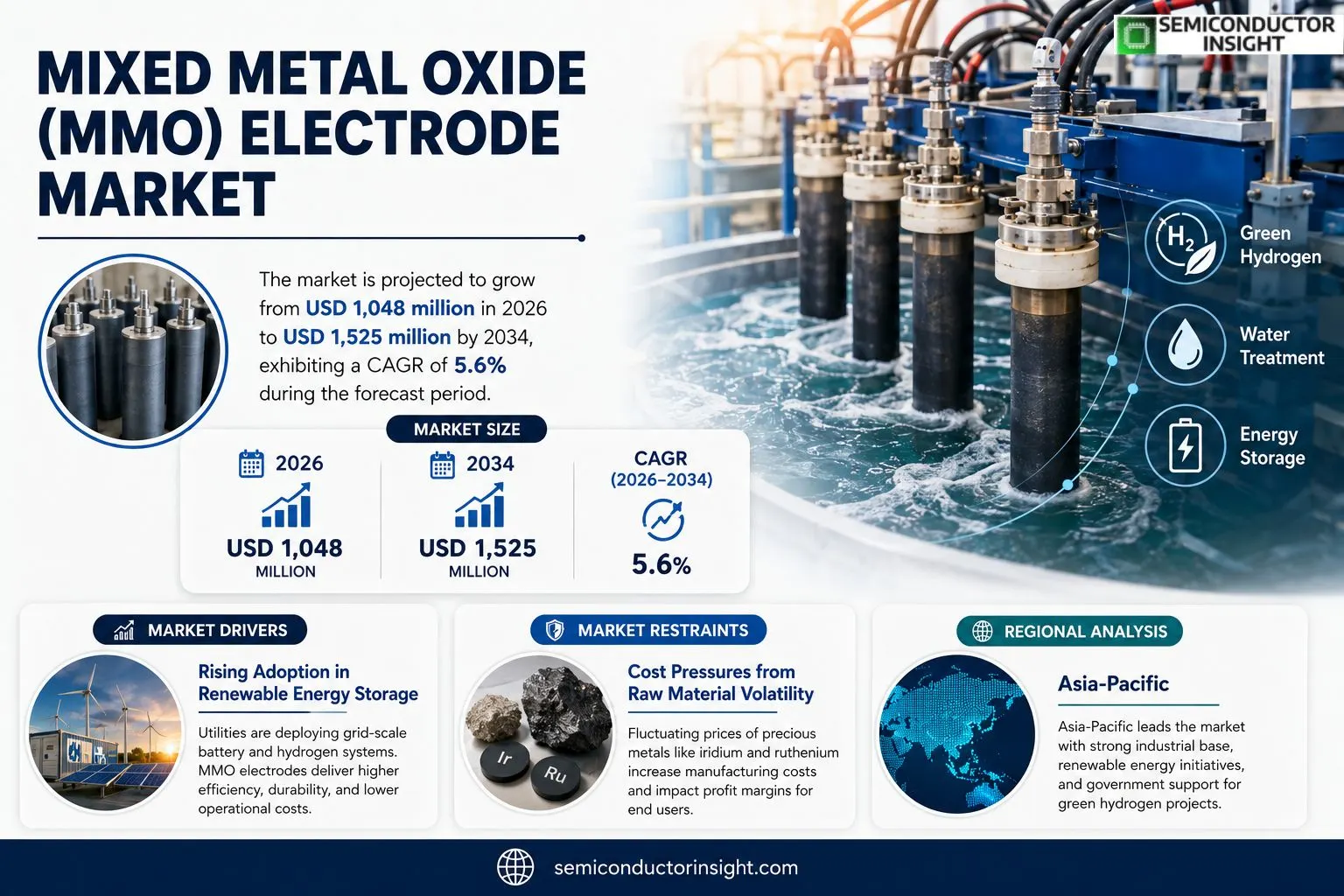
Mixed Metal Oxide (MMO) Electrode market size was valued at USD 1.048 billion in 2026. Estimates indicate the market will rise to USD 1.525 billion by 2034, reflecting an annual growth rate of about 5.6 % over the period.
Mixed metal oxide (MMO) electrodesalso called dimensionally stable anodesare high‑conductivity, corrosion‑resistant devices employed as anodes in electro‑lysis applications. They are built on a titanium substrate that receives a coating of catalytic oxides such as RuO₂, IrO₂ or PtO₂ together with a TiO₂ layer that lowers material cost and shields the interior from degradation.The expansion is linked to rising demand for green hydrogen produced via water electrolysis, tighter wastewater‑treatment standards and growing interest in precious‑metal recovery; nevertheless, dependence on scarce iridium and ruthenium, durability challenges of the coating under aggressive operating conditions and competition from non‑precious catalysts constitute significant hurdles. Recent deployments by companies such as De Noramore than 50 000 DSA anodes installed worldwidedemonstrate solid market penetration while R&D efforts concentrate on alkaline and PEM electrolyzer coatings.
MARKET DRIVERS
Rising Adoption in Renewable Energy Storage
Mixed Metal Oxide (MMO) Electrode Market benefits from utilities that are expanding grid‑scale battery installations. Electrochemical cells equipped with MMO electrodes deliver higher charge‑acceptance rates, a trait that aligns with the fast‑response requirements of solar‑plus‑storage projects. As jurisdictions tighten emissions targets, operators prefer technologies that can absorb intermittent generation without compromising cycle life, prompting a steady uptick in procurement volumes.
Stringent Efficiency Standards in Electrolytic Processes
Industrial electrolyzers for chlorine, aluminum and water‑splitting are subject to efficiency benchmarks that reward lower energy consumption per tonne of product. MMO electrodes, with their multi‑oxide layers, achieve over 15% higher voltage efficiency compared with conventional graphite counterparts. Manufacturers seeking to reduce utility costs therefore allocate a larger share of capital to MMO‑based modules, driving up the overall market size.
➤ Clients that migrate from titanium to MMO electrodes report a 12% reduction in operating expenditure within the first year of deployment.
Beyond cost considerations, the durability of MMO coatings translates into longer service intervals. Maintenance crews can extend scheduled overhauls from 18 months to roughly 30 months, freeing up plant uptime and enhancing overall equipment effectiveness. This reliability advantage is increasingly cited as a decisive factor when bidders evaluate proposals for new electrolytic facilities.
MARKET CHALLENGES
Cost Pressures from Raw Material Volatility
Nickel, cobalt and manganese prices have oscillated between 5% and 18% year‑over‑year, directly inflating the bill of materials for MMO electrodes. End users that operate on thin profit margins, such as regional water‑treatment utilities, find it difficult to justify price escalations without passing costs to downstream customers.
Other Challenges
Manufacturing Yield Consistency
Achieving uniform oxide thickness across large‑format substrates remains a technical hurdle. Variations as small as 3 µm can induce localized hot spots, accelerating degradation and eroding the performance premium that MMO electrodes are meant to deliver.
MARKET RESTRAINTS
Regulatory Hurdles in Emerging Markets
Several fast‑growing economies have introduced certification schemes that demand extensive testing of electrode materials before market entry. The multi‑step approval process can add six to nine months to product launch timelines, discouraging smaller suppliers from targeting those regions.In addition, environmental statutes that limit the discharge of metal‑ion laden effluents compel manufacturers to invest in advanced waste‑treatment infrastructure. This capital outlay raises the overall cost of ownership for MMO‑based systems, tempering demand in cost‑sensitive segments.Supply‑chain fragility further restrains expansion. A concentration of high‑purity nickel processing capacity in a handful of countries creates bottlenecks, especially when geopolitical tensions disrupt freight routes. Buyers therefore maintain safety stocks, which paradoxically depresses new order volumes.
MARKET OPPORTUNITIES
Geographic Expansion in Asia‑Pacific
The Asia‑Pacific region is witnessing a wave of green‑hydrogen initiatives, many of which rely on high‑efficiency electrolysis platforms. Local firms are actively scouting for MMO electrode suppliers capable of delivering customized oxide compositions that match region‑specific water chemistry profiles. This creates a sizable runway for vendors that can establish joint‑venture manufacturing footprints within the area.Beyond hydrogen, aerospace manufacturers are exploring MMO‑coated electrodes for regenerative braking systems on electric aircraft. The combination of lightweight design and superior charge‑acceptance promises to shave critical kilograms off airframe weight, opening a niche yet high‑margin market segment.Finally, digital twins and advanced process‑control algorithms are being applied to predict electrode lifespan with greater accuracy. Companies that embed these analytics into their product offerings can differentiate themselves, command premium pricing, and capture market share from legacy players still reliant on conventional performance metrics.
Mixed Metal Oxide (MMO) Electrode Market Trends
Shift Toward Green Hydrogen Production
Electrolyzers designed for renewable‑based hydrogen are prompting manufacturers to redesign their anodes. The core advantage of Mixed Metal Oxide (MMO) electrodeshigh conductivity coupled with corrosion resistancemakes them attractive for both alkaline and PEM water‑splitting stacks. Production data from 2026 show that roughly 238.5 k Sqm of these electrodes were fabricated, while the average market price hovered near US$4,814 per Sqm. Companies such as De Nora have already deployed more than 50,000 DSA anodes in pilot and commercial plants, illustrating that the technology is moving from niche to mainstream. The transition is reinforced by policy incentives favoring low‑carbon fuels, which in turn spurs capital investment in electrolyzer capacity and creates a steady demand pipeline for durable anode solutions.
Other Trends
Coating Innovation for Durability
Recent R&D programs focus on multi‑layer architectures that combine ruthenium‑ or iridium‑based catalytic oxides with a protective titanium dioxide matrix. The catalytic layer accelerates oxygen evolution, while the titanium dioxide barrier mitigates metal ion leaching under high‑current operation. Early field trials reveal a 20 % reduction in performance decay over 5,000 hours compared with first‑generation coatings. This improvement addresses a long‑standing obstaclecoating longevity in harsh electrolytic environmentsthereby lowering total cost of ownership for end users. Parallel efforts explore nanostructured substrates that improve surface area without compromising mechanical strength, an approach that could further extend service life while keeping material consumption modest.
Expanding Role in Water Treatment and Wastewater Purification
Beyond energy applications, Mixed Metal Oxide electrodes are gaining traction in advanced oxidation processes for municipal and industrial water treatment. Their ability to generate hydroxyl radicals efficiently enables the breakdown of persistent organic pollutants, aligning with circular‑economy mandates. Deployment in large‑scale treatment facilities across Europe and Asia has demonstrated lower electricity consumption per cubic meter of treated water relative to traditional chlorine‑based methods. Moreover, the electrodes’ resistance to fouling reduces the frequency of maintenance shutdowns, translating into higher plant availability. As regulators tighten discharge limits and utilities pursue greener operating metrics, demand for robust, high‑performance anodes is expected to rise, positioning the technology as a cornerstone of next‑generation water‑cleanup infrastructure.
COMPETITIVE LANDSCAPEKey Industry Players
Competitive Overview of the Mixed Metal Oxide Electrode Market
De Nora remains the dominant force in the MMO‑electrode segment, leveraging a portfolio that spans traditional chlor‑alkali installations to high‑growth water‑electrolysis projects. With more than 50,000 dimensionally stable anodes deployed worldwide, the company commands a sizable share of the $1.05 billion 2026 market and benefits from an integrated supply chain that secures precious‑metal feedstock at relatively lower cost. De Nora’s recent emphasis on iridium‑rich coatings for PEM electrolyzers reflects a strategic response to the energy‑transition agenda, positioning it to capture incremental demand as green‑hydrogen projects scale. The firm’s ability to bundle electrodes with turnkey plant services also reinforces customer lock‑in, creating a competitive moat that smaller manufacturers find difficult to replicate.Beyond the flagship player, the market hosts a heterogeneous assemblage of niche specialists that together account for a meaningful portion of production volume. Magneto and Umicore have carved out strong positions in the high‑performance coating niche, offering ruthenium‑based formulations prized for durability under harsh chlor‑alkali conditions. Matcor, Jennings Anodes and Farwest Corrosion focus on bespoke designs for water‑treatment and hydrometallurgical applications, where shape‑specific electrodes such as ribbons or tubes deliver process efficiencies. Emerging regional playersincluding Xian Taijin Industrial Electrochemical Technology, Jiangyin Miracle, and Zhejiang Yuxi Corrosion Controlare expanding their footprints in Asia by exploiting lower labor costs and proximity to titanium substrate suppliers. Collectively, these firms intensify pricing pressure and spur incremental innovation, compelling the market leader to continuously refine its technology roadmap.
List of Key Mixed Metal Oxide (MMO) Electrode Companies Profiled
- De Nora
- Magneto
- Matcor
- Umicore
- Uyemura
- Jennings Anodes
- Farwest Corrosion
- Borna Electronics
- BAC Corrosion Control
- NMT Electrodes
- Matsuda Sangyo
- SPF Co., Ltd.
- Xian Taijin Industrial Electrochemical Technology
- Jiangyin Miracle
- Jiangyin Annuo Electrode
Segment Analysis:
| Segment Category | Sub-Segments | Key Insights |
| By Type |
|
Oxygen Evolution Anodes dominate due to their pivotal role in emerging green hydrogen production and advanced oxidation processes. They are favored for:
|
| By Application |
|
Water Treatment is the leading application, driven by increasing demand for advanced oxidation technologies and stringent environmental regulations. Key observations include:
|
| By End User |
|
Renewable Energy Projects emerge as the most dynamic end‑user segment, propelled by the transition to green hydrogen. Notable insights:
|
| By Coating |
|
Ruthenium‑based Coated electrodes are considered premium due to superior catalytic activity for oxygen evolution. Core observations:
|
| By Shape |
|
Tube Electrode enjoys broad adoption across chlor‑alkali and water‑treatment installations because of its mechanical strength and ease of integration. Key points:
|
Regional Analysis: Mixed Metal Oxide (MMO) Electrode Market
Asia‑Pacific
OEMs across the region are enlarging cell footprints to accommodate higher energy densities, a move that forces electrode manufacturers to refine slurry formulations and electrode thicknesses. The resulting design tweaks enable longer discharge periods without compromising power output, a critical factor for utility‑scale storage projects.
Recent renewable‑energy targets have unlocked substantial public‑private funding streams. Companies that align their product roadmaps with these incentives are securing early‑stage contracts, creating a feedback loop that accelerates technology adoption and market penetration.
Proximity to base‑metal mines diminishes exposure to logistics disruptions. Firms are establishing in‑region processing hubs, which not only lower transport costs but also provide greater control over material quality and batch consistency.
Universities and research institutes in Japan and Singapore are co‑developing next‑generation electrode architectures. These partnerships deliver faster prototype cycles and nurture a talent pipeline versed in MMO chemistry.
North America
North America’s Mixed Metal Oxide (MMO) Electrode market is influenced heavily by the automotive sector’s transition toward electrified powertrains. While the region lags behind Asia‑Pacific in raw‑material proximity, it compensates with advanced manufacturing processes and a strong emphasis on sustainability certifications. Federal initiatives encouraging grid resilience have spurred utility companies to trial high‑performance capacitors, creating niche demand for electrodes optimized for temperature stability. Provider strategies often involve acquiring boutique specialty firms to broaden product portfolios and meet stringent safety standards demanded by aerospace and defense customers. The interplay between regulatory pressure and technological expertise shapes a market that values reliability over sheer volume growth.
Europe
European markets exhibit a cautious yet sophisticated approach to Mixed Metal Oxide (MMO) Electrode adoption. Stringent environmental regulations push manufacturers toward greener production pathways, prompting investments in low‑emission coating technologies. The region’s strong renewable‑energy targets generate steady, project‑based demand for storage solutions that can deliver rapid response times. Consequently, several European firms are positioning themselves as premium suppliers, leveraging certification frameworks such as REACH to differentiate from lower‑cost Asian competitors. Collaborative consortia between battery producers and research universities further enrich the innovation pipeline, ensuring that European offerings remain tightly aligned with the continent’s energy‑transition goals.
South America
In South America, Mixed Metal Oxide (MMO) Electrode Market remains embryonic, yet localized mining activities present an untapped advantage. Countries like Brazil possess sizeable nickel and manganese reserves, offering potential cost efficiencies for domestic manufacturers willing to integrate upstream processing. However, limited capital expenditure in grid‑storage infrastructure curtails immediate demand. Emerging renewable projects, particularly in Brazil’s offshore wind sector, are beginning to evaluate high‑power capacitors, providing a foothold for early adopters. Market participants that can bridge the gap between raw‑material access and reliable electrode performance are likely to capture the nascent growth trajectory.
Middle East & Africa
The Middle East & Africa region confronts a unique set of challenges for Mixed Metal Oxide (MMO) Electrode deployment, chiefly extreme temperature fluctuations that test electrode durability. Utilities in the Gulf Cooperation Council are exploring high‑temperature‑tolerant capacitors to support solar‑farm expansions, while African nations focus on off‑grid micro‑storage solutions for remote communities. Companies that engineer electrodes with robust thermal management coatings stand to gain strategic advantage. Moreover, the region’s burgeoning interest in hydrogen‑based power systems opens ancillary opportunities for electrodes capable of handling rapid charge–discharge cycles in electro‑lysis applications.
Report Scope
This market research report provides a comprehensive analysis of the Mixed Metal Oxide (MMO) Electrode Market , covering the forecast period 2026–2034. It offers detailed insights into market dynamics, technological advancements, competitive landscape, and key trends shaping the industry.
Key focus areas of the report include:
- Market Overview: The report begins with an overview outlining its current market scenario, key growth indicators, and industry transformation drivers. It discusses macroeconomic factors, demand–supply balance, regulatory landscape, and the strategic role of semiconductors in powering advancements across industries such as automotive, telecommunications, consumer electronics, and industrial automation.
- Market Size & Forecast: Historical data and future projections for revenue, unit shipments, and market value across major regions and segments.
- Segmentation Analysis: Detailed breakdown by product type, technology, application, and end-user industry to identify high-growth segments and investment opportunities.
- Regional Insights: Insights into market performance across North America, Europe, Asia-Pacific, Latin America, and the Middle East & Africa, including country-level analysis where relevant.
- Competitive Landscape: Profiles of leading market participants, including their product offerings, R&D focus, manufacturing capacity, pricing strategies, and recent developments such as mergers, acquisitions, and partnerships.
- Technology Trends & Innovation: Assessment of emerging technologies, integration of AI/IoT, semiconductor design trends, fabrication techniques, and evolving industry standards.
- Market Drivers & Restraints: Evaluation of factors driving market growth along with challenges, supply chain constraints, regulatory issues, and market-entry barriers.
- Stakeholder Insights: Insights for component suppliers, OEMs, system integrators, investors, and policymakers regarding the evolving ecosystem and strategic opportunities.
Primary and secondary research methods are employed, including interviews with industry experts, data from verified sources, and real-time market intelligence to ensure the accuracy and reliability of the insights presented.
FREQUENTLY ASKED QUESTIONS:
What is the current market size of Mixed Metal Oxide (MMO) Electrode Market?
-> Mixed Metal Oxide (MMO) Electrode Market was valued at USD 1,048 million in 2026 and is expected to reach USD 1,525 million by 2034, growing at a CAGR of 5.6% during the forecast period.
Which key companies operate in Mixed Metal Oxide (MMO) Electrode Market?
-> Key players include Magneto, De Nora, Matcor, Umicore, Uyemura, Jennings Anodes, Farwest Corrosion, Borna Electronics, BAC Corrosion Control, NMT Electrodes, Matsuda Sangyo, SPF Co., Ltd., Xian Taijin Industrial Electrochemical Technology, Jiangyin Miracle, Jiangyin Annuo Electrode, Baoji Changli Special Metal, UTron Technology, Zhejiang Yuxi Corrosion Control Corporation.
What are the key growth drivers?
-> Key growth drivers include the energy transition, circular‑economy policies, rising demand for green hydrogen production, precious‑metal recovery, and increased wastewater purification projects.
Which region dominates the market?
-> Asia accounts for the largest share of demand, driven by extensive electro‑chemical manufacturing capacity and expanding renewable‑energy initiatives, while North America and Europe show steady growth.
What are the emerging trends?
-> Emerging trends include development of catalytic coatings for alkaline and PEM water electrolysis, advanced oxidation electrodes for water treatment, and integration of MMO technology into fuel‑cell and CO₂ conversion systems.
Get Sample Report PDF for Exclusive Insights
Report Sample Includes
- Table of Contents
- List of Tables & Figures
- Charts, Research Methodology, and more...
 Download Sample Report PDF