Market Insights
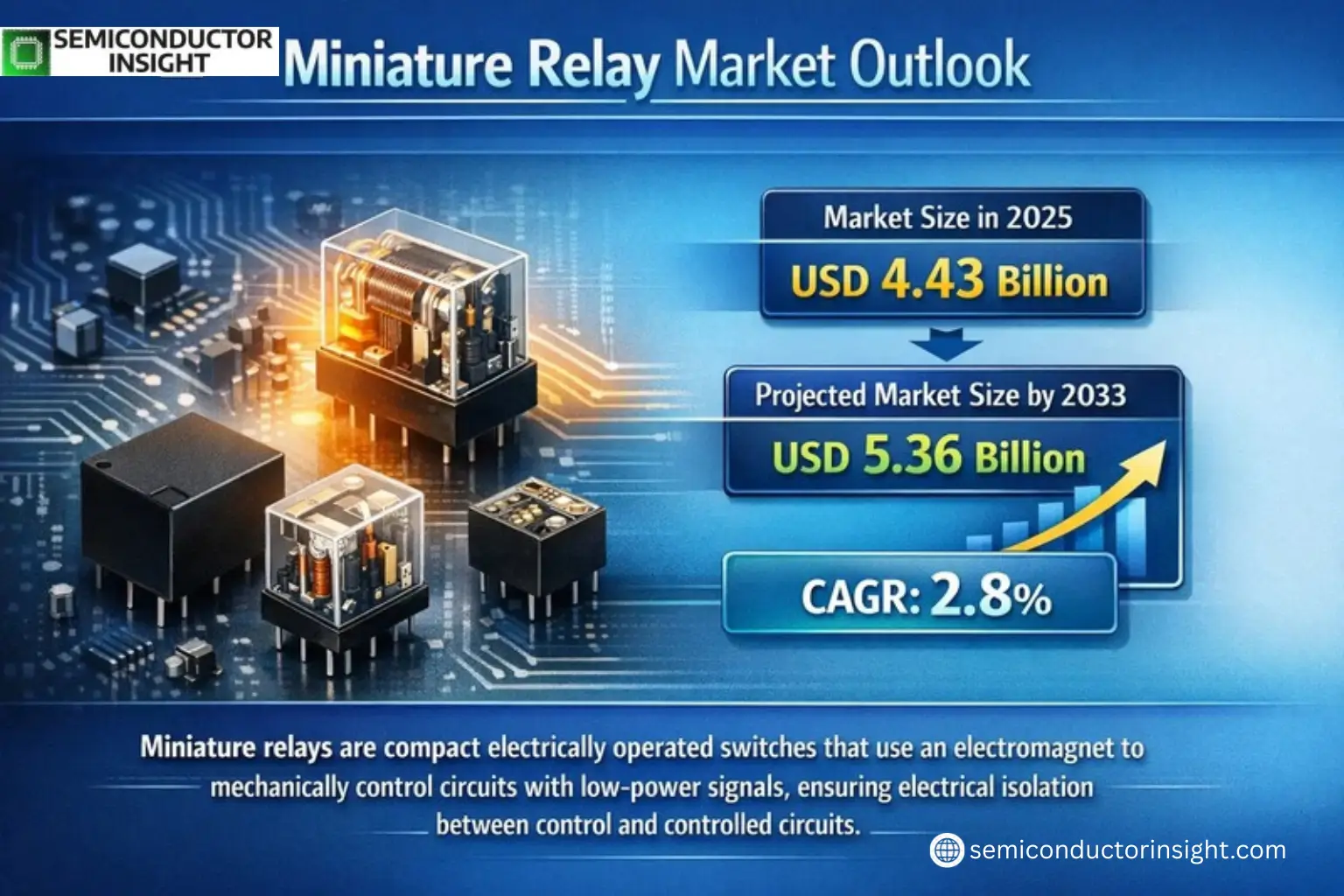
Global Miniature Relay Market size was valued at USD 4.43 billion in 2025 and is projected to reach USD 5.36 billion by 2033, exhibiting a CAGR of 2.8% during the forecast period.
Miniature relays are compact electrically operated switches that use an electromagnet to mechanically control circuits with low-power signals, ensuring electrical isolation between control and controlled circuits. These components are widely utilized in applications requiring precise switching, such as automotive systems, industrial automation, telecommunications, and consumer electronics. Key types include general-purpose relays, power relays, signal relays, safety relays, and semiconductor relays.
The market growth is driven by increasing demand for energy-efficient devices and the rapid expansion of IoT and smart technologies. For instance, solid-state relays (SSRs) are gaining traction due to their longer lifespan over five times that of traditional electromechanical relays and their adoption in electric vehicles is expected to exceed 28% by 2027. Additionally, advancements in high-frequency applications like 5G infrastructure are creating new opportunities for millimeter-wave relay solutions.
MARKET DRIVERS
Growing Demand in Automotive and Industrial Automation
Miniature Relay Market is experiencing significant growth driven by increasing adoption in automotive electronics and industrial automation systems. These compact components are essential for power distribution, signal switching, and circuit protection in space-constrained applications. The rise of electric vehicles has further amplified demand, with miniature relays playing a critical role in battery management and charging systems.
Advancements in Miniaturization Technology
Technological innovations have enabled manufacturers to produce relays with smaller footprints while maintaining or improving performance characteristics. Current miniature relays now offer switching capacities up to 10A in packages as small as 10mm × 6mm, making them ideal for modern compact electronic devices and IoT applications.
Increased focus on energy efficiency and the transition to renewable energy systems are creating additional demand for high-performance miniature relays in solar inverters and smart grid applications.
MARKET CHALLENGES
Technical Limitations in High-Current Applications
While miniature relays excel in low to medium current applications, their small size presents challenges for high-current switching scenarios exceeding 20A. Designers must balance size constraints with thermal management requirements, often requiring complex heat dissipation solutions that increase product costs.
Other Challenges
Supply Chain Constraints for Specialty Materials
The production of high-quality miniature relays requires specialized contact materials and precision components, making the market vulnerable to supply chain disruptions. Recent semiconductor shortages have highlighted the fragility of the global electronics component supply network.
MARKET RESTRAINTS
Competition from Solid-State Alternatives
The gradual shift toward solid-state relays in some applications presents a restraint for traditional miniature electromagnetic relays. While solid-state devices offer advantages in certain scenarios, electromagnetic relays maintain superiority in applications requiring galvanic isolation and high surge current tolerance.
MARKET OPPORTUNITIES
Expansion in 5G Infrastructure and Telecommunications
The rollout of 5G networks worldwide is creating new opportunities for miniature relay manufacturers. These components are critical in base station equipment and network switching hardware, where their compact size and reliability meet the stringent requirements of modern telecommunications infrastructure.
Miniature Relay Market Trends
Solid-State Technology Driving Market Transformation
Global Miniature Relay Market is undergoing significant transformation, with solid-state relays (SSRs) accelerating their substitution of traditional electromechanical models. SSRs offer a contactless design that extends operational lifespan by over 5 times compared to conventional alternatives. This technology is gaining particular traction in the new energy vehicle sector, where penetration rates are projected to exceed 28% by 2027. Programmable logic relays are also seeing increased adoption, capturing 35% of industrial applications by integrating advanced control functions.
Other Trends
Green Energy Applications
The renewable energy sector is creating substantial demand for specialized miniature relays. Photovoltaic applications now require relays with 125°C temperature ratings, with shipments projected to reach 820 million units by 2030. Energy storage system safety relays are experiencing even faster growth, demonstrating a 29% CAGR as grid-scale storage deployments expand globally.
AI and IoT Expansion
Smart home installations now exceed 2.4 billion miniature relays annually, with voice and light control modules becoming standard features. The 5G rollout is creating new demand for millimeter-wave relays capable of handling frequencies above 40GHz, establishing high-frequency performance as a critical technical differentiator in the market.
Market Challenges and Technological Breakthroughs
Material innovation remains a key challenge, with R&D investment for precious metal alternatives increasing by 25% as manufacturers explore solutions like graphene contacts. Aerospace applications are pushing performance boundaries, requiring relays capable of operating across extreme temperature ranges from -65°C to +150°C. The market is simultaneously navigating miniaturization demands while maintaining reliability under these challenging conditions.
COMPETITIVE LANDSCAPE
Key Industry Players
Market Consolidation and Technological Leadership Define Miniature Relay Sector
Miniature Relay Market is dominated by established electronics giants, with Omron Corporation leading the sector with an estimated 18.2% global revenue share. TE Connectivity and Panasonic follow closely, collectively controlling 27% of the market through their diversified product portfolios and strong distribution networks. The competitive landscape shows increasing vertical integration, with players like ABB and Schneider Electric leveraging their industrial automation expertise to develop application-specific relay solutions.
Niche specialists are gaining traction with innovations in solid-state and high-frequency relays, with Hongfa and Song Chuan capturing significant shares in the Asian markets. Automotive-grade relay manufacturers such as Hella and Fujitsu are driving technological advancements to meet stringent vehicular requirements, while Rockwell Automation and Honeywell focus on industrial IoT applications requiring miniaturized solutions.
List of Key Miniature Relay Companies Profiled
- Omron
- TE Connectivity
- Panasonic
- Fujitsu
- Teledyne
- ABB
- Schneider Electric
- Eaton
- Honeywell
- Fuji Electric
- Sharp
- Rockwell Automation
- Finder
- Hella
- Hongfa
Segment Analysis:
| Segment Category | Sub-Segments | Key Insights |
| By Type |
|
Miniature Semiconductor Relays are gaining momentum due to their superior performance characteristics:
|
| By Application |
|
PCB-mounted relays dominate with substantial growth drivers:
|
| By End User |
|
Industrial Automation represents the most demanding application segment:
|
| By Technology |
|
Solid State Technology is transforming the market landscape:
|
| By Operating Temperature |
|
Extended Temperature Range relays show accelerating adoption:
|
Regional Analysis: Global Miniature Relay Market
Rising vehicle electrification in Asia-Pacific boosts miniature relay demand for powertrain systems, charging infrastructure, and advanced driver assistance systems (ADAS). Japanese automakers lead in integrating high-reliability relays.
Manufacturing automation across Chinese and South Korean factories requires miniature relays for control panels and robotic systems. Smart factory initiatives drive premium relay adoption with enhanced durability.
Miniature relays see growing applications in smartphones, wearables, and home appliances produced across Vietnam and Thailand. Compact designs meet space-saving requirements in next-generation devices.
Solar inverters and wind turbine controls increasingly utilize miniature relays across India and Australia. Harsh environment-rated relays gain traction for sustainable energy applications.
North America
North America maintains strong miniature relay demand, particularly in aerospace, defense, and automotive sectors. The United States leads in high-performance relay development for military and medical equipment applications. Technological advancements focus on ultra-miniature relays with extended operational lifecycles. Canadian manufacturers emphasize energy-efficient relay solutions for smart grid infrastructure. The region shows growing preference for sealed relays in harsh industrial environments.
Europe
Europe’s Miniature Relay Market thrives on automotive electrification and industrial IoT adoption. Germany and Italy drive relay innovation for premium automotive applications and machinery controls. Stringent EU regulations push relay manufacturers toward eco-friendly materials and energy-efficient designs. The medical equipment sector presents growing opportunities for precision miniature relays. Eastern European countries show increasing relay consumption for manufacturing automation upgrades.
South America
Brazil and Argentina lead South America’s miniature relay adoption, primarily for automotive and appliance manufacturing. Economic fluctuations impact market growth, but infrastructure investments create opportunities. Local manufacturers focus on cost-effective relay solutions for industrial controls. Renewable energy projects drive demand for relays in solar power systems across Chile and Colombia.
Middle East & Africa
The Middle East shows steady miniature relay demand for oil/gas equipment and building automation. UAE and Saudi Arabia invest in smart city projects requiring advanced relay technologies. Africa experiences growing relay usage in telecommunications infrastructure and mining equipment. South Africa emerges as regional manufacturing hub for industrial control relays.
Report Scope
This market research report provides a comprehensive analysis of the Miniature Relay Market, covering the forecast period 2025–2033. It offers detailed insights into market dynamics, technological advancements, competitive landscape, and key trends shaping the industry.
Key focus areas of the report include:
- Market Overview: The report begins with an overview outlining its current market scenario, key growth indicators, and industry transformation drivers. It discusses macroeconomic factors, demand–supply balance, regulatory landscape, and the strategic role of relays in powering advancements across industries such as automotive, telecommunications, consumer electronics, and industrial automation.
- Market Size & Forecast: Historical data and future projections for revenue, unit shipments, and market value across major regions and segments.
- Segmentation Analysis: Detailed breakdown by product type, technology, application, and end-user industry to identify high-growth segments and investment opportunities.
- Regional Insights: Insights into market performance across North America, Europe, Asia-Pacific, Latin America, and the Middle East & Africa, including country-level analysis where relevant.
- Competitive Landscape: Profiles of leading market participants, including their product offerings, R&D focus, manufacturing capacity, pricing strategies, and recent developments such as mergers, acquisitions, and partnerships.
- Technology Trends & Innovation: Assessment of emerging technologies, integration of AI/IoT, solid-state relay advancements, and evolving industry standards.
- Market Drivers & Restraints: Evaluation of factors driving market growth along with challenges, supply chain constraints, regulatory issues, and market-entry barriers.
- Stakeholder Insights: Insights for component suppliers, OEMs, system integrators, investors, and policymakers regarding the evolving ecosystem and strategic opportunities.
Primary and secondary research methods are employed, including interviews with industry experts, data from verified sources, and real-time market intelligence to ensure the accuracy and reliability of the insights presented.
FREQUENTLY ASKED QUESTIONS:
What is the current market size of Miniature Relay Market?
-> Miniature Relay Market size was valued at USD 4.43 billion in 2025 and is projected to reach USD 5.36 billion by 2033, exhibiting a CAGR of 2.8% during the forecast period.
What is the expected CAGR for the Miniature Relay Market?
-> The market is expected to grow at a CAGR of 2.8% during the forecast period 2025-2033.
Which key companies operate in Miniature Relay Market?
-> Key players include Omron, TE Connectivity, Panasonic, Fujitsu, ABB, Schneider Electric, Eaton, and Honeywell, among others.
What are the key growth drivers?
-> Key growth drivers include solid-state relay adoption in new energy vehicles (28% penetration by 2027), demand from green energy sector (820 million units by 2030), and AI/IoT device integration (2.4 billion smart home installations).
Which region dominates the market?
-> Asia is the dominant market, with significant growth expected in China and Southeast Asia, while Europe maintains strong industrial demand.
What are the emerging trends?
-> Emerging trends include solid-state substitution, vehicle-grade upgrades, high-frequency relays for 5G (>40GHz), and graphene contact technology in development.

Get Sample Report PDF for Exclusive Insights
Report Sample Includes
- Table of Contents
- List of Tables & Figures
- Charts, Research Methodology, and more...
 Download Sample Report PDF