MIMO Radar Market Insights
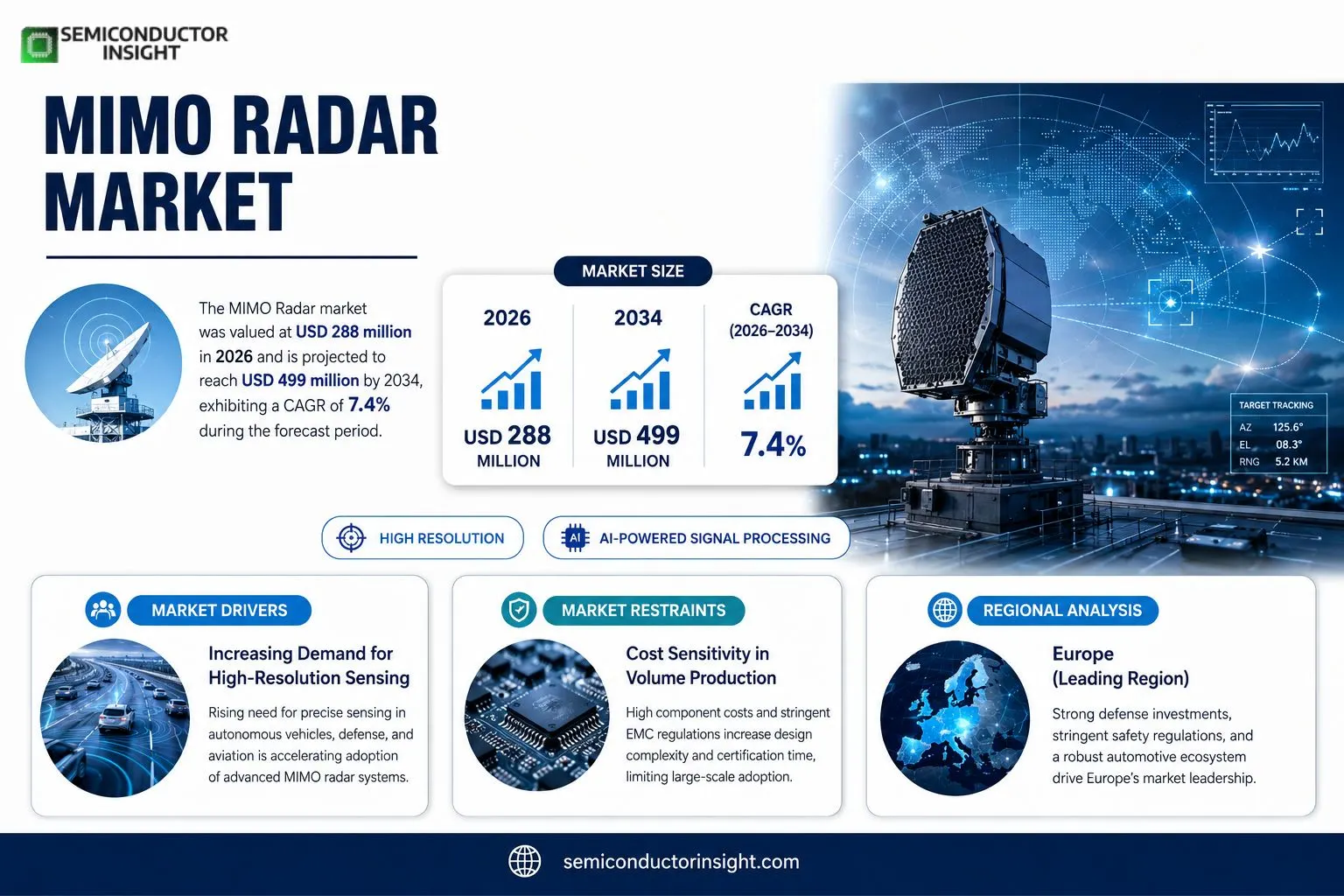
MIMO Radar market size was valued at USD 288 million in 2026. The market is projected to reach USD 499 million by 2034, exhibiting a CAGR of 7.4% during the forecast period.
Multiple‑input multiple‑output (MIMO) radar is an advanced radar system that transmits several independent signals while receiving multiple echoes simultaneously. By exploiting spatial diversity through colocated or widely separated antenna arrays, it creates virtual apertures that markedly improve angular resolution without enlarging the physical footprint. Digital beamforming permits rapid electronic steering of beams, and integrated AI‑driven signal classification lowers false‑alarm rates. Typical units are priced around USD 150 000 with a capacity utilization near 78 %. The architecture supports both 3D and emerging 4D imaging modes, making it applicable to defense air‑space surveillance, civil aviation monitoring, maritime security and high‑resolution meteorological sensing.
MARKET DRIVERS
Increasing Demand for High‑Resolution Sensing
The surge in autonomous‑vehicle programmes has lifted expectations for sensor fidelity. MIMO Radar Market suppliers that can deliver angular resolution comparable to lidar are seeing contracts from Tier‑1 automotive integrators, because the ability to distinguish closely spaced objects directly influences safety ratings.
Integration of AI‑Driven Signal Processing
Machine‑learning algorithms are being embedded within radar front‑ends to adapt beamforming in real time. This capability shortens development cycles for OEMs and reduces hardware redundancy, prompting a wave of strategic partnerships between radar chip makers and AI software firms.
➤ “From a supplier perspective, the convergence of advanced beam steering and edge‑AI is redefining the value proposition of radar systems.”
Regulatory bodies in Europe and North America have tightened performance thresholds for advanced driver‑assistance systems (ADAS). Companies that can demonstrate compliance through modular MIMO architectures are positioned to capture a larger share of upcoming vehicle‑fleet upgrades.
MARKET CHALLENGES
Cost Sensitivity in Volume Production
While performance expectations rise, manufacturers remain bound by strict bill‑of‑materials constraints. The necessity to balance silicon expense against yield rates forces many players to delay migration to next‑generation processes, thereby limiting early‑stage adoption.
Other Challenges
Supply‑Chain Volatility
Fluctuating availability of high‑frequency substrates and specialized packaging materials has introduced lead‑time unpredictability, compelling original equipment manufacturers to maintain higher safety stocks.In response, several firms are investing in regional fabs and forging long‑term contracts with substrate providers to mitigate exposure to geopolitical disruptions.
MARKET RESTRAINTS
Stringent Electromagnetic Compatibility (EMC) Standards
Automotive EMC regulations impose tight limits on spurious emissions from multi‑antenna arrays. Design teams often need to allocate additional chassis shielding and filtering, which erodes the cost advantage of integrating more channels.The need for rigorous certification testing extends time‑to‑market for new radar modules, discouraging smaller innovators lacking extensive test infrastructure.
MARKET OPPORTUNITIES
Expansion into Unmanned Aerial Systems (UAS)
UAS operators are seeking lightweight, low‑power radar solutions that can operate across diverse altitude bands. The modular nature of MIMO architectures makes them ideal for scaling beamwidth without sacrificing payload constraints, opening a parallel revenue stream beyond ground vehicles.Beyond aviation, industrial automation platforms are integrating short‑range MIMO radar for precise object detection in crowded warehouse environments, suggesting a cross‑sector growth corridor that vendors can exploit through diversified product roadmaps.
MIMO Radar Market Trends
Digital Beamforming and Higher‑Resolution Algorithms
MIMO Radar Market is being reshaped by the rapid maturation of digital beamforming architectures. By steering multiple simultaneous beams in the digital domain, manufacturers can extract finer angular detail without expanding antenna apertures. This capability lowers the hardware burden while delivering resolution that satisfies both defense tracking and civilian air‑traffic surveillance. Operators now demand the ability to discriminate closely spaced targets in congested airspace, and the new generation of MIMO arrays meets that demand with sub‑meter precision. Cost pressures are mitigated because the digital front‑end consolidates processing stages, pushing system‑level expenses toward the lower end of the historical range. As a result, procurement cycles shorten and integration into existing platforms accelerates, encouraging a wave of retrofit projects across naval and airport installations.
Other Trends
Policy‑Driven Procurement and Sovereign Supply Chains
Governments worldwide are tightening procurement criteria to favor domestically produced radar subsystems. This shift affects MIMO Radar Market by rewarding suppliers that can demonstrate in‑house micro‑processor design and locally sourced antenna fabrication. The emphasis on sovereign capability reduces reliance on legacy foreign vendors, prompting joint ventures that blend regional expertise in RF front‑ends with advanced signal‑processing know‑how. For buyers, the policy environment translates into more predictable lead times and a clearer regulatory pathway for export controls. For manufacturers, the trend incentivizes investment in end‑to‑end test facilities, which in turn improves overall gross‑margin performance by trimming external contractor fees.
AI‑Enhanced Signal Processing Integration
Artificial‑intelligence techniques are becoming integral to MIMO Radar Market’s product roadmap. Machine‑learning models trained on clutter‑rich datasets enable adaptive filtering that sharpens target detection while suppressing interference. When coupled with the inherent spatial diversity of MIMO architectures, AI algorithms raise the bar for anti‑jamming performance, a critical requirement for modern electronic‑warfare environments. Commercially, this intelligence layer opens avenues for predictive maintenance, allowing operators to anticipate component wear before failure and schedule downtime strategically. The convergence of AI and radar thus creates a feedback loop: higher reliability justifies premium pricing, while the additional revenue funds further algorithmic refinement, sustaining the market’s upward momentum.
COMPETITIVE LANDSCAPE
Key Industry Players
MIMO Radar Market – Competitive Overview
Telephonics remains the dominant force in the MIMO radar arena, leveraging its deep defense contracts and extensive RF‑front‑end expertise. The company’s ability to integrate high‑performance antenna arrays with proprietary digital beam‑forming algorithms gives it a pricing advantage that secures a sizable share of the $499 million forecast market. Its footprint, from U.S. military installations to European aerospace programs, enables cross‑selling of system‑integration services, reinforcing a tier‑1 supplier status that shapes the overall market hierarchy.Beyond the flagship, a cluster of specialized firms is reshaping niche segments. APS Systems and Arbe Robotics focus on compact, automotive‑grade modules that cater to autonomous‑driving OEMs, while InnoSenT and Smart Radar System target maritime surveillance with ruggedized antenna designs. Continental AG and Aptiv bring automotive electronics scale, accelerating adoption of 3‑D and 4‑D MIMO solutions in passenger vehicles. European contenders such as Smartmicro, ZF Friedrichshafen, and Rohde & Schwarz exploit strong regional defense budgets to deliver high‑resolution air‑space monitoring kits. Asian innovatorsincluding Magos, Hensoldt (via partnership), and Nanjing Radarare expanding capacity through cost‑effective semiconductor sourcing, thereby pressuring margins across the value chain.
List of Key MIMO Radar Companies Profiled
- Telephonics
- APS Systems
- Arbe Robotics
- InnoSenT
- Continental AG
- Aptiv
- Smart Radar System
- Smartmicro
- ZF Friedrichshafen AG
- Rohde & Schwarz
- Magos
- Hensoldt (partner)
Segment Analysis:
| Segment Category | Sub-Segments | Key Insights |
| By Type |
|
Colocated Antennas – Preferred for compact platform integration; • Enables high‑resolution beamforming with reduced footprint; • Facilitates easier thermal management and system packaging; • Aligns with emerging trends in automotive and UAV radar solutions. |
| By Application |
|
Military – Drives highest performance expectations; • Demands multi‑target tracking in contested electromagnetic environments; • Requires robust anti‑jamming and low‑probability‑of‑intercept features; • Fuels ongoing algorithmic innovation and hardware integration for next‑generation air and naval defense systems. |
| By End User |
|
Defense Procurement Agencies – Central to strategic adoption; • Prioritize systems that combine high resolution with resilience against electronic warfare; • Influence supplier road‑maps through large‑scale contracts and long‑term R&D collaborations; • Emphasize lifecycle support, firmware upgradability, and compliance with evolving defense standards. |
| By Frequency |
|
77 GHz – Dominant for automotive radar; • Offers optimal balance between range and angular resolution for advanced driver‑assistance systems; • Benefits from mature semiconductor ecosystems and cost‑effective antenna designs; • Supports upcoming 4D imaging capabilities that enhance object classification and predictive safety functions. |
| By Dimension |
|
4D MIMO Radar – Emerging performance leader; • Integrates elevation angle measurement, adding a fourth dimension to target space awareness; • Enables finer discrimination of overlapping objects in dense traffic or cluttered battlefields; • Accelerates the convergence of sensor fusion strategies in autonomous platforms and next‑gen air‑defense networks. |
Regional Analysis: MIMO Radar Market
Europe
The European Union’s push for automated driving standards has embedded radar performance criteria into type‑approval processes, compelling manufacturers to adopt MIMO configurations that meet higher resolution thresholds. Defense directives similarly mandate interoperability across NATO‑aligned systems, creating a unified technical baseline that accelerates cross‑border procurement.
Defense forces dominate the high‑value segment, while automotive OEMs represent the fastest growing user base, especially in premium vehicle lines that market advanced safety features as differentiators.
The convergence of 5G spectrum availability and higher‑frequency silicon processes enables denser antenna arrays, making MIMO radar a practical choice for both long‑range detection and short‑range urban maneuvering.
Established defense contractors are expanding into civilian domains, while pure‑play semiconductor firms are leveraging existing wafer fabs to supply cost‑efficient front‑ends, intensifying rivalry across the value chain.
North America
North America’s MIMO Radar Market is shaped by extensive federal defense spending and a vibrant automotive innovation ecosystem centered in Michigan and Silicon Valley. Defense contracts prioritize ruggedized platforms capable of operating across harsh terrains, prompting suppliers to invest heavily in reliability testing. In the civilian sphere, U.S. automakers accelerate integration of MIMO sensors to sustain competitive advantage in autonomous vehicle pilots. The region benefits from a mature supply chain that includes both legacy radar manufacturers and emerging chip‑fab players, fostering a competitive price dynamic. However, regulatory fragmentation across states can slow nationwide deployment of advanced driver‑assistance systems, creating pockets of uneven adoption that savvy vendors can exploit through targeted regional rollouts.
Asia‑Pacific
In Asia‑Pacific, rapid urbanization and government‑driven smart‑city initiatives generate a fertile backdrop for MIMO radar adoption beyond traditional defense applications. China’s defense modernization agenda invests heavily in high‑resolution radar for maritime surveillance, while Japan’s automotive giants are embedding MIMO arrays to meet domestic safety mandates. Regional supply chains are increasingly localized, with semiconductor hubs in Taiwan and South Korea delivering cost‑effective components. Nonetheless, divergent standards across countries complicate cross‑border product harmonization, urging manufacturers to adopt modular architectures that can be re‑configured for distinct regulatory regimes. The strategic lever for companies is to build alliances with local original equipment manufacturers, thereby navigating policy nuances while securing market access.
South America
South America presents a niche but growing segment for MIMO Radar Market, driven primarily by Brazil’s expanding aerospace sector and Argentina’s interest in modernizing border‑control radar networks. Automotive penetration remains modest, yet rising middle‑class demand for safety‑enhanced vehicles is prompting importers to consider MIMO‑enabled sensor packages. The region’s limited domestic component base forces reliance on imported modules, which can be mitigated through joint ventures that localize assembly. Political volatility and fluctuating currency rates pose risk, but firms that secure long‑term service contracts with government agencies can achieve stable revenue streams despite macro‑economic uncertainty.
Middle East & Africa
The Middle East & Africa region is gradually emerging as a strategic arena for MIMO Radar Market, largely because of extensive oil‑and‑gas infrastructure monitoring and heightened security concerns along critical maritime corridors. United Arab Emirates and Saudi Arabia allocate significant funds toward radar systems that can detect low‑observable threats, making MIMO technology attractive for its superior angular resolution. Automotive uptake is nascent, yet luxury vehicle imports that showcase advanced driver‑assistance features are creating an early demand signal. Supply constraints are alleviated through partnerships with European firms that provide both hardware and localized support services. Companies that can align radar capabilities with both sovereign security objectives and premium automotive expectations will likely dictate the pace of market evolution in this diverse region.
Report Scope
This market research report provides a comprehensive analysis of the MIMO Radar Market , covering the forecast period 2026–2034. It offers detailed insights into market dynamics, technological advancements, competitive landscape, and key trends shaping the industry.
Key focus areas of the report include:
- Market Overview: The report begins with an overview outlining its current market scenario, key growth indicators, and industry transformation drivers. It discusses macroeconomic factors, demand–supply balance, regulatory landscape, and the strategic role of semiconductors in powering advancements across industries such as automotive, telecommunications, consumer electronics, and industrial automation.
- Market Size & Forecast: Historical data and future projections for revenue, unit shipments, and market value across major regions and segments.
- Segmentation Analysis: Detailed breakdown by product type, technology, application, and end-user industry to identify high-growth segments and investment opportunities.
- Regional Insights: Insights into market performance across North America, Europe, Asia-Pacific, Latin America, and the Middle East & Africa, including country-level analysis where relevant.
- Competitive Landscape: Profiles of leading market participants, including their product offerings, R&D focus, manufacturing capacity, pricing strategies, and recent developments such as mergers, acquisitions, and partnerships.
- Technology Trends & Innovation: Assessment of emerging technologies, integration of AI/IoT, semiconductor design trends, fabrication techniques, and evolving industry standards.
- Market Drivers & Restraints: Evaluation of factors driving market growth along with challenges, supply chain constraints, regulatory issues, and market-entry barriers.
- Stakeholder Insights: Insights for component suppliers, OEMs, system integrators, investors, and policymakers regarding the evolving ecosystem and strategic opportunities.
Primary and secondary research methods are employed, including interviews with industry experts, data from verified sources, and real-time market intelligence to ensure the accuracy and reliability of the insights presented.
FREQUENTLY ASKED QUESTIONS:
What is the current market size of MIMO Radar Market?
-> MIMO Radar Market was valued at USD 288 million in 2026 and is expected to reach USD 499 million by 2034. The projected compound annual growth rate (CAGR) over the forecast period is 7.4%.
Which key companies operate in MIMO Radar Market?
-> Key players include Telephonics, APS System, Arbe Robotics, InnoSenT, Continental AG, Smart Radar System, Aptiv, Smartmicro, ZF Friedrichshafen AG, Rohde Schwarz, Magos, among others.
What are the key growth drivers?
-> Key growth drivers include increased defense modernization programs, rising demand for high‑resolution air traffic and meteorological monitoring, and advancements in digital beamforming and AI‑driven signal processing.
Which region dominates the market?
-> Asia-Pacific is the fastest‑growing region, while Europe remains a dominant market.
What are the emerging trends?
-> Emerging trends include integration of AI for target identification, development of compact short‑range radars for autonomous vehicles, and increased deployment of 4D MIMO radar systems for maritime security.
Get Sample Report PDF for Exclusive Insights
Report Sample Includes
- Table of Contents
- List of Tables & Figures
- Charts, Research Methodology, and more...