Millimeter-wave Radar Sensor Market Insights
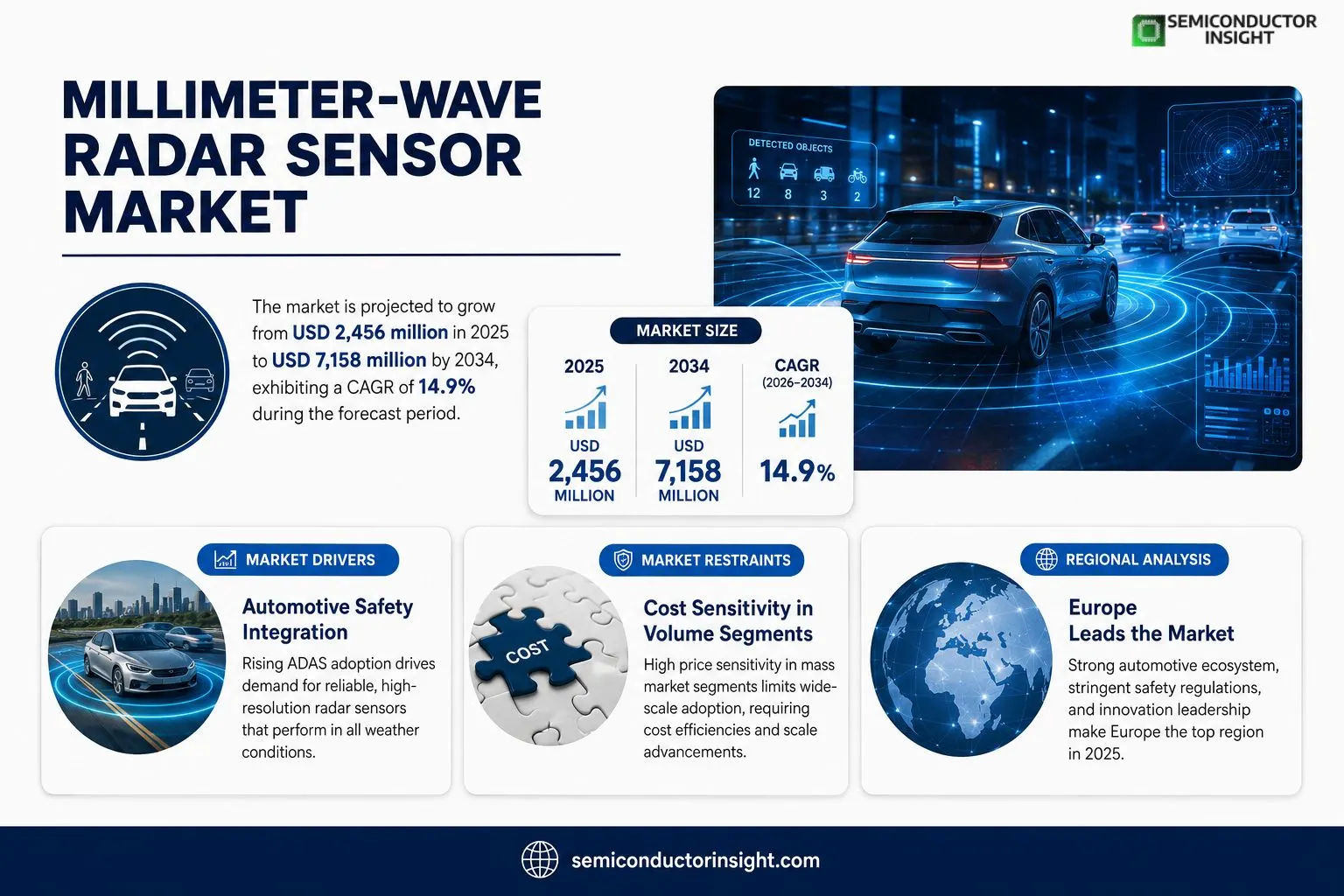
Millimeter-wave Radar Sensor market size was valued at USD 2,456 million in 2025 and is expected to reach USD 7,158 million by 2034, showing a CAGR of 14.9% during the forecast period.
Millimeter‑wave Radar Sensors operate in the 24‑81 GHz spectrum and convert radio‑frequency reflections into precise measurements of range, velocity, angle and micro‑motion. The technology is transitioning from a single automotive safety component toward a multi‑domain sensing platform that supports exterior ADAS, in‑cabin occupancy detection, industrial automation and smart‑home applications.The expansion is fueled by rising demand for advanced driver‑assistance systemswhere exterior ADAS accounted for over half of shipments in 2025combined with growing interest in cabin monitoring and robotics. Competitive pressure has shifted from pure chip specifications to integrated solutions that include transceivers, antenna packaging and software stacks. Leading suppliers such as Infineon, NXP, Texas Instruments, Asahi Kasei Microdevices (AKM) and emerging Chinese firms are accelerating product roadmaps to capture both automotive and non‑automotive segments.
`
MARKET DRIVERS
Automotive Safety Integration
The rise of advanced driver‑assistance systems (ADAS) has compelled OEMs to embed higher‑resolution sensing. Millimeter-wave Radar Sensor Market growth is fueled by the need for reliable distance measurement under adverse weather, a capability that optical sensors lack. Manufacturers that secure early access to automotive‑grade radar modules are positioning themselves to capture premium contracts.
5G Infrastructure Rollout
Telecom operators are retrofitting small‑cell sites with radar‑based monitoring to ensure line‑of‑sight compliance and to detect obstructions in real time. This deployment creates a parallel demand stream for radar chips, prompting semiconductor firms to realign R&D budgets toward higher‑frequency silicon‑on‑insulator platforms.
➤ “Integrating radar at the edge of the network not only safeguards link reliability but also opens a data‑rich frontier for smart‑city analytics.”
Industrial automation is another catalyst; factories adopting collaborative robots rely on millimeter‑wave sensors to maintain safe zones around moving equipment. The ripple effect is evident in contract awards for sensor‑fusion solutions, a trend that reinforces the market’s upward trajectory.
MARKET CHALLENGES
Regulatory Fragmentation
ly, frequency‑allocation policies differ markedly, forcing suppliers to certify multiple variants of the same product. The administrative burden translates into longer time‑to‑market cycles and higher unit costs, especially for firms lacking deep regulatory expertise.
Other Challenges
Supply‑Chain Volatility
Component shortages in high‑frequency substrates, coupled with fluctuating raw‑material prices, have introduced price instability. Tier‑1 manufacturers are increasingly buffering inventories, a practice that squeezes margins for smaller players.
MARKET RESTRAINTS
Cost Sensitivity in Volume Segments
While premium automotive and aerospace applications can absorb higher price points, mass‑market sectors such as consumer electronics remain highly price‑elastic. Millimeter-wave Radar Sensor Market therefore faces a ceiling in volume‑driven segments, where cost reductions must outpace incremental performance gains to achieve broader adoption.
MARKET OPPORTUNITIES
Emerging Robotics Platforms
Next‑generation service robots are being equipped with compact radar arrays that enable precise navigation in cluttered indoor environments. This niche, still in its infancy, promises a substantial upside as developers seek alternatives to lidar for low‑cost perception. Early entrants that tailor sensor packages for modular robot kits could secure sizable footholds before the space matures.
Millimeter-wave Radar Sensor Market Trends
Shift Toward Platform‑Centric Solutions
The 2025 shipment data reveal that the 76‑81 GHz band accounts for nearly two‑thirds of both unit volume and revenue, underscoring its dominance in exterior ADAS radar architectures. Yet manufacturers are no longer competing solely on raw sensitivity or range. The most valuable differentiator now lies in how effectively a supplier can embed RF performance into software‑rich outputsvelocity, angle, micro‑motion and trajectorywhile offering integrated transceiver‑antenna packages and qualification services. This evolution pushes Millimeter-wave Radar Sensor Market toward a platform model where hardware, firmware and design‑win support are bundled, raising the barrier to entry for niche chip‑only players.
Other Trends
Frequency Diversification Expands Application Reach
The 60 GHz segment, responsible for roughly a quarter of total shipments, is gaining importance beyond its current volume share. Its moderate cost and bandwidth make it suitable for cabin‑level sensing, industrial automation and smart‑space deployments. Meanwhile the 24 GHz band, although limited to under 10 % of units, persists in legacy short‑range programs and cost‑sensitive products. This spread of frequencies creates parallel growth paths: high‑end automotive retains the 76‑81 GHz focus, while 60 GHz fuels the emerging non‑automotive verticals, encouraging suppliers to maintain multi‑band portfolios.
Regional Ecosystems Shape Competitive Landscape
Output figures for 2025 show four clear regional anchors. Europe’s strength lies in high‑end automotive system integration, leveraging deep design expertise. North America benefits from a mature semiconductor infrastructure that accelerates industrial adoption. China combines low‑cost manufacturing with rapid iteration cycles, delivering volume at competitive prices. Japan continues to specialize in low‑power, cabin‑oriented modules with a reputation for reliability. The coexistence of these hubs means that market participants must tailor go‑to‑market strategies to regional value‑chain expectations, rather than pursuing a single playbook.
COMPETITIVE LANDSCAPE
Key Industry Players
Millimeter‑Wave Radar Sensor Market: Platform‑Centric Competition and Emerging Segments
The platform tier is currently dominated by a handful of ly integrated suppliers. Infineon, NXP and Texas Instruments combine high‑volume RF front‑ends with mature SoC integration, enabling OEMs to source complete transceiver and antenna‑packaging solutions for exterior ADAS and industrial automation. Their breadth of design‑in services, qualification libraries and mass‑production capabilities creates a de‑facto standard that squeezes out purely specification‑driven contenders. This concentration forces mid‑tier vendors to either align with one of the three ecosystem anchors or differentiate by offering specialised software stacks, safety‑critical workflow tools, or ultra‑low‑power variants that address cabin‑sensing and smart‑space use cases.Beyond the platform leaders, a vibrant cohort of niche innovators is reshaping specific frequency bands and form‑factor markets. Asahi Kasei Microdevices (AKM) and Acconeer focus on the 60 GHz segment, delivering low‑power, high‑resolution modules for in‑cabin sensing and robotics. Socionext leverages its image‑signal‑processor heritage to embed radar functions in multi‑sensor chips. A wave of Chinese companiesCalterah, Possumic Technology, AirTouch (Shanghai) Intelligent Technology, Iclegend Micro, SGR Semiconductors and ifLabelare scaling cost‑effective 76‑81 GHz solutions for volume automotive deployments while simultaneously courting the emerging industrial and consumer segments. Their rapid iteration cycles and localized supply chains give them a competitive edge in markets where price elasticity and time‑to‑market are paramount.
List of Key Millimeter-wave Radar Sensor Companies Profiled
- Infineon Technologies AG
- NXP Semiconductors
- Texas Instruments Inc.
- Asahi Kasei Microdevices (AKM)
- Socionext Inc.
- Acconeer AB
- KaiKuTeK (JMicron Technology)
- Calterah (Beijing) Technology Co., Ltd.
- Possumic Technology Co., Ltd.
- AirTouch (Shanghai) Intelligent Technology Co., Ltd.
- Iclegend Microelectronics Co., Ltd.
- SGR Semiconductors Ltd.
- ifLabel Technology Co., Ltd.
- STMicroelectronics
- Robert Bosch GmbH
Segment Analysis:
| Segment Category | Sub-Segments | Key Insights |
| By Type |
|
76‑81 GHz – Dominates the market as the preferred choice for high‑performance automotive exterior radar, offering robust range and angle resolution. • Enables richer perception data for advanced driver‑assistance systems, supporting functions such as adaptive cruise control and emergency braking. • Integrated platform solutions around this band include transceiver modules, sophisticated antenna arrays, and software stacks that accelerate system‑level integration. • Manufacturers focus on delivering end‑to‑end solutions rather than isolated chip performance, fostering tighter collaboration with OEMs. |
| By Application |
|
Automotive – Exterior ADAS – Remains the core growth engine, driven by the need for reliable long‑range detection and trajectory prediction. • The shift toward platform‑centric offerings means radar suppliers bundle hardware, firmware, and validation services to shorten time‑to‑market. • Emerging use‑cases such as cooperative perception and V2X integration are extending radar’s role beyond traditional safety functions. • Strong OEM demand encourages continual refinement of signal‑processing algorithms to improve clutter rejection and multi‑target tracking. |
| By End User |
|
Vehicle OEMs – Lead the adoption curve, seeking sensors that can be seamlessly integrated into vehicle architectures. • OEMs prioritize modular, software‑upgradable radar solutions that reduce redesign cycles for successive vehicle generations. • Collaborative development programs with tier‑1 suppliers accelerate validation across safety standards. • OEMs increasingly view radar as a data source for broader vehicle intelligence platforms, linking it with vision and lidar inputs. |
| By Functional Range |
|
Long‑range – Critical for highway‑level ADAS and autonomous driving, emphasizing high output power and low noise. • Vendors are integrating advanced beam‑forming architectures to enhance angular resolution without expanding antenna footprints. • Software ecosystems focus on predictive trajectory modeling, enabling smoother hand‑off to vehicle control systems. • The demand for long‑range capability is prompting cross‑domain collaborations with lidar and camera providers. |
| By Packaging |
|
Module‑level packages – Gaining traction as manufacturers aim to reduce board‑level complexity and accelerate time‑to‑market. • Modules combine antenna, RF front‑end, and digital processing in a calibrated package, simplifying OEM integration. • The trend supports rapid scaling for both automotive and industrial use‑cases, where mechanical robustness and thermal management are paramount. • Suppliers are offering customizable soft‑IP alongside hardware to address diverse application requirements. |
Regional Analysis: Millimeter-wave Radar Sensor Market
Europe
Vehicle manufacturers across the EU are embedding millimeter‑wave sensors into mid‑range models ahead of premium segments, driven by early adoption incentives and a desire to differentiate safety features. This shift is prompting suppliers to scale production while maintaining tight tolerances for automotive‑grade reliability.
Recent mergers among semiconductor fabs and sensor assemblers have reduced component lead times, granting European OEMs more predictability in sourcing. Consolidation also fuels joint R&D programs that target cost‑effective designs without sacrificing performance.
The EU’s forthcoming safety directives require finer object detection capabilities, effectively mandating higher‑frequency radar integration. Manufacturers that pre‑empt these standards are likely to capture the majority of forthcoming procurement cycles.
Collaborative labs in France and the Netherlands focus on sensor‑fusion algorithms, blending radar data with lidar and camera inputs. These initiatives sharpen market positioning for firms that can demonstrate integrated perception suites.
North America
In North America, Millimeter-wave Radar Sensor Market is heavily influenced by a fragmented supplier landscape and aggressive consumer‑driven adoption of advanced driver‑assistance systems. Silicon Valley’s venture capital environment continues to fund start‑ups that specialize in ultra‑compact radar modules, pressuring incumbents to innovate or partner. Simultaneously, federal safety guidelines are being updated to incorporate higher detection ranges, prompting automakers to redesign platform architectures. The convergence of these forces creates a competitive arena where speed-to-market and intellectual property depth become decisive advantages. Companies that can navigate the patent thicket while delivering cost‑effective volume units are poised to secure long‑term contracts with major OEMs.
Asia-Pacific
Asia‑Pacific exhibits a heterogeneous market, with China’s manufacturing scale, Japan’s precision engineering, and South Korea’s semiconductor expertise all feeding into Millimeter-wave Radar Sensor Market. Domestic automotive brands are accelerating feature roll‑outs to meet rising consumer expectations, while government subsidies for electric and autonomous vehicles stimulate demand for sophisticated radar solutions. However, divergent regulatory timelines across the region create a patchwork of compliance requirements, compelling suppliers to adopt flexible design platforms. Firms that can harmonize module specifications to satisfy multiple standards will benefit from the region’s accelerated rollout schedules and expanding export opportunities.
South America
In South America, Millimeter-wave Radar Sensor Market remains nascent, yet it is gaining traction as regional automakers modernize fleets to compete with imported vehicles. Economic volatility has limited large‑scale investment, but focused government initiatives aimed at improving road safety are encouraging the adoption of radar‑enhanced safety systems. Local assemblers are beginning to source sensors from nearby manufacturing hubs, reducing lead times and fostering a modest but growing supply chain. The market’s evolution will likely hinge on the ability of providers to deliver affordable, ruggedized sensors that can withstand the continent’s diverse climatic conditions.
Middle East & Africa
The Middle East & Africa present a mixed outlook for Millimeter-wave Radar Sensor Market. Wealth‑driven demand in Gulf Cooperation Council countries fuels premium vehicle sales, creating a niche for high‑performance radar units. Conversely, many African nations prioritize cost‑sensitive mobility solutions, limiting widespread adoption. Infrastructure projects that incorporate smart‑city technologies are beginning to embed radar sensors for traffic monitoring, offering a secondary avenue for market entry. Providers that can tailor pricing models and adapt sensor robustness to desert and tropical environments stand to capture the limited but strategically valuable opportunities across this diverse region.
Report Scope
This market research report provides a comprehensive analysis of the Millimeter-wave Radar Sensor Market , covering the forecast period 2026–2034. It offers detailed insights into market dynamics, technological advancements, competitive landscape, and key trends shaping the industry.
Key focus areas of the report include:
- Market Overview: The report begins with an overview outlining its current market scenario, key growth indicators, and industry transformation drivers. It discusses macroeconomic factors, demand–supply balance, regulatory landscape, and the strategic role of semiconductors in powering advancements across industries such as automotive, telecommunications, consumer electronics, and industrial automation.
- Market Size & Forecast: Historical data and future projections for revenue, unit shipments, and market value across major regions and segments.
- Segmentation Analysis: Detailed breakdown by product type, technology, application, and end-user industry to identify high-growth segments and investment opportunities.
- Regional Insights: Insights into market performance across North America, Europe, Asia-Pacific, Latin America, and the Middle East & Africa, including country-level analysis where relevant.
- Competitive Landscape: Profiles of leading market participants, including their product offerings, R&D focus, manufacturing capacity, pricing strategies, and recent developments such as mergers, acquisitions, and partnerships.
- Technology Trends & Innovation: Assessment of emerging technologies, integration of AI/IoT, semiconductor design trends, fabrication techniques, and evolving industry standards.
- Market Drivers & Restraints: Evaluation of factors driving market growth along with challenges, supply chain constraints, regulatory issues, and market-entry barriers.
- Stakeholder Insights: Insights for component suppliers, OEMs, system integrators, investors, and policymakers regarding the evolving ecosystem and strategic opportunities.
Primary and secondary research methods are employed, including interviews with industry experts, data from verified sources, and real-time market intelligence to ensure the accuracy and reliability of the insights presented.
FREQUENTLY ASKED QUESTIONS:
What is the current market size of Millimeter-wave Radar Sensor Market?
-> Millimeter-wave Radar Sensor Market was valued at USD 2,456 million in 2025 and is expected to reach USD 7,158 million by 2034 with a CAGR of 14.9%.
Which key companies operate in Millimeter-wave Radar Sensor Market?
-> Key players include Infineon, NXP, Texas Instruments, Asahi Kasei Microdevices (AKM), Socionext, Acconeer, Calterah, Possumic Technology, AirTouch (Shanghai) Intelligent Technology, Iclegend Micro, SGR Semiconductors, ifLabel.
What are the key growth drivers?
-> Key growth drivers include rising adoption of automotive exterior ADAS radars, expansion into cabin sensing, industrial automation, smart‑space applications, and the shift toward cross‑domain sensing platforms that deliver richer RF‑derived data such as range, velocity, angle, and occupancy.
Which region dominates the market?
-> Europe recorded the highest shipment volume in 2025, making it the leading region, followed by North America, China, and Japan.
What are the emerging trends?
-> Emerging trends include integration of AI/IoT for advanced perception, development of multi‑frequency radar solutions (76‑81 GHz, 60 GHz, 24 GHz), and the broadening of radar use cases into cabin sensing, robotics, and smart‑home environments.
Get Sample Report PDF for Exclusive Insights
Report Sample Includes
- Table of Contents
- List of Tables & Figures
- Charts, Research Methodology, and more...