4D Full-Range Radar Market Insights
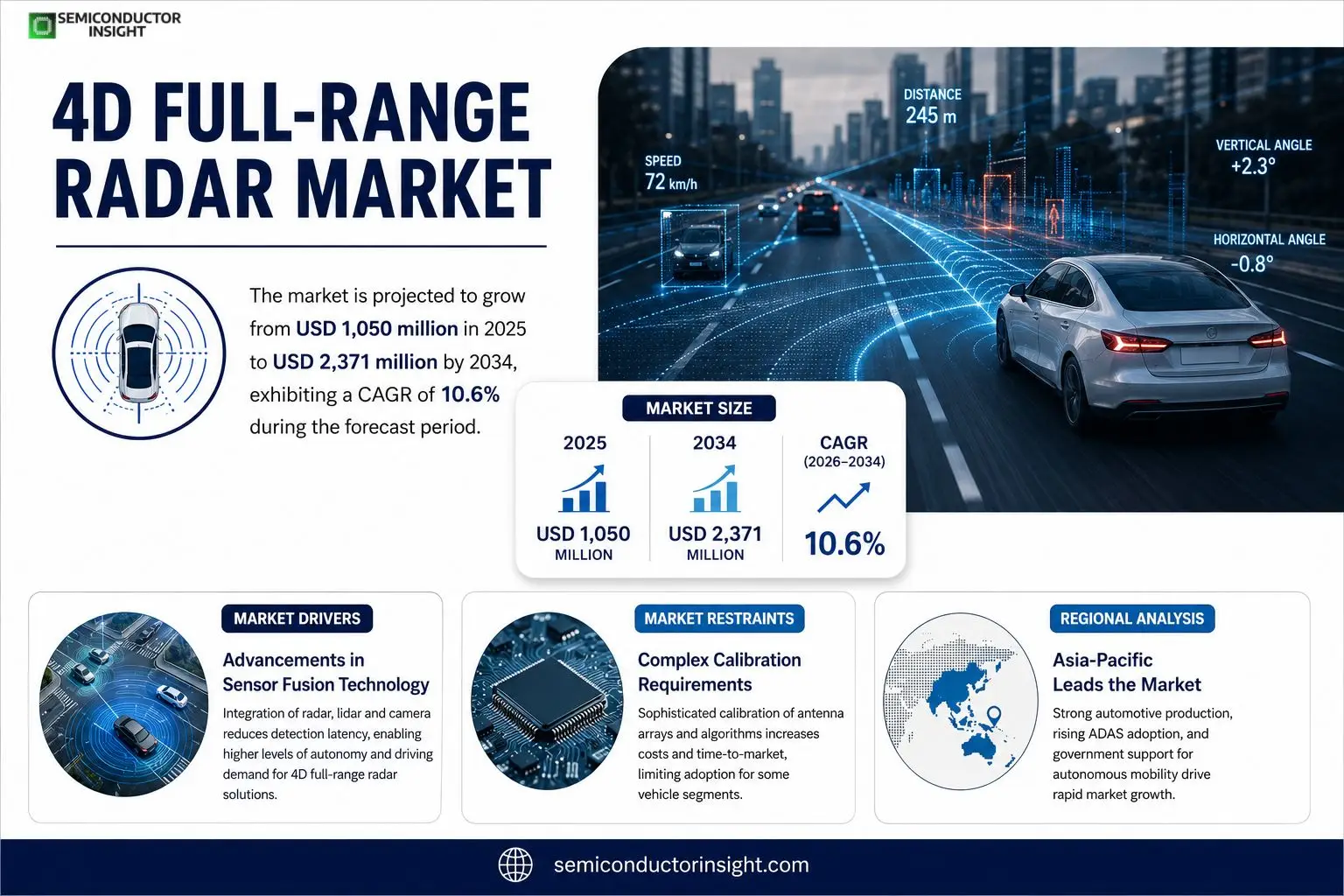
4D Full-Range Radar market size was USD 1050 million in 2025 and is forecasted to reach USD 2371 million by 2034, reflecting a CAGR of 10.6 % over the period.
4D imaging radar represents an advanced automotive perception system capable of capturing distance, speed, horizontal angle and vertical angle simultaneously. Leveraging MIMO antenna arrays, digital beamforming and sophisticated signal‑processing algorithms, it produces high‑resolution point‑cloud data that surpasses conventional three‑dimensional radar in accuracy and range.The surge in adoption stems from expanding advanced driver‑assistance systems such as adaptive cruise control, automatic emergency braking and autonomous navigation. Integration of radar‑on‑chip solutions trims system size while preserving performance, prompting OEMs and Tier‑1 suppliers to intensify R&D efforts on resolution, range extension and multi‑target tracking. Moreover, regulatory emphasis on vehicle safety standards and the growing share of electric and autonomous vehicles further stimulate market uptake.
MARKET DRIVERS
Advancements in Sensor Fusion Technology
The integration of lidar, camera and radar data streams has lowered detection latency, enabling automotive OEMs to design advanced driver‑assistance systems that rely heavily on 4D Full‑Range Radar. This technical convergence fuels demand because manufacturers can now certify higher levels of autonomy without prohibitive hardware costs. Strategic partnerships between semiconductor firms and Tier‑1 suppliers are accelerating rollout schedules.
Regulatory Momentum for Safer Vehicles
Legislative bodies across Europe and North America are tightening mandatory safety standards, particularly around blind‑spot monitoring and automatic emergency braking. The stricter rules compel original equipment manufacturers to adopt sensors that deliver longer range and higher resolution, directly benefitting the 4D Full‑Range Radar Market. Companies that pre‑emptively certify their hardware gain a competitive edge in procurement auctions.
➤ “Customers now expect a radar that can resolve objects at 250 m with centimeter‑level accuracy, a benchmark that was unimaginable a few years ago.”
Beyond safety, the ability of 4D radars to operate reliably in adverse weather expands their relevance to logistics fleets and heavy‑truck applications. Fleet operators, seeking to minimize downtime, view the technology as a cost‑effective alternative to expensive lidar arrays, thereby widening the addressable market.
MARKET CHALLENGES
High Capital Expenditure for Volume Production
Scaling the sophisticated semiconductor processes required for 4D Full‑Range Radar entails multi‑million dollar investments in wafer fabs and testing facilities. Smaller OEMs often lack the financial bandwidth to absorb these upfront costs, which stalls broader adoption in budget‑segment vehicles.
Other Challenges
Supply‑Chain Volatility
Fluctuations in silicon wafer availability and geopolitical tensions in key manufacturing regions have introduced lead‑time extensions. When component deliveries are delayed, program schedules slip, eroding confidence among auto makers who operate on tight model‑year timelines.
MARKET RESTRAINTS
Complex Calibration Requirements
Achieving optimal performance from a 4D Full‑Range Radar system demands intricate calibration of antenna arrays, signal‑processing algorithms and vehicle dynamics models. The calibration process is time‑consuming and often requires specialized expertise, which raises the total cost of ownership for manufacturers.
Competing Sensor Technologies
While radar offers unrivaled penetration through rain and fog, advancements in solid‑state lidar and high‑resolution cameras have narrowed the performance gap. Some OEMs are opting for hybrid sensor stacks that prioritize lighter, cheaper components, potentially limiting the growth ceiling of the radar segment.
MARKET OPPORTUNITIES
Expansion into Aftermarket Retrofitting
As fleet operators seek to upgrade legacy fleets without full vehicle replacement, aftermarket kits that embed 4D Full‑Range Radar are gaining traction. Retrofit solutions promise a rapid revenue stream for sensor manufacturers, especially in regions where vehicle turnover is slower.
Integration with Edge‑AI Platforms
Embedding AI accelerators at the edge of the radar hardware enables real‑time object classification and predictive path planning. Companies that bundle edge‑AI capabilities with radar modules can command higher margins and differentiate themselves in a crowded supplier landscape.
4D Full-Range Radar Market Trends
Integration of Radar‑on‑Chip Drives Compact ADAS Solutions
The migration of radar functionality onto silicon chips is reshaping vehicle electronics architecture. By consolidating antenna feeding networks, mixers and converters into a single die, manufacturers can slash system volume while preserving detection range. This shift is especially attractive for electric‑based platforms where packaging constraints are tight and weight savings translate directly into range efficiency. OEMs that adopt chip‑level radar see faster validation cycles because fewer discrete components reduce board‑level variability. Consequently, the supply chain is redirecting investment toward advanced CMOS processes, and Tier‑1 partners are renegotiating contracts to secure access to the limited wafer capacity required for high‑volume production.
Other Trends
MIMO Antenna Evolution Boosts Resolution
Multi‑input multi‑output (MIMO) arrays are moving from modest element counts toward dense lattice configurations. The higher element density yields narrower beams, allowing the sensor to differentiate closely spaced objects that previously appeared as a single echo. Automotive developers leverage this granularity to refine lane‑keeping algorithms and to improve pedestrian classification at urban intersections. The upside is a measurable lift in safety‑system performance, which in turn pressures regulation bodies to update benchmark tests, compelling suppliers to embed the latest MIMO designs in their next product releases.
Shift Toward Multi‑Band Architectures for Diverse Vehicle Classes
Different vehicle segments demand distinct radar reach and angular coverage. To address this, system architects are embedding multiple frequency bandssuch as 24 GHz for short‑range urban use and 77 GHz for highway cruisingwithin a single enclosure. This hybrid approach lets a single radar unit serve both forward‑facing and side‑looking functions, simplifying wiring harnesses. Manufacturers that master cross‑band signal processing gain a competitive edge by offering a unified hardware platform that can be tuned via software updates for varying market demands. The broader industry implication is a consolidation of component inventories and a reduction in overall bill‑of‑materials for vehicle programs.
COMPETITIVE LANDSCAPE
Key Industry Players
Competitive Overview of the 4D Full‑Range Radar Sector
ZF Friedrichshafen AG dominates the high‑performance segment, leveraging its deep automotive heritage and extensive tier‑1 supplier network to secure long‑term contracts with major OEMs in Europe and North America. The company’s integrated radar‑on‑chip portfolio, coupled with a strong emphasis on software‑defined signal processing, positions it as the benchmark for system reliability and scalability. ZF’s strategic acquisitions of niche antenna‑array designers have widened its addressable market, allowing the firm to capture a sizable share of both ADAS and fully autonomous vehicle projects. This dominance forces rivals to either specialize in differentiated frequency bands or pursue collaborative R&D alliances that can accelerate time‑to‑market for next‑generation perception suites.Beyond the incumbent leaders, a cohort of agile innovators is reshaping the competitive equation. Vayyar and Qamcom target the premium‑car segment with ultra‑compact 4D imaging modules that emphasize vertical angle resolution, while Altos Radar and Smartmicro focus on cost‑effective solutions for mass‑market electric vehicles in Asia. Huawei’s aggressive push into automotive silicon, supported by its 5G ecosystem, introduces a compelling cross‑industry value proposition. Meanwhile, European specialists such as Arbe and RadSee are carving out niches in high‑frequency (77 GHz) radar for advanced driver‑assistance systems, and Chinese firms including SINPRO Intelligent Technology (Shanghai) Co., Ltd., Shenzhen Chengtai Technology Co. Ltd, and Whst Co., Ltd. are expanding production capacity to meet regional demand surges. This heterogeneous landscape creates a dynamic environment where differentiation hinges on integration depth, algorithmic sophistication, and the ability to meet disparate regulatory standards.
List of Key 4D Full‑Range Radar Companies Profiled
- ZF Friedrichshafen AG
- Continental AG
- Aptiv
- Huawei
- Vayyar
- Qamcom
- Altos Radar
- Smartmicro
- Arbe
- RadSee
- SINPRO Intelligent Technology (Shanghai) Co., Ltd.
- Shenzhen Chengtai Technology Co. Ltd
- Ambarella
- Geometrical Perception and Learning
- ANNGIC
- Whst Co., Ltd.
Segment Analysis:
| Segment Category | Sub-Segments | Key Insights |
| By Type |
|
Mid‑Range (100‑300 m) provides a balanced mix of detection reach and cost efficiency, making it the preferred choice for most ADAS functions.
|
| By Application |
|
Automotive (Car) remains the dominant arena, driven by intensive integration with ADAS and autonomous driving stacks.
|
| By End User |
|
OEMs shape the market direction by defining radar specifications early in vehicle platforms.
|
| By Technology |
|
Radar‑on‑Chip is emerging as the pivotal technology, shrinking module footprints while sustaining performance.
|
| By Value Chain |
|
System Integration Services command growing attention as manufacturers seek end‑to‑end validation.
|
Regional Analysis: 4D Full-Range Radar Market
North America
OEMs and defense contractors in the United States are piloting semiconductor‑on‑silicon‑lens architectures that compress antenna arrays without sacrificing angular fidelity, accelerating product cycles for 4D Full-Range Radar solutions.
Federal agencies have issued guidance that recognises 4D radar signatures as a standard metric for autonomous vehicle safety assessments, prompting quicker certification pathways for compliant systems.
Beyond traditional aerospace, logistics firms are exploring 4D radar for warehouse automation, where three‑dimensional scene awareness can optimise robotic navigation and obstacle avoidance.
Leading chipset producers are leveraging strategic alliances with software firms to bundle AI‑driven target classification, differentiating their 4D Full-Range Radar offerings from commodity radar kits.
Europe
European defence ministries have incorporated 4D Full-Range Radar into joint air‑defence initiatives, leveraging cross‑border procurement to share development costs. Automotive clusters in Germany and France are aligning standards bodies to harmonise sensor data formats, a move that lowers integration friction for vehicle manufacturers. Meanwhile, EU funding programmes are earmarked for research on low‑power radar modules suitable for electric vehicles, reinforcing Europe’s role as a regulatory and standard‑setting nucleus.
Asia‑Pacific
In Asia‑Pacific, rapid urbanisation fuels demand for traffic‑management solutions that rely on high‑resolution radar to monitor congestion and improve safety. Countries such as Japan and South Korea are investing heavily in autonomous mobility pilots, where 4D radar’s ability to detect pedestrians at varying heights offers a clear advantage. China’s state‑backed semiconductor push is accelerating domestic chip production, positioning the region to become a major manufacturing hub for next‑generation radar arrays.
South America
South American markets are beginning to explore 4D Full-Range Radar for border surveillance and maritime monitoring, where terrain‑induced clutter has traditionally limited conventional radar efficacy. Emerging automotive joint ventures are testing these sensors in pilot fleets to address the continent’s diverse road conditions, from dense city streets to remote high‑altitude routes. Government incentives for indigenous technology development are encouraging local firms to co‑develop signal‑processing algorithms tailored to regional operating environments.
Middle East & Africa
The Middle East leverages 4D Full-Range Radar to reinforce oil‑field security and critical infrastructure monitoring, benefitting from the technology’s ability to track low‑observable threats in desert environments. In Africa, pilot projects are evaluating radar‑based early‑warning systems for wildlife protection and anti‑poaching operations, where three‑dimensional tracking can differentiate animal movement from human intrusion. Collaborative research centres are emerging, linking universities with defense contractors to adapt radar waveforms for the region’s unique atmospheric conditions.
Report Scope
This market research report provides a comprehensive analysis of the 4D Full-Range Radar Market , covering the forecast period 2026–2034. It offers detailed insights into market dynamics, technological advancements, competitive landscape, and key trends shaping the industry.
Key focus areas of the report include:
- Market Overview: The report begins with an overview outlining its current market scenario, key growth indicators, and industry transformation drivers. It discusses macroeconomic factors, demand–supply balance, regulatory landscape, and the strategic role of semiconductors in powering advancements across industries such as automotive, telecommunications, consumer electronics, and industrial automation.
- Market Size & Forecast: Historical data and future projections for revenue, unit shipments, and market value across major regions and segments.
- Segmentation Analysis: Detailed breakdown by product type, technology, application, and end-user industry to identify high-growth segments and investment opportunities.
- Regional Insights: Insights into market performance across North America, Europe, Asia-Pacific, Latin America, and the Middle East & Africa, including country-level analysis where relevant.
- Competitive Landscape: Profiles of leading market participants, including their product offerings, R&D focus, manufacturing capacity, pricing strategies, and recent developments such as mergers, acquisitions, and partnerships.
- Technology Trends & Innovation: Assessment of emerging technologies, integration of AI/IoT, semiconductor design trends, fabrication techniques, and evolving industry standards.
- Market Drivers & Restraints: Evaluation of factors driving market growth along with challenges, supply chain constraints, regulatory issues, and market-entry barriers.
- Stakeholder Insights: Insights for component suppliers, OEMs, system integrators, investors, and policymakers regarding the evolving ecosystem and strategic opportunities.
Primary and secondary research methods are employed, including interviews with industry experts, data from verified sources, and real-time market intelligence to ensure the accuracy and reliability of the insights presented.
FREQUENTLY ASKED QUESTIONS:
What is the current market size of 4D Full-Range Radar Market?
-> 4D Full-Range Radar Market was valued at USD 1050 million in 2025 and is expected to reach USD 2371 million by 2034, growing at a CAGR of 10.6% during the forecast period.
Which key companies operate in 4D Full-Range Radar Market?
-> Key players include ZF Friedrichshafen AG, Vayyar, Qamcom, Continental AG, Altos Radar, Aptiv, HUAWEI, Ambarella, Smartmicro, Geometrical Perception and Learning, ANNGIC, Whst Co., Ltd., SINPRO Intelligent Technology (Shanghai) Co., Ltd., Shenzhen Chengtai Technology Co. Ltd, Arbe, RadSee.
What are the key growth drivers?
-> Key growth drivers include increasing demand for advanced driver-assistance systems (ADAS) and autonomous driving technologies, enhanced object detection and real‑time data processing, adoption of radar‑on‑chip technologies, regulatory support for vehicle safety standards, and the expanding electric and autonomous vehicle market.
Which region dominates the market?
-> Asia‑Pacific is the leading region in terms of production and adoption, while Europe remains a significant market due to a strong automotive manufacturing base.
What are the emerging trends?
-> Emerging trends include radar‑on‑chip integration, higher‑resolution MIMO antenna arrays, AI‑enhanced signal processing, and expanded use of 4D imaging radar in autonomous driving, advanced cruise control, and safety systems.
Get Sample Report PDF for Exclusive Insights
Report Sample Includes
- Table of Contents
- List of Tables & Figures
- Charts, Research Methodology, and more...
 Download Sample Report PDF