Millimeter Wave Sensor for Remote Patient Monitoring Market Insights
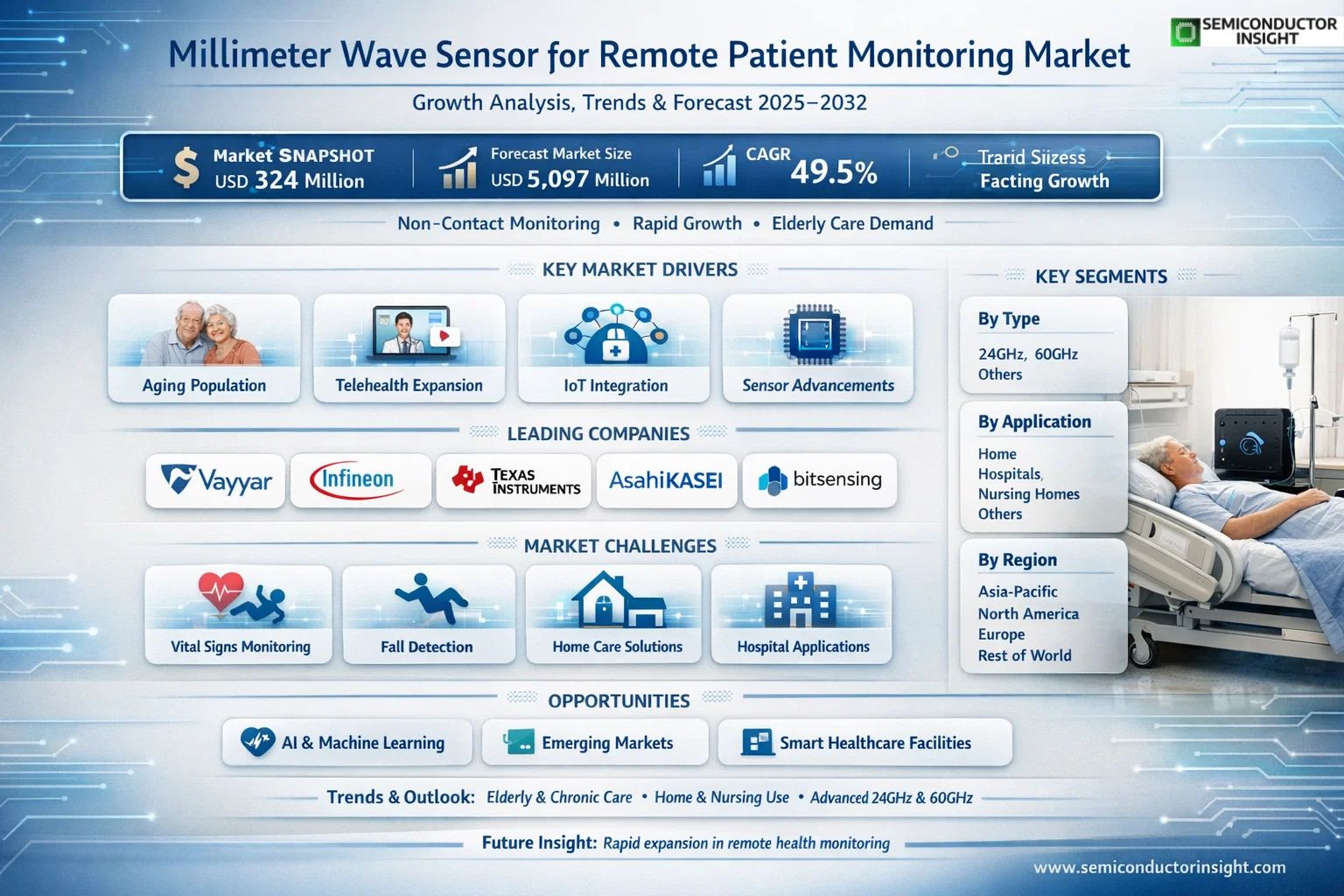
Global Millimeter Wave Sensor for Remote Patient Monitoring market size was valued at USD 324 million in 2025. The market is projected to reach USD 5,097 million by 2032, exhibiting a CAGR of 49.5% during the forecast period.
A millimeter wave (mmWave) sensor is a high-frequency electromagnetic wave device, typically operating at 24GHz or 60GHz, designed for non-contact remote patient monitoring. This technology detects minute movements and physiological changes, enabling accurate measurement of vital signs such as heart rate, respiration, and even fall detection without physical contact. In healthcare, mmWave sensors provide a comfortable and hygienic solution for continuous monitoring, especially suited for managing chronic conditions and elderly care.
The market is experiencing rapid growth due to several factors, including increased investment in healthcare IoT, rising demand for non-contact vital signs monitoring, and an expanding elderly population. Additionally, advancements in radar sensing technologies are contributing to market expansion. Initiatives by the key players in the market are also expected to fuel the growth. Vayyar Imaging, Asahi Kasei Group, Infineon Technologies, Texas Instruments, bitsensing, Iflabel, and Qinglei Tech are some of the key players that operate in the market with a wide range of portfolios.
MARKET DRIVERS
Aging Population and Chronic Disease Prevalence
Millimeter Wave Sensor for Remote Patient Monitoring Market is propelled by the global aging population, with over 1.5 billion people expected to be aged 60 and above by 2050. These sensors enable non-contact detection of vital signs like heart rate and respiration, reducing the need for physical interactions and supporting home-based care for chronic conditions such as cardiovascular diseases and diabetes.
Post-Pandemic Telehealth Surge
The COVID-19 pandemic accelerated telehealth adoption, with remote monitoring solutions growing at a 28% CAGR since 2020. Millimeter wave technology stands out for its accuracy in cluttered environments, driving demand in Millimeter Wave Sensor for Remote Patient Monitoring Market as healthcare providers prioritize contactless solutions.
➤ Integration with IoT ecosystems enhances real-time data transmission, boosting market penetration in hospital and home settings.
Advancements in sensor miniaturization and signal processing further fuel growth, enabling seamless deployment in wearables and smart home devices for continuous patient surveillance.
MARKET CHALLENGES
High Development and Deployment Costs
Developing millimeter wave sensors involves sophisticated radar technology, leading to elevated costs that challenge widespread adoption in Millimeter Wave Sensor for Remote Patient Monitoring Market. Initial investments often exceed $500,000 per deployment, limiting scalability for smaller healthcare providers.
Other Challenges
Regulatory Compliance and Data Privacy
Stringent FDA and GDPR regulations require extensive validation trials, delaying market entry by up to 18 months. Ensuring patient data security amid rising cyber threats adds complexity to integration.Interoperability issues with legacy healthcare systems further hinder seamless data flow, requiring customized solutions that increase operational expenses.
MARKET RESTRAINTS
Technical Limitations in Accuracy
Millimeter wave sensors face challenges in multi-person environments, where signal interference reduces vital sign detection accuracy to below 90% in some cases, restraining growth in Millimeter Wave Sensor for Remote Patient Monitoring Market. Motion artifacts from patient movement exacerbate these issues.High power consumption compared to optical sensors limits battery life in portable devices, necessitating frequent recharges that disrupt continuous monitoring.Limited spectrum availability due to 5G allocations creates bandwidth constraints, impacting sensor performance in dense urban healthcare settings.These factors collectively slow market expansion despite technological promise.
MARKET OPPORTUNITIES
AI and Machine Learning Integration
Millimeter Wave Sensor for Remote Patient Monitoring Market presents opportunities through AI-driven analytics, improving predictive capabilities for early disease detection with up to 95% accuracy in anomaly identification. Partnerships with tech giants could accelerate this trend.Expansion into emerging markets like Asia-Pacific, where telehealth penetration is rising at 32% annually, offers untapped potential for cost-effective deployments.Growth in elderly care facilities and smart hospitals, projected to add $2.5 billion in market value by 2028, underscores demand for scalable solutions.
Millimeter Wave Sensor for Remote Patient Monitoring Market Trends
Rising Adoption in Elderly and Chronic Care Monitoring
Millimeter wave sensors operating at frequencies like 24GHz and 60GHz are gaining traction in remote patient monitoring due to their ability to detect minute movements for vital signs such as heart rate and respiration without physical contact. This non-invasive approach enhances patient comfort and hygiene, particularly in managing chronic conditions and elderly care, where continuous monitoring is essential. Healthcare providers increasingly favor these sensors for their precision in fall detection and physiological tracking, aligning with broader shifts toward contactless technologies post-pandemic.
Other Trends
Expansion in Home and Nursing Home Applications
The home segment and nursing homes represent key application areas for millimeter wave sensors in remote patient monitoring, driven by the need for unobtrusive, real-time health oversight. These settings benefit from sensors that enable independent living for seniors while providing caregivers with actionable data on vital signs. Industry surveys highlight growing demand in these areas, as they support aging populations and reduce hospital readmissions through proactive monitoring.
Competitive Dynamics Among Key Manufacturers
Leading players such as Vayyar Imaging, Asahi Kasei Group, Infineon Technologies, Texas Instruments, bitsensing, Iflabel, and Qinglei Tech dominate the millimeter wave sensor landscape for remote patient monitoring. These companies focus on innovation in product types including 24GHz and 60GHz variants, alongside other frequencies, to capture shares in hospital, home, and nursing home markets. Recent developments emphasize integration with existing healthcare systems, mergers, and enhanced sensor capabilities to address industry challenges like pricing and regulatory hurdles. Regional dynamics show strong potential in North America, Europe, and Asia, with countries like the US, China, Germany, and Japan leading adoption due to advanced healthcare infrastructures and research investments. This competitive environment fosters rapid advancements, enabling better market penetration across diverse applications and geographies.
COMPETITIVE LANDSCAPE
Key Industry Players
Leading Innovators in Millimeter Wave Sensors for Remote Patient Monitoring
Millimeter Wave Sensor for Remote Patient Monitoring Market is characterized by a dynamic competitive landscape dominated by semiconductor giants and specialized radar technology firms. Leading players such as Infineon Technologies and Texas Instruments hold substantial market shares, leveraging their extensive portfolios in 24GHz and 60GHz mmWave radar chips optimized for non-contact detection of vital signs like heart rate and respiration. Vayyar Imaging emerges as a key innovator with its 4D imaging capabilities, enabling precise movement tracking for fall detection and elderly care. These top-tier companies collectively command a significant revenue portion, driving an oligopolistic structure fueled by the market’s explosive 49.5% CAGR from 2025 to 2032, as healthcare shifts toward hygienic, continuous remote monitoring solutions.
Besides the frontrunners, a cadre of niche players including Asahi Kasei Group, bitsensing, and Qinglei Tech are carving out specialized segments through tailored integrations for nursing homes, hospitals, and home applications. These firms emphasize AI-enhanced signal processing and low-power designs, addressing challenges in multi-person environments and regulatory compliance. Emerging contributors like Iflabel and Acconeer AB focus on compact, cost-effective sensors, expanding adoption in Asia-Pacific and North America. This tier fosters innovation in IoT interoperability, positioning the market for broader penetration amid rising chronic disease management demands.
List of Key Millimeter Wave Sensor for Remote Patient Monitoring Companies Profiled
- Vayyar Imaging
- Infineon Technologies
- Texas Instruments
- Asahi Kasei Group
- bitsensing
- Iflabel
- Qinglei Tech
- Acconeer AB
- Novelda AS
- NXP Semiconductors
- STMicroelectronics
- Renesas Electronics
- Sony Semiconductor Solutions
Segment Analysis:
| Segment Category | Sub-Segments | Key Insights |
| By Type |
|
24GHz
|
| By Application |
|
Home
|
| By End User |
|
Homecare
|
| By Monitoring Parameter |
|
Fall Detection
|
| By Deployment Type |
|
Fixed Installation
|
Regional Analysis: Millimeter Wave Sensor for Remote Patient Monitoring Market
North America
Innovations in millimeter wave sensor precision dominate North America, with enhanced signal processing enabling accurate vital signs monitoring amid motion. Integration with 5G networks boosts data speeds for real-time remote patient oversight. R&D hubs focus on low-power designs, extending battery life for portable devices in homecare settings.
Primary uses include elderly care and chronic condition tracking, where sensors detect subtle physiological changes remotely. Hospitals deploy them for post-discharge monitoring, reducing readmissions. Telehealth platforms embed these for virtual consultations, enhancing patient outcomes through continuous oversight.
FDA guidelines streamline approvals for medical-grade sensors, emphasizing safety and efficacy. Compliance with HIPAA ensures secure data handling, building trust. Streamlined pathways encourage market entry, supporting trends in scalable remote monitoring solutions.
Leading firms pursue mergers and AI integrations to differentiate offerings. Focus on user-friendly interfaces drives adoption. Strategic alliances with telehealth providers expand reach, shaping business strategies for long-term market leadership.
Europe
Europe displays robust growth in Millimeter Wave Sensor for Remote Patient Monitoring Market, fueled by comprehensive public health systems and an aging populace. Emphasis on data sovereignty under GDPR influences sensor architectures for secure, localized processing. Collaborative EU initiatives promote standardization, enabling cross-national deployments in rural areas. Trends lean toward hybrid systems combining millimeter wave with optical sensors for comprehensive monitoring. Business strategies emphasize sustainability, with eco-friendly manufacturing gaining traction. Healthcare providers prioritize interoperability with existing digital health records, addressing fragmented care delivery. Investments in pilot programs for dementia and cardiovascular patients highlight the region’s proactive stance, positioning Europe as a key innovator through 2034.
Asia-Pacific
Asia-Pacific emerges as a high-potential region in Millimeter Wave Sensor for Remote Patient Monitoring Market, driven by rapid urbanization and expanding healthcare access. Dense populations and rising chronic ailments spur demand for affordable, scalable sensor solutions. Manufacturing prowess supports cost-effective production, facilitating exports. Government-backed digital health initiatives accelerate adoption in smart cities. Trends focus on mobile-integrated sensors for widespread homecare use. Business strategies involve localization and partnerships with local telecoms for 5G-enabled monitoring. Challenges like infrastructure gaps are met with innovative edge computing, ensuring reliable remote patient insights amid diverse regulatory environments.
South America
South America shows promising momentum in Millimeter Wave Sensor for Remote Patient Monitoring Market, propelled by improving telemedicine infrastructures and underserved rural populations. Economic recovery enables healthcare digitization, with sensors addressing access barriers through non-contact monitoring. Public-private partnerships drive pilots for maternal and infectious disease tracking. Trends emphasize low-cost, rugged designs suited to varied climates. Business strategies center on affordability and training programs for healthcare workers. Regional collaborations foster technology transfer, enhancing capacity for remote oversight and positioning South America for accelerated expansion.
Middle East & Africa
The Middle East & Africa region advances steadily in Millimeter Wave Sensor for Remote Patient Monitoring Market, supported by oil-funded health investments and mobile penetration. Arid climates favor dust-resistant sensors for nomadic and remote communities. Visionary smart city projects integrate them into urban health networks. Trends highlight solar-powered variants for off-grid areas. Business strategies prioritize public tenders and workforce upskilling. Addressing disease burdens like diabetes through proactive monitoring underscores potential, with international aid accelerating adoption across diverse terrains.
Report Scope
This market research report provides a comprehensive analysis of Millimeter Wave Sensor for Remote Patient Monitoring Market, covering the forecast period 2025–2032. It offers detailed insights into market dynamics, technological advancements, competitive landscape, and key trends shaping the industry.
Key focus areas of the report include:
- Market Overview: The report begins with an overview outlining its current market scenario, key growth indicators, and industry transformation drivers. It discusses macroeconomic factors, demand–supply balance, regulatory landscape, and the strategic role of millimeter wave sensors in powering advancements across healthcare industries such as nursing homes, hospitals, home care, and elderly monitoring.
- Market Size & Forecast: Historical data and future projections for revenue, unit shipments, and market value across major regions and segments.
- Segmentation Analysis: Detailed breakdown by product type, technology, application, and end-user industry to identify high-growth segments and investment opportunities.
- Regional Insights: Insights into market performance across North America, Europe, Asia-Pacific, Latin America, and the Middle East & Africa, including country-level analysis where relevant.
- Competitive Landscape: Profiles of leading market participants, including their product offerings, R&D focus, manufacturing capacity, pricing strategies, and recent developments such as mergers, acquisitions, and partnerships.
- Technology Trends & Innovation: Assessment of emerging technologies, integration of AI/IoT, semiconductor design trends, fabrication techniques, and evolving industry standards.
- Market Drivers & Restraints: Evaluation of factors driving market growth along with challenges, supply chain constraints, regulatory issues, and market-entry barriers.
- Stakeholder Insights: Insights for component suppliers, OEMs, system integrators, investors, and policymakers regarding the evolving ecosystem and strategic opportunities.
Primary and secondary research methods are employed, including interviews with industry experts, data from verified sources, and real-time market intelligence to ensure the accuracy and reliability of the insights presented.
FREQUENTLY ASKED QUESTIONS:
What is the current market size of Millimeter Wave Sensor for Remote Patient Monitoring Market?
-> Millimeter Wave Sensor for Remote Patient Monitoring Market was valued at USD 324 million in 2025 and is expected to reach USD 5,097 million by 2032, at a CAGR of 49.5%.
Which key companies operate in Millimeter Wave Sensor for Remote Patient Monitoring Market?
-> Key players include Vayyar Imaging, Asahi Kasei Group, Infineon Technologies, Texas Instruments, bitsensing, Iflabel, Qinglei Tech, among others.
What are the key growth drivers?
-> Key growth drivers include demand for non-contact vital signs monitoring, aging population managing chronic conditions, and hygienic solutions for continuous elderly care.
Which region dominates the market?
-> North America is a dominant market, while Asia shows significant growth potential.
What are the emerging trends?
-> Emerging trends include 24GHz and 60GHz mmWave sensors for heart rate, respiration, and fall detection in nursing homes, hospitals, and home settings.

Get Sample Report PDF for Exclusive Insights
Report Sample Includes
- Table of Contents
- List of Tables & Figures
- Charts, Research Methodology, and more...
 Download Sample Report PDF