Millimeter-wave Radar for Health Market Insights
Global Millimeter-wave Radar for Health market size was valued at USD 320 million in 2025. The market is projected to reach USD 967 million by 2032, exhibiting a CAGR of 17.6% during the forecast period.
Millimeter-wave radar for health is a high-frequency radar technology that operates in the millimeter-wave spectrum to monitor and assess physiological parameters. Its small wavelengths allow for precise detection of subtle movements and vital signs, like heart rate, respiration, and even sleep patterns, without direct contact with the body. This technology is increasingly applied in healthcare due to its non-intrusive nature, enabling continuous monitoring in various settings, including hospitals and homes. It holds promise for elderly care, fall detection, and chronic disease management, leveraging AI to interpret real-time data for better health outcomes.
The market is experiencing rapid growth due to several factors, including the aging population, surge in demand for chronic disease management, and advantages of non-contact health monitoring technology. Sleep monitoring, fall detection, and cardiopulmonary function tracking constitute the three main application scenarios, among which 60GHz band radar occupies a dominant position with high precision and low power consumption. The competition landscape is polarized: international giants such as Infineon and Texas Instruments monopolize high-end chips, while Chinese manufacturers like Catland and SiDian Micro seize the consumer market through low-cost solutions. Infineon, Texas Instruments, Asahi Kasei Microdevices, Vayyar, Bitsensing, and Huawei are some of the key players operating in the market with wide-ranging portfolios.
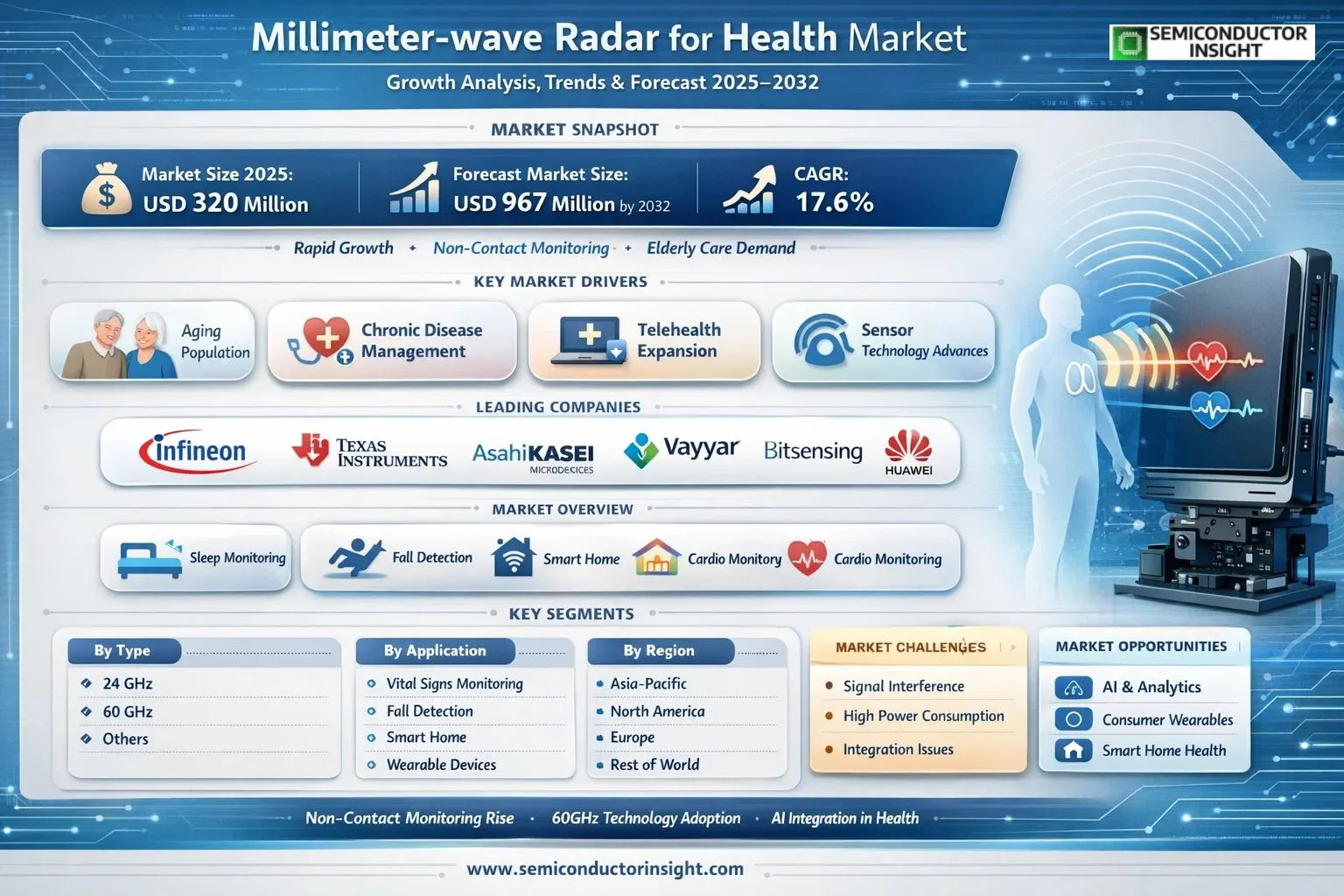
MARKET DRIVERS
Advancements in mmWave Sensor Precision
Millimeter-wave Radar for Health Market is propelled by rapid improvements in sensor resolution, enabling accurate non-contact detection of vital signs such as heart rate and respiration. These radars leverage Doppler shifts for real-time monitoring, outperforming traditional wearables in cluttered environments.
Surge in Telehealth and Elderly Care Needs
Aging populations worldwide, with over 1.5 billion people aged 65+ projected by 2050, drive demand for contactless health solutions. mmWave radars excel in fall detection and sleep analysis, reducing caregiver burdens in home settings.
➤ The sector is forecasted to expand at a 26% CAGR through 2030, fueled by IoT integration.
Post-pandemic shifts toward remote monitoring have accelerated adoption, with healthcare providers integrating these systems into smart hospitals for continuous patient surveillance.
MARKET CHALLENGES
Technical Limitations in Multi-Person Scenarios
Millimeter-wave Radar for Health Market faces hurdles in distinguishing signals from multiple subjects, leading to accuracy drops below 85% in dynamic settings like busy households. Signal interference from walls or furniture further complicates deployment.
Other Challenges
Integration with Existing Systems
Compatibility issues with legacy medical devices slow rollout, requiring custom firmware that increases timelines by 40%.
High Power Consumption
Battery life constraints limit portable applications, with current prototypes draining power 2x faster than optical alternatives.Scalability remains a barrier as production volumes struggle to meet rising demands from wellness apps.
MARKET RESTRAINTS
Elevated Costs and Regulatory Barriers
Development costs for millimeter-wave radar health systems exceed $5 million per prototype, deterring smaller firms from entry into Millimeter-wave Radar for Health Market. FDA approvals demand extensive clinical trials, extending market entry by 18-24 months.Data privacy concerns under GDPR and HIPAA impose stringent encryption needs, inflating compliance expenses by 30%.Limited clinician awareness hampers prescriptions, with only 20% of facilities trialing radar-based vitals despite proven 95% accuracy in controlled tests.Infrastructure gaps in emerging markets cap penetration to under 10% globally.
MARKET OPPORTUNITIES
AI-Enhanced Analytics and Wearable Fusion
Millimeter-wave Radar for Health Market holds potential in AI-driven predictive analytics for early disease detection, merging radar data with machine learning for 98% anomaly prediction rates in respiration patterns.Expansion into consumer wearables and smart home ecosystems could capture 35% of the $50 billion remote monitoring space by 2028.Partnerships with telehealth giants open avenues for bundled solutions, targeting chronic care management for diabetes and cardiovascular patients.Emerging applications in neonatal monitoring and automotive health seats promise untapped revenue streams amid rising wellness tech investments.
Millimeter-wave Radar for Health Market Trends
Rise of Non-Contact Vital Signs Monitoring
Millimeter-wave Radar for Health Market is experiencing significant momentum driven by the demand for non-intrusive health monitoring solutions. This technology leverages high-frequency millimeter waves to detect subtle movements associated with vital signs such as heart rate, respiration, and sleep patterns without physical contact. Its adoption is accelerating in healthcare settings, particularly for elderly care, fall detection, and chronic disease management, as it enables continuous monitoring in hospitals and homes alike. The non-contact approach addresses key challenges in traditional methods, offering hygiene benefits and patient comfort, while AI integration enhances data interpretation for improved health outcomes.
Other Trends
Advancements in 60GHz Band Dominance
Within Millimeter-wave Radar for Health Market, the 60GHz frequency band holds a leading position due to its high precision and low power consumption, making it ideal for applications like sleep monitoring, fall detection, and cardiopulmonary function tracking. This band outperforms others such as 24GHz in detecting fine physiological signals, supporting miniaturized designs that reduce equipment costs below $100. Manufacturers are focusing on these iterations to broaden accessibility in consumer and medical-grade devices.
Competitive Dynamics and AI Integration
The competitive landscape in Millimeter-wave Radar for Health Market features a divide between international leaders like Infineon and Texas Instruments, who dominate high-end chip supplies, and Chinese firms such as Catland and SiDian Micro, capturing consumer segments with cost-effective solutions. Key trends include AI algorithm enhancements for advanced features like sleep stage diagnosis, alongside regulatory progress via FDA and NMPA certifications for medical devices. However, challenges persist with data privacy under GDPR and varying radio frequency standards hindering global expansion. Future opportunities center on home-based elderly care and integration into smart home ecosystems, with medical-grade applications poised for increased prevalence.
COMPETITIVE LANDSCAPE
Key Industry Players
Leading Innovators in Millimeter-Wave Radar for Health Monitoring
Millimeter-wave Radar for Health Market exhibits a polarized competitive structure, dominated by international semiconductor giants such as Infineon Technologies and Texas Instruments, who control the high-end chip supply chain with advanced 60GHz and 24GHz radar transceivers optimized for precise vital signs detection, including heart rate and respiration monitoring. These leaders leverage decades of RF expertise to deliver low-power, high-resolution sensors integral to medical-grade devices, capturing significant market share through partnerships with healthcare OEMs. The market, valued at US$320 million in 2025 and projected to reach US$967 million by 2032 at a 17.6% CAGR, is driven by non-contact applications in elderly care and chronic disease management, where these firms’ AI-integrated solutions enable FDA/NMPA-certified products amid rising demand for home-based monitoring.
Complementing the giants, a vibrant ecosystem of niche players, particularly Chinese manufacturers like Catland, SiDian Micro, CALTERAH, and Chuhang Tech, rapidly penetrate consumer segments with cost-effective modules under $100, focusing on sleep tracking, fall detection, and smart home integration. Companies such as Vayyar, Bitsensing, and Asahi Kasei Microdevices innovate in miniaturized designs and multi-band radars, while Huawei, EZVIZ, and Aqara embed radar tech into IoT ecosystems. Emerging firms like AirTouch, WHST, and Seeed Studio target wearables and vital signs wearables, fostering competition through rapid iteration in AI algorithms and regulatory compliance, though challenges persist in data privacy under GDPR and RF standardization variances.
List of Key Millimeter-wave Radar for Health Companies Profiled
- Infineon Technologies
- Texas Instruments
- Vayyar Imaging
- Asahi Kasei Microdevices
- Vitalcare
- AxEnd
- Bitsensing
- Huawei
- EZVIZ
- AirTouch (Shanghai) Intelligent Technology
- Seeed Studio
- WHST
- CALTERAH Semiconductor
- Shenzhen Ferry Smart
- Uniview
- Tsingray
- Chuhang Tech
Segment Analysis:
| Segment Category | Sub-Segments | Key Insights |
| By Type |
|
60 GHz
|
| By Application |
|
Vital Signs Monitoring
|
| By End User |
|
Homecare & Elderly Care
|
| By Care Setting |
|
Home-based
|
| By Technology Integration |
|
AI-Enhanced
|
Regional Analysis: Millimeter-wave Radar for Health Market
North America
Tech clusters like Silicon Valley and Boston spearhead millimeter-wave radar advancements for health monitoring, integrating with IoT for real-time data. Startups innovate in ultra-high precision sensors, tailoring solutions for neonatal care and elderly fall prevention, driving Millimeter-wave Radar for Health Market forward.
Hospitals rapidly adopt radar-based systems for contactless patient surveillance in ICUs, reducing infection risks. Telehealth expansions embed these technologies, enhancing remote diagnostics and chronic condition oversight in the North American Millimeter-wave Radar for Health Market.
Abundant funding from venture capitalists supports healthtech firms developing radar solutions, enabling scalability. This capital influx accelerates R&D, positioning North America as a leader in Millimeter-wave Radar for Health Market through sustained growth initiatives.
Partnerships between radar developers and medical device giants facilitate market penetration, customizing solutions for diverse applications. These alliances strengthen ecosystem maturity in North America’s Millimeter-wave Radar for Health Market.
Europe
Europe exhibits steady growth in Millimeter-wave Radar for Health Market, underpinned by stringent medical device regulations and a focus on quality healthcare. Countries like Germany and the UK lead in research, developing radar technologies for precision vital signs detection in clinical settings. The emphasis on data privacy under GDPR influences solution designs, promoting secure remote monitoring for home care and rehabilitation. Market dynamics revolve around collaborations between universities and medtech firms, advancing applications in elderly care amid aging populations. Challenges include high compliance costs, yet supportive EU funding for digital health initiatives accelerates adoption. Integration with wearable tech and smart hospitals enhances non-invasive diagnostics, positioning Europe as a hub for reliable, regulated millimeter-wave radar deployments in health sectors.
Asia-Pacific
Asia-Pacific emerges as a high-growth region in Millimeter-wave Radar for Health Market, fueled by rapid urbanization and expanding healthcare access. Nations such as Japan, China, and South Korea drive innovation, leveraging manufacturing prowess for cost-effective radar sensors in vital monitoring devices. Government-backed smart city projects integrate these technologies for public health surveillance and disaster response. Market dynamics highlight demand for affordable solutions in densely populated areas, targeting sleep analysis and contactless screening. Local firms partner with global players to customize offerings, addressing tropical disease monitoring needs. Despite infrastructure variances, the region’s tech-savvy populace and policy incentives propel widespread adoption of millimeter-wave radar in both institutional and consumer health applications.
South America
South America shows promising potential in Millimeter-wave Radar for Health Market, navigating infrastructural challenges with innovative adaptations. Brazil and Chile pioneer deployments in urban hospitals for non-contact patient monitoring, aiding underserved rural areas via telemedicine. Market dynamics center on cost-sensitive solutions for chronic illness management and maternal health, with growing interest from private clinics. Regional collaborations import advanced radar tech, localizing it for tropical climates and mobility applications. Economic recovery efforts boost investments, enhancing radar use in emergency response and elderly care, gradually elevating South America’s role in global healthtech landscapes.
Middle East & Africa
The Middle East & Africa region advances cautiously in Millimeter-wave Radar for Health Market, prioritizing remote and harsh-environment applications. Gulf countries like the UAE invest in smart healthcare infrastructure, deploying radars for oilfield worker monitoring and pilgrim health screening. In Africa, initiatives target infectious disease surveillance and nomadic community care through portable systems. Market dynamics emphasize partnerships with international firms to build local capacity, focusing on affordability and durability. Government visions for digital transformation foster pilot programs, positioning the region for expanded millimeter-wave radar adoption in preventive health and borderless care delivery.
Report Scope
This market research report provides a comprehensive analysis of Millimeter-wave Radar for Health Market, covering the forecast period 2025–2032. It offers detailed insights into market dynamics, technological advancements, competitive landscape, and key trends shaping the industry.
Key focus areas of the report include:
- Market Overview: The report begins with an overview outlining its current market scenario, key growth indicators, and industry transformation drivers. It discusses macroeconomic factors, demand–supply balance, regulatory landscape, and the strategic role of millimeter-wave radar in powering advancements across industries such as healthcare, elderly care, smart homes, and chronic disease management.
- Market Size & Forecast: Historical data and future projections for revenue, unit shipments, and market value across major regions and segments.
- Segmentation Analysis: Detailed breakdown by product type, technology, application, and end-user industry to identify high-growth segments and investment opportunities.
- Regional Insights: Insights into market performance across North America, Europe, Asia-Pacific, Latin America, and the Middle East & Africa, including country-level analysis where relevant.
- Competitive Landscape: Profiles of leading market participants, including their product offerings, R&D focus, manufacturing capacity, pricing strategies, and recent developments such as mergers, acquisitions, and partnerships.
- Technology Trends & Innovation: Assessment of emerging technologies, integration of AI/IoT, semiconductor design trends, fabrication techniques, and evolving industry standards.
- Market Drivers & Restraints: Evaluation of factors driving market growth along with challenges, supply chain constraints, regulatory issues, and market-entry barriers.
- Stakeholder Insights: Insights for component suppliers, OEMs, system integrators, investors, and policymakers regarding the evolving ecosystem and strategic opportunities.
Primary and secondary research methods are employed, including interviews with industry experts, data from verified sources, and real-time market intelligence to ensure the accuracy and reliability of the insights presented.
FREQUENTLY ASKED QUESTIONS:
What is the current market size of Millimeter-wave Radar for Health Market?
-> Global Millimeter-wave Radar for Health market was valued at USD 320 million in 2025 and is projected to reach USD 967 million by 2032, at a CAGR of 17.6% during the forecast period.
Which key companies operate in Millimeter-wave Radar for Health Market?
-> Key players include Infineon, Texas Instruments, Asahi Kasei Microdevices, Vayyar, Bitsensing, and Huawei, among others.
What are the key growth drivers?
-> Key growth drivers include aging population, surge in demand for chronic disease management, and advantages of non-contact health monitoring technology.
Which region dominates the market?
-> Asia is the fastest-growing region, driven by China, while North America remains a dominant market.
What are the emerging trends?
-> Emerging trends include AI algorithm integration for sleep stage diagnosis, miniaturized design with unit prices under $100, and smart home ecosystem integration for elderly care.

Get Sample Report PDF for Exclusive Insights
Report Sample Includes
- Table of Contents
- List of Tables & Figures
- Charts, Research Methodology, and more...
 Download Sample Report PDF