Market Insights
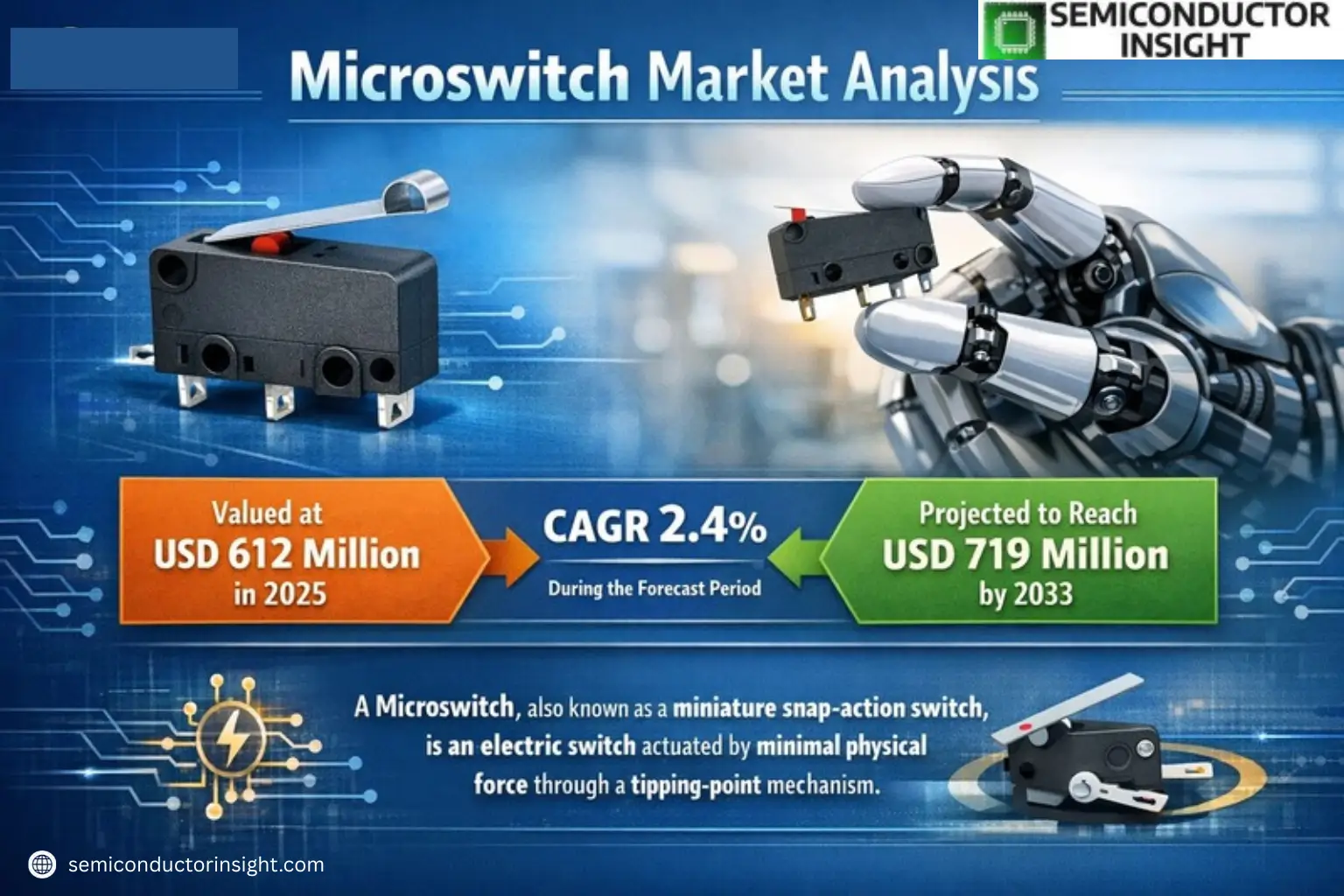
Global Microswitch Market was valued at USD 612 million in 2025 and is projected to reach USD 719 million by 2033, exhibiting a CAGR of 2.4% during the forecast period.
A Microswitch, also known as a miniature snap-action switch, is an electric switch actuated by minimal physical force through a tipping-point mechanism. These switches operate reliably at specific actuator positions, ensuring consistent performance across millions of cycles ranging from over 1 million for standard models to 10 million for heavy-duty variants. Their durability stems from a design that translates small actuator movements into rapid electrical contact shifts, often incorporating hysteresis to prevent unintended reversals.
The market growth is driven by increasing demand across applications like electronic equipment, instruments, and power systems, where precision and reliability are critical. China dominates the market with a 40% share, followed by Europe and Japan at approximately 30% each. Ultraminiature microswitches lead product segments with a 45% share, reflecting trends toward compact device designs. Key players such as Omron, Alps, and Panasonic collectively hold over 20% of the market, leveraging innovations to meet evolving industry needs.
MARKET DRIVERS
Increasing Automation Across Industries
The growing demand for automation in manufacturing, automotive, and consumer electronics is a key driver for the Microswitch Market. These compact, highly reliable switches are essential components in automated systems, with industrial automation applications accounting for nearly 42% of global microswitch demand. The rising adoption of Industry 4.0 technologies further accelerates market growth.
Advancements in Miniaturization Technology
Technological innovations enabling smaller, more durable microswitch designs are expanding application possibilities. Current Microswitch Market trends show a 15% annual growth in demand for subminiature versions, particularly in medical devices and IoT applications. Manufacturers are focusing on developing switches with higher current ratings in smaller form factors.
Stringent safety regulations across various industries are also driving adoption, as microswitches provide reliable fail-safe mechanisms in critical applications.
MARKET CHALLENGES
Price Pressure from Alternative Technologies
Microswitch Market faces competition from emerging solid-state and optical switch technologies that offer longer lifespans in certain applications. Price sensitivity in mass-produced consumer electronics has led to intense margin pressures, with average selling prices declining nearly 3% annually over the past five years.
Other Challenges
Material Shortages Impacting Production
Supply chain disruptions have caused volatility in raw material availability, particularly for specialty metals used in high-performance microswitch contacts. Some manufacturers report lead times extending to 12-14 weeks for certain models.
MARKET RESTRAINTS
Design Limitations in High-Frequency Applications
Mechanical microswitches face inherent limitations in ultra-high-frequency switching applications, where solid-state alternatives dominate. This constraint limits market penetration in advanced electronics sectors, with approximately 18% of potential applications opting for alternative solutions due to performance requirements.
MARKET OPPORTUNITIES
Emerging Applications in Renewable Energy
The rapid expansion of solar and wind energy infrastructure presents significant growth opportunities for the Microswitch Market. These applications require rugged, weather-resistant switching solutions for safety and control systems, with demand expected to grow 22% annually through 2028.
Microswitch Market Trends (2025-2033)
Steady Growth in Microswitch Market Projected Through 2033
Global Microswitch Market, valued at USD 612 million in 2025, is forecast to reach USD 719 million by 2033, growing at a compound annual growth rate (CAGR) of 2.4%. This steady expansion is driven by increasing demand across multiple industries, including electronics, appliances, and power systems. The durability of Microswitches, capable of 1-10 million operational cycles, makes them a preferred choice for manufacturers seeking reliable switching solutions.
Other Trends
Regional Market Dynamics
China dominates the Microswitch Market with over 40% global share, followed by Europe and Japan collectively holding approximately 30%. The Asia-Pacific region’s growth is fueled by expanding electronics manufacturing and industrialization, while mature markets maintain steady demand for replacement and upgrade cycles.
Product Segmentation
Ultraminiature Microswitches lead product categories with 45% market share, reflecting industry trends toward compact device designs. Standard and sub-miniature types continue to serve specific application requirements, particularly in industrial settings where larger form factors remain practical.
Emerging Application Areas
Electronic equipment remains the largest application segment for Microswitches, followed by instruments, power systems, and appliances. Growing automation across industries and the Internet of Things (IoT) expansion are creating new opportunities for Microswitch integration in smart devices and industrial control systems.
Competitive Landscape
Four major manufacturers – Omron, Alps, Johnson Electric (Burgess), and Panasonic – collectively command over 20% of the global Microswitch Market. Competition focuses on reliability improvements, customization capabilities, and cost optimization to meet diverse industry requirements.
COMPETITIVE LANDSCAPE
Key Industry Players
Global Microswitch Market Dominated by Established Electronics Giants
Global Microswitch Market features a competitive landscape with four major players Omron, Alps, Johnson Electric (Burgess), and Panasonic collectively holding over 20% market share. Omron maintains technological leadership through its patented snap-action mechanism designs, while Panasonic dominates the Asian markets with cost-effective solutions for appliances and electronics. The industry shows moderate fragmentation with regional specialists complementing global leaders.
Second-tier players like Honeywell, CHERRY, and C&K specialize in industrial-grade switches for harsh environments, while Chinese manufacturers such as Kaihua and Greetech are gaining traction through competitive pricing. Emerging players focus on ultraminiature switches for IoT devices, competing on miniaturization capabilities and lifecycle durability exceeding 10 million operations. The market sees steady M&A activity as larger firms acquire niche specialists to broaden product portfolios.
List of Key Microswitch Companies Profiled
- Omron
- Alps Alpine
- Johnson Electric (Burgess)
- Panasonic
- Honeywell
- CHERRY
- C&K
- ZIPPY Technology
- TTC
- Kaihua Electronics
- Greetech
- SCI
- Salecom
- Camsco Electric
- Solteam
Segment Analysis:
| Segment Category | Sub-Segments | Key Insights |
| By Type |
|
Ultraminiature leads due to its compact size and superior durability:
|
| By Application |
|
Electronic Equipment dominates with critical usage across industries:
|
| By End User |
|
Consumer Electronics remains the key growth driver:
|
| By Actuation Force |
|
Medium Force switches are most versatile:
|
| By Contact Configuration |
|
SPDT configuration sees widest implementation:
|
Regional Analysis: Global Microswitch Market
Asia-Pacific’s thriving industrial automation sector drives significant microswitch demand, particularly for safety interlocks and position sensing applications in manufacturing equipment. The region’s focus on smart factories creates premium opportunities for high-precision microswitches.
As the global electronics manufacturing center, the region’s appliance and device producers require reliable microswitches for controls, safety mechanisms, and user interfaces, with increasing demand for miniature and waterproof variants.
Asia-Pacific’s position as the largest vehicle manufacturing region sustains strong microswitch demand for applications in door panels, gear shifts, and control systems, with electric vehicle adoption creating new requirements.
The concentration of component manufacturers and end-users in close proximity creates efficient microswitch supply chains, allowing for rapid prototyping, cost optimization, and just-in-time delivery models favored by regional manufacturers.
North America
North America maintains strong Microswitch Market growth, particularly in high-reliability applications for aerospace, defense, and medical equipment. The region benefits from technological advancements in microswitch design and material science, with U.S. manufacturers leading in specialized applications requiring extreme durability. Automation trends across manufacturing and increased adoption of smart home technologies drive consistent demand. The presence of automotive OEMs and tier-1 suppliers sustains requirements for vehicle-grade switching components, with growing interest in modular switch solutions.
Europe
Europe’s Microswitch Market is characterized by demand for premium, safety-certified components across industrial and automotive sectors. Strict EU regulations on equipment safety and energy efficiency influence microswitch specifications, with manufacturers focusing on RoHS-compliant and low-power designs. Germany remains the largest market, fueled by its machine tool industry and automotive manufacturing. The region sees increasing adoption in renewable energy systems and building automation, with emphasis on long lifecycle and maintenance-free operation requirements.
South America
South America presents emerging opportunities in the Microswitch Market, particularly in Brazil’s growing appliance manufacturing sector and Chile’s mining equipment industry. The region shows preference for cost-competitive models with basic functionality, though demand for higher-specification industrial switches is increasing with foreign direct investment in manufacturing. Infrastructure development projects and urbanization drive demand for microswitches in elevator controls and construction equipment applications.
Middle East & Africa
The MEA Microswitch Market is experiencing gradual growth, primarily driven by GCC countries’ industrial diversification programs and infrastructure development. Applications in oil & gas equipment, HVAC systems, and security devices constitute key demand drivers. South Africa serves as the manufacturing hub for the region, with growing capability in electronic component assembly. The market shows preference for durable switches capable of withstanding harsh environmental conditions prevalent in the region.
Report Scope
This market research report provides a comprehensive analysis of the Microswitch Market , covering the forecast period 2025–2033. It offers detailed insights into market dynamics, technological advancements, competitive landscape, and key trends shaping the industry.
Key focus areas of the report include:
- Market Overview: The report begins with an overview outlining its current market scenario, key growth indicators, and industry transformation drivers. It discusses macroeconomic factors, demand–supply balance, regulatory landscape, and the strategic role of semiconductors in powering advancements across industries such as automotive, telecommunications, consumer electronics, and industrial automation.
- Market Size & Forecast: Historical data and future projections for revenue, unit shipments, and market value across major regions and segments.
- Segmentation Analysis: Detailed breakdown by product type, technology, application, and end-user industry to identify high-growth segments and investment opportunities.
- Regional Insights: Insights into market performance across North America, Europe, Asia-Pacific, Latin America, and the Middle East & Africa, including country-level analysis where relevant.
- Competitive Landscape: Profiles of leading market participants, including their product offerings, R&D focus, manufacturing capacity, pricing strategies, and recent developments such as mergers, acquisitions, and partnerships.
- Technology Trends & Innovation: Assessment of emerging technologies, integration of AI/IoT, semiconductor design trends, fabrication techniques, and evolving industry standards.
- Market Drivers & Restraints: Evaluation of factors driving market growth along with challenges, supply chain constraints, regulatory issues, and market-entry barriers.
- Stakeholder Insights: Insights for component suppliers, OEMs, system integrators, investors, and policymakers regarding the evolving ecosystem and strategic opportunities.
Primary and secondary research methods are employed, including interviews with industry experts, data from verified sources, and real-time market intelligence to ensure the accuracy and reliability of the insights presented.
FREQUENTLY ASKED QUESTIONS:
What is the current market size of Microswitch Market?
-> Microswitch Market was valued at USD 612 million in 2025 and is projected to reach USD 719 million by 2033, exhibiting a CAGR of 2.4% during the forecast period.
What is the expected CAGR for Microswitch Market?
-> The market is expected to grow at a CAGR of 2.4% during the forecast period 2025-2033.
Which key companies operate in Microswitch Market?
-> Key players include Omron, Alps, Johnson Electric(Burgess), Panasonic, TROX, ZIPPY, Honeywell, CHERRY, among others.
Which region dominates the Microswitch Market?
-> China is the largest market with over 40% share, followed by Europe and Japan which together hold about 30% share.
What are the major application segments in Microswitch Market?
-> The largest application is Electronic Equipment, followed by Instrument, Power System, Appliances Equipment, and others.
What is the leading product type segment?
-> Ultraminiature Type dominates with about 45% market share.

Get Sample Report PDF for Exclusive Insights
Report Sample Includes
- Table of Contents
- List of Tables & Figures
- Charts, Research Methodology, and more...
 Download Sample Report PDF