Metal Shielding Device Market Insights
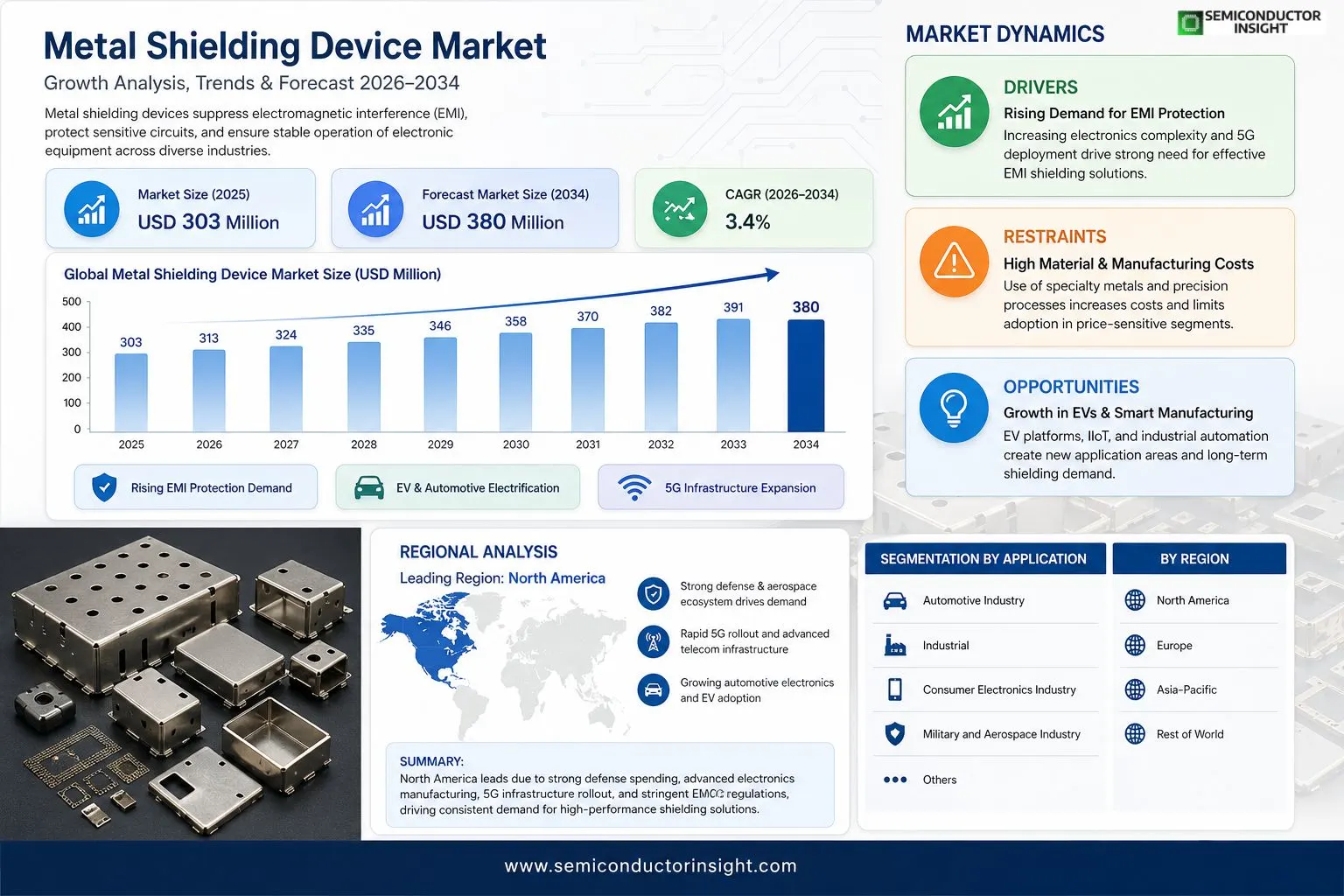
Global Metal Shielding Device market size was valued at USD 303 million in 2025. The market is projected to grow from USD 313 million in 2026 to USD 380 million by 2034, exhibiting a CAGR of 3.4% during the forecast period.
A metal shielding device is an important component widely used in electronic equipment. Its primary function is to suppress electromagnetic interference (EMI), protect sensitive circuits, and ensure the stable operation of equipment. These devices are typically fabricated from materials such as copper, aluminum, steel, and their alloys, and are available in forms including metal shields and composite shielding configurations. By creating a conductive barrier, metal shielding devices effectively contain or exclude electromagnetic fields, making them indispensable across a broad range of industries.
The market is witnessing steady growth driven by surging demand across the automotive, consumer electronics, industrial, and military and aerospace sectors. The rapid proliferation of connected devices, the advancement of 5G infrastructure, and the increasing complexity of electronic systems have intensified the need for robust EMI shielding solutions. Furthermore, stringent regulatory standards governing electromagnetic compatibility (EMC) across major economies continue to reinforce adoption. 3M, Laird Performance Materials, Parker Hannifin Corporation, TE Connectivity, and Parker Chomerics are among the key global manufacturers operating in this market with diversified product portfolios catering to multiple end-use applications.
MARKET DRIVERS
Rising Demand for Electromagnetic Interference (EMI) Protection Across Electronics Industries
Global metal shielding device market is experiencing robust growth, driven primarily by the accelerating proliferation of electronic devices across consumer, industrial, and defense sectors. As electronic systems become increasingly miniaturized and densely packed, the risk of electromagnetic interference (EMI) between components intensifies significantly. Metal shielding devices , including cans, foils, gaskets, and enclosures , serve as critical barriers that prevent signal degradation and ensure regulatory compliance. The rapid expansion of 5G telecommunications infrastructure has further amplified demand, as higher frequency bands require more precise and effective shielding solutions to maintain signal integrity.
Expansion of Automotive Electronics and EV Platforms Fueling Metal Shielding Adoption
The automotive industry’s transition toward electric vehicles (EVs) and advanced driver-assistance systems (ADAS) represents a significant growth driver for Metal Shielding Device Market. Modern EVs incorporate a high density of power electronics, battery management systems, and wireless communication modules, all of which generate and are susceptible to electromagnetic noise. Metal shielding components are increasingly integrated into EV architectures to protect sensitive control units and ensure compliance with international EMC standards. Automakers and Tier-1 suppliers are investing heavily in shielding technologies to meet both performance and regulatory requirements, sustaining strong long-term demand.
➤ The convergence of 5G deployment, EV adoption, and smart manufacturing is creating an unprecedented demand cycle for advanced metal shielding devices, positioning the market for sustained multi-year growth.
Defense and aerospace applications further reinforce demand for Metal Shielding Device Market. Military-grade electronics require highly reliable shielding to maintain operational effectiveness in contested electromagnetic environments. Ongoing modernization programs across North America, Europe, and Asia-Pacific are generating consistent procurement of high-performance shielding enclosures and components, providing a stable, high-value revenue stream for manufacturers operating in this sector.
MARKET CHALLENGES
Technical Complexity in Shielding High-Frequency 5G and mmWave Applications
One of the foremost challenges facing Metal Shielding Device Market is the technical difficulty of designing effective shielding solutions for millimeter-wave (mmWave) and sub-6 GHz 5G frequencies. At these elevated frequencies, traditional shielding architectures experience performance degradation due to increased skin effect losses, aperture leakage, and thermal management conflicts. Engineering teams must balance shielding effectiveness with the need for heat dissipation, signal passage, and mechanical compactness. This technical complexity increases development cycles and costs, creating barriers for smaller manufacturers and complicating the qualification process for end-use applications.
Other Challenges
Supply Chain Volatility for Specialty Metals
Metal Shielding Device Market is exposed to fluctuations in the availability and pricing of specialty metals such as copper, aluminum, mu-metal, and various ferrous alloys. Geopolitical tensions, mining output variability, and logistics disruptions have contributed to periodic supply constraints and cost pressures. Manufacturers relying on these materials face margin compression and procurement uncertainty, which can delay production schedules and affect contractual commitments to OEM customers.
Miniaturization Demands Conflicting with Shielding Perform Zance
As electronic assemblies continue to shrink in form factor, integrating effective metal shielding within increasingly confined spaces presents a persistent engineering challenge. Thin-wall shielding cans and ultra-compact gaskets must deliver equivalent or superior EMI attenuation compared to their larger predecessors, requiring advanced materials science and precision manufacturing capabilities. This trend raises tooling and production costs and demands continuous R&D investment, which is difficult to sustain for mid-tier and small-scale suppliers in Metal Shielding Device Market.
MARKET RESTRAINTS
High Material and Manufacturing Costs Limiting Adoption in Price-Sensitive Segments
A key restraint on Metal Shielding Device Market is the relatively high cost associated with precision-manufactured metal shielding components, particularly those destined for high-frequency or defense-grade applications. The use of specialty alloys, multi-layer constructions, and tight dimensional tolerances drives up per-unit costs compared to alternative shielding approaches such as conductive coatings or polymer-based composites. In price-sensitive segments such as consumer electronics and low-cost industrial equipment, procurement teams may opt for less expensive but potentially less effective shielding alternatives, constraining the addressable market for traditional metal shielding device manufacturers.
Competitive Pressure from Alternative EMI Shielding Technologies
Metal Shielding Device Market faces growing competitive pressure from alternative EMI mitigation technologies, including conductive elastomers, absorptive materials, and PCB-level filtering solutions. These alternatives often offer advantages in weight, flexibility, and ease of integration, making them attractive for applications where mechanical rigidity and weight are constraints. As materials science advances, the performance gap between metal and non-metal shielding solutions continues to narrow in certain frequency ranges, posing a credible substitution risk. Manufacturers in Metal Shielding Device Market must continuously demonstrate superior shielding effectiveness, reliability, and total cost of ownership to retain specification preference among design engineers.
MARKET OPPORTUNITIES
Growth of Smart Manufacturing and Industrial IoT Creating New Shielding Demand
The accelerating adoption of Industrial Internet of Things (IIoT) technologies and smart manufacturing platforms presents a significant opportunity for Metal Shielding Device Market. Factory automation systems, wireless sensor networks, and edge computing nodes deployed in electromagnetically harsh industrial environments require robust shielding solutions to maintain data integrity and operational reliability. As Industry 4.0 investments scale globally, the installed base of shielded industrial electronics is expanding rapidly, creating recurring demand for both new installations and maintenance replacements of metal shielding components.
Expansion into Emerging Markets and Localized Electronics Manufacturing Hubs
Emerging economies in Southeast Asia, India, and Latin America are witnessing substantial growth in domestic electronics manufacturing, driven by government incentive programs and supply chain diversification strategies from global OEMs. This geographic expansion of electronics production creates new end-market opportunities for metal shielding device suppliers capable of establishing local supply relationships and meeting regional regulatory standards. Companies that invest in regional manufacturing capacity or distribution partnerships are well positioned to capture incremental demand as these manufacturing ecosystems mature and require higher volumes of compliant EMI shielding solutions.
Advancing Medical Electronics and Wearable Health Devices Opening Premium Market Segments
The rapid growth of connected medical devices, implantable electronics, and wearable health monitoring systems represents a high-value opportunity for Metal Shielding Device Market. These applications demand stringent EMI shielding to protect both device functionality and patient safety, and they operate under rigorous regulatory frameworks that favor proven metal shielding solutions over experimental alternatives. As telehealth adoption expands and medical device miniaturization continues, demand for precision-engineered metal shielding components tailored to biomedical specifications is expected to grow steadily, offering manufacturers access to premium pricing and long-term design-win revenue streams.
Metal Shielding Device Market Trends
Rising Demand for Electromagnetic Interference Suppression Drives Metal Shielding Device Market
Metal Shielding Device Market has witnessed consistent momentum driven by the growing need to suppress electromagnetic interference (EMI) across a wide range of industries. As electronic systems become increasingly compact and interconnected, the role of metal shielding devices in protecting sensitive circuits and ensuring stable equipment operation has grown substantially. Key end-use sectors such as automotive, consumer electronics, industrial manufacturing, and military and aerospace continue to rely heavily on these components to maintain signal integrity and device reliability. The expansion of electronic content in modern vehicles, alongside the proliferation of smart consumer devices, has reinforced sustained procurement of metal shielding solutions globally.
Other Trends
Automotive Electrification Accelerating Adoption
The rapid shift toward electric vehicles (EVs) and advanced driver-assistance systems (ADAS) has created significant new demand within Metal Shielding Device Market. Modern EVs incorporate a dense array of electronic control units, battery management systems, and communication modules, all of which require effective EMI shielding to ensure safe and reliable performance. As automakers globally scale up EV production and integrate more sophisticated onboard electronics, demand for both metal shields and composite shielding solutions is expected to see continued upward pressure from the automotive industry segment.
Military and Aerospace Segment Emphasizing High-Performance Shielding
The military and aerospace industry represents a critical application area for Metal Shielding Device Market, where performance standards and reliability requirements are exceptionally stringent. Defense electronics, radar systems, avionics, and communication equipment all demand superior EMI shielding to function effectively in high-interference environments. Procurement from this sector continues to support the market for precision-engineered metal shielding components, with manufacturers such as 3M, Parker Hannifin Corporation, TE Connectivity, and Laird Performance Materials maintaining a strong presence in supplying specialized shielding solutions.
Competitive Landscape and Regional Developments Shaping Market Direction
Metal Shielding Device Market features a competitive landscape comprising both global leaders and regional manufacturers. Companies including Parker Chomerics, Leader Tech, TATSUTA Electric Wire and Cable, Tech Etch, and Vanguard Products, alongside emerging players from China such as Shenzhen Dongbang Hong Industrial and Shenzhen FRD Science and Technology, are actively competing across product quality, customization capability, and pricing. Asia-Pacific, particularly China, continues to be a significant production and consumption hub, while North America and Europe maintain strong demand driven by advanced manufacturing and defense sectors. These regional dynamics are collectively shaping procurement strategies and competitive positioning across Global Metal Shielding Device Market.
COMPETITIVE LANDSCAPE
Key Industry Players
Global Metal Shielding Device Market: Competitive Dynamics, Key Manufacturers, and Strategic Positioning
Global Metal Shielding Device market, valued at approximately USD 303 million in 2025 and projected to reach USD 380 million by 2034 at a CAGR of 3.4%, is characterized by a moderately consolidated competitive landscape. Industry heavyweights such as 3M, Laird Performance Materials, Parker Hannifin Corporation, and TE Connectivity collectively command a significant portion of global revenue, leveraging their extensive R&D capabilities, diversified product portfolios, and well-established distribution networks. These leading players maintain their competitive edge by continuously innovating across both Metal Shield and Composite Shielding product segments, catering to high-demand verticals including automotive, military and aerospace, consumer electronics, and industrial applications. The top five players collectively held a notable share of global market revenue in 2025, underscoring the strategic importance of scale and technological expertise in this sector.
Beyond the dominant players, the competitive arena includes several specialized and regionally significant manufacturers that are gaining traction across key geographies such as North America, Europe, and Asia-Pacific. Companies like Leader Tech, Tech Etch, TATSUTA Electric Wire and Cable, Vanguard Products, and Parker Chomerics have carved out strong niche positions by offering tailored EMI shielding solutions optimized for specific end-use environments. Meanwhile, China-based manufacturers such as Shenzhen Dongbang Hong Industrial, SHENZHEN XINGHEDA TECHNOLOGY, jiuchang-shield, and Shenzhen FRD Science & Technology are emerging as cost-competitive alternatives, progressively expanding their global footprint. The interplay between established multinational corporations and agile regional specialists continues to intensify competition, driving product differentiation, pricing innovation, and strategic partnerships across the Metal Shielding Device value chain.
List of Key Metal Shielding Device Companies Profiled
- 3M
- Laird Performance Materials
- Parker Hannifin Corporation
- SCHWARZ
- TE Connectivity
- Parker Chomerics
- Leader Tech
- TATSUTA Electric Wire and Cable
- Vanguard Products
- Tech Etch
- Shenzhen Dongbang Hong Industrial
- SHENZHEN XINGHEDA TECHNOLOGY
- jiuchang-shield
- Shenzhen FRD Science & Technology
Segment Analysis:
| Segment Category | Sub-Segments | Key Insights |
| By Type |
|
Metal Shield represents the dominant product type in Global Metal Shielding Device market, driven by its superior electromagnetic interference (EMI) suppression capabilities and widespread compatibility across a broad range of electronic systems.
|
| By Application |
|
Consumer Electronics Industry stands as one of the most influential application segments for Metal Shielding Devices, underpinned by the relentless proliferation of compact, high-frequency electronic devices that demand robust EMI management.
|
| By End User |
|
OEMs (Original Equipment Manufacturers) constitute the leading end-user category in Metal Shielding Device Market, as they integrate shielding components directly into product designs at the manufacturing stage across automotive, electronics, and industrial equipment sectors.
|
| By Material |
|
Copper-Based Shielding leads this segment owing to copper’s exceptional electrical conductivity and its longstanding use as the benchmark material for high-performance electromagnetic shielding across precision electronics and telecommunications equipment.
|
| By Form Factor |
|
Board-Level Shields represent the most widely adopted form factor within Metal Shielding Device Market, as the ongoing miniaturization of electronic assemblies and the increasing density of printed circuit board (PCB) designs necessitate targeted, component-level electromagnetic protection.
|
Regional Analysis: Metal Shielding Device Market
North America
North America’s defense establishment represents one of the most significant end-use pillars for Metal Shielding Device Market. Ongoing procurement of advanced avionics, radar systems, and communications hardware necessitates reliable electromagnetic shielding to ensure operational integrity. Government-backed modernization initiatives across the U.S. Army, Navy, and Air Force continue to create sustained, long-term procurement pipelines for specialized metal shielding solutions.
The aggressive rollout of 5G infrastructure across the United States and Canada has materially elevated demand within Metal Shielding Device Market. Base stations, small cells, and network edge devices all require precision EMI shielding to maintain signal fidelity and regulatory compliance. Telecom operators and infrastructure developers are partnering with shielding solution providers to address increasingly complex electromagnetic environments created by spectrum-dense deployments.
Stringent FCC regulations and MIL-SPEC standards governing electromagnetic compatibility in the United States provide a structured compliance framework that actively drives adoption of certified metal shielding devices. Manufacturers operating in this region are compelled to invest in advanced shielding technologies to meet evolving mandates, which simultaneously elevates product quality standards and positions North American suppliers as preferred partners for global buyers seeking compliant solutions.
The rapid electrification of the North American automotive sector is generating substantial new demand streams within Metal Shielding Device Market. Electric vehicles and advanced driver-assistance systems require sophisticated EMI shielding to protect sensitive control modules from interference. Major automotive OEMs and their Tier-1 suppliers across Michigan, Ohio, and Ontario are increasingly integrating metal shielding components as standard design requirements across new vehicle platforms.
Europe
Europe represents the second most influential regional market for metal shielding devices, characterized by a sophisticated manufacturing base, rigorous CE marking and REACH compliance requirements, and strong demand from the automotive, industrial automation, and defense sectors. Germany leads regional consumption, anchored by its world-class automotive engineering industry and precision electronics manufacturing clusters. The United Kingdom and France contribute through their established aerospace and defense procurement programs, where metal shielding devices are critical to the performance and survivability of complex electronic systems. The European metal shielding device market also benefits from the region’s proactive approach to smart manufacturing and Industry 4.0 adoption, where factory automation equipment increasingly requires EMI-protected electronic assemblies. Additionally, the European Union’s emphasis on energy transition and smart grid infrastructure is opening new application corridors for shielding solutions in power electronics and grid management systems, supporting consistent regional market expansion through the forecast period.
Asia-Pacific
Asia-Pacific is recognized as the fastest-growing regional market for metal shielding devices, propelled by massive consumer electronics production volumes, expanding defense budgets across key nations, and accelerating telecommunications infrastructure investment. China dominates the regional landscape as both the world’s largest electronics manufacturer and an increasingly significant defense electronics producer, generating enormous baseline demand for EMI shielding materials and components. Japan and South Korea contribute through their leadership in semiconductor fabrication, advanced displays, and precision electronic systems, where metal shielding devices are integral to product design. India is emerging as a notable growth frontier, supported by government-led electronics manufacturing incentive schemes and rising defense indigenization programs. The convergence of 5G deployment, electric vehicle production scale-up, and industrial automation across the Asia-Pacific region collectively positions Metal Shielding Device Market for robust, sustained expansion well into the next decade.
South America
South America occupies a developing position within Global metal shielding device market, with Brazil serving as the primary demand center driven by its telecommunications sector, defense modernization initiatives, and growing consumer electronics assembly industry. Argentina and Chile contribute modest but gradually increasing demand as their industrial electronics and energy infrastructure sectors mature. The region’s market growth is tempered by economic volatility, currency fluctuation risks, and relatively limited domestic manufacturing capacity for advanced shielding materials, which creates dependence on imports from North America, Europe, and Asia-Pacific. However, increasing foreign direct investment in Brazilian electronics manufacturing and expanding regional 5G rollout programs are generating new demand streams for metal shielding devices. As industrial and defense infrastructure investment gradually accelerates across the continent, South America is expected to register steady, if measured, market progression over the forecast horizon.
Middle East & Africa
The Middle East and Africa region represents an emerging and strategically evolving market for metal shielding devices, with growth primarily concentrated in Gulf Cooperation Council nations. Saudi Arabia, the UAE, and Qatar are channeling substantial investment into defense modernization, smart city development, and telecommunications infrastructure, all of which require capable EMI shielding solutions for their associated electronic systems. The UAE’s positioning as a regional technology hub and its ambitious initiatives in aerospace, defense, and advanced manufacturing are particularly supportive of metal shielding device adoption. In Africa, the market remains nascent but is gradually taking shape through telecommunications infrastructure buildout and increasing government attention to defense electronics. While procurement is largely import-driven across the region, the long-term trajectory of Metal Shielding Device Market across the Middle East and Africa is underpinned by sustained capital investment in technology-intensive sectors.
Report Scope
This market research report provides a comprehensive analysis of Metal Shielding Device Market, covering the forecast period 2026–2034. It offers detailed insights into market dynamics, technological advancements, competitive landscape, and key trends shaping the industry.
Key focus areas of the report include:
- Market Overview: The report begins with an overview outlining its current market scenario, key growth indicators, and industry transformation drivers. It discusses macroeconomic factors, demand–supply balance, regulatory landscape, and the strategic role of metal shielding devices in powering advancements across industries such as automotive, military and aerospace, consumer electronics, and industrial automation.
- Market Size & Forecast: Historical data and future projections for revenue, unit shipments, and market value across major regions and segments.
- Segmentation Analysis: Detailed breakdown by product type, technology, application, and end-user industry to identify high-growth segments and investment opportunities.
- Regional Insights: Insights into market performance across North America, Europe, Asia-Pacific, Latin America, and the Middle East & Africa, including country-level analysis where relevant.
- Competitive Landscape: Profiles of leading market participants, including their product offerings, R&D focus, manufacturing capacity, pricing strategies, and recent developments such as mergers, acquisitions, and partnerships.
- Technology Trends & Innovation: Assessment of emerging technologies, integration of AI/IoT, EMI shielding design trends, fabrication techniques, and evolving industry standards.
- Market Drivers & Restraints: Evaluation of factors driving market growth along with challenges, supply chain constraints, regulatory issues, and market-entry barriers.
- Stakeholder Insights: Insights for component suppliers, OEMs, system integrators, investors, and policymakers regarding the evolving ecosystem and strategic opportunities.
Primary and secondary research methods are employed, including interviews with industry experts, data from verified sources, and real-time market intelligence to ensure the accuracy and reliability of the insights presented.
FREQUENTLY ASKED QUESTIONS:
What is the current market size of Metal Shielding Device Market?
-> Global Metal Shielding Device Market was valued at USD 303 million in 2025 and is expected to reach USD 380 million by 2034, growing at a CAGR of 3.4% during the forecast period.
Which key companies operate in Metal Shielding Device Market?
-> Key players include 3M, Laird Performance Materials, Parker Hannifin Corporation, SCHWARZ, TE Connectivity, Parker Chomerics, Leader Tech, TATSUTA Electric Wire and Cable, Vanguard Products, and Tech Etch, among others.
What are the key growth drivers?
-> Key growth drivers include rising demand for electromagnetic interference (EMI) suppression in electronic equipment, growing adoption of metal shielding devices in automotive and consumer electronics industries, and increasing requirements for stable and reliable circuit protection in military and aerospace applications.
Which region dominates the market?
-> Asia-Pacific is among the fastest-growing regions driven by strong electronics manufacturing activity in China, Japan, South Korea, and Southeast Asia, while North America remains a significant market supported by robust demand from military, aerospace, and consumer electronics sectors.
What are the emerging trends?
-> Emerging trends include advanced composite shielding materials, miniaturization of shielding components for compact electronic devices, and growing integration of metal shielding solutions in electric vehicles (EVs) and next-generation wireless communication systems.

Get Sample Report PDF for Exclusive Insights
Report Sample Includes
- Table of Contents
- List of Tables & Figures
- Charts, Research Methodology, and more...
 Download Sample Report PDF