MARKET INSIGHTS
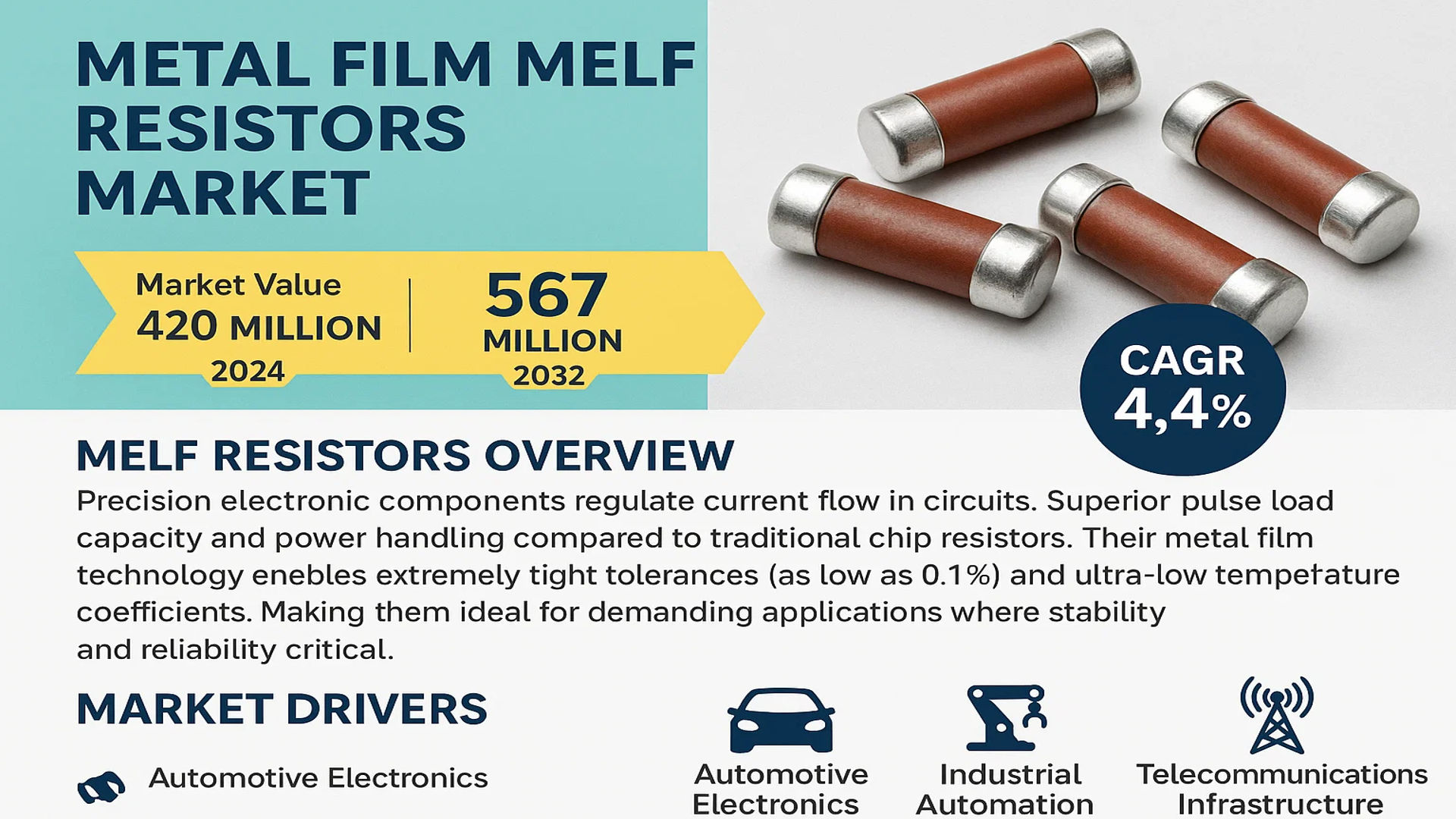
The global Metal Film MELF Resistors Market was valued at 420 million in 2024 and is projected to reach US$ 567 million by 2032, at a CAGR of 4.4% during the forecast period.
Metal film MELF resistors are precision electronic components designed to regulate current flow in circuits. These surface-mount devices feature a cylindrical structure that delivers superior pulse load capacity and power handling compared to traditional chip resistors. Their metal film technology enables extremely tight tolerances (as low as 0.1%) and ultra-low temperature coefficients (down to 5 ppm/°C), making them ideal for demanding applications where stability and reliability are critical. The MELF (Metal Electrode Leadless Face) design provides better heat dissipation and mechanical robustness than flat chip resistors.
Market growth is driven by increasing demand from automotive electronics, industrial automation, and telecommunications infrastructure. The automotive sector particularly benefits from MELF resistors’ ability to withstand harsh environments and voltage surges. Asia-Pacific dominates consumption, accounting for over 40% of global demand, fueled by electronics manufacturing in China, Japan and South Korea. Key players like Vishay, TE Connectivity and YAGEO are expanding production capacity to meet growing needs for high-reliability components in 5G infrastructure and electric vehicles.
MARKET DYNAMICS
MARKET DRIVERS
Growing Demand for High-Precision Electronics to Accelerate Metal Film MELF Resistors Adoption
The global electronics industry’s shift toward miniaturization and high-performance components is driving substantial demand for metal film MELF resistors. These components are increasingly favored in applications requiring tight tolerances down to 0.1% and ultra-low temperature coefficients as low as 5 ppm/°C. The automotive electronics sector alone is projected to account for over 28% of demand by 2030, as vehicles incorporate more advanced driver assistance systems (ADAS) and electric vehicle powertrains needing stable, high-reliability resistors.
5G Infrastructure Rollout Creating New Demand Opportunities
With global 5G base station installations expected to surpass 7 million units by 2025, telecom infrastructure represents one of the fastest-growing application segments for metal film MELF resistors. These components are critical in RF signal processing circuits due to their excellent high-frequency characteristics and pulse handling capabilities. The cylindrical MELF package demonstrates 30-40% better thermal dissipation compared to standard chip resistors, making them ideal for dense 5G equipment designs operating in harsh environmental conditions.
Medical Electronics Boom Expanding Application Horizons
The medical equipment sector is emerging as a high-growth market, particularly for precision diagnostic instruments and implantable devices where component reliability is paramount. Metal film MELF resistors are increasingly specified in patient monitoring systems and imaging equipment, where their stable performance across temperature fluctuations and superior longevity meet stringent medical safety standards. The global medical electronics market is forecast to maintain a 6.8% CAGR through 2030, creating sustained demand for high-performance passive components.
MARKET RESTRAINTS
Cost Premium Over Conventional Chip Resistors Limits Mainstream Adoption
While offering superior performance characteristics, metal film MELF resistors typically command 15-30% price premiums compared to standard thick-film chip resistors. This cost differential poses adoption challenges in consumer electronics and other price-sensitive segments where engineers often opt for adequate rather than optimal component solutions. Despite their technical advantages, the higher manufacturing complexity involving specialized deposition techniques and laser trimming contributes to sustained price differentials.
Automation Challenges in High-Volume Assembly Lines
The cylindrical form factor of MELF resistors creates handling and placement challenges in surface-mount assembly processes optimized for rectangular chip components. While improvements in pick-and-place equipment have reduced these hurdles, many high-volume manufacturers still face throughput reductions of 10-15% when incorporating MELF resistors into production lines. This has limited their penetration in mass-produced consumer devices where assembly speed is prioritized over component performance.
MARKET CHALLENGES
Supply Chain Vulnerabilities for Niche Materials
The specialized nickel-chromium and tantalum nitride films used in premium metal film MELF resistors face periodic supply constraints, as these materials are also demanded by aerospace and defense sectors. Recent geopolitical tensions have exacerbated lead time fluctuations, with some specialty resistor alloys experiencing 20-30 week delivery times compared to standard electronic materials. Manufacturers must balance inventory strategies against the risk of materials obsolescence in rapidly evolving resistor technologies.
Design Transition Barriers in Established Electronics
Despite their technical merits, many electronics designers remain hesitant to transition from familiar chip resistor footprints to MELF configurations. Legacy PCB layouts often lack provisions for the circular land patterns required by MELF resistors, requiring complete board redesigns that add engineering time and cost. In industries like industrial automation where equipment lifecycles exceed 10 years, the inertia of established design practices continues to slow adoption rates for advanced passive components.
MARKET OPPORTUNITIES
Emerging Aerospace and Defense Applications Create New Frontiers
The expanding satellite constellation market and next-generation military electronics present significant growth opportunities for metal film MELF resistors. Their radiation-hardened characteristics and ability to withstand extreme temperature cycling (-55°C to +175°C) make them ideal for space applications. With over 5,000 new satellites expected to launch by 2030, demand for space-qualified resistors could grow at nearly 12% annually, outpacing the broader electronics market.
Automotive Electrification Drives Component Innovation
The rapid transition to electric vehicles is creating demand for resistors capable of handling higher voltages and power densities. Metal film MELF resistors are finding new applications in battery management systems and onboard chargers, where their superior pulse withstand capabilities and long-term stability outperform conventional components. With EV production volumes projected to triple by 2030, resistor suppliers have opportunities to develop automotive-grade MELF products meeting AEC-Q200 qualification standards.
Advanced Industrial Automation Requires Robust Components
Industry 4.0 initiatives are driving demand for industrial electronics capable of reliable operation in harsh factory environments. Metal film MELF resistors are increasingly specified in motor drives, process control systems, and robotics where vibration resistance and moisture immunity are critical. The superior mechanical robustness of the cylindrical package combined with precise electrical characteristics positions these components well for growth in smart manufacturing applications.
METAL FILM MELF RESISTORS MARKET TRENDS
Increasing Demand for High-Precision Electronics Drives Market Growth
The global Metal Film MELF Resistors market is experiencing significant growth, valued at $420 million in 2024 and projected to reach $567 million by 2032, with a compound annual growth rate (CAGR) of 4.4%. This expansion is primarily driven by the increasing demand for high-precision electronic components in industries such as automotive, telecommunications, and medical equipment. Metal Film MELF resistors offer superior performance with tolerances as low as 0.1% and temperature coefficients of just 5 ppm/°C, making them indispensable in applications requiring extreme reliability. Their cylindrical design enhances pulse handling and power dissipation, solidifying their position in high-performance circuits.
Other Trends
Expansion in Automotive and Industrial Electronics
The automotive sector is increasingly integrating advanced electronic systems, leading to heightened adoption of Metal Film MELF resistors. These components are critical in engine control modules, safety systems, and infotainment applications, where stability under fluctuating temperatures is crucial. Meanwhile, industrial automation is leveraging these resistors for precise control in robotics, power supplies, and measurement instruments. Their ability to maintain performance in harsh environments ensures steady market demand, particularly as smart manufacturing and IoT solutions continue evolving.
Technological Advancements in Telecommunication and Medical Equipment
Rapid advancements in 5G infrastructure and telecommunication equipment are propelling the need for stable, high-frequency resistors. Metal Film MELF resistors provide low noise and excellent high-frequency characteristics, making them ideal for signal processing and RF circuits. Similarly, the medical equipment sector relies on these resistors for diagnostic devices, imaging systems, and wearable health monitors, where precision is non-negotiable. With the U.S. remaining a key market and China emerging as a manufacturing hub, global supply chains are adapting to meet the escalating demand.
COMPETITIVE LANDSCAPE
Key Industry Players
Leading Manufacturers Focus on Innovation to Secure Market Position
The Metal Film MELF Resistors market exhibits a moderately fragmented competitive structure, with dominant global players competing alongside regional manufacturers. Vishay Intertechnology currently leads the industry, leveraging its extensive product portfolio and technological expertise in precision resistors. The company holds a significant portion of the global market, supported by its strong distribution network across North America, Europe, and Asia-Pacific.
YAGEO Corporation and KOA Speer Electronics are also major contenders in this space, benefiting from their established presence in the automotive and industrial electronics sectors. Their recent investments in miniaturized high-performance resistors have strengthened their competitive standing, particularly in applications requiring extreme temperature stability and pulse load durability.
Mid-sized players like Viking Tech Corporation and SEI Stackpole Electronics are gaining traction through specialized product offerings. These companies differentiate themselves by focusing on niche applications in medical equipment and aerospace where ultra-precise resistance values are critical.
The competitive dynamics are further intensified by strategic activities among key participants. TE Connectivity‘s recent acquisitions in the passive components space and Ohmite Manufacturing‘s expansion into emerging markets demonstrate how companies are preparing for anticipated growth in demand for high-reliability resistors.
List of Key Metal Film MELF Resistor Manufacturers
- Vishay Intertechnology, Inc. (U.S.)
- YAGEO Group (Taiwan)
- KOA Speer Electronics, Inc. (U.S.)
- TE Connectivity Ltd. (Switzerland)
- Viking Tech Corporation (Taiwan)
- SEI Stackpole Electronics (U.S.)
- Walsin Technology Corporation (Taiwan)
- Ohmite Manufacturing Co. (U.S.)
- UNI ROYAL Corporation (Taiwan)
- TA-I Technology Co., Ltd. (Taiwan)
Segment Analysis:
By Type
Fixed Resistor Segment Dominates Due to High Demand in Stable Circuit Applications
The market is segmented based on type into:
- Fixed Resistor
- Subtypes: Standard, Precision, and High-Power
- Variable Resistor
- Subtypes: Linear and Logarithmic Taper
- Micro Miniature Resistors
- Others
By Application
Industrial Electronics Segment Leads Due to Extensive Use in Power Electronics and Control Systems
The market is segmented based on application into:
- Industrial Electronics
- Automotive
- Telecommunication Infrastructure
- Measurement / Testing Equipment
- Medical Equipment
- Others
By End-User
Manufacturing Sector Drives Growth Through Increasing Automation and IoT Integration
The market is segmented based on end-user into:
- Electronics Manufacturing
- Automotive Industry
- Telecom Service Providers
- Healthcare Sector
- Others
Regional Analysis: Metal Film MELF Resistors Market
Asia-Pacific
The Asia-Pacific region dominates the Metal Film MELF Resistors market, accounting for the largest revenue share globally, driven by China’s electronics manufacturing powerhouse and India’s growing industrial automation sector. With China producing over 35% of the world’s electronic components, demand for high-precision resistors like MELF types remains robust across automotive electronics, telecommunications, and industrial applications. Japan and South Korea contribute significantly due to their advanced semiconductor industries, where MELF resistors are favored for their reliability in microelectronics. The region benefits from cost-efficient manufacturing ecosystems and increasing R&D investments in electronics miniaturization. However, price sensitivity in emerging markets sometimes prioritizes cheaper alternatives over premium MELF resistors.
North America
North America maintains strong demand for Metal Film MELF Resistors, particularly in aerospace, defense, and medical equipment applications where component reliability is non-negotiable. The U.S. market, supported by stringent MIL-spec standards, drives innovation in high-temperature and pulse-resistant resistor technologies. Major OEMs increasingly adopt MELF resistors for EV power management systems, aligning with the region’s $158 billion semiconductor industry growth. While facing competition from chip resistors, the market sustains through specialized applications in satellite communications and renewable energy inverters. Canada’s telecom infrastructure expansion further supplements regional demand.
Europe
Europe’s market thrives on industrial automation and automotive electrification trends, with Germany’s automotive sector alone consuming over 25% of regional MELF resistor supply. The EU’s push for energy-efficient electronics has accelerated adoption in smart grid systems and IoT devices. Strict RoHS and REACH compliance requirements give certified MELF resistor manufacturers a competitive edge, particularly Scandinavian firms specializing in ultra-low TCR variants. The region shows growing preference for anti-sulfurization MELF resistors in harsh industrial environments, though higher production costs compared to Asian alternatives remain a challenge for mass adoption.
South America
This emerging market demonstrates gradual growth, primarily driven by Brazil’s automotive aftermarket and Argentina’s renewable energy sector. While price sensitivity limits penetration in consumer electronics, industrial applications show increasing acceptance, particularly in oil/gas equipment monitoring systems. Infrastructure development projects create opportunities for resistor suppliers, though import dependency and currency fluctuations hinder market expansion. Local assembly of electronic components using imported MELF resistors is gaining traction as regional automotive and aerospace industries mature.
Middle East & Africa
The region presents niche opportunities in oilfield electronics and telecommunications infrastructure, with UAE and Saudi Arabia leading adoption. Demand stems from harsh environment applications where MELF resistors outperform standard SMD types. While the market remains small compared to global volumes, increasing investments in smart city projects and desalination plant automation drive steady growth. Limited local manufacturing capabilities result in strong reliance on imports from Europe and Asia, creating supply chain vulnerabilities during global component shortages.
Report Scope
This market research report provides a comprehensive analysis of the Global Metal Film MELF Resistors Market, covering the forecast period 2024–2032. It offers detailed insights into market dynamics, technological advancements, competitive landscape, and key trends shaping the industry.
Key focus areas of the report include:
- Market Size & Forecast: Historical data and future projections for revenue, unit shipments, and market value across major regions and segments. The market is projected to grow from USD 420 million in 2024 to USD 567 million by 2032, at a CAGR of 4.4%.
- Segmentation Analysis: Detailed breakdown by product type (Variable Resistor, Fixed Resistor), application (Automotive, Industrial Electronics, Telecommunication Infrastructure, Measurement/Testing Equipment, Medical Equipment, Others), and end-user industry.
- Regional Outlook: Insights into market performance across North America, Europe, Asia-Pacific, Latin America, and the Middle East & Africa. The U.S. and China are key markets, with Asia-Pacific leading in growth.
- Competitive Landscape: Profiles of leading market participants, including Vishay, Koa Speer, TE Connectivity, Viking Tech, and YAGEO, among others. The top five players held a significant market share in 2024.
- Technology Trends & Innovation: Assessment of advancements in resistor technology, including low-temperature coefficients (as low as 5 ppm/°C) and high pulse handling capabilities.
- Market Drivers & Restraints: Evaluation of factors such as rising demand for high-reliability components in automotive and industrial applications, alongside challenges like supply chain constraints.
- Stakeholder Analysis: Insights for component suppliers, OEMs, system integrators, and investors regarding strategic opportunities in the evolving market.
Primary and secondary research methods, including interviews with industry experts and verified data sources, ensure the accuracy and reliability of the insights presented.
FREQUENTLY ASKED QUESTIONS:
What is the current market size of the Global Metal Film MELF Resistors Market?
-> Metal Film MELF Resistors Market was valued at 420 million in 2024 and is projected to reach US$ 567 million by 2032, at a CAGR of 4.4% during the forecast period.
Which key companies operate in the Global Metal Film MELF Resistors Market?
-> Key players include Vishay, Koa Speer, TE Connectivity, Viking Tech, YAGEO, SEI Stackpole, and Walsin Technology, among others.
What are the key growth drivers?
-> Key growth drivers include rising demand for high-reliability resistors in automotive electronics, industrial automation, and telecommunication infrastructure.
Which region dominates the market?
-> Asia-Pacific is the fastest-growing region, driven by expanding electronics manufacturing in China, Japan, and South Korea.
What are the emerging trends?
-> Emerging trends include miniaturization of components, advancements in thin-film technology, and increasing adoption in medical devices.

Get Sample Report PDF for Exclusive Insights
Report Sample Includes
- Table of Contents
- List of Tables & Figures
- Charts, Research Methodology, and more...
 Download Sample Report PDF