
MARKET INSIGHTS
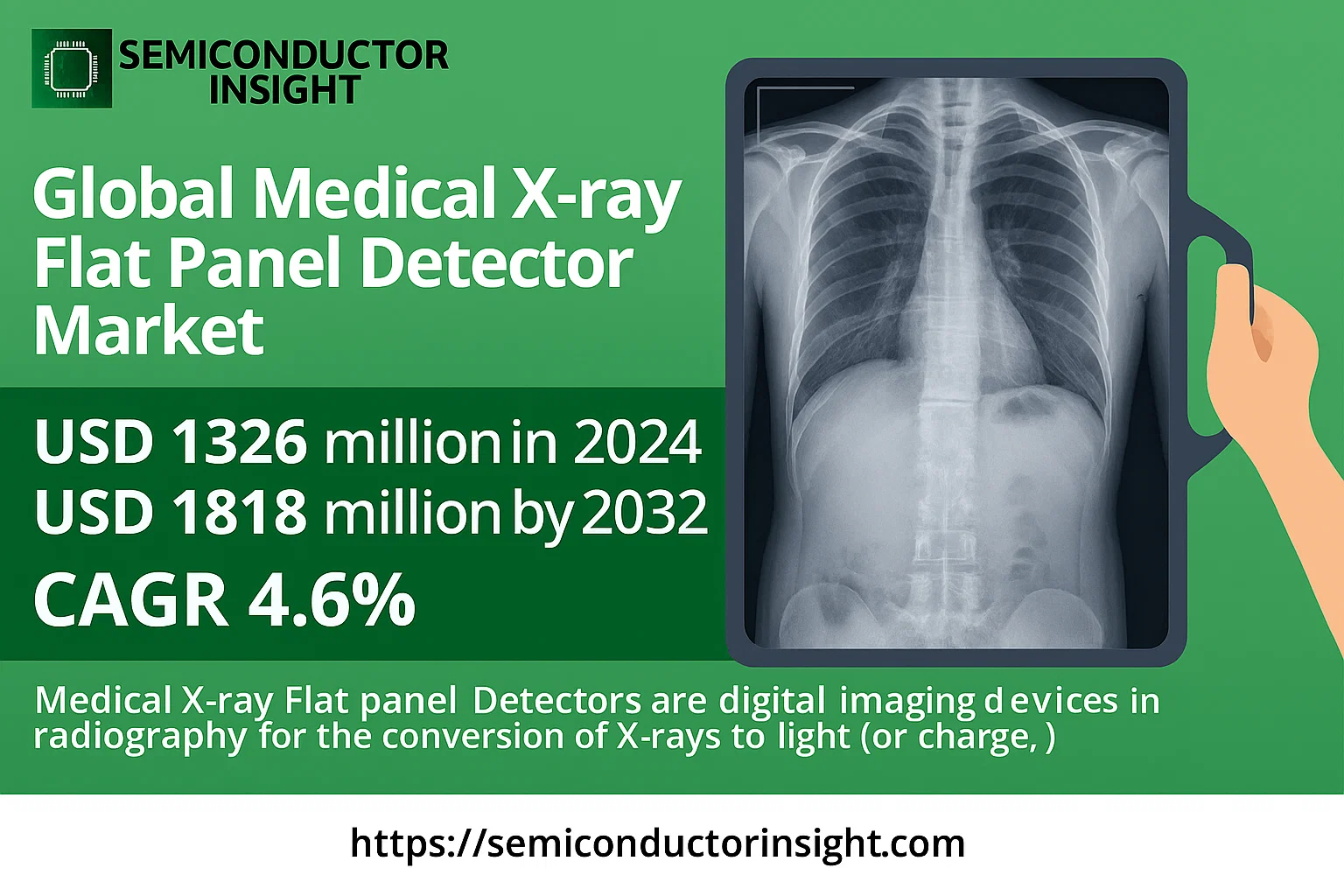
Global Medical X-ray Flat Panel Detector Market size was valued at USD 1326 million in 2024 to USD 1818 million by 2032, exhibiting a CAGR of 4.6% during the forecast period.
Medical X-ray Flat Panel Detectors are digital imaging devices used in radiography for the conversion of X-rays to light (indirect conversion) or charge (direct conversion), which is then read out using thin film transistors (TFT array). This technology has largely replaced traditional film and computed radiography systems due to its superior image quality, faster image acquisition, and improved workflow efficiency.
The market is experiencing steady growth driven by several factors, including the rising global prevalence of chronic diseases requiring diagnostic imaging, technological advancements in detector design, and the expanding adoption of digital radiography systems in hospitals and clinics. Furthermore, increasing healthcare expenditure and government initiatives for modernizing healthcare infrastructure are contributing to market expansion. Initiatives by key players are also expected to fuel market growth; for instance, continuous product launches with higher resolution and portability cater to diverse clinical needs. Varex Imaging, Trixell, Canon, iRay Technology, and Vieworks are some of the key players that operate in the market with a wide range of portfolios.
MARKET DRIVERS
Rising Global Prevalence of Chronic Diseases
The increasing incidence of chronic conditions such as cardiovascular diseases, cancer, and orthopedic disorders necessitates frequent and advanced diagnostic imaging. This drives substantial demand for medical X-ray systems equipped with modern flat panel detectors (FPDs), which offer superior image quality and faster throughput compared to traditional computed radiography systems. The shift towards early and accurate diagnosis is a primary factor propelling market growth.
Technological Advancements and Digitalization
Continuous innovation in detector technology, including the development of amorphous selenium (a-Se) and cesium iodide (CsI) based detectors, enhances image resolution and low-dose performance. Global push for digitalization in healthcare, supported by government initiatives, is accelerating the replacement of analog X-ray systems with digital radiography (DR) systems using flat panel detectors.
Additionally, the growing installation of FPDs in portable and handheld X-ray devices is expanding their use in point-of-care and emergency settings, meeting the need for rapid diagnostic capabilities.
MARKET CHALLENGES
High Initial Investment and Budget Constraints
The significant capital expenditure required for purchasing and installing new digital X-ray systems with flat panel detectors poses a major challenge, especially for small and medium-sized healthcare facilities in developing regions. The high cost of advanced detectors and the associated infrastructure upgrades can limit market penetration.
Other Challenges
Technical Complexity and Maintenance
Flat panel detectors are sophisticated devices requiring specialized knowledge for operation and maintenance. Issues such as detector calibration, artifact correction, and the need for regular servicing can lead to increased operational costs and downtime, presenting significant hurdles for end-users.
Regulatory Hurdles and Reimbursement Policies
Stringent regulatory approvals for medical devices and varying reimbursement policies across different countries can delay product launches and affect the profitability of manufacturers, creating an inconsistent market environment.
MARKET RESTRAINTS
Market Saturation in Developed Regions
Mature markets, such as North America and Western Europe, exhibit high adoption rates of digital radiography systems. This leads to a replacement market rather than new installations, slowing down the overall growth rate. The long lifespan of modern FPDs, often exceeding ten years, further extends the replacement cycle and acts as a restraint on market expansion.
Concerns Regarding Radiation Dose
Despite advances in low-dose imaging, persistent concerns among patients and practitioners about cumulative radiation exposure can influence the frequency of X-ray examinations. This sensitivity acts as a restraint, particularly in pediatric and routine screening applications, pushing the industry towards developing even lower-dose technologies.
MARKET OPPORTUNITIES
Expansion in Emerging Economies
Rising healthcare expenditure, improving healthcare infrastructure, and growing medical tourism in emerging economies across Asia-Pacific, Latin America, and the Middle East present significant growth opportunities. Governments in these regions are investing heavily in modernizing diagnostic imaging departments, creating a fertile ground for FPD adoption.
Advancements in Application-Specific Detectors
There is a growing opportunity to develop specialized flat panel detectors for emerging applications such as fluoroscopy, mammography, dental CBCT, and surgical C-arms. These specialized detectors require unique performance characteristics, opening new revenue streams for manufacturers who can innovate in these niche segments.
Integration with Telehealth and PACS
The expansion of telehealth services and Picture Archiving and Communication Systems (PACS) creates a strong demand for digital imaging solutions that can seamlessly integrate and share high-quality images. FPDs are ideally suited for this connected ecosystem, offering a substantial opportunity for market growth in the evolving digital health landscape.
Medical X-ray Flat Panel Detector Market Trends
Steady Market Expansion Fueled by Technological Adoption
Global Medical X-ray Flat Panel Detector Market is on a trajectory of steady growth, driven by the widespread adoption of digital radiography systems. The market, valued at approximately USD 1326 million in 2024, is projected to reach USD 1818 million by 2032, reflecting a compound annual growth rate (CAGR) of 4.6%. This expansion is largely fueled by the ongoing replacement of traditional computed radiography and film-based systems with more efficient and higher-resolution flat panel detectors (FPDs) across healthcare facilities. FPDs, which convert X-rays to light or charge using thin film transistor arrays, offer superior image quality, faster results, and improved workflow efficiency.
Other Trends
Dominance of Indirect Conversion Technology
In terms of technology, indirect conversion FPDs continue to dominate the market landscape, holding a commanding share of approximately 90%. This prevalence is due to their well-established performance, cost-effectiveness for many applications, and high imaging speed. While direct conversion detectors offer superior spatial resolution, their higher cost and more complex manufacturing process have limited their market penetration to niche, high-end applications where the highest possible image detail is critical.
Hospital Sector as the Primary End-User
The application analysis reveals that hospitals are the largest end-user segment, accounting for roughly 83% of the market. The high volume of diagnostic procedures, including general radiography, fluoroscopy, and mammography, conducted in hospital settings drives this significant demand. Clinics represent the secondary market segment, benefiting from the decentralization of healthcare services and the increasing availability of advanced diagnostic tools in outpatient settings.
Consolidated Competitive Landscape and Regional Dynamics
The competitive environment is characterized by a high degree of consolidation, with the top five players—including Varex Imaging, iRay Technology, Trixell, Canon, and Vieworks—collectively holding over 70% of the global market share. Regionally, North America leads with a share of about 35%, supported by advanced healthcare infrastructure and high healthcare expenditure. Asia-Pacific follows closely with a 33% share, driven by rapidly improving medical facilities, government healthcare initiatives, and a large patient population. Europe holds a significant 25% market share, with steady demand from its well-established healthcare systems. The continuous focus on product innovation, strategic mergers, and expansion into emerging markets are key trends shaping the strategies of leading market players.
COMPETITIVE LANDSCAPE
Key Industry Players
Market Dominated by a Handful of Established Giants
Global Medical X-ray Flat Panel Detector Market is characterized by a high level of concentration, with the top five players collectively commanding over 70% of the market share. Varex Imaging stands as a dominant leader, leveraging its extensive product portfolio and strong technological heritage. Trixell, a joint venture, is another pivotal player, particularly strong in the European market. The competitive environment is defined by continuous technological innovation, strategic mergers and acquisitions, and a focus on expanding into high-growth regions, with price competitiveness and product reliability being key differentiators.
Beyond the market leaders, a tier of significant niche players contributes to the dynamic competitive landscape. Companies like iRay Technology and Canon have established strong positions through specialized product offerings and aggressive growth strategies. Other manufacturers, including Vieworks, Rayence, and CareRay, compete effectively by focusing on cost-optimized solutions and targeting specific applications or regional markets. The presence of major imaging corporations such as Fujifilm and Konica Minolta further intensifies competition, driving advancements in detector performance, such as higher resolution and faster image readout speeds.
List of Key Medical X-ray Flat Panel Detector Companies Profiled
- Varex Imaging
- Trixell
- iRay Technology
- Canon
- Vieworks
- Rayence
- CareRay
- Hamamatsu
- DRTECH
- Teledyne DALSA
- Konica Minolta
- Fujifilm
- Carestream Health
Segment Analysis:
| Segment Category | Sub-Segments | Key Insights |
| By Type |
|
Indirect Flat Panel Detectors continue to lead the market segment due to their well-established technology, superior performance in dynamic imaging applications, and widespread adoption in general radiography. Their dominance is reinforced by a mature manufacturing ecosystem and proven reliability in converting X-rays to visible light using a scintillator layer. In contrast, direct conversion detectors offer advantages in dental and mammography applications with higher resolution, but face challenges related to manufacturing complexity and cost, limiting their broader market penetration despite their theoretical benefits. |
| By Application |
|
Hospitals constitute the dominant application segment, driven by their extensive need for high-volume imaging across diverse departments like emergency care, orthopedics, and cardiology. The critical requirement for reliable, fast, and high-quality diagnostic imaging in hospital settings fuels substantial and continuous investment in advanced flat panel detector technology. While clinics and diagnostic imaging centers are significant users, particularly for specialized and outpatient services, their collective demand is overshadowed by the comprehensive and capital-intensive imaging infrastructure maintained by large hospital networks, which serves as the primary driver for market growth. |
| By End User |
|
Original Equipment Manufacturers (OEMs) are the leading end-user segment, as they integrate flat panel detectors directly into new medical imaging systems such as digital radiography, fluoroscopy, and surgical C-arms. The technological integration and performance specifications required for new systems create a high-value, tightly controlled supply chain dominated by OEM partnerships. The aftermarket segment is growing steadily, driven by the need to upgrade or replace detectors in existing imaging equipment to extend system life and improve image quality, while system integrators serve a niche market for retrofitting or building custom imaging solutions. |
| By Panel Size |
|
Large Area Detectors are the most prominent segment, as they are essential for full-body and orthopedic imaging applications commonly performed in hospital radiology departments. Their ability to capture large anatomical regions in a single exposure improves workflow efficiency and patient throughput. Small area detectors are critical for specialized applications like dental and mammography, offering high spatial resolution, while medium area detectors provide versatility for various procedures including pediatric and extremity imaging. The demand for large area panels is sustained by their fundamental role in high-volume general radiography. |
| By Portability |
|
Fixed/Static Detectors lead this segment, as they form the backbone of installed base imaging systems in radiology rooms and dedicated suites, prized for their stability, integration, and consistent high performance. However, there is a rapidly growing interest in portable and mobile detectors, which support point-of-care imaging in intensive care units, operating theaters, and remote locations, enhancing diagnostic capabilities outside traditional settings. The evolution towards more flexible and decentralized healthcare delivery is gradually increasing the strategic importance of portable solutions, though fixed systems remain the volume leader due to their entrenched position in core hospital infrastructure. |
Regional Analysis: Medical X-ray Flat Panel Detector Market
The region is at the forefront of adopting the latest FPD technologies, including high-resolution detectors and advanced integration with PACS and AI-driven diagnostic tools. Hospitals and large imaging centers continuously invest in state-of-the-art digital radiography systems to improve diagnostic accuracy and workflow efficiency, creating a highly competitive and innovative market environment that pushes technological boundaries.
Stringent FDA regulations ensure that only high-quality, safe, and effective FPDs enter the market. This regulatory rigor, combined with favorable reimbursement codes from payers like Medicare and private insurers for digital X-ray procedures, creates a stable and predictable market. This environment encourages healthcare providers to invest in premium FPD systems, confident in their clinical and financial viability.
North America is home to several leading global FPD manufacturers and a dense network of specialist suppliers. This strong industrial base is supported by significant investment in R&D focused on improving detector efficiency, durability, and reducing radiation dose. Collaboration between manufacturers, academic institutions, and healthcare providers fuels continuous product innovation and refinement tailored to clinical needs.
The market is characterized by a well-defined replacement cycle where aging analog and CR systems are systematically being phased out in favor of digital FPDs. The compelling clinical and operational benefits of FPDs, such as faster image acquisition and superior image quality, drive this replacement trend. The market is relatively saturated but remains dynamic due to technological upgrades and expansion into niche applications like veterinary and portable imaging.
Europe
Europe represents a highly developed and significant market for Medical X-ray FPDs, characterized by advanced healthcare systems and strong regulatory oversight from bodies like the European Medicines Agency. Countries such as Germany, France, and the United Kingdom are key contributors, with a high density of advanced medical facilities. The market is driven by a focus on minimizing patient radiation exposure, leading to demand for low-dose, high-efficiency detectors. There is also a strong push towards integrating FPD systems with digital health records and telemedicine platforms, especially in Western Europe. The presence of major international players and a growing emphasis on preventive healthcare sustain steady market growth. However, purchasing decisions are often influenced by stringent budget controls within national health services, which can lengthen sales cycles compared to North America.
Asia-Pacific
The Asia-Pacific region is the fastest-growing market for Medical X-ray FPDs, fueled by rapidly improving healthcare infrastructure, rising healthcare expenditure, and growing awareness of early disease diagnosis. China, Japan, and India are the primary growth engines. China’s market is expanding rapidly due to government initiatives to modernize hospitals and clinics, creating massive demand for digital imaging equipment. Japan boasts a technologically advanced market with a high penetration of digital systems and strong domestic manufacturing capabilities. India’s market growth is driven by increasing private investment in healthcare and a large patient population. The region presents a mix of high-end system adoption in developed countries and volume-driven, cost-sensitive demand in emerging economies, offering diverse opportunities for manufacturers.
South America
The South American market for Medical X-ray FPDs is emerging, with growth potential constrained by economic volatility and varying levels of healthcare investment across countries. Brazil is the largest market in the region, driven by its sizable population and ongoing efforts to upgrade public and private healthcare infrastructure. However, market growth is often sensitive to government healthcare budgets and economic conditions. The adoption of digital X-ray technology is gradually increasing, primarily in urban hospitals and private diagnostic centers, as they seek to improve diagnostic capabilities. The market is characterized by a price-sensitive customer base, with demand focused on reliable, cost-effective FPD solutions rather than the latest high-end technologies.
Middle East & Africa
The Middle East & Africa region presents a diverse and developing market for Medical X-ray FPDs. The Gulf Cooperation Council (GCC) countries, such as the UAE and Saudi Arabia, are the most advanced markets, driven by high per capita income, government initiatives to build world-class medical tourism hubs, and significant investments in healthcare infrastructure. These markets demand high-quality, advanced FPD systems. In contrast, the broader African market is highly fragmented and price-sensitive, with growth primarily dependent on foreign aid and donor-funded projects to equip public health facilities. The overall market potential is significant but uneven, with adoption concentrated in major urban centers and specialized hospitals, while rural areas largely rely on basic imaging equipment.
Report Scope
This market research report provides a comprehensive analysis of the Medical X-ray Flat Panel Detector Market , covering the forecast period 2025–2032. It offers detailed insights into market dynamics, technological advancements, competitive landscape, and key trends shaping the industry.
Key focus areas of the report include:
- Market Overview: The report begins with an overview outlining its current market scenario, key growth indicators, and industry transformation drivers. It discusses macroeconomic factors, demand–supply balance, regulatory landscape, and the strategic role of semiconductors in powering advancements across industries such as automotive, telecommunications, consumer electronics, and industrial automation.
- Market Size & Forecast: Historical data and future projections for revenue, unit shipments, and market value across major regions and segments.
- Segmentation Analysis: Detailed breakdown by product type, technology, application, and end-user industry to identify high-growth segments and investment opportunities.
- Regional Insights: Insights into market performance across North America, Europe, Asia-Pacific, Latin America, and the Middle East & Africa, including country-level analysis where relevant.
- Competitive Landscape: Profiles of leading market participants, including their product offerings, R&D focus, manufacturing capacity, pricing strategies, and recent developments such as mergers, acquisitions, and partnerships.
- Technology Trends & Innovation: Assessment of emerging technologies, integration of AI/IoT, semiconductor design trends, fabrication techniques, and evolving industry standards.
- Market Drivers & Restraints: Evaluation of factors driving market growth along with challenges, supply chain constraints, regulatory issues, and market-entry barriers.
- Stakeholder Insights: Insights for component suppliers, OEMs, system integrators, investors, and policymakers regarding the evolving ecosystem and strategic opportunities.
Primary and secondary research methods are employed, including interviews with industry experts, data from verified sources, and real-time market intelligence to ensure the accuracy and reliability of the insights presented.
FREQUENTLY ASKED QUESTIONS:
What is the current market size of Medical X-ray Flat Panel Detector Market?
-> Medical X-ray Flat Panel Detector Market size was valued at USD 1326 million in 2024 to USD 1818 million by 2032, exhibiting a CAGR of 4.6% during the forecast period.
Which key companies operate in Medical X-ray Flat Panel Detector Market?
-> Key players include Varex Imaging, iRay Technology, Trixell, Canon, Vieworks, among others, with the top five players holding a share over 70%.
What are the key growth drivers?
-> Key growth drivers include increasing demand for advanced medical imaging, technological advancements in radiography, and the rising prevalence of chronic diseases requiring diagnostic imaging.
Which region dominates the market?
-> North America is the largest market with a share of about 35%, followed by Asia-Pacific and Europe with market shares of 33% and 25%, respectively.
What are the emerging trends?
-> Emerging trends include the shift towards indirect conversion flat panel detectors, which hold a 90% market share, and the dominant application in Hospitals, accounting for about 83% of the market.
Get Sample Report PDF for Exclusive Insights
Report Sample Includes
- Table of Contents
- List of Tables & Figures
- Charts, Research Methodology, and more...
 Download Sample Report PDF


