MARKET INSIGHTS
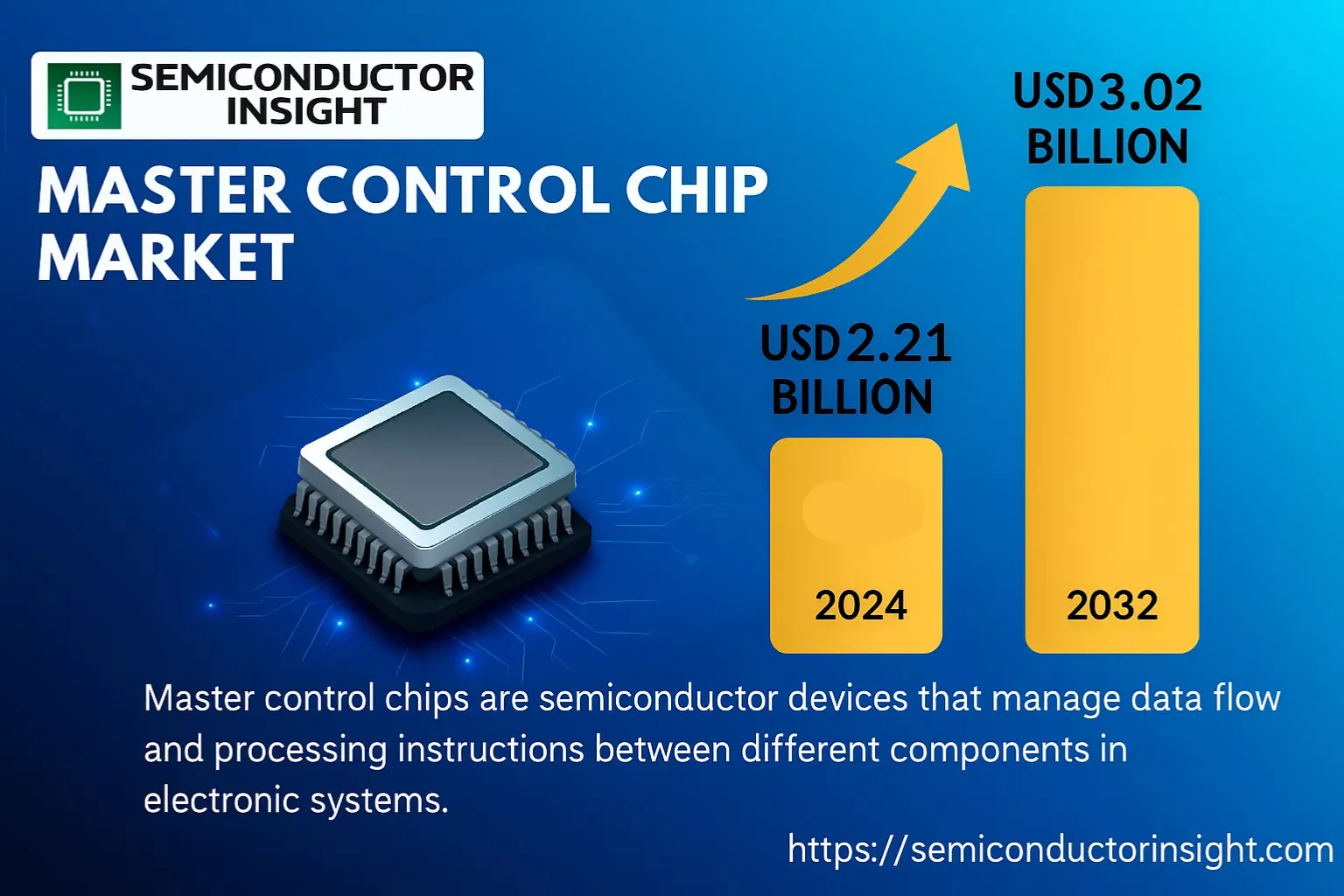
Global Master Control Chip Market was valued at USD 2.21 billion in 2024. The market is projected to grow to USD 3.02 billion by 2032, exhibiting a CAGR of 3.2% during the forecast period.
Master control chips are semiconductor devices that manage data flow and processing instructions between different components in electronic systems. These integrated circuits serve as the central processing unit for storage devices, consumer electronics, and automotive systems, coordinating operations like data transfer, error correction, and power management. The market includes expandable control chips, SSD control chips, and embedded control chips.
Market growth is driven by increasing demand for data storage, the expansion of cloud computing, and rising adoption of solid-state drives in consumer electronics and data centers. However, the market faces headwinds from supply chain constraints and the high cost of advanced chip manufacturing.
Geographically, China dominates the market with a 39% revenue share, followed by Southeast Asia (15%) and North America (14%). This distribution reflects both manufacturing concentration and regional demand patterns for electronic devices.
MARKET DRIVERS
Proliferation of Smart and Connected Devices
The global expansion of the Internet of Things (IoT), smart home systems, and connected automotive electronics is a principal driver for the master control chip market. These chips are essential for managing core processing, communication, and control functions in a vast array of devices, from smart appliances to industrial sensors. The demand for greater intelligence and connectivity in consumer electronics and industrial automation is fueling significant market growth.
Advancements in Semiconductor Technology
Continuous innovation in semiconductor manufacturing, including the adoption of smaller process nodes like 7nm and 5nm, enables the production of more powerful, energy-efficient, and compact master control chips. This allows for enhanced performance in high-end applications such as artificial intelligence processing at the edge, autonomous vehicles, and advanced robotics, pushing the boundaries of what these control units can achieve.
➤ The global demand for processing power in edge computing applications is projected to drive the market for high-performance master control chips to over $25 billion by 2027.
Furthermore, the integration of AI-specific accelerators and machine learning capabilities directly into master control chips is becoming a standard requirement for next-generation devices, creating a sustained cycle of technological advancement and replacement.
MARKET CHALLENGES
Global Supply Chain Constraints and Component Shortages
The master control chip market faces persistent challenges from global semiconductor supply chain disruptions. Geopolitical tensions, fluctuating raw material costs, and concentrated manufacturing capacity can lead to significant production delays and increased costs for chip manufacturers and their downstream customers, impacting market stability.
Other Challenges
Technical Complexity and Design Integration
As master control chips evolve to handle more complex tasks, the engineering challenges of integrating diverse functionalities (processing, connectivity, security) onto a single chip while managing power consumption and thermal output become increasingly difficult and costly.
Intense Competition and Price Pressure
The market is highly competitive, with numerous established players and new entrants vying for market share. This intense competition, particularly in consumer electronics segments, creates significant price pressure, squeezing profit margins and driving the need for continuous cost optimization.
MARKET RESTRAINTS
High Research and Development Costs
The design and development of advanced master control chips require immense capital investment in R&D, specialized engineering talent, and sophisticated design software. These high upfront costs act as a significant barrier to entry for smaller companies and can restrain the pace of innovation from new market participants.
Cyclical Nature of the Semiconductor Industry
The master control chip market is subject to the inherent cyclicality of the broader semiconductor industry. Periods of oversupply leading to price erosion can be followed by shortages, creating an unpredictable business environment that complicates long-term planning and investment for manufacturers.
MARKET OPPORTUNITIES
Expansion into Automotive and Industrial Automation
The transition towards electric vehicles (EVs), advanced driver-assistance systems (ADAS), and Industry 4.0 presents a major growth avenue. Master control chips are critical for vehicle control units, robotic controllers, and smart factory systems, representing a high-value market segment with strong long-term growth prospects.
Rise of Edge AI and Customized Solutions
The growing need for real-time data processing at the network edge, away from centralized cloud data centers, creates demand for specialized master control chips with integrated AI processors. This trend opens opportunities for companies to develop application-specific solutions for sectors like healthcare diagnostics, smart cities, and surveillance.
Master Control Chip Market Trends
Sustained Growth Driven by Data Storage Demands
The global Master Control Chip market is on a steady growth trajectory, valued at $2,213 million in 2024 and projected to reach $3,023 million by 2032, at a Compound Annual Growth Rate (CAGR) of 3.2% during the forecast period. This expansion is primarily fueled by the ever-increasing demand for data storage, particularly with the proliferation of consumer electronics and enterprise-level solid-state storage. The dominance of the Solid State Drives (SSD) application segment, which accounts for approximately 50% of the market, underscores this trend. As high-speed, efficient storage becomes standard across devices, the core components like master control chips are experiencing sustained demand, with SSD control chips representing the largest product type segment at a 50% market share.
Other Trends
Significant Geographic Concentration and Market Leadership
The market exhibits a pronounced geographic concentration, with China being the largest market, holding a share of about 39%. This is followed by Southeast Asia (15%) and North America (14%). The regional distribution reflects the concentration of electronics manufacturing and assembly in the Asia-Pacific region. The competitive landscape is similarly concentrated, with the top five players—including Marvell Technology, Silicon Motion, and Phison Electronics—collectively holding a dominant market share of approximately 77%. This high level of consolidation indicates a mature market where technological expertise and scale are critical competitive advantages.
Diversification into Emerging Applications
Beyond the established SSD market, diversification into other applications presents a significant trend. The automotive sector is emerging as a key growth area, requiring advanced control chips for infotainment systems, advanced driver-assistance systems (ADAS), and in-vehicle networking. This diversification is encouraging innovation among manufacturers to develop specialized chips that meet the stringent reliability and performance requirements of the automotive industry. While consumer electronics and SSDs remain the core markets, the push into automotive and other specialized fields represents a strategic move to capture new growth opportunities and mitigate reliance on a single dominant segment.
COMPETITIVE LANDSCAPE
Key Industry Players
A Highly Concentrated Market Led by Storage and Connectivity Specialists
The global Master Control Chip market is characterized by a high degree of concentration, with the top five manufacturers commanding approximately 77% of the market share. This dominance is driven by significant R&D investments, extensive patent portfolios, and long-standing relationships with major OEMs in the consumer electronics and data storage industries. Marvell Technology stands as a definitive leader, leveraging its broad portfolio of storage, networking, and connectivity controller solutions. Its position is bolstered by serving key segments like enterprise storage and data centers. Close behind are storage controller specialists Silicon Motion and Phison Electronics, which are pivotal in the SSD Control Chip segment—the largest product category accounting for a 50% market share. Their expertise in NAND flash memory controllers makes them essential suppliers to the global solid-state drive market, which itself represents the largest application field.
Beyond the dominant players, a competitive landscape of specialized and regional manufacturers caters to niche applications and specific geographic markets. Companies like ASMedia Technology excel in high-speed connectivity controllers, such as USB and PCIe, which are critical components in modern computing. A significant number of key players are based in China, the world’s largest market for Master Control Chips with a 39% share, including YEESTOR Microelectronics, Lianyun Technology, and Beijing Yixin Technology. These companies are increasingly focusing on developing solutions for the domestic consumer electronics and growing automotive sectors. Other notable international players include Microchip, a major supplier of embedded control solutions, and JMicron, historically significant in the SSD controller space. The market also features emerging specialized firms like DapuStor Corporation, which is focusing on enterprise and data center SSD controllers, indicating ongoing innovation and segmentation within the industry.
List of Key Master Control Chip Companies Profiled
- Marvell Technology
- Silicon Motion
- Phison Electronics
- ASMedia Technology
- YEESTOR Microelectronics
- Lianyun Technology (Hangzhou)
- ASolid Technology
- Alcor Micro
- Beijing Yixin Technology
- Yingren Technology(Shanghai)
- HOSIN Global Electronics
- Microchip
- JMicron
- Shenzhen Chipsbank Technologies
- DapuStor Corporation
Segment Analysis:
| Segment Category | Sub-Segments | Key Insights |
| By Type |
|
SSD Control Chip dominates the market due to the explosive growth in data generation and the widespread adoption of solid-state drives across consumer electronics and enterprise storage systems. This segment’s leadership is driven by the critical requirement for high-speed data processing, superior reliability, and efficient power management in modern computing. The transition from traditional hard drives to faster, more durable SSDs in applications ranging from personal computers to data centers fuels consistent demand. The technological innovation focused on increasing data transfer speeds and storage capacities solidifies the pivotal role of these chips in the digital infrastructure ecosystem. |
| By Application |
|
Solid State Drives represent the most significant application segment, underpinning the storage needs of the modern digital economy. The insatiable demand for faster boot times, quick application loading, and robust performance in both personal computing and large-scale cloud servers drives this segment’s prominence. The proliferation of high-resolution content, IoT devices, and AI workloads necessitates reliable, high-performance storage solutions where master control chips are essential. This dominance is further reinforced by the ongoing miniaturization of devices and the trend towards higher-capacity storage, ensuring that SSD control chips remain a cornerstone of technological advancement and market growth. |
| By End User |
|
Enterprise & Data Centers are the leading end-user segment, as they require the highest performance and reliability for mission-critical operations. The exponential growth in cloud computing, big data analytics, and online services places immense demands on storage infrastructure, making robust master control chips indispensable. This segment is characterized by a continuous drive for innovation to support higher input/output operations per second and enhanced data integrity. The strategic importance of data as a corporate asset and the shift towards hyper-scale data centers ensure that this segment maintains its critical position, driving specifications for the entire industry. |
| By Integration Complexity |
|
High-Performance Chips lead this category, catering to applications where speed, low latency, and data integrity are non-negotiable. These chips are engineered for enterprise servers, high-end workstations, and professional-grade storage arrays, incorporating advanced error correction, wear leveling, and power-loss protection features. The design complexity and stringent performance requirements create significant barriers to entry, favoring established players with deep technical expertise. The relentless demand for faster data processing from AI, machine learning, and real-time analytics ensures that high-performance solutions remain at the forefront of technological and market development. |
| By Product Lifecycle Stage |
|
Mature Products constitute the largest segment, representing well-established control chips for mainstream SATA and PCIe SSDs that have achieved widespread adoption. These products benefit from standardized interfaces, proven reliability, and economies of scale, making them the default choice for a vast majority of applications. Competition in this segment is intense, focusing on cost reduction and incremental performance improvements. While innovation continues, the primary market driver is the sheer volume demand from the replacement of older storage technologies and the expansion of storage capacity in existing devices, ensuring stable and predictable market dynamics for these foundational components. |
Regional Analysis: Master Control Chip Market
Asia-Pacific
The region’s dominance in semiconductor manufacturing is the cornerstone of its leadership. Countries like Taiwan, South Korea, and China host the world’s most advanced foundries. This proximity to cutting-edge fabrication processes allows for close collaboration between Master Control Chip designers and manufacturers, optimizing chip performance and enabling rapid iteration cycles for new product developments, which is a significant competitive advantage.
A massive and tech-savvy consumer base creates insatiable demand for devices powered by master control chips. From smartphones and laptops to smart home devices and gaming consoles, the Asia-Pacific region is both the primary producer and the largest market. This dual role fuels continuous innovation as manufacturers compete to integrate more powerful and efficient chips to capture market share in this highly competitive landscape.
National industrial policies heavily favor the semiconductor sector. Significant state-backed investments, tax incentives, and research grants are common, aiming to achieve technological self-sufficiency and global leadership. These policies de-risk large-scale investments in R&D and infrastructure, encouraging local companies to aggressively expand their Master Control Chip portfolios and capture a larger portion of the global value chain.
The rapid modernization of manufacturing and the automotive industry in the region presents a major growth vector. Master Control Chips are critical for industrial automation, robotics, and the new generation of electric and connected vehicles. Local chip suppliers are deeply integrated into these supply chains, providing tailored solutions that meet the specific requirements of Asian manufacturers, further entrenching their market position.
North America
North America remains a critical hub for high-end Master Control Chip design and innovation, anchored by a strong ecosystem of leading fabless semiconductor companies and major technology firms. The region’s strength lies in its advanced research institutions, significant venture capital funding for tech startups, and dominance in demanding sectors like data centers, cloud computing, and advanced artificial intelligence applications. These sectors require the most powerful and specialized master control chips, driving a focus on R&D for leading-edge process nodes and architectures. While much of the physical manufacturing occurs overseas, the intellectual property and design leadership concentrated in the United States and Canada ensure the region maintains a high-value position in the global market, particularly for premium and cutting-edge applications.
Europe
The European market for Master Control Chips is characterized by a strong emphasis on industrial, automotive, and aerospace applications, where reliability, safety, and precision are paramount. The region is home to world-leading automotive manufacturers and industrial equipment suppliers, creating robust demand for specialized chips that meet stringent regulatory and performance standards. European semiconductor companies often focus on niche, high-value segments rather than competing in the high-volume consumer market. Collaboration within the European Union on initiatives to bolster its semiconductor sovereignty is also shaping the market, aiming to reduce external dependencies and foster innovation in specific technological areas like automotive-grade chips and embedded systems for industrial IoT.
South America
The Master Control Chip market in South America is a developing landscape, currently characterized by its role as a consumption market rather than a production or innovation hub. Demand is primarily driven by the consumer electronics sector and the gradual modernization of industrial infrastructures in countries like Brazil and Argentina. The market growth is closely tied to broader economic conditions and foreign investment in technology infrastructure. While local manufacturing of semiconductors is minimal, there is a growing dependency on imports to meet the needs of various industries. The market potential is significant but is tempered by challenges related to economic volatility and infrastructure development.
Middle East & Africa
The Middle East and Africa region presents a market with diverse and emerging opportunities for Master Control Chips. In the Middle East, wealthy Gulf nations are investing heavily in smart city projects, digital transformation initiatives, and diversifying their economies beyond oil, which drives demand for chips used in infrastructure, telecommunications, and consumer technologies. In Africa, the market is driven by rapid mobile adoption and the gradual growth of the technology sector, though from a relatively low base. The region overall is largely import-dependent, with growth potential hinging on economic diversification strategies and increased digitalization efforts across various sectors.
Report Scope
This market research report provides a comprehensive analysis of the Master Control Chip Market , covering the forecast period 2025–2032. It offers detailed insights into market dynamics, technological advancements, competitive landscape, and key trends shaping the industry.
Key focus areas of the report include:
- Market Overview: The report begins with an overview outlining its current market scenario, key growth indicators, and industry transformation drivers. It discusses macroeconomic factors, demand–supply balance, regulatory landscape, and the strategic role of semiconductors in powering advancements across industries such as automotive, telecommunications, consumer electronics, and industrial automation.
- Market Size & Forecast: Historical data and future projections for revenue, unit shipments, and market value across major regions and segments.
- Segmentation Analysis: Detailed breakdown by product type, technology, application, and end-user industry to identify high-growth segments and investment opportunities.
- Regional Insights: Insights into market performance across North America, Europe, Asia-Pacific, Latin America, and the Middle East & Africa, including country-level analysis where relevant.
- Competitive Landscape: Profiles of leading market participants, including their product offerings, R&D focus, manufacturing capacity, pricing strategies, and recent developments such as mergers, acquisitions, and partnerships.
- Technology Trends & Innovation: Assessment of emerging technologies, integration of AI/IoT, semiconductor design trends, fabrication techniques, and evolving industry standards.
- Market Drivers & Restraints: Evaluation of factors driving market growth along with challenges, supply chain constraints, regulatory issues, and market-entry barriers.
- Stakeholder Insights: Insights for component suppliers, OEMs, system integrators, investors, and policymakers regarding the evolving ecosystem and strategic opportunities.
Primary and secondary research methods are employed, including interviews with industry experts, data from verified sources, and real-time market intelligence to ensure the accuracy and reliability of the insights presented.
FREQUENTLY ASKED QUESTIONS:
What is the current market size of Master Control Chip Market?
-> Global Master Control Chip Market was valued at USD 2213 million in 2024 and is projected to reach USD 3023 million by 2032, exhibiting a CAGR of 3.2% during the forecast period.
Which key companies operate in Master Control Chip Market?
-> Key players include Marvell Technology, Silicon Motion, Phison Electronics, ASMedia Technology, YEESTOR Microelectronics, among others. The top five players hold a share of about 77%.
What are the key growth drivers?
-> Key growth is driven by demand from key application segments such as Solid State Drives and Consumer Electronics, alongside technological advancements and increasing data storage needs.
Which region dominates the market?
-> China is the largest market, accounting for a share of about 39%, followed by Southeast Asia and North America with shares of 15% and 14%, respectively.
What are the emerging trends?
-> Key trends include the dominance of the SSD Control Chip product segment, which accounts for a 50% share, and the growth of the Solid State Drives application, which also holds a share of about 50%.

Get Sample Report PDF for Exclusive Insights
Report Sample Includes
- Table of Contents
- List of Tables & Figures
- Charts, Research Methodology, and more...
 Download Sample Report PDF