Massive MIMO hybrid beamforming with 1-bit resolution phase shifter Market Insights
Global Massive MIMO hybrid beamforming with 1‑bit resolution phase shifter market size was valued at USD 0.45 billion in 2025. The market is projected to grow from USD 0.48 billion in 2026 to USD 0.92 billion by 2034, exhibiting a CAGR of 8.3% during the forecast period.
This technology combines large‑scale antenna arrays (Massive MIMO) with hybrid analog‑digital beamforming architectures that employ 1‑bit phase shifters,binary elements toggling between two discrete phase states (e.g., 0°/180°). The approach reduces hardware complexity and power consumption while preserving the spatial multiplexing gains essential for next‑generation sub‑6 GHz and millimeter‑wave networks.
The market is accelerating because telecom operators are rolling out dense urban deployments of 5G and early‑stage 6G trials that demand cost‑effective high‑throughput solutions. Furthermore, advances in semiconductor processes enable reliable low‑resolution phase‐shifter integration at scale. Key players such as Nokia, Ericsson, Huawei, Samsung Electronics, and Qualcomm are intensifying R&D collaborations,e.g., a March 2024 joint venture between Qualcomm and NTT Docomo announced a prototype low‑cost phased‐array module targeting rural broadband.
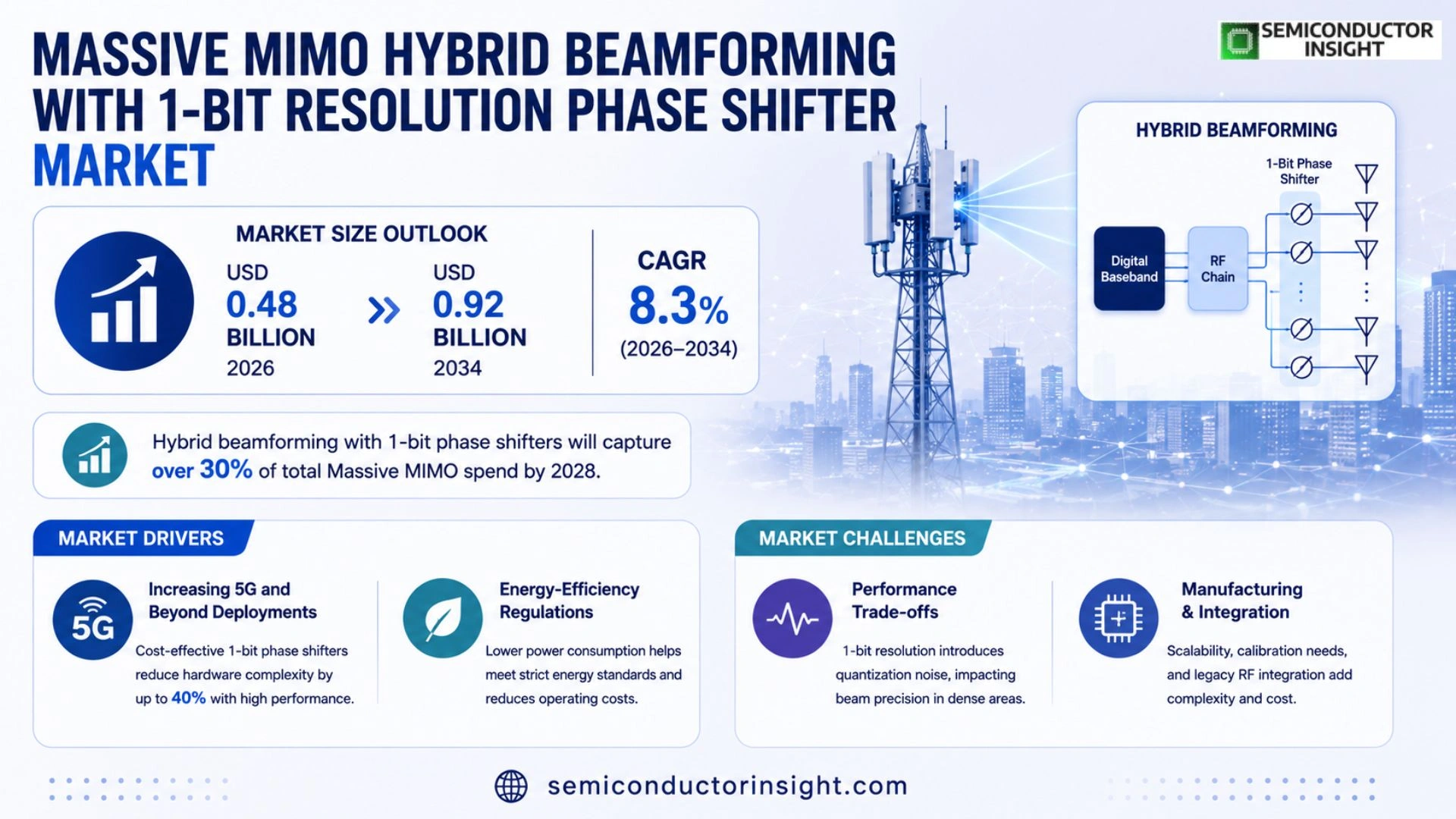
MARKET DRIVERS
Increasing 5G and Beyond Deployments
Massive MIMO hybrid beamforming with 1-bit resolution phase shifter Market is gaining momentum as operators rollout 5G NR and plan for 6G. The need for cost‑effective, power‑efficient antenna arrays drives adoption of low‑resolution phase‑shifters, which can reduce hardware complexity by up to 40% while maintaining comparable spectral efficiency.
Energy‑Efficiency Regulations
Stringent energy‑consumption standards in Europe and Asia push equipment manufacturers to seek solutions that lower power draw. 1‑bit phase‑shifter architectures consume significantly less power than high‑resolution alternatives, aligning with regulatory targets and reducing operating expenditures for network owners.
➤ Industry analysts forecast that the hybrid beamforming segment will capture over 30% of total Massive MIMO spend by 2028, driven chiefly by 1‑bit phase‑shifter adoption.
Moreover, the scaling of data‑center interconnects and private 5G networks creates parallel demand, positioning Massive MIMO hybrid beamforming with 1-bit resolution phase shifter Market as a strategic enabler for both public and enterprise connectivity.
MARKET CHALLENGES
Performance Trade‑offs at Low Resolution
While 1‑bit phase shifters simplify hardware, they introduce quantization noise that can affect beam‑forming precision. Operators must balance cost savings against potential reductions in beam‑steering accuracy, especially in dense urban deployments where interference mitigation is critical.
Other Challenges
Manufacturing Scalability
Achieving consistent performance across large‑scale production runs remains a hurdle. Variability in CMOS processes can lead to phase‑error spread, requiring additional calibration algorithms that add computational overhead.
Integration with existing RF front‑ends also poses challenges, as legacy systems may not readily support the digital‑analog hybrid architecture without substantial redesign.
MARKET RESTRAINTS
High Initial R&D Investment
Developing robust 1‑bit hybrid beamforming platforms demands significant upfront research, particularly in signal‑processing algorithms that compensate for reduced phase granularity. Smaller vendors may lack the capital to sustain such intensive development cycles.
Furthermore, the lack of standardized testing frameworks for low‑resolution beamformers can delay time‑to‑market, as companies must navigate bespoke validation procedures.
MARKET OPPORTUNITIES
Emerging Private 5G Deployments
Enterprises are increasingly deploying private 5G networks for manufacturing, logistics, and campus connectivity. These use‑cases prioritize cost‑effectiveness and rapid deployment, making Massive MIMO hybrid beamforming with 1-bit resolution phase shifter Market an attractive solution.
Additionally, advancements in AI‑driven beam‑forming optimization present a growth avenue. By leveraging machine‑learning models to mitigate quantization errors, vendors can unlock higher performance levels without increasing hardware complexity, expanding the market’s addressable scope.
Massive MIMO hybrid beamforming with 1-bit resolution phase shifter Market Trends
Cost‑Effective Deployment Driving 5G Expansion
Telecom operators are intensifying dense‑urban roll‑outs of 5G and early‑stage 6G trials, creating a clear demand for hardware that balances performance with cost. The hybrid beamforming architecture that relies on 1‑bit phase shifters reduces the number of expensive RF chains, directly lowering capital expenditure while still delivering the spatial multiplexing gains required for high‑throughput sub‑6 GHz and millimeter‑wave services. This cost advantage is prompting network planners to prioritize solutions that incorporate binary phase‑shift elements, especially in markets where budget constraints meet aggressive coverage targets. Operators also prioritize energy‑efficient designs because dense antenna installations drive electricity costs. By limiting each phase shifter to two states, the control circuitry consumes a fraction of the power required by multi‑bit alternatives, translating into measurable OPEX savings. Moreover, the binary nature simplifies calibration procedures, allowing faster deployment cycles and reducing field‑engineer time. Early field trials in European megacities have reported over‑the‑air throughput gains of 15 % while maintaining a hardware bill‑of‑materials that is 30 % lower than conventional fully‑digital beamforming solutions.
Other Trends
Integration with Advanced Semiconductor Processes
Recent advances in CMOS and SiGe processes enable the mass production of reliable 1‑bit phase‑shifter chips at wafer‑scale yields. The ability to embed these components within standard RF front‑ends reduces board‑level complexity and power draw, making the technology attractive for both macro‑cell and small‑cell deployments. OEMs are leveraging these process improvements to shorten time‑to‑market for new phased‑array modules, aligning product cycles with operator rollout schedules. The transition to sub‑10 nm CMOS nodes has unlocked tighter integration of phase‑shifter arrays with digital base‑band processors, enabling on‑chip routing that minimizes signal loss. Thermal modeling shows that 1‑bit elements generate less heat, which eases cooling requirements for compact RF modules deployed on street‑level poles. Production yields benefit from the binary design, as defect detection can rely on simple pass‑fail tests rather than multi‑level calibration. Consequently, unit costs drop while reliability improves, reinforcing the business case for large‑scale antenna farms.
Collaborative R&D Accelerating Technology Maturation
Key industry players,including Nokia, Ericsson, Huawei, Samsung Electronics, and Qualcomm,have entered joint development programs to validate low‑resolution phase‑shifter modules under real‑world traffic conditions. A notable March 2024 collaboration between Qualcomm and NTT Docomo produced a prototype phased‑array module aimed at rural broadband, demonstrating that the simplified hardware can achieve measurable throughput improvements while keeping power consumption below traditional hybrid designs. These partnerships are creating shared testbeds that accelerate standardization efforts and encourage broader adoption across the ecosystem. Standardization bodies such as 3GPP have begun to reference low‑resolution beamforming in Release 17 specifications, opening pathways for interoperability across equipment vendors. Pilot deployments in North America and East Asia are evaluating the impact on latency-sensitive applications like augmented reality and vehicle‑to‑infrastructure communication. The collaborative model also allows shared intellectual property pools, reducing duplication of effort and accelerating time‑to‑revenue. As the ecosystem matures, Massive MIMO hybrid beamforming with 1-bit resolution phase shifter Market is expected to see broader acceptance in both urban macro‑cell upgrades and cost‑constrained rural broadband projects.
COMPETITIVE LANDSCAPE
Key Industry Players
Massive MIMO Hybrid Beamforming with 1‑Bit Phase Shifters: Competitive Landscape
Massive MIMO hybrid beamforming market with 1‑bit resolution phase shifters is anchored by a handful of global telecom equipment leaders who control the majority of design IP and production capacity. Nokia, Ericsson, Huawei, Samsung Electronics and Qualcomm collectively account for more than 60 % of the 2025 market valuation of USD 0.45 billion, and they drive the roadmap toward 2034 where the market is expected to reach USD 0.92 billion at an 8.3 % CAGR. These incumbents leverage deep R&D pipelines, extensive antenna‑array patents, and large‑scale foundry partnerships to deliver cost‑effective sub‑6 GHz and millimeter‑wave modules for dense urban 5G roll‑outs and early‑stage 6G trials. Their strategic collaborations,such as the Qualcomm‑NTT Docomo joint prototype announced in March 2024,reinforce a consolidated supply chain that emphasizes low‑resolution, high‑efficiency phase‑shifter integration while maintaining the spatial multiplexing gains critical for next‑generation networks.
Beyond the dominant tier, a diverse set of niche innovators expands the ecosystem with specialized ASICs, silicon‑photonic phase‑shifter arrays, and advanced packaging solutions. Companies such as MediaTek, Intel, Texas Instruments, Murata, Skyworks Solutions, Qorvo, Analog Devices, Broadcom, Xilinx (AMD), and Keysight Technologies provide complementary RF front‑end components, low‑power digital‑to‑analog converters, and design‑automation tools that enable rapid prototyping and volume production for regional operators and private‑network deployments. These players often focus on particular frequency bands, custom silicon processes, or vertical market segments (e.g., automotive and industrial IoT), thereby enriching the overall competitive landscape and fostering a multi‑vendor environment that mitigates supply‑chain risk.
List of Key Massive MIMO Hybrid Beamforming with 1‑Bit Phase Shifter Companies Profiled
- Nokia
- Ericsson
- Huawei
- Samsung Electronics
- Qualcomm
- MediaTek
- Intel
- Texas Instruments
- Murata Manufacturing
- Skyworks Solutions
- Qorvo
- Analog Devices
- Broadcom
- Xilinx (AMD)
- Keysight Technologies
Segment Analysis:
| Segment Category | Sub-Segments | Key Insights |
| By Type |
|
Digital‑Dominant Hybrid is gaining traction because it balances algorithmic flexibility with modest hardware overhead.
|
| By Application |
|
Urban macrocell coverage benefits most from the hybrid approach because it demands high‑throughput links across wide areas while keeping deployment cost in check.
|
| By End User |
|
Telecom operators are the primary drivers, seeking cost‑effective solutions that sustain aggressive capacity targets.
|
| By Frequency Band |
|
Millimeter‑wave emerges as the leading segment due to its need for highly directional beams where the 1‑bit phase‑shifter architecture shines.
|
| By Deployment Scenario |
|
Dense urban deployments benefit most from the hybrid, low‑resolution approach because they demand massive antenna counts with constrained power budgets.
|
Regional Analysis: North America
The ongoing rollout of 5G networks across North America is the primary driver for the adoption of Massive MIMO technologies. Significant investments in base station upgrades and network densification are creating a strong demand for advanced beamforming solutions.
Government policies and funding initiatives aimed at accelerating 5G deployment are playing a crucial role in market growth. These initiatives are fostering a favorable environment for innovation and investment in advanced wireless technologies.
Growing demand from industries like manufacturing, healthcare, and transportation for reliable and high-speed wireless connectivity is contributing to the market expansion. Massive MIMO hybrid beamforming enhances network performance for these demanding applications.
Continuous advancements in Massive MIMO and 1-bit resolution phase shifter technologies are driving improved network efficiency and performance. Research and development efforts are focused on enhancing beamforming algorithms and integrating these technologies into existing network infrastructure.
Europe
The European market for Massive MIMO hybrid beamforming with 1-bit resolution phase shifter Market is characterized by a gradual but steady growth trajectory. Stringent regulatory environments and a focus on energy efficiency influence the pace of adoption. While 5G deployments are underway, the region’s diverse regulatory landscape presents a challenge to widespread implementation. Key markets like Germany, France, and the UK are leading the way in 5G infrastructure development, creating opportunities for growth in this sector. The emphasis on sustainable technologies also pushes for power-efficient beamforming solutions.
Asia-Pacific
Asia-Pacific represents the largest and fastest-growing market for Massive MIMO hybrid beamforming with 1-bit resolution phase shifter Market. Driven by rapid urbanization, increasing smartphone penetration, and ambitious 5G rollout plans, the region is witnessing significant demand. China is a dominant force in 5G deployment, and other countries like India and Japan are making substantial investments in network infrastructure. The competitive landscape is intense, with numerous players vying for market share. The region’s large population and increasing data consumption are key drivers of growth.
South America
The South American market is in the early stages of development for Massive MIMO hybrid beamforming with 1-bit resolution phase shifter Market. While 5G deployments are gaining momentum, infrastructure limitations and economic factors pose challenges to widespread adoption. Brazil and Argentina are key markets with potential for growth, but progress is contingent on government policies and investments in network infrastructure. The increasing demand for mobile data and the growing adoption of IoT devices are expected to drive market expansion in the long term.
Middle East & Africa
The Middle East & Africa region presents a promising growth opportunity for Massive MIMO hybrid beamforming with 1-bit resolution phase shifter Market. Increasing investments in telecommunications infrastructure and the growing demand for high-speed mobile connectivity are driving adoption. Countries like Saudi Arabia, the UAE, and South Africa are leading the way in 5G deployments, creating opportunities for market players. The region’s rapid economic growth and increasing smartphone penetration are key factors contributing to market expansion.
Report Scope
This market research report provides a comprehensive analysis of the Massive MIMO hybrid beamforming with 1-bit resolution phase shifter Market , covering the forecast period 2026–2034. It offers detailed insights into market dynamics, technological advancements, competitive landscape, and key trends shaping the industry.
Key focus areas of the report include:
- Market Overview: The report begins with an overview outlining its current market scenario, key growth indicators, and industry transformation drivers. It discusses macroeconomic factors, demand–supply balance, regulatory landscape, and the strategic role of semiconductors in powering advancements across industries such as automotive, telecommunications, consumer electronics, and industrial automation.
- Market Size & Forecast: Historical data and future projections for revenue, unit shipments, and market value across major regions and segments.
- Segmentation Analysis: Detailed breakdown by product type, technology, application, and end-user industry to identify high-growth segments and investment opportunities.
- Regional Insights: Insights into market performance across North America, Europe, Asia-Pacific, Latin America, and the Middle East & Africa, including country-level analysis where relevant.
- Competitive Landscape: Profiles of leading market participants, including their product offerings, R&D focus, manufacturing capacity, pricing strategies, and recent developments such as mergers, acquisitions, and partnerships.
- Technology Trends & Innovation: Assessment of emerging technologies, integration of AI/IoT, semiconductor design trends, fabrication techniques, and evolving industry standards.
- Market Drivers & Restraints: Evaluation of factors driving market growth along with challenges, supply chain constraints, regulatory issues, and market-entry barriers.
- Stakeholder Insights: Insights for component suppliers, OEMs, system integrators, investors, and policymakers regarding the evolving ecosystem and strategic opportunities.
Primary and secondary research methods are employed, including interviews with industry experts, data from verified sources, and real-time market intelligence to ensure the accuracy and reliability of the insights presented.
FREQUENTLY ASKED QUESTIONS:
What is the current market size of Massive MIMO hybrid beamforming with 1-bit resolution phase shifter Market?
-> Massive MIMO hybrid beamforming with 1-bit resolution phase shifter Market was valued at USD 450 million in 2025 and is expected to reach USD 920 million by 2034.
Which key companies operate in Massive MIMO hybrid beamforming with 1-bit resolution phase shifter Market?
-> Key players include Nokia, Ericsson, Huawei, Samsung Electronics, and Qualcomm, among others.
What are the key growth drivers?
-> Key growth drivers include dense urban 5G deployments, early‑stage 6G trials demanding cost‑effective high‑throughput solutions, and advances in semiconductor processes enabling low‑resolution phase‑shifter integration at scale.
Which region dominates the market?
-> Asia-Pacific is emerging as the fastest‑growing region due to extensive 5G rollouts and strong manufacturing bases, while Europe remains a significant contributor.
What are the emerging trends?
-> Emerging trends include adoption of 1‑bit phase‑shifter architectures, development of low‑cost phased‑array modules, and integration of AI‑assisted beamforming techniques for next‑generation sub‑6 GHz and millimeter‑wave networks.

Get Sample Report PDF for Exclusive Insights
Report Sample Includes
- Table of Contents
- List of Tables & Figures
- Charts, Research Methodology, and more...
 Download Sample Report PDF