SEMICONDUCTOR INSIGHT
MARKET RESEARCH REPORT

Magnetron Market

2026 to 2034
MARKET INTELLIGENCE
ACROSS KEY REGIONS
2026 EDITION
ELECTRONIC COMPONENTS Semiconductor Market Research

Magnetron Market

Size, Share & Industry Analysis, By Type (Continuous Magnetrons, Pulse Magnetrons), By Application (Drying/Heating, Medical, Radar, Industrial LINACs, Plasma, Others), By End User (Consumer Electronics, Industrial, Healthcare, Defense & Security), By Technology (Standard Magnetrons, High-Efficiency Magnetrons, Frequency-Agile / Tunable Magnetrons), and Regional Forecast, 2026-2034

◷
UPDATED 14 October 2026
▤
REPORT LENGTH Detailed Report
▣
REPORT CODE 0cc3f65f1213
▯
FORMATS PDF

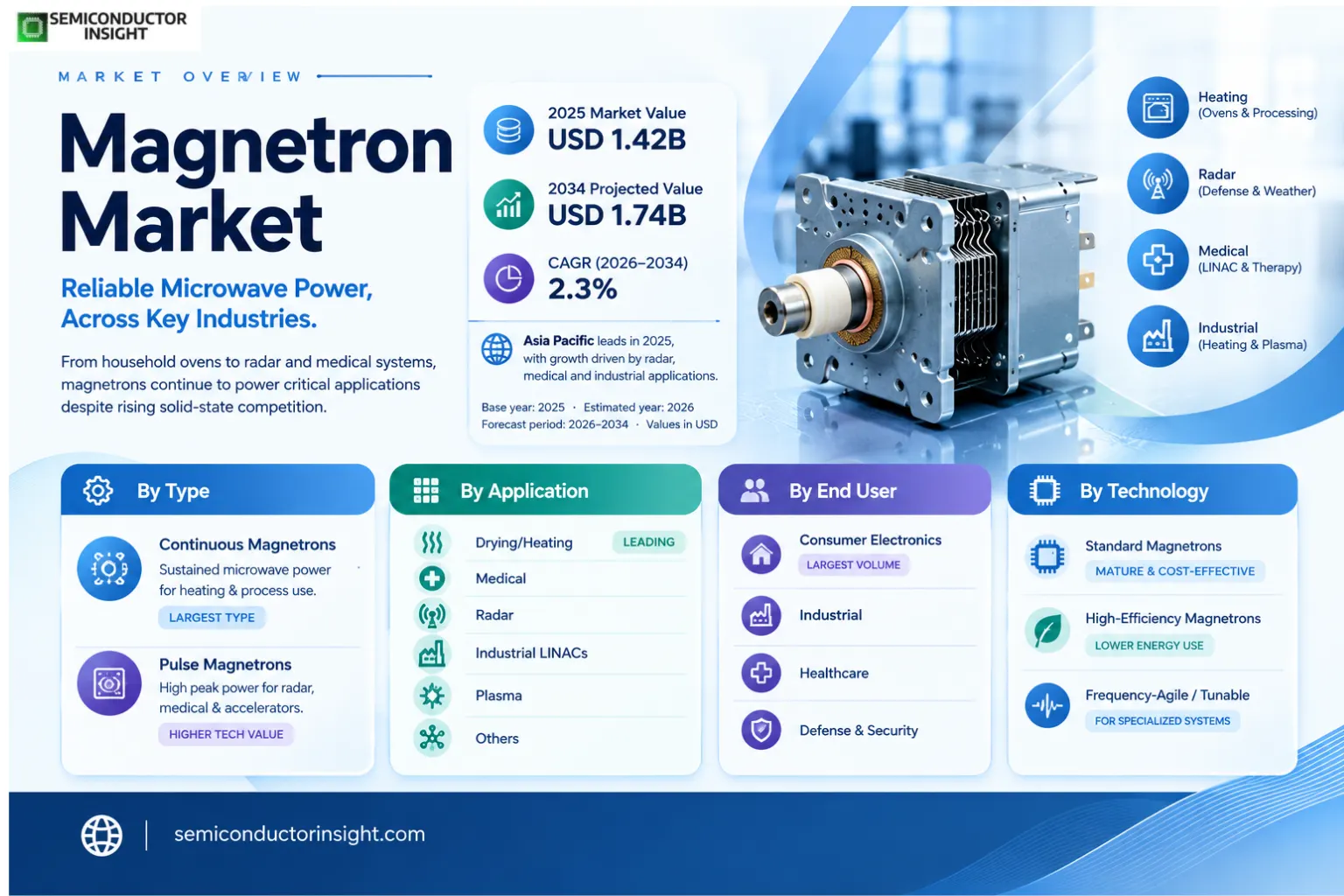
The magnetron market was valued at USD 1.42 billion in 2025 and is projected to reach USD 1.74 billion by 2034, expanding at a 2.3% CAGR over 2026–2034. Asia Pacific leads in 2025, while the market is being reshaped by solid-state microwave competition, high-power radar requirements and specialized medical and plasma applications..

Get the sample PDF with study scope, segmentation and methodology details.

Key Statistics

2025 Market Size
USD 1.42 billion
2034 Projected Market Size
USD 1.74 billion
CAGR (2026–2034)
2.3%
Largest Market in 2025
Asia Pacific

Key Takeaways

  • Market size and growth: the market is valued at USD 1.42 billion in 2025 and is projected to reach USD 1.74 billion by 2034, with a 2.3% CAGR over 2026–2034.
  • Continuous Magnetrons is the leading type because continuous-wave devices dominate microwave cooking and industrial heating, creating the largest recurring production base.
  • Drying/Heating is the leading application because microwave ovens and industrial dielectric heating consume the largest volumes of standardized magnetrons.
  • Asia Pacific leads regionally, while Asia Pacific offers the strongest incremental growth.
  • Primary driver: steady microwave-appliance demand and specialized radar, medical and industrial heating applications sustain the installed base
  • Principal restraint: solid-state RF sources are displacing magnetrons where frequency agility, lifetime and precise control justify higher system cost

Market Overview

The magnetron market was valued at USD 1.42 billion in 2025 and is projected to reach USD 1.74 billion by 2034, expanding at a 2.3% CAGR over 2026–2034. Asia Pacific leads in 2025, while the market is being reshaped by solid-state microwave competition, high-power radar requirements and specialized medical and plasma applications..

Base year: 2025 · Estimated year: 2026 · Forecast period: 2026–2034 · Values in USD

Magnetrons are high-power vacuum electronic oscillators that convert DC electrical energy into microwave energy through crossed electric and magnetic fields. They are used in domestic microwave ovens, commercial food processing, radar transmitters, medical linear accelerators, industrial heating, scientific systems and plasma generation. Continuous-wave products serve high-volume heating applications, while pulsed devices are engineered for high peak power, precise frequency ranges and demanding duty cycles.

The market is mature in household appliances but remains technically important in radar, radiotherapy and industrial systems where high microwave power and proven reliability matter. Teledyne e2v currently supplies magnetrons for medical, transport, security and industrial applications, with products spanning kilowatt-class continuous operation to multi-megawatt pulsed S-band output. This breadth shows why the category persists despite advances in semiconductor RF power.

Competitive pressure is strongest where solid-state RF sources provide better frequency agility, controllability or lifetime economics. Magnetrons retain an advantage in many cost-sensitive, high-power systems because they deliver substantial microwave output with relatively simple architectures. The commercial opportunity is therefore concentrated in efficient appliance designs, high-power pulsed radar, medical LINAC platforms and specialized industrial heating where total system cost still favors vacuum electronics.

Segment Analysis: By Type

By type, the market is segmented into Continuous Magnetrons, Pulse Magnetrons. Continuous Magnetrons holds the leading position based on current application breadth and purchasing economics.

Type Function / role Market position
Continuous Magnetrons Generate sustained microwave power for heating and process applications. Largest type because microwave ovens and industrial heating require high-volume continuous-wave sources.
Pulse Magnetrons Generate high peak power in short pulses for radar, medical and accelerator applications. Smaller volume but higher technical value where peak power, pulse quality and frequency stability are critical.

Commercial implications by type

The product mix is polarized between high-volume, cost-sensitive continuous devices and lower-volume pulsed products with demanding engineering requirements. Continuous magnetrons compete on efficiency, consistency and manufacturing scale, while pulsed devices compete on peak power, frequency stability, lifetime, cooling and integration with modulators. Suppliers serving both markets need different manufacturing, testing and service capabilities.

Segment Analysis: By Application

By application, demand is segmented into Drying/Heating, Medical, Radar, Industrial LINACs, Plasma, Others. Drying/Heating is the leading use case because it directly connects the technology to measurable operating, safety or performance benefits.

Application Demand characteristics
Drying/Heating Largest application covering household microwave ovens, commercial food processing and industrial dielectric heating.
Medical Radiotherapy LINACs use pulsed microwave sources with tight reliability and service requirements.
Radar Marine, weather, air-traffic, defense and surveillance systems use high-power pulsed microwave generation.
Industrial LINACs Accelerators for inspection and industrial processes require high-energy pulsed RF systems.
Plasma Surface treatment and semiconductor-related plasma systems create specialized demand.
Others Scientific equipment, security scanners and niche microwave-processing systems broaden the market.

By End User

End User Commercial relevance
Consumer Electronics Microwave appliance production drives the largest unit volume.
Industrial Food, materials and process heating require robust high-power sources.
Healthcare Radiotherapy and imaging systems require highly reliable pulsed magnetrons.
Defense & Security Radar and threat-simulation systems value high peak power and frequency control.

By Technology

Technology Commercial relevance
Standard Magnetrons Mature designs emphasize scale, cost and proven system integration.
High-Efficiency Magnetrons Improved cathode, cavity and magnetic designs target lower energy consumption.
Frequency-Agile / Tunable Magnetrons Specialized systems add tuning or control for radar and scientific applications.

Magnetron Market Size & Share

Regional Analysis

Asia Pacific leads the market because the region contains a very large share of global microwave-appliance manufacturing and significant radar, electronics and industrial-heating capacity. Asia Pacific is positioned for the fastest expansion as adoption increases in consumer appliance penetration, localized manufacturing and defense and industrial microwave investment.

How does regional demand differ across this market?

Asia Pacific dominates the volume market through appliance manufacturing in China, South Korea and Japan. North America is more weighted toward defense, radar, medical and specialized industrial systems. Europe has strong medical, radar and industrial-heating demand. South America and the Middle East & Africa are smaller and more import-dependent, with demand concentrated in appliances, radar modernization and selected industrial processes.

Region Position Growth outlook Demand profile Supplier selection
Asia Pacific Largest Fastest Appliances and manufacturing Cost, volume, reliability
North America Second Stable Defense, medical and industrial Performance, service, lifecycle
Europe Third Moderate Medical and industrial Efficiency and compliance
South America Smaller Selective Appliances and infrastructure Price and availability
Middle East & Africa Emerging Project-led Radar, security and appliances Ruggedness and support
Asia Pacific LARGEST & FASTEST-GROWING

Why does Asia Pacific lead?

China, South Korea and Japan combine mass appliance production, electronics supply chains and growing radar and industrial-microwave requirements, giving the region the broadest volume base.

Market positionLargest
Growth outlookFastest
Demand profileAppliances and manufacturing
Selection factorCost, volume, reliability
Country Position in region What drives demand
China Largest volume Large microwave-appliance manufacturing and industrial processing support high unit demand.
South Korea Electronics hub Major appliance and electronics groups sustain integrated component sourcing.
Japan Technology-intensive Industrial, medical and radar applications support higher-value magnetron designs.
  • Appliance production supports the deepest standardized supply chain.
  • Defense modernization creates demand for specialized pulsed products.
  • Industrial microwave adoption expands beyond consumer cooking.
North America HIGH-VALUE

What defines North American demand?

The United States has strong radar, radiotherapy, scientific and industrial microwave markets, where system reliability and service continuity matter more than lowest component cost.

Market positionSecond
Growth outlookStable
Demand profileDefense, medical and industrial
Selection factorPerformance, service, lifecycle
Country Position in region What drives demand
United States Regional leader Defense, medical and industrial systems create the largest high-value demand.
Canada Specialty Research, medical and radar applications support targeted purchases.
Mexico Appliance-linked Electronics and appliance manufacturing create standardized demand.
  • Medical LINACs require dependable pulsed RF subsystems.
  • Radar applications support high-peak-power devices.
  • Industrial heating offers a durable non-consumer market.
Europe SPECIALIZED

How is Europe positioned?

Europe combines established medical-equipment, scientific, industrial-heating and radar markets. Buyers emphasize efficiency, lifetime and compliance, supporting technically differentiated products.

Market positionThird
Growth outlookModerate
Demand profileMedical and industrial
Selection factorEfficiency and compliance
Country Position in region What drives demand
Germany Industrial leader Industrial process equipment and engineering demand support specialized magnetrons.
United Kingdom RF and medical A long microwave-tube heritage supports high-power and medical applications.
France Defense and science Radar, aerospace and research create high-value demand.
  • Energy efficiency influences industrial system design.
  • Radiotherapy supports long-lifecycle service demand.
  • Radar modernization sustains pulsed magnetron applications.
South America VALUE-DRIVEN

What drives South American demand?

Consumer appliances represent the broadest demand pool, while radar and medical systems create smaller high-value requirements. Import availability and distributor support strongly influence purchasing.

Market positionSmaller
Growth outlookSelective
Demand profileAppliances and infrastructure
Selection factorPrice and availability
Country Position in region What drives demand
Brazil Regional leader Large consumer-electronics and industrial base supports the broadest demand.
Argentina Selective Medical and industrial equipment create targeted demand.
Chile Infrastructure Radar, mining and imported appliances support smaller requirements.
  • Appliance replacement sustains recurring component demand.
  • Medical systems create service-oriented opportunities.
  • Import costs influence supplier selection.
Middle East & Africa EMERGING

Where are opportunities in Middle East & Africa?

Defense, air-traffic, security and imported appliances drive demand, while industrial heating and medical infrastructure create selected high-value opportunities.

Market positionEmerging
Growth outlookProject-led
Demand profileRadar, security and appliances
Selection factorRuggedness and support
Country Position in region What drives demand
Saudi Arabia Defense and infrastructure Radar and infrastructure investment support specialized demand.
UAE Security and aviation Airport, defense and commercial systems create high-value applications.
South Africa Regional industrial base Medical, industrial and appliance markets provide diversified demand.
  • Radar modernization is an important premium niche.
  • Appliance demand is largely import supplied.
  • Field support is crucial for medical and defense systems.

Competitive Landscape

Competition is split between high-volume appliance manufacturers and specialist vacuum-electronics suppliers serving radar, medical and industrial systems.

LG, Toshiba, Samsung, Midea, Galanz and other appliance-linked suppliers compete around high-volume manufacturing economics, while Teledyne e2v, L3Harris and CPI address high-power radar, medical and specialized RF applications.

Technical differentiation is strongest in pulsed products. Peak power, frequency stability, cooling, lifetime and modulator compatibility determine qualification, and customers can remain with a proven tube family for many years because redesigning the RF chain is costly.

Solid-state alternatives are forcing magnetron suppliers to focus on applications where output power and system economics remain favorable. This encourages better efficiency, compact packaging and closer integration with modulators and system-level controls.

Competitive tier Representative participants Competitive focus
Appliance-scale suppliers LG, Toshiba, Samsung, Midea, Galanz High-volume continuous magnetrons and cost efficiency
High-power RF specialists Teledyne e2v, CPI, L3Harris Radar, medical, security and industrial pulsed devices
Regional specialists NJR, Kunshan Guoli, Guogang Electric Niche products and localized supply

Companies Profiled

LG Electronics, Toshiba Electronic Devices & Storage, Samsung Electronics, Teledyne e2v, Hitachi Power Solutions, NJR, Midea Group, Galanz, Panasonic Industrial Devices, L3Harris Technologies, Kunshan Guoli Microwave, CPI International

Production Capacity Analysis

Capacity depends on precision cavity machining, cathode and vacuum processing, permanent magnets or electromagnets, ceramic-metal seals, high-voltage conditioning and RF test infrastructure.

Continuous appliance magnetrons can be produced at high scale, but manufacturing still requires consistent vacuum processing, cavity geometry and magnetic alignment. Cost competitiveness therefore comes from automated assembly and yield control rather than simple labor intensity.

High-power pulsed devices have a different capacity profile because each design requires extensive electrical conditioning and RF testing. Multi-megawatt radar magnetrons also require cooling and waveguide validation, making engineering and test capacity a more important bottleneck than final assembly volume.

Market Dynamics

The market is stable rather than uniformly high-growth, with mature appliance volumes offset by defensible high-value demand in radar, medical and industrial systems.

Magnetrons are no longer the default microwave source in every application, but they remain difficult to replace when very high power must be delivered at acceptable cost. The long-term market therefore depends on maintaining reliability and efficiency while solid-state systems take share in applications that value tunability, compact electronics and software-defined control.

Market Drivers

Drivers Impact Analysis

Driver Impact Commercial mechanism
Microwave appliance demand Medium Household and commercial microwave ovens sustain high unit volumes for continuous magnetrons.
Radar modernization Medium Marine, weather, air-traffic and defense systems continue to use high-power pulsed sources.
Medical LINAC demand Medium Radiotherapy platforms require reliable microwave generation and long-term service support.
Industrial microwave heating Medium Food, materials and plasma processing benefit from volumetric heating and high power.

Microwave appliance demand

Household and commercial microwave ovens sustain high unit volumes for continuous magnetrons.

Radar modernization

Marine, weather, air-traffic and defense systems continue to use high-power pulsed sources.

Medical LINAC demand

Radiotherapy platforms require reliable microwave generation and long-term service support.

Industrial microwave heating

Food, materials and plasma processing benefit from volumetric heating and high power.

Market Restraints

Restraints Impact Analysis

Restraint Impact Commercial mechanism
Solid-state RF substitution High Semiconductor amplifiers offer frequency agility, controllability and longer maintenance intervals in selected applications.
Energy efficiency pressure Medium Appliance and industrial users increasingly compare system-level electrical efficiency.
Vacuum-tube maintenance Medium Cathode aging and high-voltage hardware create lifecycle service requirements.
Specialized manufacturing Medium High-power products require vacuum, RF and high-voltage expertise that limits supplier flexibility.

Solid-state RF substitution

Semiconductor amplifiers offer frequency agility, controllability and longer maintenance intervals in selected applications.

Energy efficiency pressure

Appliance and industrial users increasingly compare system-level electrical efficiency.

Vacuum-tube maintenance

Cathode aging and high-voltage hardware create lifecycle service requirements.

Specialized manufacturing

High-power products require vacuum, RF and high-voltage expertise that limits supplier flexibility.

Market Opportunities

High-efficiency appliance magnetrons

Incremental efficiency improvements can preserve magnetron economics in high-volume cooking appliances.

Medical radiotherapy

Long product lifecycles and installed LINAC platforms support premium replacement and OEM demand.

Advanced radar

High peak power remains valuable in long-range and specialized radar systems.

Plasma and materials processing

Microwave plasma can create new demand in semiconductor, coating and industrial-treatment applications.

Supply Chain Analysis

Materials & vacuum parts
Copper, ceramics, cathodes, magnets
Tube manufacturing
Cavity machining, vacuum sealing, conditioning
RF subsystems
Modulators, waveguides, cooling, controls
OEM integration
Appliances, radar, LINACs, industrial systems

Materials and vacuum parts

Cathode materials, copper cavities, ceramic insulators and magnetic systems determine power capability and lifetime.

Tube manufacturing

Vacuum integrity, dimensional control and conditioning are essential because small process deviations can alter frequency and reliability.

RF subsystems

Pulsed systems require modulators, waveguides, circulators and cooling matched to the magnetron’s operating envelope.

OEM integration

Customers qualify the source as part of a complete microwave system, making interface stability and service continuity important.

Recent Developments

2026 — Teledyne e2v maintains broad magnetron portfolio

Current products cover medical, transport, security and industrial applications with outputs from kilowatt-class to multi-megawatt pulsed systems. Source

2026 — Teledyne e2v integrates magnetrons into radiotherapy RF subsystems

Integrated magnetron modules are positioned for compact, maintainable radiotherapy platforms. Source

2023 — CPI C-band coaxial magnetron remains relevant for radar

CPI’s 100 kW C-band device illustrates continued use of tunable pulsed magnetrons in weather and threat-simulation radar. Source

Report Scope & Segmentation

Attribute Coverage
Market Magnetron
Base Year 2025
Estimated Year 2026
Forecast Period 2026–2034
2025 Market Size USD 1.42 billion
2026 Estimated Size USD 1.45 billion
2034 Forecast Size USD 1.74 billion
CAGR 2.3% (2026–2034)
By Type Continuous Magnetrons, Pulse Magnetrons
By Application Drying/Heating, Medical, Radar, Industrial LINACs, Plasma, Others
By End User Consumer Electronics, Industrial, Healthcare, Defense & Security
By Technology Standard Magnetrons, High-Efficiency Magnetrons, Frequency-Agile / Tunable Magnetrons
Regions Asia Pacific, North America, Europe, South America, Middle East & Africa
Companies Profiled LG Electronics, Toshiba Electronic Devices & Storage, Samsung Electronics, Teledyne e2v, Hitachi Power Solutions, NJR, Midea Group, Galanz, Panasonic Industrial Devices, L3Harris Technologies, Kunshan Guoli Microwave, CPI International

Frequently Asked Questions

What is the magnetron market size in 2025?

The market is valued at USD 1.42 billion in 2025.

What is the projected market size by 2034?

The market is projected to reach USD 1.74 billion by 2034.

What is the CAGR from 2026 to 2034?

The market is expected to expand at a 2.3% CAGR.

Which region leads the market?

Asia Pacific is the largest region in 2025.

Which type leads the market?

Continuous Magnetrons is the leading type.

Which application leads demand?

Drying/Heating is the leading application.

What is the primary growth driver?

steady microwave-appliance demand and specialized radar, medical and industrial heating applications sustain the installed base.

What is the principal restraint?

solid-state RF sources are displacing magnetrons where frequency agility, lifetime and precise control justify higher system cost.

Where are the strongest opportunities?

medical LINACs, advanced radar, plasma processing and higher-efficiency microwave heating.

Which companies are active in the market?

LG Electronics, Toshiba Electronic Devices & Storage, Samsung Electronics, Teledyne e2v, Hitachi Power Solutions, NJR, Midea Group, Galanz.

Research Sources & Evidence Base

View primary and industry evidence used in this overview
  1. Teledyne e2v: Magnetrons — Current magnetron applications and product specifications.
  2. Teledyne e2v: RF Systems — System integration in medical and high-power RF.
  3. Communications & Power Industries: VMC1360GD C-Band Coaxial Magnetron — Radar magnetron performance example.

Magnetron Market Size, Share & Industry Analysis, By Type (Continuous Magnetrons, Pulse Magnetrons), By Application (Drying/Heating, Medical, Radar, Industrial LINACs, Plasma, Others), By End User (Consumer Electronics, Industrial, Healthcare, Defense & Security), By Technology (Standard Magnetrons, High-Efficiency Magnetrons, Frequency-Agile / Tunable Magnetrons), and Regional Forecast, 2026-2034

Get Sample Report PDF for Exclusive Insights

Report Sample Includes

  • Table of Contents
  • List of Tables & Figures
  • Charts, Research Methodology, and more...

PDF Icon Download Sample Report PDF

Download Sample Report

Table of Content

1 Introduction to Research & Analysis Reports
1.1 Magnetron Market Definition
1.2 Market Segments
1.2.1 Segment by Type
1.2.2 Segment by Application
1.3 Global Magnetron Market Overview
1.4 Features & Benefits of This Report
1.5 Methodology & Sources of Information
1.5.1 Research Methodology
1.5.2 Research Process
1.5.3 Base Year
1.5.4 Report Assumptions & Caveats
2 Global Magnetron Overall Market Size
2.1 Global Magnetron Market Size: 2024 VS 2032
2.2 Global Magnetron Market Size, Prospects & Forecasts: 2026-2034
2.3 Global Magnetron Sales: 2026-2034
3 Company Landscape
3.1 Top Magnetron Players in Global Market
3.2 Top Global Magnetron Companies Ranked by Revenue
3.3 Global Magnetron Revenue by Companies
3.4 Global Magnetron Sales by Companies
3.5 Global Magnetron Price by Manufacturer (2020-2025)
3.6 Top 3 and Top 5 Magnetron Companies in Global Market, by Revenue in 2024
3.7 Global Manufacturers Magnetron Product Type
3.8 Tier 1, Tier 2, and Tier 3 Magnetron Players in Global Market
3.8.1 List of Global Tier 1 Magnetron Companies
3.8.2 List of Global Tier 2 and Tier 3 Magnetron Companies
4 Sights by Product
4.1 Overview
4.1.1 Segment by Type – Global Magnetron Market Size Markets, 2024 & 2032
4.1.2 Continuous Magnetrons
4.1.3 Pulse Magnetrons
4.2 Segment by Type – Global Magnetron Revenue & Forecasts
4.2.1 Segment by Type – Global Magnetron Revenue, 2020-2025
4.2.2 Segment by Type – Global Magnetron Revenue, 2026-2032
4.2.3 Segment by Type – Global Magnetron Revenue Market Share, 2026-2034
4.3 Segment by Type – Global Magnetron Sales & Forecasts
4.3.1 Segment by Type – Global Magnetron Sales, 2020-2025
4.3.2 Segment by Type – Global Magnetron Sales, 2026-2032
4.3.3 Segment by Type – Global Magnetron Sales Market Share, 2026-2034
4.4 Segment by Type – Global Magnetron Price (Manufacturers Selling Prices), 2026-2034
5 Sights by Application
5.1 Overview
5.1.1 Segment by Application – Global Magnetron Market Size, 2024 & 2032
5.1.2 Drying/Heating
5.1.3 Medical
5.1.4 Radar
5.1.5 Industrial LINACs
5.1.6 Plasma
5.1.7 Others
5.2 Segment by Application – Global Magnetron Revenue & Forecasts
5.2.1 Segment by Application – Global Magnetron Revenue, 2020-2025
5.2.2 Segment by Application – Global Magnetron Revenue, 2026-2032
5.2.3 Segment by Application – Global Magnetron Revenue Market Share, 2026-2034
5.3 Segment by Application – Global Magnetron Sales & Forecasts
5.3.1 Segment by Application – Global Magnetron Sales, 2020-2025
5.3.2 Segment by Application – Global Magnetron Sales, 2026-2032
5.3.3 Segment by Application – Global Magnetron Sales Market Share, 2026-2034
5.4 Segment by Application – Global Magnetron Price (Manufacturers Selling Prices), 2026-2034
6 Sights by Region
6.1 By Region – Global Magnetron Market Size, 2024 & 2032
6.2 By Region – Global Magnetron Revenue & Forecasts
6.2.1 By Region – Global Magnetron Revenue, 2020-2025
6.2.2 By Region – Global Magnetron Revenue, 2026-2032
6.2.3 By Region – Global Magnetron Revenue Market Share, 2026-2034
6.3 By Region – Global Magnetron Sales & Forecasts
6.3.1 By Region – Global Magnetron Sales, 2020-2025
6.3.2 By Region – Global Magnetron Sales, 2026-2032
6.3.3 By Region – Global Magnetron Sales Market Share, 2026-2034
6.4 North America
6.4.1 By Country – North America Magnetron Revenue, 2026-2034
6.4.2 By Country – North America Magnetron Sales, 2026-2034
6.4.3 United States Magnetron Market Size, 2026-2034
6.4.4 Canada Magnetron Market Size, 2026-2034
6.4.5 Mexico Magnetron Market Size, 2026-2034
6.5 Europe
6.5.1 By Country – Europe Magnetron Revenue, 2026-2034
6.5.2 By Country – Europe Magnetron Sales, 2026-2034
6.5.3 Germany Magnetron Market Size, 2026-2034
6.5.4 France Magnetron Market Size, 2026-2034
6.5.5 U.K. Magnetron Market Size, 2026-2034
6.5.6 Italy Magnetron Market Size, 2026-2034
6.5.7 Russia Magnetron Market Size, 2026-2034
6.5.8 Nordic Countries Magnetron Market Size, 2026-2034
6.5.9 Benelux Magnetron Market Size, 2026-2034
6.6 Asia
6.6.1 By Region – Asia Magnetron Revenue, 2026-2034
6.6.2 By Region – Asia Magnetron Sales, 2026-2034
6.6.3 China Magnetron Market Size, 2026-2034
6.6.4 Japan Magnetron Market Size, 2026-2034
6.6.5 South Korea Magnetron Market Size, 2026-2034
6.6.6 Southeast Asia Magnetron Market Size, 2026-2034
6.6.7 India Magnetron Market Size, 2026-2034
6.7 South America
6.7.1 By Country – South America Magnetron Revenue, 2026-2034
6.7.2 By Country – South America Magnetron Sales, 2026-2034
6.7.3 Brazil Magnetron Market Size, 2026-2034
6.7.4 Argentina Magnetron Market Size, 2026-2034
6.8 Middle East & Africa
6.8.1 By Country – Middle East & Africa Magnetron Revenue, 2026-2034
6.8.2 By Country – Middle East & Africa Magnetron Sales, 2026-2034
6.8.3 Turkey Magnetron Market Size, 2026-2034
6.8.4 Israel Magnetron Market Size, 2026-2034
6.8.5 Saudi Arabia Magnetron Market Size, 2026-2034
6.8.6 UAE Magnetron Market Size, 2026-2034
7 Manufacturers & Brands Profiles
7.1 LG
7.1.1 LG Company Summary
7.1.2 LG Business Overview
7.1.3 LG Magnetron Major Product Offerings
7.1.4 LG Magnetron Sales and Revenue in Global (2020-2025)
7.1.5 LG Key News & Latest Developments
7.2 TOSHIBA
7.2.1 TOSHIBA Company Summary
7.2.2 TOSHIBA Business Overview
7.2.3 TOSHIBA Magnetron Major Product Offerings
7.2.4 TOSHIBA Magnetron Sales and Revenue in Global (2020-2025)
7.2.5 TOSHIBA Key News & Latest Developments
7.3 Samsung
7.3.1 Samsung Company Summary
7.3.2 Samsung Business Overview
7.3.3 Samsung Magnetron Major Product Offerings
7.3.4 Samsung Magnetron Sales and Revenue in Global (2020-2025)
7.3.5 Samsung Key News & Latest Developments
7.4 E2V
7.4.1 E2V Company Summary
7.4.2 E2V Business Overview
7.4.3 E2V Magnetron Major Product Offerings
7.4.4 E2V Magnetron Sales and Revenue in Global (2020-2025)
7.4.5 E2V Key News & Latest Developments
7.5 Hitachi
7.5.1 Hitachi Company Summary
7.5.2 Hitachi Business Overview
7.5.3 Hitachi Magnetron Major Product Offerings
7.5.4 Hitachi Magnetron Sales and Revenue in Global (2020-2025)
7.5.5 Hitachi Key News & Latest Developments
7.6 NJR ?New JRC?
7.6.1 NJR ?New JRC? Company Summary
7.6.2 NJR ?New JRC? Business Overview
7.6.3 NJR ?New JRC? Magnetron Major Product Offerings
7.6.4 NJR ?New JRC? Magnetron Sales and Revenue in Global (2020-2025)
7.6.5 NJR ?New JRC? Key News & Latest Developments
7.7 Midea
7.7.1 Midea Company Summary
7.7.2 Midea Business Overview
7.7.3 Midea Magnetron Major Product Offerings
7.7.4 Midea Magnetron Sales and Revenue in Global (2020-2025)
7.7.5 Midea Key News & Latest Developments
7.8 Galanz
7.8.1 Galanz Company Summary
7.8.2 Galanz Business Overview
7.8.3 Galanz Magnetron Major Product Offerings
7.8.4 Galanz Magnetron Sales and Revenue in Global (2020-2025)
7.8.5 Galanz Key News & Latest Developments
7.9 Panasonic
7.9.1 Panasonic Company Summary
7.9.2 Panasonic Business Overview
7.9.3 Panasonic Magnetron Major Product Offerings
7.9.4 Panasonic Magnetron Sales and Revenue in Global (2020-2025)
7.9.5 Panasonic Key News & Latest Developments
7.10 Dongbu Daewoo
7.10.1 Dongbu Daewoo Company Summary
7.10.2 Dongbu Daewoo Business Overview
7.10.3 Dongbu Daewoo Magnetron Major Product Offerings
7.10.4 Dongbu Daewoo Magnetron Sales and Revenue in Global (2020-2025)
7.10.5 Dongbu Daewoo Key News & Latest Developments
7.11 Shuangda Electronic
7.11.1 Shuangda Electronic Company Summary
7.11.2 Shuangda Electronic Business Overview
7.11.3 Shuangda Electronic Magnetron Major Product Offerings
7.11.4 Shuangda Electronic Magnetron Sales and Revenue in Global (2020-2025)
7.11.5 Shuangda Electronic Key News & Latest Developments
7.12 L3 Harris
7.12.1 L3 Harris Company Summary
7.12.2 L3 Harris Business Overview
7.12.3 L3 Harris Magnetron Major Product Offerings
7.12.4 L3 Harris Magnetron Sales and Revenue in Global (2020-2025)
7.12.5 L3 Harris Key News & Latest Developments
7.13 Kunshan Guoli
7.13.1 Kunshan Guoli Company Summary
7.13.2 Kunshan Guoli Business Overview
7.13.3 Kunshan Guoli Magnetron Major Product Offerings
7.13.4 Kunshan Guoli Magnetron Sales and Revenue in Global (2020-2025)
7.13.5 Kunshan Guoli Key News & Latest Developments
7.14 Guogang Electric
7.14.1 Guogang Electric Company Summary
7.14.2 Guogang Electric Business Overview
7.14.3 Guogang Electric Magnetron Major Product Offerings
7.14.4 Guogang Electric Magnetron Sales and Revenue in Global (2020-2025)
7.14.5 Guogang Electric Key News & Latest Developments
7.15 CPI (Beverly)
7.15.1 CPI (Beverly) Company Summary
7.15.2 CPI (Beverly) Business Overview
7.15.3 CPI (Beverly) Magnetron Major Product Offerings
7.15.4 CPI (Beverly) Magnetron Sales and Revenue in Global (2020-2025)
7.15.5 CPI (Beverly) Key News & Latest Developments
8 Global Magnetron Production Capacity, Analysis
8.1 Global Magnetron Production Capacity, 2026-2034
8.2 Magnetron Production Capacity of Key Manufacturers in Global Market
8.3 Global Magnetron Production by Region
9 Key Market Trends, Opportunity, Drivers and Restraints
9.1 Market Opportunities & Trends
9.2 Market Drivers
9.3 Market Restraints
10 Magnetron Supply Chain Analysis
10.1 Magnetron Industry Value Chain
10.2 Magnetron Upstream Market
10.3 Magnetron Downstream and Clients
10.4 Marketing Channels Analysis
10.4.1 Marketing Channels
10.4.2 Magnetron Distributors and Sales Agents in Global
11 Conclusion
12 Appendix
12.1 Note
12.2 Examples of Clients
12.3 DisclaimerList of Tables
Table 1. Key Players of Magnetron in Global Market
Table 2. Top Magnetron Players in Global Market, Ranking by Revenue (2024)
Table 3. Global Magnetron Revenue by Companies, (US$, Mn), 2020-2025
Table 4. Global Magnetron Revenue Share by Companies, 2020-2025
Table 5. Global Magnetron Sales by Companies, (K Units), 2020-2025
Table 6. Global Magnetron Sales Share by Companies, 2020-2025
Table 7. Key Manufacturers Magnetron Price (2020-2025) & (USD/Unit)
Table 8. Global Manufacturers Magnetron Product Type
Table 9. List of Global Tier 1 Magnetron Companies, Revenue (US$, Mn) in 2024 and Market Share
Table 10. List of Global Tier 2 and Tier 3 Magnetron Companies, Revenue (US$, Mn) in 2024 and Market Share
Table 11. Segment by Type – Global Magnetron Revenue, (US$, Mn), 2024 & 2032
Table 12. Segment by Type – Global Magnetron Revenue (US$, Mn), 2020-2025
Table 13. Segment by Type – Global Magnetron Revenue (US$, Mn), 2026-2032
Table 14. Segment by Type – Global Magnetron Sales (K Units), 2020-2025
Table 15. Segment by Type – Global Magnetron Sales (K Units), 2026-2032
Table 16. Segment by Application – Global Magnetron Revenue, (US$, Mn), 2024 & 2032
Table 17. Segment by Application – Global Magnetron Revenue, (US$, Mn), 2020-2025
Table 18. Segment by Application – Global Magnetron Revenue, (US$, Mn), 2026-2032
Table 19. Segment by Application – Global Magnetron Sales, (K Units), 2020-2025
Table 20. Segment by Application – Global Magnetron Sales, (K Units), 2026-2032
Table 21. By Region – Global Magnetron Revenue, (US$, Mn), 2025-2032
Table 22. By Region – Global Magnetron Revenue, (US$, Mn), 2020-2025
Table 23. By Region – Global Magnetron Revenue, (US$, Mn), 2026-2032
Table 24. By Region – Global Magnetron Sales, (K Units), 2020-2025
Table 25. By Region – Global Magnetron Sales, (K Units), 2026-2032
Table 26. By Country – North America Magnetron Revenue, (US$, Mn), 2020-2025
Table 27. By Country – North America Magnetron Revenue, (US$, Mn), 2026-2032
Table 28. By Country – North America Magnetron Sales, (K Units), 2020-2025
Table 29. By Country – North America Magnetron Sales, (K Units), 2026-2032
Table 30. By Country – Europe Magnetron Revenue, (US$, Mn), 2020-2025
Table 31. By Country – Europe Magnetron Revenue, (US$, Mn), 2026-2032
Table 32. By Country – Europe Magnetron Sales, (K Units), 2020-2025
Table 33. By Country – Europe Magnetron Sales, (K Units), 2026-2032
Table 34. By Region – Asia Magnetron Revenue, (US$, Mn), 2020-2025
Table 35. By Region – Asia Magnetron Revenue, (US$, Mn), 2026-2032
Table 36. By Region – Asia Magnetron Sales, (K Units), 2020-2025
Table 37. By Region – Asia Magnetron Sales, (K Units), 2026-2032
Table 38. By Country – South America Magnetron Revenue, (US$, Mn), 2020-2025
Table 39. By Country – South America Magnetron Revenue, (US$, Mn), 2026-2032
Table 40. By Country – South America Magnetron Sales, (K Units), 2020-2025
Table 41. By Country – South America Magnetron Sales, (K Units), 2026-2032
Table 42. By Country – Middle East & Africa Magnetron Revenue, (US$, Mn), 2020-2025
Table 43. By Country – Middle East & Africa Magnetron Revenue, (US$, Mn), 2026-2032
Table 44. By Country – Middle East & Africa Magnetron Sales, (K Units), 2020-2025
Table 45. By Country – Middle East & Africa Magnetron Sales, (K Units), 2026-2032
Table 46. LG Company Summary
Table 47. LG Magnetron Product Offerings
Table 48. LG Magnetron Sales (K Units), Revenue (US$, Mn) and Average Price (USD/Unit) & (2020-2025)
Table 49. LG Key News & Latest Developments
Table 50. TOSHIBA Company Summary
Table 51. TOSHIBA Magnetron Product Offerings
Table 52. TOSHIBA Magnetron Sales (K Units), Revenue (US$, Mn) and Average Price (USD/Unit) & (2020-2025)
Table 53. TOSHIBA Key News & Latest Developments
Table 54. Samsung Company Summary
Table 55. Samsung Magnetron Product Offerings
Table 56. Samsung Magnetron Sales (K Units), Revenue (US$, Mn) and Average Price (USD/Unit) & (2020-2025)
Table 57. Samsung Key News & Latest Developments
Table 58. E2V Company Summary
Table 59. E2V Magnetron Product Offerings
Table 60. E2V Magnetron Sales (K Units), Revenue (US$, Mn) and Average Price (USD/Unit) & (2020-2025)
Table 61. E2V Key News & Latest Developments
Table 62. Hitachi Company Summary
Table 63. Hitachi Magnetron Product Offerings
Table 64. Hitachi Magnetron Sales (K Units), Revenue (US$, Mn) and Average Price (USD/Unit) & (2020-2025)
Table 65. Hitachi Key News & Latest Developments
Table 66. NJR ?New JRC? Company Summary
Table 67. NJR ?New JRC? Magnetron Product Offerings
Table 68. NJR ?New JRC? Magnetron Sales (K Units), Revenue (US$, Mn) and Average Price (USD/Unit) & (2020-2025)
Table 69. NJR ?New JRC? Key News & Latest Developments
Table 70. Midea Company Summary
Table 71. Midea Magnetron Product Offerings
Table 72. Midea Magnetron Sales (K Units), Revenue (US$, Mn) and Average Price (USD/Unit) & (2020-2025)
Table 73. Midea Key News & Latest Developments
Table 74. Galanz Company Summary
Table 75. Galanz Magnetron Product Offerings
Table 76. Galanz Magnetron Sales (K Units), Revenue (US$, Mn) and Average Price (USD/Unit) & (2020-2025)
Table 77. Galanz Key News & Latest Developments
Table 78. Panasonic Company Summary
Table 79. Panasonic Magnetron Product Offerings
Table 80. Panasonic Magnetron Sales (K Units), Revenue (US$, Mn) and Average Price (USD/Unit) & (2020-2025)
Table 81. Panasonic Key News & Latest Developments
Table 82. Dongbu Daewoo Company Summary
Table 83. Dongbu Daewoo Magnetron Product Offerings
Table 84. Dongbu Daewoo Magnetron Sales (K Units), Revenue (US$, Mn) and Average Price (USD/Unit) & (2020-2025)
Table 85. Dongbu Daewoo Key News & Latest Developments
Table 86. Shuangda Electronic Company Summary
Table 87. Shuangda Electronic Magnetron Product Offerings
Table 88. Shuangda Electronic Magnetron Sales (K Units), Revenue (US$, Mn) and Average Price (USD/Unit) & (2020-2025)
Table 89. Shuangda Electronic Key News & Latest Developments
Table 90. L3 Harris Company Summary
Table 91. L3 Harris Magnetron Product Offerings
Table 92. L3 Harris Magnetron Sales (K Units), Revenue (US$, Mn) and Average Price (USD/Unit) & (2020-2025)
Table 93. L3 Harris Key News & Latest Developments
Table 94. Kunshan Guoli Company Summary
Table 95. Kunshan Guoli Magnetron Product Offerings
Table 96. Kunshan Guoli Magnetron Sales (K Units), Revenue (US$, Mn) and Average Price (USD/Unit) & (2020-2025)
Table 97. Kunshan Guoli Key News & Latest Developments
Table 98. Guogang Electric Company Summary
Table 99. Guogang Electric Magnetron Product Offerings
Table 100. Guogang Electric Magnetron Sales (K Units), Revenue (US$, Mn) and Average Price (USD/Unit) & (2020-2025)
Table 101. Guogang Electric Key News & Latest Developments
Table 102. CPI (Beverly) Company Summary
Table 103. CPI (Beverly) Magnetron Product Offerings
Table 104. CPI (Beverly) Magnetron Sales (K Units), Revenue (US$, Mn) and Average Price (USD/Unit) & (2020-2025)
Table 105. CPI (Beverly) Key News & Latest Developments
Table 106. Magnetron Capacity of Key Manufacturers in Global Market, 2023-2025 (K Units)
Table 107. Global Magnetron Capacity Market Share of Key Manufacturers, 2023-2025
Table 108. Global Magnetron Production by Region, 2020-2025 (K Units)
Table 109. Global Magnetron Production by Region, 2026-2032 (K Units)
Table 110. Magnetron Market Opportunities & Trends in Global Market
Table 111. Magnetron Market Drivers in Global Market
Table 112. Magnetron Market Restraints in Global Market
Table 113. Magnetron Raw Materials
Table 114. Magnetron Raw Materials Suppliers in Global Market
Table 115. Typical Magnetron Downstream
Table 116. Magnetron Downstream Clients in Global Market
Table 117. Magnetron Distributors and Sales Agents in Global Market

List of Figures
Figure 1. Magnetron Product Picture
Figure 2. Magnetron Segment by Type in 2024
Figure 3. Magnetron Segment by Application in 2024
Figure 4. Global Magnetron Market Overview: 2024
Figure 5. Key Caveats
Figure 6. Global Magnetron Market Size: 2024 VS 2032 (US$, Mn)
Figure 7. Global Magnetron Revenue: 2026-2034 (US$, Mn)
Figure 8. Magnetron Sales in Global Market: 2026-2034 (K Units)
Figure 9. The Top 3 and 5 Players Market Share by Magnetron Revenue in 2024
Figure 10. Segment by Type – Global Magnetron Revenue, (US$, Mn), 2024 & 2032
Figure 11. Segment by Type – Global Magnetron Revenue Market Share, 2026-2034
Figure 12. Segment by Type – Global Magnetron Sales Market Share, 2026-2034
Figure 13. Segment by Type – Global Magnetron Price (USD/Unit), 2026-2034
Figure 14. Segment by Application – Global Magnetron Revenue, (US$, Mn), 2024 & 2032
Figure 15. Segment by Application – Global Magnetron Revenue Market Share, 2026-2034
Figure 16. Segment by Application – Global Magnetron Sales Market Share, 2026-2034
Figure 17. Segment by Application -Global Magnetron Price (USD/Unit), 2026-2034
Figure 18. By Region – Global Magnetron Revenue, (US$, Mn), 2025 & 2032
Figure 19. By Region – Global Magnetron Revenue Market Share, 2020 VS 2024 VS 2032
Figure 20. By Region – Global Magnetron Revenue Market Share, 2026-2034
Figure 21. By Region – Global Magnetron Sales Market Share, 2026-2034
Figure 22. By Country – North America Magnetron Revenue Market Share, 2026-2034
Figure 23. By Country – North America Magnetron Sales Market Share, 2026-2034
Figure 24. United States Magnetron Revenue, (US$, Mn), 2026-2034
Figure 25. Canada Magnetron Revenue, (US$, Mn), 2026-2034
Figure 26. Mexico Magnetron Revenue, (US$, Mn), 2026-2034
Figure 27. By Country – Europe Magnetron Revenue Market Share, 2026-2034
Figure 28. By Country – Europe Magnetron Sales Market Share, 2026-2034
Figure 29. Germany Magnetron Revenue, (US$, Mn), 2026-2034
Figure 30. France Magnetron Revenue, (US$, Mn), 2026-2034
Figure 31. U.K. Magnetron Revenue, (US$, Mn), 2026-2034
Figure 32. Italy Magnetron Revenue, (US$, Mn), 2026-2034
Figure 33. Russia Magnetron Revenue, (US$, Mn), 2026-2034
Figure 34. Nordic Countries Magnetron Revenue, (US$, Mn), 2026-2034
Figure 35. Benelux Magnetron Revenue, (US$, Mn), 2026-2034
Figure 36. By Region – Asia Magnetron Revenue Market Share, 2026-2034
Figure 37. By Region – Asia Magnetron Sales Market Share, 2026-2034
Figure 38. China Magnetron Revenue, (US$, Mn), 2026-2034
Figure 39. Japan Magnetron Revenue, (US$, Mn), 2026-2034
Figure 40. South Korea Magnetron Revenue, (US$, Mn), 2026-2034
Figure 41. Southeast Asia Magnetron Revenue, (US$, Mn), 2026-2034
Figure 42. India Magnetron Revenue, (US$, Mn), 2026-2034
Figure 43. By Country – South America Magnetron Revenue Market Share, 2026-2034
Figure 44. By Country – South America Magnetron Sales, Market Share, 2026-2034
Figure 45. Brazil Magnetron Revenue, (US$, Mn), 2026-2034
Figure 46. Argentina Magnetron Revenue, (US$, Mn), 2026-2034
Figure 47. By Country – Middle East & Africa Magnetron Revenue, Market Share, 2026-2034
Figure 48. By Country – Middle East & Africa Magnetron Sales, Market Share, 2026-2034
Figure 49. Turkey Magnetron Revenue, (US$, Mn), 2026-2034
Figure 50. Israel Magnetron Revenue, (US$, Mn), 2026-2034
Figure 51. Saudi Arabia Magnetron Revenue, (US$, Mn), 2026-2034
Figure 52. UAE Magnetron Revenue, (US$, Mn), 2026-2034
Figure 53. Global Magnetron Production Capacity (K Units), 2026-2034
Figure 54. The Percentage of Production Magnetron by Region, 2024 VS 2032
Figure 55. Magnetron Industry Value Chain
Figure 56. Marketing Channels