MARKET INSIGHTS
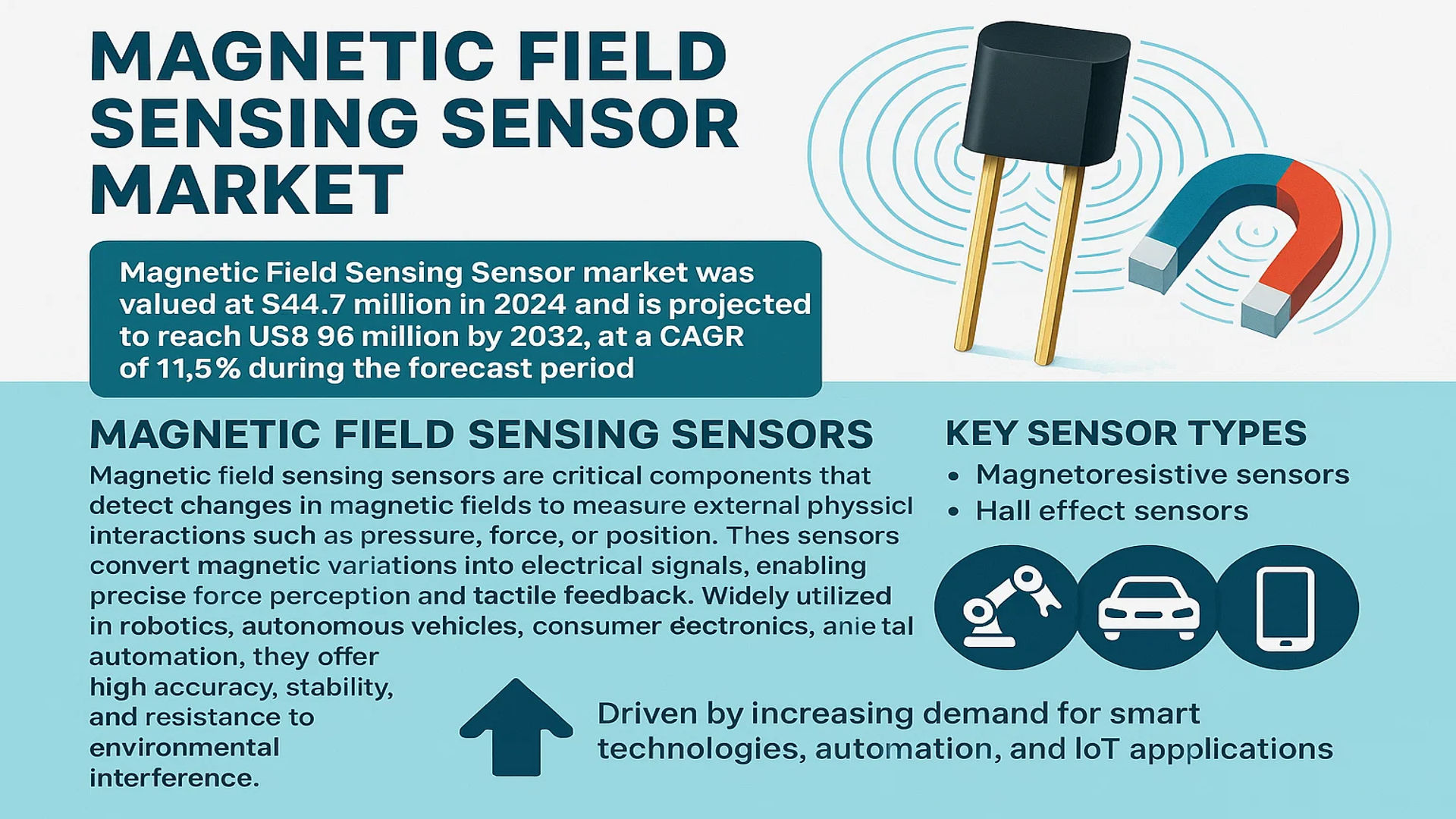
The global Magnetic Field Sensing Sensor market was valued at 44.7 million in 2024 and is projected to reach US$ 96 million by 2032, at a CAGR of 11.5% during the forecast period.
Magnetic field sensing sensors are critical components that detect changes in magnetic fields to measure external physical interactions such as pressure, force, or position. These sensors convert magnetic variations into electrical signals, enabling precise force perception and tactile feedback. Widely utilized in robotics, autonomous vehicles, consumer electronics, and industrial automation, they offer high accuracy, stability, and resistance to environmental interference. The market includes key sensor types such as magnetoresistive sensors and Hall effect sensors, each catering to specific industry requirements.
The market is driven by increasing demand for smart technologies, automation, and the rapid expansion of IoT applications. Notably, the automotive sector is a major growth contributor, leveraging these sensors for advanced driver-assistance systems (ADAS) and electric vehicle (EV) powertrains. Additionally, innovations in healthcare, such as wearable medical devices, are further accelerating adoption. Leading players like TDK Corporation, Infineon Technologies, and Honeywell International dominate the market with continuous advancements, including miniaturization and enhanced sensitivity for next-generation applications.
MARKET DYNAMICS
MARKET DRIVERS
Expansion of Automotive Electronics to Accelerate Market Adoption
The automotive industry’s rapid digital transformation is driving substantial demand for magnetic field sensing sensors. With advanced driver assistance systems (ADAS) becoming standard in modern vehicles, the need for precise position and current detection has surged. Over 45% of new vehicles globally now incorporate ADAS features requiring magnetic sensors for functions like steering angle detection and pedal positioning. The transition toward electric vehicles further amplifies this demand, as EV powertrains require sophisticated current monitoring that magnetic sensors provide. Leading manufacturers are responding with specialized automotive-grade sensor solutions designed to withstand harsh operating conditions.
Growth in Industrial Automation to Fuel Sensor Deployment
Industrial facilities globally are accelerating automation initiatives, creating robust demand for magnetic field sensing in position measurement and equipment monitoring applications. The Industrial Internet of Things (IIoT) ecosystem increasingly relies on these sensors for predictive maintenance, where they monitor vibration and rotational speed in motors and actuators. Modern manufacturing plants now deploy thousands of these sensors across production lines to enable real-time process control. This industrial adoption is further supported by the reliability of magnetic sensors in dirty, high-vibration environments where optical alternatives often fail.
Advancements in Consumer Electronics to Stimulate Market Growth
The miniaturization trend in smartphones, wearables, and other portable devices continues to drive innovation in magnetic sensor technology. Modern smartphones now incorporate multiple magnetic sensors for compass functionality, flip cover detection, and camera stabilization, with premium models containing over five such sensors per device. The wearable technology segment shows particularly strong growth potential, as health monitoring devices utilize magnetic sensors for precise motion tracking. Recent product launches demonstrate the integration of high-sensitivity magnetic sensors in ultra-compact form factors below 1mm, enabling new applications in the consumer electronics space.
MARKET RESTRAINTS
Performance Limitations in Extreme Environments to Constrain Applications
While magnetic field sensors offer numerous advantages, their performance degrades under extreme conditions that are common in industrial and automotive settings. Temperature variations beyond standard operating ranges (-40°C to +125°C) can significantly impact measurement accuracy, requiring expensive compensation circuits. Additionally, strong external magnetic fields present in electric vehicle powertrains and heavy machinery can cause interference issues. Manufacturers face the challenge of developing sensors that maintain precision while withstanding electromagnetic interference from nearby high-current applications, often necessitating costly shielding solutions.
Other Restraints
Material Cost Volatility
The reliance on rare-earth materials in sensor manufacturing exposes producers to price fluctuations in the global commodities market. Prices for neodymium and other critical components have shown volatility exceeding 15% year-over-year, directly impacting production costs. This unpredictability complicates long-term pricing strategies and can squeeze profit margins for sensor manufacturers.
Miniaturization Complexities
The push for smaller form factors introduces significant engineering challenges in maintaining sensor performance. As package sizes shrink below 1 mm², maintaining signal integrity and immunity to electromagnetic interference requires innovative design approaches that increase development costs and time-to-market for new products.
MARKET CHALLENGES
Intense Price Competition to Pressure Manufacturer Margins
The magnetic field sensing sensor market features strong competition across all application segments, particularly in consumer electronics where cost sensitivity is extreme. Asian manufacturers have intensified price competition by offering standard sensor solutions at 15-20% below established Western suppliers. This pricing pressure forces all participants to optimize production costs while maintaining quality, with many moving manufacturing to lower-cost regions. The challenge is particularly acute for companies developing advanced sensor technologies with higher R&D costs that cannot be easily recouped in the current competitive environment.
Other Challenges
Design Complexity in Emerging Applications
The integration of magnetic sensors into novel applications like medical robotics and AR/VR systems presents unexpected design hurdles. These applications require sensors to perform reliably in dynamic environments while consuming minimal power, often necessitating customized solutions that increase development timelines.
Supply Chain Disruptions
Recent global supply chain volatility has exposed vulnerabilities in semiconductor component availability. Magnetic sensor manufacturers face extended lead times for specialized packaging materials and test equipment, delaying product launches and increasing inventory management costs.
MARKET OPPORTUNITIES
Emerging Medical Applications to Open New Growth Pathways
The healthcare sector presents substantial untapped potential for magnetic field sensing technology. Advanced medical equipment increasingly incorporates these sensors for precise position tracking in robotic surgery systems and medical imaging devices. Emerging applications in wearable medical monitors utilize miniaturized magnetic sensors to track subtle body movements for neurological and rehabilitation applications. The medical sensor segment commands premium pricing while requiring rigorous quality standards, offering manufacturers higher margins than commoditized consumer applications.
Smart Infrastructure Development to Drive Market Expansion
Global smart city initiatives are creating new opportunities for magnetic sensing in traffic management and utility monitoring. Intelligent transportation systems employ magnetic sensors for vehicle detection at intersections, while smart grids utilize them for current monitoring in power distribution networks. These infrastructure applications typically involve large-scale deployments with long product lifecycles, providing stable revenue streams for sensor manufacturers. The growing emphasis on energy efficiency in buildings also drives demand for magnetic sensors in HVAC system controls and smart meter applications.
Advancements in Sensor Fusion to Create Competitive Advantages
The integration of magnetic sensors with other sensing modalities presents compelling opportunities for value creation. Sensor fusion solutions combining magnetic, inertial, and environmental sensors enable more sophisticated motion tracking and position detection capabilities. These integrated systems command higher ASPs while providing differentiation opportunities in competitive markets. Leading manufacturers are investing heavily in fusion algorithm development and system-on-chip solutions to capitalize on this trend across automotive, industrial, and consumer applications.
MAGNETIC FIELD SENSING SENSOR MARKET TRENDS
Advancements in Sensor Technologies Driving Market Expansion
The global magnetic field sensing sensor market is experiencing robust growth, fueled by continuous advancements in sensor technologies. In recent years, the development of high-precision magnetoresistive and Hall-effect sensors has enabled more accurate detection of magnetic fields, significantly enhancing applications in industrial automation, automotive safety systems, and consumer electronics. The integration of artificial intelligence (AI) and machine learning into sensor systems has further improved their efficiency, allowing for real-time data processing and adaptive response mechanisms. Major players like TDK Corporation and Infineon Technologies are leading the charge with innovations in miniaturization and power efficiency, enabling the deployment of magnetic sensors in increasingly diverse applications.
Other Trends
Automotive Industry Adoption
The automotive sector represents one of the largest consumers of magnetic field sensing sensors, driven by the increasing demand for advanced driver-assistance systems (ADAS) and electrification. With the global automotive industry projected to incorporate over 20 magnetic sensors per electric vehicle (EV), applications range from battery monitoring to position detection in electric power steering systems. The shift toward autonomous vehicles is further accelerating demand, as magnetic sensors play a crucial role in navigation, obstacle detection, and vehicle stability controls.
Growth in Consumer Electronics and Wearables
Consumer electronics is another rapidly growing segment for magnetic field sensing sensors, particularly in smartphones, tablets, and wearable devices. These sensors are widely used in touchless control interfaces, gesture recognition, and compass functionalities. The rising adoption of foldable smartphones has led to an increased need for hinge-position detection, where magnetic field sensors ensure seamless screen transitions. Additionally, health-monitoring wearables leverage these sensors for detecting movement and orientation, contributing to an enhanced user experience.
Industrial Automation and Smart Manufacturing
In industrial settings, magnetic field sensors are becoming indispensable for predictive maintenance and process automation. Sensors equipped with advanced diagnostic capabilities help monitor machinery conditions, reducing downtime and improving operational efficiency. The Industry 4.0 revolution is prompting manufacturers to integrate these sensors into IoT-enabled smart machines, facilitating data-driven decision-making. With automation investments growing at a steady pace, demand for robust and reliable magnetic sensing solutions is expected to rise correspondingly.
COMPETITIVE LANDSCAPE
Key Industry Players
Technological Innovation and Strategic Expansions Drive Market Competition
The global magnetic field sensing sensor market exhibits a moderately fragmented competitive landscape, featuring a diverse mix of multinational conglomerates and specialized sensor manufacturers. TDK Corporation and Infineon Technologies collectively command significant market share, owing to their extensive R&D capabilities and broad application coverage across automotive, industrial, and consumer electronics sectors.
Notably, Honeywell International has strengthened its position through advanced magnetoresistive sensor developments, particularly for aerospace and defense applications where precision and reliability are paramount. Similarly, Allegro MicroSystems has carved a niche in high-performance Hall-effect sensors, capturing substantial demand from electric vehicle manufacturers.
Several players are pursuing vertical integration strategies to enhance supply chain resilience. NXP Semiconductors, for instance, recently expanded its Belgian production facility to meet growing demand for automotive-grade magnetic sensors, while Melexis has invested in next-generation TMR (Tunnel Magnetoresistance) technology to improve sensor sensitivity.
Market consolidation is accelerating, with TE Connectivity and Sensata Technologies actively acquiring specialized sensor startups to augment their technological portfolios. This trend reflects the industry’s shift toward integrated sensing solutions that combine multiple measurement capabilities.
List of Key Magnetic Field Sensing Sensor Manufacturers
- TDK Corporation (Japan)
- Infineon Technologies (Germany)
- Honeywell International (U.S.)
- Allegro MicroSystems (U.S.)
- TE Connectivity (Switzerland)
- NXP Semiconductors (Netherlands)
- Melexis (Belgium)
- AMS OSRAM (Austria)
- Sensata Technologies (U.S.)
- Baumer Group (Switzerland)
- Aichi Steel Corporation (Japan)
- Tacterion GmbH (Germany)
Segment Analysis:
By Type
Magnetoresistive Sensor Segment Leads Due to High Precision and Wide Application Range
The market is segmented based on type into:
- Magnetoresistive Sensor
- Subtypes: Anisotropic Magnetoresistive (AMR), Giant Magnetoresistive (GMR), Tunnel Magnetoresistive (TMR)
- Hall Effect Sensor
- Others
By Application
Automotive Industry Dominates Due to Increasing Adoption in Safety and Navigation Systems
The market is segmented based on application into:
- Automotive Industry
- Sub-applications: Position sensing, Speed detection, Current measurement
- Consumer Electronics
- Medical Industry
- Industrial Automation
- Others
By Technology
Non-Contact Sensing Technology Gains Traction Due to Enhanced Reliability
The market is segmented based on technology into:
- Contact-based Sensing
- Non-contact Sensing
By End-User Industry
Industrial Sector Shows Strong Growth Owing to Automation Trends
The market is segmented based on end-user industry into:
- Automotive
- Aerospace & Defense
- Healthcare
- Industrial Manufacturing
- Consumer Electronics
Regional Analysis: Magnetic Field Sensing Sensor Market
Asia-Pacific
The Asia-Pacific region dominates the magnetic field sensing sensor market, accounting for the largest revenue share in 2024. This leadership position is driven by China’s massive electronics manufacturing sector and India’s expanding automotive industry. The region benefits from strong government support for industrial automation and IoT development, with China’s “Made in China 2025” initiative accelerating demand for precision sensors. Japan remains a technology innovator, particularly in Hall Effect sensors, while South Korea’s consumer electronics giants are integrating magnetic sensors into next-generation devices. Local manufacturers are gaining traction through cost-competitive alternatives, though quality gaps with Western counterparts persist in some applications.
North America
North America represents the second-largest market, characterized by technological sophistication and early adoption of advanced applications. The U.S. accounts for over 70% of regional demand, with magnetic sensors increasingly deployed in electric vehicles, medical devices, and aerospace systems. Regulatory pressure for improved vehicle safety features (like electronic stability control) and initiatives like the CHIPS Act are propelling market growth. Research partnerships between sensor manufacturers and universities are driving breakthroughs in miniaturization and energy efficiency. However, high production costs and supply chain reconfiguration post-pandemic present ongoing challenges for market players.
Europe
Europe maintains a strong position in high-performance magnetic sensing technologies, particularly for automotive and industrial applications. Germany leads regional adoption, with its robust automotive sector incorporating sensors for position detection and electric powertrain monitoring. The EU’s focus on renewable energy systems has boosted demand for sensors in wind turbine pitch control and solar tracking. Strict electromagnetic compatibility (EMC) regulations compel manufacturers to enhance interference resistance in sensor designs. While innovation remains strong, slower economic growth in key markets like Italy and France has somewhat tempered investment in new sensor deployments across some industries.
South America
The South American market shows moderate but steady growth, primarily fueled by Brazil’s industrial automation initiatives and Argentina’s emerging automotive sector. Magnetic sensors find increasing use in agricultural equipment and oil/gas applications, though adoption rates lag behind global averages. Economic instability and import dependency on sensor components continue to restrain market expansion. Manufacturers are focusing on cost-optimized solutions to better serve price-sensitive regional buyers, with localized assembly operations gaining traction to circumvent import challenges.
Middle East & Africa
This region presents nascent opportunities, with growth concentrated in GCC countries’ industrial diversification programs and South Africa’s mining sector modernization. Magnetic sensors are being incorporated into oilfield equipment and smart city infrastructure projects. The lack of local manufacturing capabilities results in complete reliance on imports, creating supply vulnerabilities. While adoption is currently limited to high-value applications, increasing foreign direct investment in technology sectors suggests long-term market potential, particularly for oil/gas and building automation applications.
Report Scope
This market research report provides a comprehensive analysis of the global Magnetic Field Sensing Sensor market, covering the forecast period 2024–2032. It offers detailed insights into market dynamics, technological advancements, competitive landscape, and key trends shaping the industry.
Key focus areas of the report include:
- Market Size & Forecast: Historical data and future projections for revenue, unit shipments, and market value across major regions and segments. The global Magnetic Field Sensing Sensor market was valued at USD 44.7 million in 2024 and is projected to reach USD 96 million by 2032, growing at a CAGR of 11.5%.
- Segmentation Analysis: Detailed breakdown by product type (Magnetoresistive Sensor, Hall Effect Sensor), application (Medical Industry, Consumer Electronics, Automotive Industry, Others), and end-user industry to identify high-growth segments.
- Regional Outlook: Insights into market performance across North America, Europe, Asia-Pacific, Latin America, and the Middle East & Africa. The U.S. market is a key contributor, while China shows significant growth potential.
- Competitive Landscape: Profiles of leading market participants including TDK Corporation, Infineon Technologies, Honeywell International, Allegro MicroSystems, and NXP Semiconductors, covering their product portfolios, R&D investments, and strategic initiatives.
- Technology Trends & Innovation: Assessment of emerging sensor technologies, integration with IoT platforms, miniaturization trends, and advancements in magnetic field detection accuracy.
- Market Drivers & Restraints: Analysis of factors such as increasing automation, demand for precise force measurement in robotics, and challenges related to material costs and technical complexities.
- Stakeholder Analysis: Strategic insights for sensor manufacturers, component suppliers, OEMs, and investors regarding emerging opportunities in smart devices and industrial automation.
The research methodology combines primary interviews with industry experts and analysis of verified market data from reputable sources to ensure accuracy and reliability.
FREQUENTLY ASKED QUESTIONS:
What is the current market size of Global Magnetic Field Sensing Sensor Market?
-> Magnetic Field Sensing Sensor market was valued at 44.7 million in 2024 and is projected to reach US$ 96 million by 2032, at a CAGR of 11.5% during the forecast period..
Which key companies operate in this market?
-> Leading players include TDK Corporation, Infineon Technologies, Honeywell International, Allegro MicroSystems, and NXP Semiconductors.
What are the key growth drivers?
-> Growth is driven by increasing automation, demand for precise force measurement in robotics, and expansion of smart wearable devices.
Which region dominates the market?
-> North America currently leads in market share, while Asia-Pacific shows the highest growth potential.
What are the emerging trends?
-> Key trends include miniaturization of sensors, integration with IoT systems, and development of high-precision magnetic field detection technologies.

Get Sample Report PDF for Exclusive Insights
Report Sample Includes
- Table of Contents
- List of Tables & Figures
- Charts, Research Methodology, and more...
 Download Sample Report PDF