
MARKET INSIGHTS
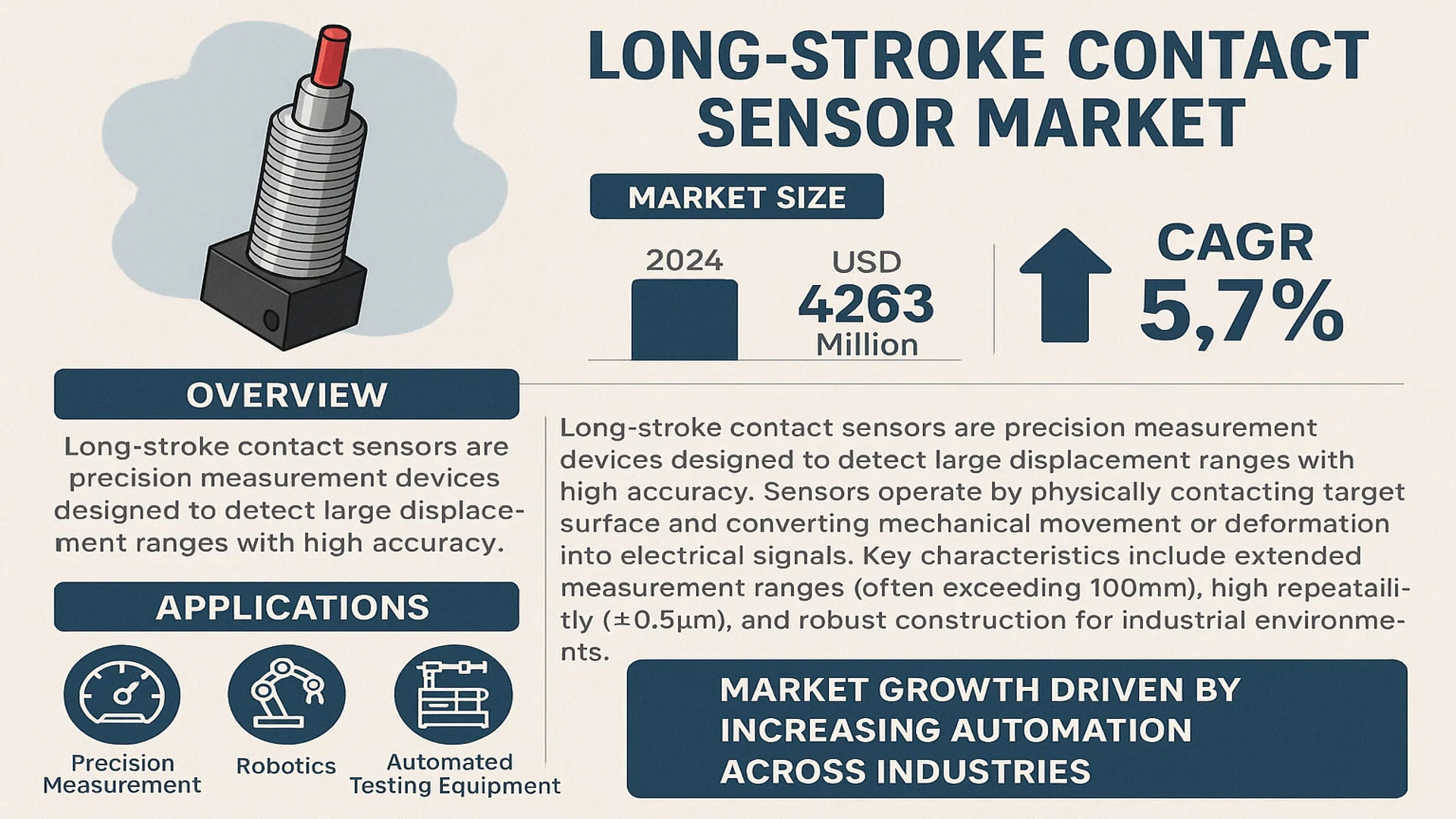
The global Long-Stroke Contact Sensor Market was valued at 2905 million in 2024 and is projected to reach US$ 4263 million by 2032, at a CAGR of 5.7% during the forecast period.
Long-stroke contact sensors are precision measurement devices designed to detect large displacement ranges with high accuracy. These sensors operate by physically contacting the target surface and converting mechanical movement or deformation into electrical signals. Key characteristics include extended measurement ranges (often exceeding 100mm), high repeatability (±0.5μm typically), and robust construction for industrial environments. The technology finds critical applications in precision measurement systems, robotics, automated testing equipment, and electronic manufacturing where millimeter-level accuracy is required.
Market growth is primarily driven by increasing automation across industries, with the industrial automation sector alone projected to grow at 8.9% CAGR through 2030. Furthermore, demand for quality control in manufacturing processes and the expansion of Industry 4.0 applications are accelerating adoption. In 2024, the NPN Normally Open Type segment dominated with approximately 62% market share, while Asia-Pacific accounted for 38% of global demand led by China’s manufacturing sector expansion. Recent product innovations include IP67-rated sensors for harsh environments and smart sensors with integrated IoT connectivity features from leading manufacturers.
MARKET DYNAMICS
MARKET DRIVERS
Growing Industrial Automation to Accelerate Long-Stroke Contact Sensor Adoption
The rapid advancement of Industry 4.0 and smart manufacturing is significantly driving demand for long-stroke contact sensors globally. These precision measurement devices are becoming indispensable in automated production lines where accurate position feedback is critical. The global industrial automation market is projected to grow at over 9% annually, creating corresponding demand for sensor technologies. Leading manufacturers are integrating these sensors into robotic arms, CNC machines, and assembly lines to improve process control while reducing manual calibration requirements.
Expansion of Robotics Applications Boosts Market Potential
Robotics represent one of the fastest-growing application segments for long-stroke contact sensors, particularly in collaborative robotics and automated material handling systems. With the robotics market expected to exceed $80 billion by 2026, sensor manufacturers are developing specialized solutions for robotic joint positioning and end-effector control. The automotive industry remains the largest adopter, utilizing these sensors in robotic welding and painting systems where millimeter-level precision is required across large working envelopes.
Recent technological advancements have further enhanced the appeal of long-stroke sensors in robotics. For instance, the development of self-calibrating models with integrated temperature compensation has reduced maintenance requirements in industrial environments. Furthermore, the miniaturization of sensor heads without sacrificing measurement range has enabled their integration into more compact robotic systems.
MARKET RESTRAINTS
High Precision Manufacturing Costs Limit Market Penetration
While long-stroke contact sensors offer superior performance characteristics, their relatively high production costs remain a significant barrier to wider adoption. The specialized materials and precision manufacturing processes required for these sensors often result in prices that are 30-50% higher than alternative displacement measurement solutions. This premium pricing particularly affects price-sensitive markets and smaller manufacturers where return on investment calculations may not justify the upgrade.
The complex calibration procedures required for long-stroke sensors also add to total cost of ownership. Unlike simpler proximity sensors, these devices often require specialized fixtures and trained technicians for installation and periodic recalibration. Many end-users in developing markets find these operational requirements challenging to implement, leading them to opt for less sophisticated measurement solutions despite potential performance trade-offs.
MARKET CHALLENGES
Technical Limitations in Harsh Environments
Long-stroke contact sensors face inherent technical challenges when deployed in extreme operating conditions. High-vibration industrial environments can affect measurement accuracy due to mechanical noise transmission through the sensor probe. Similarly, applications involving rapid movement cycles may experience premature wear of contact points, reducing operational lifespan. Manufacturers report that vibration-related issues account for nearly 20% of field failures in certain industrial applications.
Environmental factors such as temperature fluctuations, humidity, and contamination present additional challenges. While sealed designs have improved recently, particulate intrusion remains a common failure mode in dusty manufacturing environments. The industry continues to work on advanced sealing technologies and alternative measurement principles to address these limitations while maintaining the core benefits of contact-based measurement.
MARKET OPPORTUNITIES
Emerging Applications in Electric Vehicle Production
The accelerating transition to electric vehicles presents significant growth opportunities for long-stroke contact sensor manufacturers. Battery production and assembly processes require precise dimensional verification across large component surfaces, creating demand for sensors with extended measurement ranges. Leading automotive suppliers are investing heavily in sensor-integrated production systems to support the projected four-fold increase in EV battery manufacturing capacity by 2030.
Advanced driver assistance systems (ADAS) calibration is another promising application area. As vehicle manufacturers incorporate more sophisticated safety systems, they require precise alignment tools incorporating long-stroke measurement capabilities. Several tier-one automotive suppliers have recently partnered with sensor manufacturers to develop specialized solutions for this emerging application segment.
The renewable energy sector also offers substantial growth potential. Wind turbine manufacturers increasingly utilize long-stroke sensors for blade profile measurement and alignment during production. With global wind power capacity expected to double within the next decade, this niche application could become a significant market segment for specialized sensor solutions.
LONG-STROKE CONTACT SENSOR MARKET TRENDS
Industrial Automation Surge Driving Market Expansion
The global long-stroke contact sensor market is witnessing significant growth due to the accelerating adoption of industrial automation across manufacturing, robotics, and precision measurement sectors. These sensors, capable of detecting displacements up to several millimeters with high repeatability, play a crucial role in automated quality control systems. The market is projected to grow at a 5.7% CAGR, reaching $4.26 billion by 2032, driven by their ability to enhance operational efficiency in high-precision applications. The rising demand for automated surface profiling in semiconductor manufacturing and automotive assembly lines is further fueling this expansion, as these sensors provide reliable contact-based measurements in harsh industrial environments.
Other Trends
Rise of Smart Factory Solutions
Smart factories incorporating Industry 4.0 technologies are increasing deployments of long-stroke contact sensors for real-time process monitoring. These sensors integrate with IoT platforms to enable predictive maintenance, reducing downtime in production lines. Their ability to withstand mechanical wear while maintaining micron-level accuracy makes them indispensable in automotive welding systems and robotic assembly applications, where manufacturers report 20-30% improvements in production line reliability through sensor-enabled automation.
Technological Advancements in Precision Measurement
Recent innovations in sensor materials and signal processing algorithms have enhanced the performance characteristics of long-stroke contact sensors. Advanced models now feature reduced hysteresis and improved temperature stability, maintaining accuracy within ±1μm across operating ranges exceeding 50mm. The development of modular sensor systems with interchangeable probes has expanded their application scope in coordinate measuring machines (CMMs) and optical alignment systems. Furthermore, the integration of wireless connectivity options allows for easier retrofitting in existing industrial equipment, addressing one of the key adoption barriers in mature manufacturing facilities.
Regional Manufacturing Hubs Influencing Demand
Asia-Pacific dominates sensor adoption, accounting for over 40% of global demand, as China’s electronics manufacturing sector continues its rapid expansion. Meanwhile, North American manufacturers are prioritizing high-accuracy variants for aerospace and medical device applications, where measurement tolerances below 5μm are becoming standard. Europe’s emphasis on automotive automation has driven specialized sensor developments for inline vehicle component inspection, with German automakers leading in deployment of contact-based measurement systems for chassis assembly verification.
COMPETITIVE LANDSCAPE
Key Industry Players
Innovation and Precision Drive Market Leadership in Long-Stroke Contact Sensor Segment
The global long-stroke contact sensor market features a dynamic competitive environment, with a mix of established multinational corporations and specialized manufacturers vying for market share. Keyence Corporation has emerged as a market leader, leveraging its strong reputation in industrial automation and sensor technologies. The company’s comprehensive product line, featuring both NPN Normally Open and Closed Type variants, has helped it secure an estimated 18% market share in 2024.
Panasonic Industrial Devices maintains significant presence across Asia-Pacific and North America, with its sensors widely adopted in robotics and electronic manufacturing applications. Meanwhile, Amphenol Advanced Sensors has been gaining traction through its focus on high-precision measurement solutions, particularly for aerospace and automotive applications. These top three players collectively account for approximately 35% of the global market revenue.
Strategic acquisitions have been a key growth driver, with companies like Sugawara Laboratories expanding their geographic footprint through regional partnerships. The market has also seen increased R&D investment in ruggedized sensor designs that can withstand harsh industrial environments while maintaining measurement accuracy.
List of Key Long-Stroke Contact Sensor Manufacturers
- Keyence Corporation (Japan)
- Panasonic Industrial Devices (Japan)
- Amphenol Advanced Sensors (U.S.)
- Acmeto Technology Group (Germany)
- Sugawara Laboratories (Japan)
- Unipulse Corporation (Japan)
- CCP Contact Probes (U.S.)
- Janpos Precision Instruments (China)
- Metrol Co., Ltd. (Japan)
- Sugiden Sensor Technologies (Japan)
Segment Analysis:
By Type
NPN Normally Open Type Dominates Due to High Adoption in Industrial Automation
The market is segmented based on type into:
- NPN Normally Open Type
- NPN Normally Closed Type
By Application
Precision Measurement Leads the Market Due to Critical Need in Quality Control Systems
The market is segmented based on application into:
- Precision Measurement
- Electronic Manufacturing
- Automated Testing
- Robotics
- Surface Profile Detection
By End-User Industry
Manufacturing Sector Dominates Due to Extensive Use in Production Lines
The market is segmented based on end-user industry into:
- Automotive
- Aerospace
- Semiconductor
- Electronics
- Industrial Machinery
By Sensing Range
Medium Stroke Sensors Lead Due to Balanced Performance and Cost Efficiency
The market is segmented based on sensing range into:
- Short Stroke (0-10mm)
- Medium Stroke (10-50mm)
- Long Stroke (50mm+)
Regional Analysis: Long-Stroke Contact Sensor Market
Asia-Pacific
The Asia-Pacific region leads the global long-stroke contact sensor market, driven by rapid industrialization and automation in manufacturing sectors. China dominates with over 35% market share in 2024, fueled by its massive electronics manufacturing industry and government initiatives like Made in China 2025. Japan remains a key precision engineering hub, with companies like Keyence and Panasonic innovating high-accuracy sensors for automotive and semiconductor applications. While cost sensitivity favors conventional sensors, increasing quality standards are pushing adoption of advanced variants with higher measurement ranges (50-200mm stroke length). The region’s robotics industry, projected to grow at 12% CAGR through 2030, presents significant opportunities for contact displacement sensors in motion control applications.
North America
North America’s market is characterized by technological sophistication, with the U.S. accounting for 28% of global R&D investments in sensor technologies. The region sees strong demand from aerospace (for wing deformation monitoring) and biomedical device manufacturing, where sub-micron accuracy requirements drive premium sensor adoption. However, reshoring of manufacturing has intensified competition among domestic suppliers like Amphenol and niche players. California’s robotics cluster and Canada’s growing autonomous vehicle sector are creating new application areas, though high labor costs limit volume deployment in some industries.
Europe
Europe maintains steady growth through its established mechanical engineering sector, with Germany and Italy being primary consumers. Industry 4.0 adoption has increased demand for integrated sensor systems in smart factories, particularly for quality control applications. EU machinery safety directives EN ISO 13856 standards influence product specifications, favoring suppliers with certified safety-rated sensors. The region shows slower growth than Asia but higher average selling prices due to stringent performance requirements. Eastern European markets are emerging as cost-effective manufacturing bases for sensor components, though the technology gap with Western Europe persists.
South America
The market in South America remains constrained by economic instability but shows pockets of growth in Brazil’s automotive sector and Argentina’s agricultural equipment manufacturing. Local production is limited, with over 75% of sensors imported from Asia and Europe. Mining applications in Chile and Peru drive demand for ruggedized sensors, while underdeveloped industrialization in other countries limits broader market penetration. Currency volatility and import restrictions continue to challenge consistent supply, though regional trade agreements may improve access to competitively priced sensor solutions in the medium term.
Middle East & Africa
This developing market shows potential through infrastructure projects and gradual industrial diversification. The UAE leads in sensor adoption for oil/gas equipment monitoring, while South Africa’s manufacturing sector uses these components in heavy machinery. Market growth faces hurdles from limited technical expertise in sensor integration and reliance on foreign suppliers. However, smart city initiatives in Saudi Arabia and growing automation in Turkish manufacturing suggest long-term opportunities, provided local distribution networks and service capabilities improve to support advanced sensor implementations.
Report Scope
This market research report provides a comprehensive analysis of the global Long-Stroke Contact Sensor market, covering the forecast period 2024–2032. It offers detailed insights into market dynamics, technological advancements, competitive landscape, and key trends shaping the industry.
Key focus areas of the report include:
- Market Size & Forecast: Historical data and future projections for revenue, unit shipments, and market value across major regions and segments. The global Long-Stroke Contact Sensor market was valued at USD 2905 million in 2024 and is projected to reach USD 4263 million by 2032, at a CAGR of 5.7% during the forecast period.
- Segmentation Analysis: Detailed breakdown by product type (NPN Normally Open Type, NPN Normally Closed Type), application (Precision Measurement, Electronic Manufacturing, Automated Testing, Robotics, Surface Profile Detection), and end-user industry to identify high-growth segments and investment opportunities.
- Regional Outlook: Insights into market performance across North America, Europe, Asia-Pacific, Latin America, and the Middle East & Africa, including country-level analysis where relevant. The U.S. market size is estimated at USD million in 2024, while China is projected to reach USD million.
- Competitive Landscape: Profiles of leading market participants, including their product offerings, R&D focus, manufacturing capacity, pricing strategies, and recent developments such as mergers, acquisitions, and partnerships. Key players include Acmeto Technology Group, Panasonics, Keyence, Sugawara Laboratories, Unipulse, Janpos, Metrol, Sugiden, CCP Contact Probes, and Amphenol.
- Technology Trends & Innovation: Assessment of emerging technologies, integration of AI/IoT in sensor applications, advancements in precision measurement, and evolving industry standards.
- Market Drivers & Restraints: Evaluation of factors driving market growth such as increasing automation in manufacturing, demand for precision measurement tools, and robotics adoption, along with challenges like supply chain constraints and high R&D costs.
- Stakeholder Analysis: Insights for component suppliers, OEMs, system integrators, investors, and policymakers regarding the evolving ecosystem and strategic opportunities in the sensor technology market.
Primary and secondary research methods are employed, including interviews with industry experts, data from verified sources, and real-time market intelligence to ensure the accuracy and reliability of the insights presented.
FREQUENTLY ASKED QUESTIONS:
What is the current market size of Global Long-Stroke Contact Sensor Market?
-> Long-Stroke Contact Sensor Market was valued at 2905 million in 2024 and is projected to reach US$ 4263 million by 2032, at a CAGR of 5.7% during the forecast period.
Which key companies operate in Global Long-Stroke Contact Sensor Market?
-> Key players include Acmeto Technology Group, Panasonics, Keyence, Sugawara Laboratories, Unipulse, Janpos, Metrol, Sugiden, CCP Contact Probes, and Amphenol, among others.
What are the key growth drivers?
-> Key growth drivers include increasing automation in manufacturing, demand for precision measurement tools, and rising adoption of robotics across industries.
Which region dominates the market?
-> Asia-Pacific is the fastest-growing region, driven by manufacturing expansion in China and Japan, while North America remains a technological leader in sensor innovation.
What are the emerging trends?
-> Emerging trends include integration of AI in sensor systems, development of smart factories, and increasing use of contact sensors in robotics and automation.

Get Sample Report PDF for Exclusive Insights
Report Sample Includes
- Table of Contents
- List of Tables & Figures
- Charts, Research Methodology, and more...
 Download Sample Report PDF



